

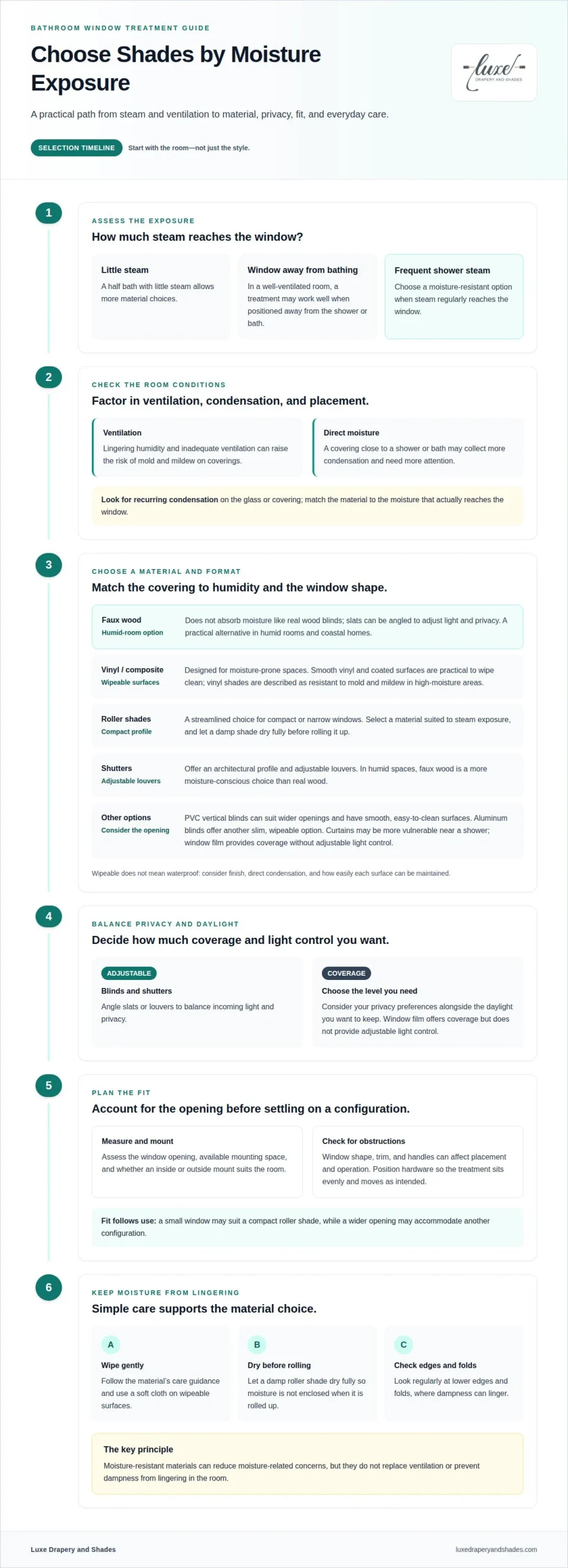
Moisture resistance matters more than style alone when choosing waterproof shades for bathrooms. In a well-ventilated room, a window treatment may work well if it’s positioned away from the shower or bath; when steam regularly reaches the window, moisture-resistant options such as faux wood blinds are a more practical choice. The right fit also needs to balance privacy with the daylight you want to keep.
A bathroom should feel private and bright without its window covering becoming a constant concern in a humid space. The right solution depends on how much moisture reaches the window, how well the room is ventilated, and whether you prefer filtered light or more coverage.
This guide explains which treatments can suit humid rooms, how privacy and light control work together, and what to consider when choosing a custom fit. Material, placement, and everyday moisture exposure all shape the result.
Key Takeaways
- Match the window treatment to how much steam reaches the window, and favor easy-clean surfaces in wetter bathrooms.
- Compare faux wood blinds, roller shades, and shutters by their moisture exposure, window shape, and desired look.
- Understand how ventilation and lingering humidity affect the risk of mold and mildew on bathroom coverings.
- Balance privacy with daylight by considering adjustable coverage and the way light-filtering materials soften a room.
What are the best window treatments for bathrooms?
Easy-Clean Window Coverings
Smooth vinyl and coated shades are practical choices because their surfaces can be wiped clean. Faux wood and composite treatments also suit humid environments, where steam and condensation can affect other materials. For a compact bathroom window, a roller shade offers a streamlined profile, while blinds provide adjustable slats.
Consider how close the window is to the shower or bath before choosing a material. A covering that regularly collects condensation needs more attention than one farther from direct steam. Wipeable surfaces simplify upkeep, but they don’t eliminate the need to manage moisture in the room.
Follow the care guidance for your chosen material, and use a soft cloth on wipeable surfaces. Let a damp roller shade dry fully before rolling it up, so moisture isn’t enclosed. Check the lower edge and folds regularly, since dampness can linger there.
Professional Measuring and Installing of Bathroom Shades
When measuring and installing bathroom shades, a professional assesses the window opening, available mounting space, and whether an inside or outside mount suits the room. Share your privacy preferences, desired light levels, and whether the window is near a shower. These details help guide the treatment and fit.
Window shape, trim, and obstructions such as handles can affect placement and operation. A professional accounts for these conditions when measuring and positioning the hardware. Accurate measurements and installation help the shade sit evenly and move as intended without interfering with the window.
Your preferred coverage and the way you use the bathroom help determine the final arrangement. A small window, for example, may suit a compact roller shade, while a wider opening may accommodate another configuration. Choose a material with the window’s exposure to steam in mind.
Which Rooms Typically Need Water-Resistant Blinds?
Choose a covering suited to moisture where regular steam, condensation, or damp air reaches the window. Bathrooms with showers are a clear example, especially when the window treatment is close to the bathing area. Laundry rooms and kitchens can also be humid; consider how much moisture collects around each window.
Faux wood blinds suit humid rooms because they don’t absorb moisture like real wood blinds. That makes them a practical option for bathrooms and coastal homes, where damp air can be part of daily life. Their slats can be angled to adjust incoming light and privacy, while the finish brings a tailored, wood-inspired look.
Shutters offer an architectural profile and adjustable louvers. In a humid space, faux wood is a more moisture-conscious choice than real wood, a detail frequently emphasized by specialists like Mint Floors & Shutters when choosing long-lasting materials for wet areas. Consider how close the shutter is to a shower or sink and whether its surfaces are easy to wipe. The fitted frame also needs to suit the window trim and available clearance.
Roller shades have a compact silhouette that can work well on narrow bathroom windows. Their simple profile avoids a stack of slats, but material matters: a shade regularly exposed to steam should be suited to humid conditions. Let a damp shade dry fully before rolling it up.
PVC vertical blinds can be an option for high-humidity rooms. Their smooth surfaces are easy to clean, and vertical panels can suit wider openings. Aluminum blinds offer another slim, wipeable option. These aren’t the same as waterproof shades, so consider the finish, direct condensation, and how easily each slat can be maintained.
Match the treatment to the room’s moisture exposure, not just its name. A half bath with little steam allows for more material choices than a bathroom with frequent showers. In coastal Los Angeles, consider faux wood as an alternative where humid air makes real wood less suitable.
Mold and mildew risks in humid bathrooms
Faux wood, vinyl, composite, and performance fabrics are suited to humid bathrooms because they’re designed to resist moisture. Mold and mildew can develop on window coverings exposed to constant humidity, especially without proper ventilation.
Materials for Humid Bathrooms
Material choice matters most where shower steam or condensation reaches the window. Faux wood, vinyl, and composite treatments are designed to resist moisture, warping, and mildew, making them practical options for damp conditions. Smooth surfaces also make routine cleaning more straightforward than textured materials that can hold moisture.
Performance fabrics are another option for humid rooms, but exposure still matters. A fabric covering near a frequently used shower faces more moisture than one in a half bath. Consider the window’s location, the room’s ventilation, and how often condensation settles on the covering before choosing a material.
Shades That Resist Mold and Mildew
Vinyl shades are described as durable and resistant to mold and mildew in high-moisture areas. Faux wood and composite coverings are also designed for humid environments. These material qualities can reduce moisture-related concerns, but they don’t replace ventilation or prevent dampness from lingering in the room.
Fabric curtains or shades may be more vulnerable to moisture in a bathroom with a shower than in a powder room. If a roller shade becomes damp, let it dry fully before rolling it up. This prevents moisture from being enclosed against the shade’s surface.
Kitchens and laundry rooms can also expose window coverings to humidity. Cooking steam near a kitchen window or damp air around laundry equipment can affect materials over time. Choose wipeable, moisture-resistant surfaces for windows close to these sources, and consider whether ventilation clears humid air effectively.
In any room, watch for recurring condensation on the glass or covering. If the treatment stays damp after bathing, cooking, or laundry, choose one suited to moisture and address the room’s ventilation. A treatment that suits a dry half bath may not be right for a bathroom with a shower.
Bathroom privacy and light control
A bathroom window treatment should preserve privacy without making daylight feel scarce. The balance depends on the window’s position, sightlines from neighboring homes, and how much light the room needs. A street-facing window, for example, may need more coverage than a high window facing a private garden.
Adjustable slats let you redirect daylight while limiting direct views into the room. Light-filtering materials soften incoming light and maintain privacy, while opaque fabrics provide stronger coverage. Choose based on the room’s use: a bathroom used in the evening may need more coverage than one used mainly during daylight.
Top-down control offers another way to balance privacy and light. Lower the shade from the top to admit daylight while keeping the lower part of the window covered. This can suit a ground-floor bathroom where eye-level privacy matters but natural light is still welcome. Custom-fit treatments can also address small or unusually placed windows where standard dimensions may leave gaps.
Before selecting waterproof shades for bathrooms, consider privacy both inside and outside the room. A shade that filters light during the day may look different after dark, when interior lights are on. Assess the coverage at different times and consider whether nearby windows, paths, or buildings create direct sightlines.
Coordinating window and room lighting can make the space more adaptable. For instance, use filtered daylight in the morning, then choose stronger window coverage in the evening. Lutron lighting control systems can coordinate interior lighting, while the window treatment provides privacy and adjusts daylight. The right arrangement depends on the window’s exposure and your preferred coverage.
For a considered fit, explore custom window-treatment options that balance bathroom privacy with natural light.
Luxe Drapery and Shades
Luxe Drapery and Shades helps you choose a bathroom window treatment based on privacy, daylight, and exposure to moisture. Consider the window’s size and placement, how much steam reaches it, and the coverage you prefer.
Luxe Drapery and Shades offers Roller Shades, Roman Shades, and Cellular Shades, each with a distinct profile and light-control options. In a humid space, consider how close the window is to a shower and how the covering can be maintained. A tailored fit can also address unusual window dimensions and trim.
Contact Luxe Drapery and Shades to discuss a bathroom window treatment that suits your space and preferences.
Shape a More Considered Bathroom
Make the bathroom window part of the room’s design, not an afterthought. A treatment should complement the finishes while providing the privacy and light control that make the space comfortable day to day. Start by deciding what matters most at this window: a tailored fit, a softer finish, or a clean-lined shade.
For waterproof shades for bathrooms, make moisture exposure part of the design conversation, rather than choosing by appearance alone. Luxe Drapery and Shades offers Custom Drapery, Roller Shades, and Roman Shades, helping bring a considered window-treatment choice into the broader interior scheme.
When you’re ready to explore a tailored approach for your bathroom, contact Luxe Drapery and Shades. A thoughtful selection can bring privacy, light, and style into closer balance, creating a room that feels beautifully resolved.
Frequently Asked Questions
What types of waterproof window shades are best for bathrooms?
Faux wood blinds and vinyl or PVC coverings are practical choices for bathrooms exposed to humidity. They’re moisture-resistant options, though “waterproof” shouldn’t be assumed to mean suitable for direct, repeated water spray. For a window beside a shower, prioritize the material’s moisture tolerance and ease of cleaning. For a drier powder room, you can weigh appearance and light control more broadly.
Are faux wood blinds, vinyl roller shades, or cellular shades suitable for humid bathrooms?
Faux wood blinds and vinyl roller shades can suit humid bathrooms because their materials are designed to resist moisture. Cellular shades require more careful consideration: the term describes their construction, not a guarantee of water resistance. For example, a cellular shade on a window away from shower steam faces different conditions than one beside a frequently used shower.
What materials are truly waterproof and easy to clean?
Vinyl and PVC are described as moisture-resistant and easy to wipe, but that doesn’t make every product made from them fully waterproof. Check the distinction between resistance to humidity and protection from direct water exposure when selecting a covering. Smooth surfaces can make everyday cleaning simpler; textured materials may need more attention around folds, edges, or other areas where dampness can remain.
What are the best waterproof shades for bathroom privacy and light control?
Choose the coverage style according to the window’s sightlines and the amount of light you want. Opaque materials offer more privacy, while light-filtering options soften daylight. Top-down control can admit light through the upper portion while covering the lower window. For a bathroom facing a neighboring home, consider how the treatment looks both in daylight and after dark, with interior lights on.
How can you prevent moisture damage and extend the life of bathroom shades?
Avoid leaving coverings damp: ventilate the room, wipe condensation from nearby surfaces, and let a wet roller shade dry fully before raising it. Pay particular attention to windows close to a shower, where steam may repeatedly collect. Follow the material’s care instructions and check folds, lower edges, and slats for lingering moisture during regular bathroom cleaning.