

What if the detail above a window could make the entire treatment feel more balanced, rather than more formal? Valances can add a considered finishing layer, but their effect depends on more than style alone. A shape that feels graceful in one room may look heavy in another, especially when its scale isn’t suited to the window or the treatments below it.
If you’re unsure how a valance differs from full drapery, or whether it will feel dated, those are sensible questions. Treat it as a proportion-led design choice, coordinated with the room rather than added as an afterthought. This guide compares popular valance styles and explains how to plan their size, fabric, and relationship to custom drapery or shades. With a clearer sense of proportion, you can create a tailored window design that feels polished and at home in your Los Angeles space.
Key Takeaways
- Use a valance to soften a window, add texture, or connect its treatment with the room’s furnishings.
- Compare straight and pleated silhouettes by the mood they create and how they relate to your interior.
- Choose between a subtle finishing touch and a more prominent focal point based on the window’s scale and surrounding decor.
- Plan proportions around the full window treatment, not only the glass, and coordinate the valance with drapery or shades.
- Custom design can bring scale, fabric, and neighboring treatments together for a polished finish in your Los Angeles home.
What Are Valances, and What Do They Add to a Window?
A valance is a top treatment that finishes or frames a window without covering the full opening. It may be made from soft fabric and used on its own or coordinated with a shade or drapery. Its main role is visual: it can soften the window’s outline, add texture, and connect the window with nearby furnishings.
A valance finishes the top of a window; full-length drapery frames the opening with fabric that extends down its sides. That distinction helps clarify what each treatment contributes. A valance won’t provide the same coverage or visual presence as long panels, but it can give a shade a more intentional, layered appearance. Choose based on the window, the room, and whether you want a quiet finishing touch or a more noticeable focal point.
Fabric, shape, and placement all influence the result. A softly gathered profile introduces movement, while a straighter edge tends to look clean and tailored. A valance that spans the full treatment can make the window feel more integrated; one that sits close to the frame creates a subtler accent. For a foundational overview of valance history and forms, see Window Valance Wikipedia.
How a valance changes a room’s window design
Think of the top treatment as a visual bridge. For example, pair a simple shade with a fabric valance that echoes the room’s upholstery or introduces a contrasting texture. Either approach can work. The goal is to relate the window to the wider interior without making every element match. A considered finish helps the window feel settled within the room rather than separate from it.
Valances, cornices, and full-length drapery
A fabric valance is soft, while a cornice is a more structured, box-like top treatment that may be built from wood or upholstered. Both finish the upper part of a window. Full-length drapery extends farther down and can frame the view, add height, and provide broader coverage depending on its design. For a closer look at panels and their role in a complete treatment, explore this custom drapery guide.
Valance Styles: Compare Silhouettes Before Choosing
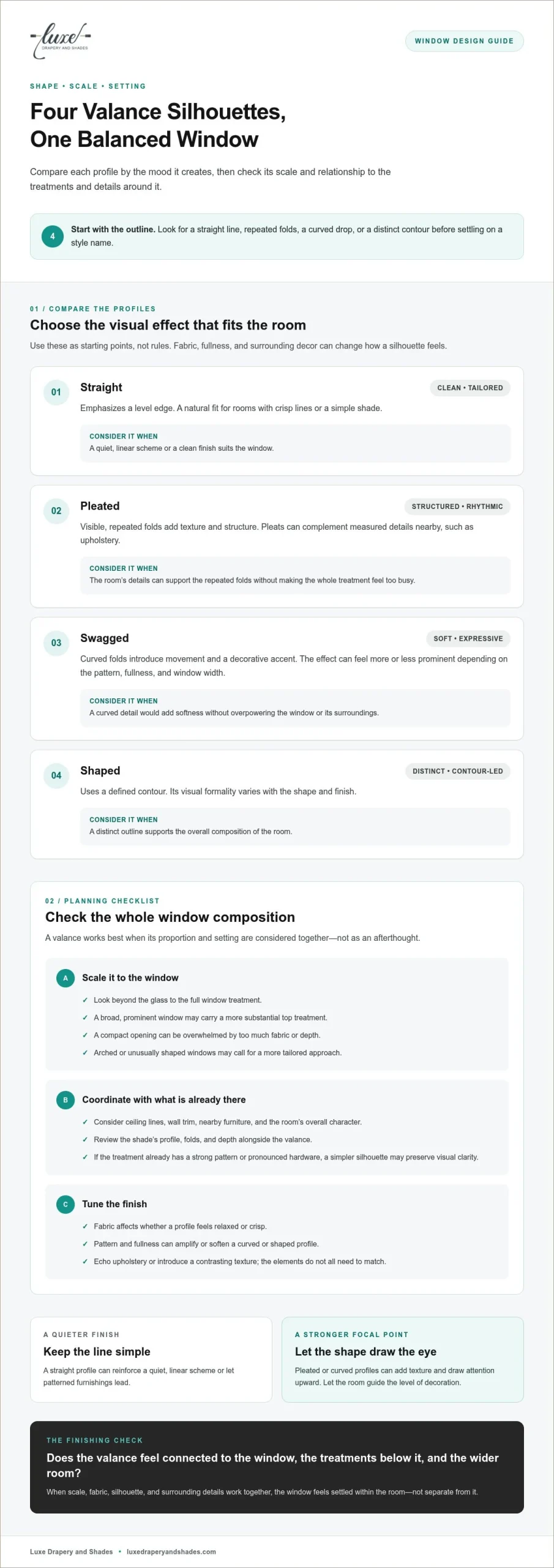
Start by comparing the outline, not just the style name. Notice whether the treatment creates a straight line, gathered folds, or a curved drop. Then consider how much attention that shape will draw beside the window’s other features. Fabric, fullness, and the surrounding decor can make the same profile feel restrained or ornate.
| Silhouette | Visual formality | Design context |
|---|---|---|
| Straight | Clean and tailored | Rooms with crisp lines or a simple shade |
| Pleated | Structured, with visible rhythm | Interiors where measured folds complement nearby details |
| Swagged | Soft and expressive | Spaces that benefit from a curved, decorative accent |
| Shaped | Varies with the contour and finish | Interiors where a distinct outline supports the overall composition |
Use these categories as starting points, not rules. The right profile depends on the window’s scale, furnishings, and existing treatments. Before choosing, look at the window from across the room and decide whether it needs a quiet finish or a detail that draws the eye.
Straight and pleated valances for a clean finish
Straight profiles emphasize a level edge; pleated profiles add repeated folds and texture. Both can feel composed, but fabric affects the impression: a softer material may relax the line, while a more structured fabric can make it appear crisp. Consider nearby furniture, trim, and shade details together. Pleats that echo upholstery can feel coordinated, while a plain edge may let patterned furnishings lead.
Swag and shaped valances for added softness
Swags introduce curved folds, while shaped profiles use a more defined contour. These options bring visual movement, though pattern, fullness, and window width can amplify or soften the effect. A generous sweep over a broad opening reads differently from a restrained curve on a compact window. Let the room guide the level of decoration rather than assuming a curved profile is either dated or inherently elegant.
Check whether the window’s top edge feels visually bare or already balanced by a shade, trim, and nearby furnishings. A straight profile can reinforce a quiet, linear scheme; a pleated or curved one can add texture and draw the eye upward. If the treatment already includes a strong pattern or pronounced hardware, a simpler silhouette may preserve visual clarity.
Consider what the profile will frame. A valance above a shade can create a layered finish, but its folds and depth should sit comfortably with the shade’s clean lines. Review fabric, silhouette, and surrounding details together so the final design feels intentional rather than added on. For a tailored composition, explore custom window-treatment design that brings those elements into balance.
Will a Valance Suit Your Window and Existing Treatments?
A valance can feel current when its proportions and setting are considered as carefully as its silhouette. The question isn’t simply whether a style is traditional or modern. Ask whether its shape, visual weight, and finish belong with the window and room. A restrained treatment may quietly complete the composition; a fuller or more decorative one can make the window a focal point.
A valance’s visual weight depends on its scale and surroundings. A broad, prominent window may carry a more substantial top treatment, while a compact opening can be overwhelmed by too much fabric or depth. Look beyond the window itself: ceiling lines, wall trim, nearby furniture, and the room’s overall character all influence what feels balanced. Arched or unusually shaped windows may call for a more tailored approach than a simple rectangular opening.
Existing treatments matter, too. A shade with a clean profile can provide a quiet base for a more expressive top layer. If the shade already has texture or strong visual detail, a simpler valance can keep the combination from feeling crowded. Aim for a good relationship between the elements, not a uniform formula.
Pairing a valance with shades or drapery
Coordinate through one or two shared qualities, such as a related color, complementary texture, or fabric that echoes another element in the room. Exact matching isn’t necessary. A subtle contrast can distinguish the layers while keeping them visually connected. With drapery, consider how the top treatment relates to the panels’ folds, hardware, and overall presence. For a layered design involving Roman shades, this custom Roman shades guide can help frame the shade as part of the larger window composition.
When a valance may not be the right visual choice
In a minimal interior, a clean shade or simple drapery may better preserve uncluttered lines. A small window can also benefit from a lighter treatment that doesn’t visually dominate its opening. In a room already rich with pattern, trim, or decorative furnishings, another detailed layer may compete for attention. These are cues to edit the design, not rules against adding a valance.
Before settling on a direction, view the window alongside its surroundings rather than making a decision from a fabric sample alone. Consider whether the room needs a quiet finish or a distinctive accent, then assess how the treatment relates to the window’s shape and existing layers. If the combined effect feels crowded, simplify the profile or reduce visual contrast. That can restore a sense of ease while allowing each element to contribute.
How to Plan Valance Scale, Fabric, and Finish in Los Angeles
Start with the whole room, then narrow your focus to the window. In Los Angeles, natural light can shift how fabric color and texture appear during the day, so view samples in the room rather than choosing under showroom lighting alone. Use this sequence to create a design that feels tailored, not added on.
- Observe the room. Note the wall color, furnishings, flooring, and overall level of detail.
- Assess the window. Record its width and height, trim, mounting area, and nearby architectural features.
- Coordinate treatments. Account for the shade or drapery beneath the valance, including its full visual span.
- Refine the finish. Review fabric, folds, edges, and other details in the context of the room.
Assess window proportions before selecting a shape
Begin with the window’s actual boundaries. Note where its trim meets the wall and how much space is available above and beside it. A taller profile or fuller folds can give the top treatment more visual presence; a more restrained height and shape may preserve a light, open impression. Neither is a universal formula. Assess the opening as part of the wall and room, not as an isolated rectangle.
Measurements should account for the complete window treatment, not only the glass. Include the shade or drapery’s outer edges, the space it occupies, the planned mounting position, and the hardware. This wider view helps prevent a valance from appearing disconnected from the treatment below or cramped against nearby trim. A custom design can be tailored to the relationship between the window, treatment, and architecture.
Coordinate color, texture, and surrounding materials
Compare potential fabrics with the room’s wall color, upholstery, flooring, and shade material. A close tonal relationship can create a quiet, continuous look; a measured contrast or difference in texture can add depth without introducing another competing pattern. For example, a textured fabric beside a smooth shade can distinguish the layers while keeping the overall palette cohesive. Aim for considered coordination, not an exact match.
Pay attention to changing light. A color that appears soft in the morning may read differently as daylight shifts, and texture can become more or less pronounced depending on the window and room lighting. View fabric in place at different times of day, near the window and against the surrounding finishes. This gives you a more reliable impression than choosing by color name alone.
Once scale, materials, and finish feel aligned, bring the details together in a tailored plan. Plan a custom window treatment that coordinates the valance with the full window design.
Create a Custom Valance Design with Luxe Drapery and Shades
A well-designed valance is part of a complete window composition, not an isolated finishing piece. In a custom plan, its proportions, fabric, and placement can be considered alongside the shade or drapery beneath it, as well as the room’s architecture and furnishings. This joined-up approach helps the finished treatment feel intentional, with each layer contributing to the room rather than competing for attention.
Luxe Drapery and Shades provides custom window-treatment design and professional installation for homes and commercial spaces in Los Angeles. The team brings design choices and on-site installation together, considering scale and coordination as part of the project from the outset.
What a considered design conversation can address
Start with the feeling you want the room to convey. A calm, understated interior may call for a simpler profile, while a room with more expressive furnishings may welcome a stronger decorative accent. Practical priorities matter, too: the existing shade or drapery, how the window is used, and the visual space around the opening all help shape the design.
Then consider fabric and finish in context. A valance might relate to custom drapery through a shared color, complementary texture, or detail that echoes another element in the room. With shades, the contrast between a clean, structured surface and a softer fabric layer can create depth. Coordination doesn’t require an exact match. Material and construction recommendations can be tailored to the project and the desired balance of texture, form, and function.
Proportion deserves attention before final decisions are made. The treatment’s width and height should relate to the full window arrangement, including neighboring panels, shade edges, trim, and nearby architectural features. Considering these elements together gives the design continuity and helps prevent a valance from feeling disconnected from the rest of the room.
From design direction to professionally finished installation
A tailored plan translates the initial design direction into a cohesive treatment, aligning scale, fabric, and adjacent window coverings. Professional installation completes that plan in the space, where placement and the relationship to the window shape the finished result. The aim is a polished composition that feels considered as part of the room, not simply attractive as a fabric sample.
Luxe Drapery and Shades is a California licensed and bonded contractor, CSLB #1066068. Los Angeles homeowners and businesses can explore custom window treatments and plan a valance alongside custom drapery or shades. Start a conversation with Luxe Drapery and Shades to shape a tailored design for your space.
Shape a Window Design That Feels Like Home
A window treatment can influence how a room feels every day, from the softness of its natural light to the sense of finish around the view. Let the atmosphere you want to create guide your next step, rather than relying on a style label alone. Consider how valances might work with the room’s existing lines, textures, and furnishings.
Gather a few visual references, note what you appreciate in the space, and consider how the window needs to function. Those observations can become the starting point for a tailored design, where each choice relates to the whole. A carefully planned treatment can do more than dress a window; it can help make the room feel distinctly yours.
Explore custom window treatments and take the first step toward a window design shaped around your home. With thoughtful planning, your vision can become a beautifully resolved part of everyday living.
Frequently Asked Questions
What is a valance on a window?
A valance is a decorative window treatment placed across the top of an opening. It can create a finished transition between the window and the wall, and may visually tie a shade or drapery hardware into the room’s design. Depending on its construction and placement, it can also draw attention upward or make the top of the window feel more defined.
Are valances still in style in 2026?
Yes. In 2026, valances remain a considered option, especially when their design feels intentional rather than overly elaborate. Cleaner profiles and lighter visual treatments suit contemporary spaces, while tailored pleats or more decorative shapes can complement rooms with richer details. The key is how the treatment relates to the architecture and furnishings, not whether the room follows a particular trend.
Can you put a valance over blinds or shades?
Yes, a valance can be installed above blinds or shades as a decorative top layer. Leave enough room for the blind or shade to operate smoothly and for its controls to remain accessible. For example, a valance over a Roman shade should account for the shade’s folded stack when raised, so the layers feel coordinated and function comfortably.
How do you choose the right valance style for a room?
Start with the room’s strongest design cues, such as the shape of its trim, the formality of its furnishings, and whether the window treatment should blend in or stand out. Compare those cues with the valance’s silhouette and detail. In a room with patterned upholstery, a quieter profile may bring balance; in a simpler space, a more expressive shape can add character.
How high should a valance be above a window?
There isn’t one height that suits every window. Placement depends on the window’s proportions, ceiling and trim, mounting position, and the shade or drapery beneath it. Assess the full treatment, including hardware and any raised shade stack, before settling on a design. A custom plan can account for those elements without relying on a generic measurement rule.
Can valances work in a modern Los Angeles home?
Yes. In a modern Los Angeles home, a valance can suit the architecture when its lines, scale, and finish feel connected to the space. A simple profile may complement clean-lined interiors, while a textured fabric can bring warmth to a room with smooth surfaces. Consider how the treatment looks beside the home’s trim, furnishings, and natural light before choosing its level of detail.
What is the difference between a valance and a cornice?
A valance is generally a soft window treatment, often made from fabric, while a cornice is a more structured top piece with a firm, box-like form that may be upholstered or made from wood. Both finish the upper portion of a window, but they create different effects: fabric can introduce softness, while a cornice emphasizes a defined architectural line.