What if the only thing standing between your curated outdoor sanctuary and a sudden Pacific gust was a screen that wasn’t designed to stay in its tracks? It’s a common disappointment for many homeowners when a high-end space is compromised by fabric that becomes brittle under the California sun or a motor that fails before the second season. Finding the most durable patio zip screens requires looking past the surface to the engineering that keeps the mesh taut and the operation silent.
We understand that true home comfort relies on pieces that perform as beautifully as they look. You deserve an outdoor room that remains a reliable, weather-proof retreat regardless of the elements. In this guide, we’ll reveal the engineering secrets and premium materials that define the world’s most resilient shading solutions. You’ll learn how advanced tensile strength, high-performance retention tracks, and seamless Lutron smart home integration create a sophisticated environment with minimal maintenance requirements. It’s time to transform your patio into a lasting extension of your home’s luxury.
Key Takeaways
- Understand why the side-channel “zip” design is superior to standard weighted shades for maintaining stability and tension in unpredictable Los Angeles breezes.
- Identify the essential hardware specifications, such as extruded aluminum and high-grade powder coating, that prevent corrosion and structural failure in coastal environments.
- Learn why solar mesh is often the top choice for the most durable patio zip screens due to its exceptional thermal stability and resistance to UV-induced brittleness.
- Explore how to tailor your shade selection to your specific Los Angeles microclimate, from the salt air of Malibu to the intense inland heat of the Valley.
- Discover the transformative benefits of professional installation and seamless Lutron smart home integration for a truly effortless and long-lasting outdoor living experience.
What Defines the Most Durable Patio Zip Screens?
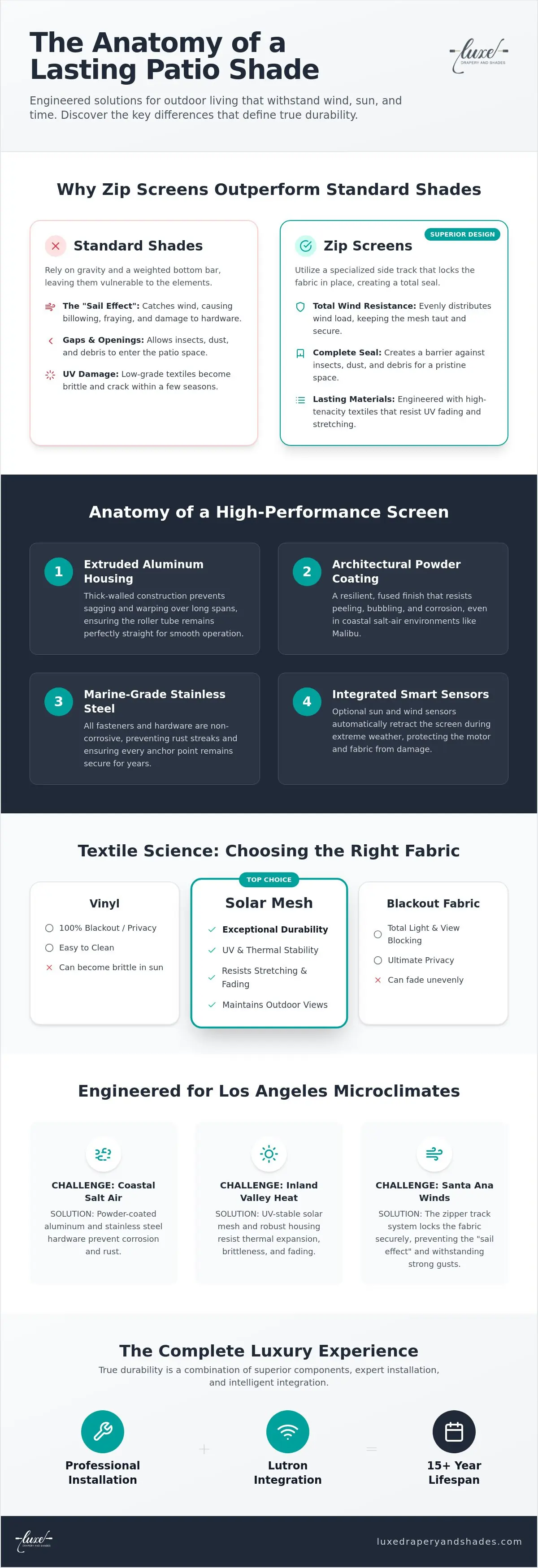
A zip screen represents a sophisticated evolution from traditional retractable solar shade screens. Unlike standard systems that rely purely on gravity and a weighted bottom bar, these high-performance solutions utilize a specialized track that physically locks the fabric in place along the entire vertical edge. This “zipped” enclosure creates a total seal, effectively turning an open-air patio into a protected, climate-controlled sanctuary. It’s this level of structural integrity that defines the most durable patio zip screens, ensuring they remain functional and elegant for fifteen years or more with only basic maintenance.
In the varied microclimates of Southern California, standard shades often fall short of expectations. When an afternoon breeze catches a traditional weighted-hem shade, the fabric acts like a sail, putting immense pressure on the mounting brackets and the roller tube. This tension often results in frayed edges, pulled seams, or bent hardware. A zip screen eliminates this vulnerability by distributing wind load evenly across the vertical side channels. This total seal does more than just resist wind; it provides a barrier against fine dust, garden debris, and evening insects, preserving the pristine condition of your curated outdoor furnishings.
The Mechanical Advantage of the Zipper Track
The side-channel serves as the primary structural anchor of an outdoor screen. By capturing the fabric within a recessed track, the system prevents the “sail effect” that typically destroys lesser roller products. Modern engineering has introduced self-lubricating polymers within these tracks to ensure consistent performance. These materials allow the fabric to glide smoothly even as it expands or contracts with the temperature, preventing the common frustrations of jamming or tearing. This friction-free movement is a hallmark of a professional-grade system designed for daily use and long-term reliability.
Why Los Angeles Patios Demand Higher Durability Standards
Our local environment presents specific challenges that demand superior materials and craftsmanship. The intense UV index in Los Angeles can cause standard plastics and low-grade textiles to become brittle and crack within just a few seasons. Additionally, the region is famous for significant temperature fluctuations between sun-drenched afternoons and cool coastal evenings. The most durable patio zip screens are engineered to handle this thermal expansion without warping or losing tension. When the Santa Ana winds arrive, a system backed by professional-grade engineering provides the quiet confidence that your investment will remain secure and beautiful against the elements.
The Anatomy of a High-Performance Outdoor Screen
The foundation of the most durable patio zip screens lies in the hidden quality of the raw materials used for the housing. While mass-market options often use thin-gauge metals that can warp over time, a high-performance system utilizes thick-walled extruded aluminum. This choice ensures the cassette remains perfectly straight over long spans, preventing the internal roller from sagging. To protect these structural components in coastal enclaves like Santa Monica or Malibu, an architectural-grade powder coating is essential. Unlike standard paint, which can peel or bubble when exposed to salt air, powder coating creates a resilient, fused finish. This level of protection is vital given how Los Angeles microclimates can accelerate wear on inferior materials.
Longevity is also found in the smallest details, such as the use of marine-grade stainless steel hardware. Using non-corrosive fasteners ensures that every anchor point remains secure without the risk of rust streaks staining your home’s exterior. To further safeguard your investment, integrated sun and wind sensors act as a sophisticated fail-safe. These devices automatically retract the screen during extreme weather events, ensuring the system isn’t subjected to forces beyond its design capacity. It’s a proactive approach to durability that preserves the life of the motor and the fabric alike.
Textile Science: Beyond Simple Mesh
The fabric choice is where aesthetic beauty meets technical endurance. High-tenacity polyester cores are generally preferred over fiberglass for outdoor screens because they resist stretching and maintain their shape under constant tension. We prioritize textiles treated with UV-stable pigments to ensure deep charcoals and soft linens don’t fade after just two summers of intense exposure. High-quality textiles should offer a specific balance of features:
- Dimensional Stability: Fabrics that won’t sag during the heat of the day or tighten excessively during cool nights.
- Micro-perforation: Precise weaves that balance wind resistance with the need for essential patio ventilation.
- Fungal Resistance: Coatings that prevent mildew growth in humid coastal air.
The Intelligence Factor: Torque-Sensing Motors
A durable screen is only as good as the motor that drives it. High-torque smart motors, like those used in our Lutron home automation systems, feature advanced obstacle detection. If a piece of furniture or a stray toy is left in the track, the motor senses the resistance and stops immediately. This prevents the fabric from bunching or the motor from burning out. For a truly effortless experience, you might consult with a design expert to see how these intelligent systems can be programmed to respond to your daily rhythm.
Comparing Durability: Vinyl vs. Solar Mesh vs. Blackout Fabrics
Selecting the right textile is as much a matter of engineering as it’s an aesthetic choice. While the frame provides the structural skeleton, the fabric is the skin that must withstand the daily rigors of the Southern California environment. For homeowners seeking the most durable patio zip screens, the choice usually narrows down to solar mesh, clear vinyl, or blackout fabrics. Each material interacts differently with the elements, particularly when considering the energy-efficient standards for climate-appropriate materials often referenced in the Los Angeles Green Building Code.
Solar mesh is widely considered the gold standard for durability in our region. It’s woven from high-tenacity yarns that resist sagging even under intense afternoon heat. Because it’s micro-perforated, it allows a small amount of wind to pass through, which reduces the overall pressure on the retention tracks. In contrast, clear vinyl offers a crystal-clear view, essentially acting as an outdoor window. However, vinyl requires more frequent care with specialized polishes to prevent the clouding or “yellowing” caused by salt air and UV exposure. While beautiful, it’s a higher-maintenance choice compared to the “set and forget” nature of solar mesh.
Blackout zip screens provide the ultimate in privacy and light control, but they present unique wind load considerations. Because the fabric is solid, it acts like a sail, catching every ounce of a breeze. This increased pressure means the structural frame must be exceptionally robust to prevent the system from bowing. Regardless of the material you choose, regular maintenance is the key to longevity. A simple, gentle rinse of the tracks and a wipe-down with mild soap removes abrasive dust and salt particles before they can degrade the fibers or the “zip” mechanism.
Tensile Strength and Wind Load Ratings
A 50mph wind rating is a common industry benchmark, but it’s important to understand that this is a theoretical maximum. Achieving this level of resilience requires a perfectly plumb installation by a licensed professional. If the tracks are even slightly misaligned, the zip mechanism won’t distribute the load correctly, leading to premature wear. Furthermore, the width of your opening matters. Wider spans—those exceeding 15 feet—require specialized “Brawny” hardware with thicker internal rollers to maintain fabric tension and prevent the bottom bar from sagging over time.
Aesthetic Durability: Maintaining the Luxury Look
True durability isn’t just about structural survival; it’s about maintaining a pristine, luxury appearance for years. Coastal environments in Santa Monica or Venice necessitate anti-fungal treatments to prevent mold from taking hold in the damp morning air. Color choice also plays a role in longevity. While dark charcoals and bronzes are popular for their modern look, high-quality UV-stable pigments are required to ensure these deep hues don’t bleach into a dull grey under the relentless sun. You can see how these materials fit into our curated guide to luxury patio shading to better understand which textile matches your home’s aesthetic and exposure level.
Los Angeles Microclimates: Choosing for Your Specific Zip Code
Los Angeles is a city of distinct topographies; your home’s location dictates the specific stresses your outdoor shading will endure. A property in the San Fernando Valley faces a completely different set of environmental challenges than a residence perched on the cliffs of Malibu. Finding the most durable patio zip screens requires a personalized approach that accounts for these microclimates. Engineering a solution for a coastal breeze is a far cry from preparing a structure for the intense thermal expansion of the inland heat. By matching the hardware and textile specifications to your specific zip code, you ensure your investment remains both functional and pristine for years to come.
The Coastal Challenge: Salt and Humidity
Living within miles of the Pacific Ocean means your home is constantly exposed to a fine mist of salt air. This environment is notoriously aggressive toward standard aluminum hardware, causing it to pit and corrode within just a few seasons. For ocean-front properties in Santa Monica or Venice, the most durable patio zip screens utilize sealed motor housings to prevent salt from reaching sensitive electronic components. The AAMA 2604 standard defines a high-performance powder coating that provides five years of South Florida-level weather resistance, specifically engineered to prevent the pitting and corrosion common in coastal environments. If you have property in Florida, Pinnacle Auto Glass offers a similarly high standard of protection for your vehicle’s windshield. Without these architectural-grade finishes, even the most expensive systems can quickly lose their luster.
The Valley Heat: Preventing Fabric Sag
Inland areas like Pasadena or the Valley experience temperatures that regularly exceed 100°F. This intense heat can cause lower-quality textiles to lose their dimensional stability, leading to a permanent sag in the center of the screen often referred to as “smiling.” To combat this, we utilize high-tension spring systems within the side tracks to keep the mesh perfectly taut regardless of the thermometer’s reading. Choosing the right openness factor is also critical for longevity. A 1% openness mesh provides maximum heat blockage for inland estates, while a 5% openness allows for better airflow in canyon homes where cooling breezes are a priority. This balance prevents heat from being trapped against the house, protecting both the screen and your home’s interior cooling efficiency.
Hillside homes in Bel Air or the Hollywood Hills face a third challenge: unpredictable canyon gusts. These wind patterns require heavy-duty tracks and reinforced zippers that can handle sudden changes in pressure without dislodging. In dense urban neighborhoods, the focus often shifts to balancing this structural durability with daytime privacy. High-performance screens allow you to enjoy an unobstructed view of the city while preventing neighbors from seeing into your private retreat. To ensure your outdoor room is built to withstand your neighborhood’s unique demands, you should schedule a professional site assessment with a licensed specialist who understands the nuances of Los Angeles geography.
The Luxe Drapery Approach: Engineered Luxury for Your Patio
At Luxe Drapery and Shades, we believe that the most durable patio zip screens are not merely products you buy, but systems we engineer specifically for your home’s architecture. Off-the-shelf solutions often fail because they lack the precision required to handle the structural shifts of a Los Angeles residence. A bespoke design ensures that every millimeter of the track aligns with your patio’s unique dimensions, preventing the friction that eventually leads to motor strain or fabric tears. It’s this commitment to craftsmanship that transforms a functional shade into a permanent, high-performance home accent.
Our white-glove installation process is led by a licensed California contractor (CSLB #1066068), ensuring that every track is perfectly plumb and every mounting point is structurally sound. This technical rigor is essential for jam-free operation over a decade of use. Beyond the initial setup, we serve as your local partner for long-term maintenance and smart home updates. By integrating your outdoor shades with your home’s interior logic, we create a unified environment where comfort is automated and effortless.
Smart Integration with Lutron Sivoia
The hallmark of a truly refined outdoor atmosphere is the absence of noise. By utilizing Lutron Sivoia technology, we provide ultra-quiet motorization that moves with a whisper. This system allows you to sync your patio screens with your home’s “Sunset” scene, where the shades descend automatically as the evening air cools. If a sudden storm hits Los Angeles while you’re away, remote access via your smartphone allows you to secure your screens from anywhere in the world. It’s about peace of mind and the seamless fusion of technology with luxury living.
Your Next Steps to a Weather-Proof Patio
Creating the most durable patio zip screens begins with a detailed site assessment to measure for precision and structural integrity. We don’t believe in one-size-fits-all solutions. Our design consultants help you navigate a vast array of customization options, from matching the housing colors to your home’s architectural trim to selecting the ideal mesh openness for your specific exposure. We’re here to ensure that your outdoor room is as resilient as it is beautiful. To begin your transformation, contact Luxe Drapery and Shades for a professional consultation and discover how engineered luxury can elevate your lifestyle.
Refining Your Outdoor Vision with Enduring Quality
Designing a truly resilient outdoor space is an investment in your home’s long-term atmosphere and comfort. By understanding the engineering behind the most durable patio zip screens, including the structural integrity of extruded aluminum and the intelligence of torque-sensing motors, you can create a sanctuary that withstands the unique demands of the Southern California climate. Whether you’re mitigating salt air corrosion on the coast or managing intense thermal expansion in the Valley, the right combination of high-performance textiles and smart automation ensures your patio remains a sophisticated extension of your living space year-round.
As a locally owned and operated business in Los Angeles, Luxe Drapery and Shades brings specialized expertise to every installation. Our team of expert Lutron certified installers and our status as a licensed California contractor, CSLB #1066068, provide the professional assurance that your project will be handled with white-glove care. It’s time to transition from a simple patio to a curated outdoor room that responds effortlessly to your lifestyle.
Request Your Custom Outdoor Shading Consultation
We look forward to helping you define the future of your home’s comfort and style.
Frequently Asked Questions
How much wind can a zip screen actually handle?
High-performance zip screens are typically engineered to withstand wind speeds up to 50mph when fully deployed. This resilience depends heavily on the structural integrity of the mounting surface and the precision of the installation. For coastal homes in Malibu or Santa Monica, we prioritize reinforced tracks and heavy-duty housing to manage the constant pressure of sea breezes without compromising the system.
Do zip screens require a lot of maintenance to stay durable?
These systems require very little maintenance to preserve their longevity and appearance. We recommend a gentle rinse of the side channels with fresh water every few months to remove salt, sand, and dust. Periodically cleaning the mesh with a mild, non-abrasive soap will keep the textile looking pristine and prevent abrasive particles from wearing down the internal zip mechanism.
Can zip screens be integrated with my existing smart home system?
Yes, our zip screens are designed for seamless integration with sophisticated home automation platforms. As specialists in Lutron lighting and shading control, we often link outdoor screens to interior scenes. This allows your patio protection to activate automatically alongside your indoor window treatments, creating a unified and effortless home experience.
What is the difference between a zip screen and a standard outdoor roller shade?
The primary difference lies in the side-channel retention system that defines the most durable patio zip screens. While a standard roller shade uses a weighted bar that can swing or “sail” in the wind, a zip screen locks the fabric into vertical tracks. This creates a complete seal that blocks insects and debris while providing vastly superior wind resistance.
Will the fabric on my zip screen fade in the intense Los Angeles sun?
We utilize architectural-grade textiles treated with UV-stable pigments to resist the bleaching effects of the Southern California sun. These high-tenacity cores are engineered to maintain their color depth and structural strength for ten to fifteen years. Choosing a high-quality mesh ensures your outdoor room stays vibrant and beautiful despite the relentless UV exposure found in our region.
Are motorized zip screens more durable than manual ones?
Motorized versions often prove more durable because they eliminate the uneven tension and physical strain associated with manual operation. Intelligent motors include advanced obstacle detection and torque sensing. These features stop the motor immediately if the track is blocked, protecting the fabric and the internal components from the accidental damage that often occurs with manual systems.
Can I install zip screens on my existing pergola or patio cover?
Zip screens can absolutely be integrated into existing pergolas or attached patio covers. Our team assesses the structural capacity of your current architecture to ensure a secure and stable fit. We then custom-engineer the housing and tracks to match your existing trim, creating a cohesive and permanent addition to your outdoor living space that feels like part of the original design.
How long does a professional zip screen installation take?
A professional installation typically takes between one and two days per area, depending on the complexity of the wiring and the mounting surface. Our process begins with precise measurements to ensure the tracks are perfectly plumb. This technical attention to detail is what guarantees the smooth, jam-free operation that characterizes a high-performance shading system.