

What if your outdoor living space could anticipate the movement of the sun with the same grace as a custom-tailored interior? You’ve likely invested significant thought into every corner of your home, yet the midday heat or a sudden glare can quickly turn a curated deck into an unusable space. It’s frustrating when manual hardware feels bulky and disconnected from your sophisticated aesthetic or your existing smart home ecosystem.
An automated awning for deck environments is more than a utility; it’s an architectural investment that requires the same design precision as your interior window treatments. At its core, the right shading solution elevates functional household items into a lens for experiencing a better lifestyle. In this guide, you’ll discover how precision-engineered systems create a seamless, climate-controlled sanctuary. We will explore the latest in voice-controlled integration, high-performance fabrics, and minimalist designs that ensure your outdoor space feels like a natural, effortless extension of your home.
Key Takeaways
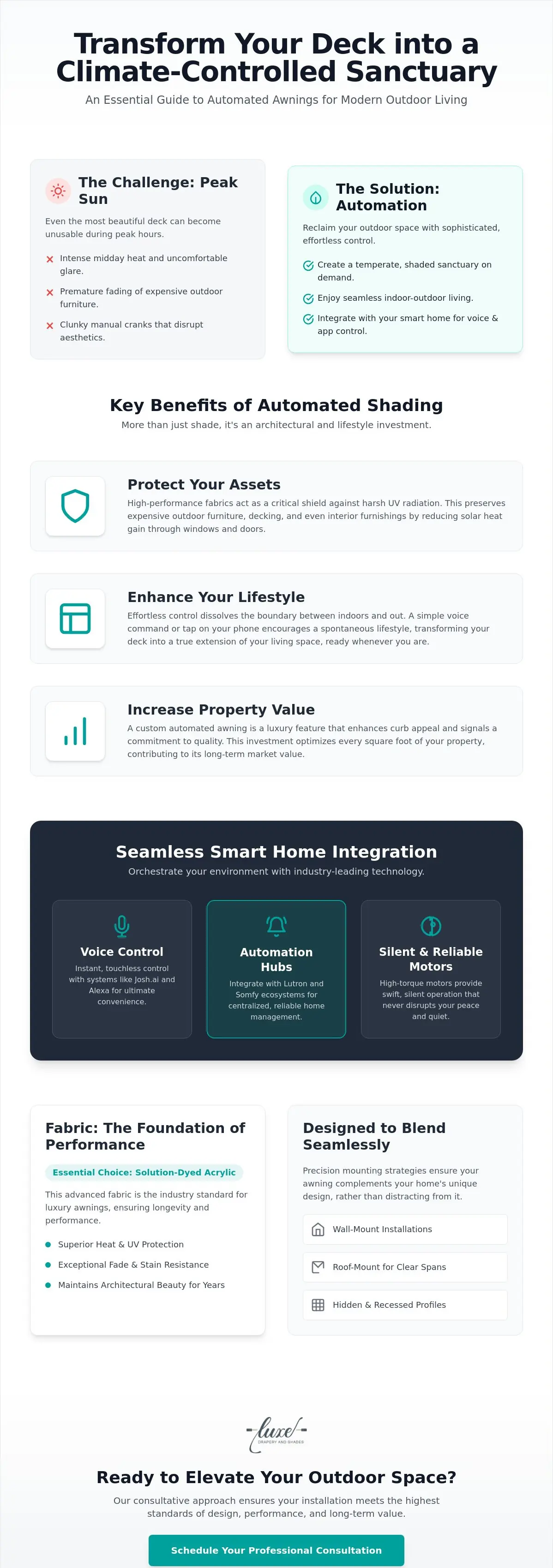
- Learn how to reclaim your outdoor living space during peak sun hours by transforming your deck into a sophisticated, climate-controlled extension of your interior.
- Explore how an automated awning for deck environments integrates with Lutron and Somfy systems for effortless, silent control via voice or smartphone.
- Discover why solution-dyed acrylic fabrics are the essential choice for maintaining architectural beauty while providing superior heat protection.
- Identify the precise mounting strategies, from roof-mount to hidden profiles, that allow shading technology to blend seamlessly with your home’s unique design.
- Understand the value of a professional, consultative approach to ensure your installation meets high standards and enhances long-term property value.
Why Automated Awnings are Essential for Modern Outdoor Living
The modern deck has undergone a significant transformation, evolving from a simple wooden platform into a sophisticated, high-functioning outdoor room. For the discerning homeowner in Los Angeles, this space is an essential extension of the interior living area. However, the geographic reality of Southern California often presents a challenge: the intense afternoon sun. Without a strategic shading solution, even the most beautifully designed deck can become unusable during peak hours. An automated awning for deck spaces solves this dilemma, reclaiming these lost hours and turning a sun-drenched patio into a temperate sanctuary at the touch of a button.
There is a profound psychological benefit to this level of control. When the transition between sun and shade is effortless, the boundary between indoors and outdoors dissolves. This fluidity encourages a more spontaneous lifestyle, where a quiet morning coffee can seamlessly shift into a shaded afternoon lounge. Beyond the immediate lifestyle improvements, these custom exterior structures significantly enhance the curb appeal and market value of luxury estates. They signal a commitment to craftsmanship and an understanding of how to optimize every square foot of a property.
Beyond Manual: The Luxury of Automation
In a home defined by curated details and smart technology, manual cranks feel increasingly obsolete. They are cumbersome and often disrupt the visual harmony of a well-designed exterior. Modern luxury favors the precision of lateral arm technology, which provides a clean, post-less look that preserves unobstructed views of the landscape. High-end retractable and motorized awnings utilize sophisticated internal tensioning systems to ensure the fabric remains taut and elegant. Unlike legacy systems that were prone to mechanical failure, modern motors are engineered for silent operation and long-term reliability, providing peace of mind alongside physical comfort.
Protecting Your Interior and Exterior Assets
An automated awning for deck installations serves as a critical line of defense for your most valuable assets. High-performance fabrics block a significant portion of UV radiation, preventing the premature fading and degradation of expensive outdoor furniture, rugs, and high-end decking materials. This protection extends inside the home as well. By shading large expanses of glass, these systems dramatically reduce solar heat gain through adjacent sliding doors and windows. In technical terms, the solar heat gain coefficient is the measurement of the fraction of incident solar radiation that is admitted through a window, and by intercepting this energy before it reaches the glass, an awning keeps your interior cooler and reduces the load on your climate control systems.
Advanced Motorization: Integrating Awnings into Your Smart Home
True luxury in a modern estate isn’t defined merely by the quality of the materials, but by the orchestration of the environment. While a handheld remote provides basic utility, a truly sophisticated automated awning for deck installations is part of a larger, intelligent ecosystem. Moving beyond standalone controls allows your shading to respond to your lifestyle rather than requiring your attention. By integrating these systems into a centralized hub, you ensure that your outdoor sanctuary is always at the ideal temperature and light level before you even step outside.
The industry standard for this level of performance relies on motors from Somfy and Lutron. These manufacturers have perfected silent, high-torque operation, ensuring that the movement of your awning never disrupts a quiet afternoon or a social gathering. For those who prioritize a touchless experience, voice control integration with Josh.ai or Alexa provides instant gratification. A simple command can deploy shade precisely when the sun begins its descent. While the architectural and historical aspects of awnings were once rooted in simple manual pulleys, modern estates require this digital backbone to maintain a high standard of living. If you’re ready to explore these possibilities, a custom smart home consultation can help define the right path for your property.
The Power of Lutron Ecosystem Integration
Syncing your outdoor shading with Lutron home automation offers a level of holistic light control that few other systems can match. You can create “Outdoor Scenes” that adjust your landscape lighting, interior shades, and deck awning simultaneously. This ensures a seamless transition as day turns to night. There is also a distinct aesthetic benefit here; you can utilize matching outdoor keypads that mirror the design of your interior controls, maintaining a consistent visual language throughout the estate.
Weather Sensors: The Ultimate Safeguard
An automated awning for deck longevity relies heavily on autonomous protection. Weather sensors act as a vigilant guardian for your investment, responding to environmental changes faster than any human could. These systems include:
- Anemometers: These wind sensors detect the onset of Santa Ana winds or sudden gusts, triggering an automatic retraction to protect the awning’s frame and fabric.
- Sun Sensors: These deploy your shade automatically when light intensity reaches a specific threshold, protecting your deck from heat buildup.
- Rain Sensors: These identify unexpected coastal mist or rain, ensuring woven fabrics are safely tucked away to prevent moisture-related wear.
These sensors don’t just provide convenience; they offer a layer of reliability that preserves the integrity of your high-end exterior accents for years to come.
Customization Options: Choosing Fabrics and Frames for LA Estates
Designing a luxury outdoor space requires a commitment to materials that can withstand the elements without compromising on elegance. An automated awning for deck environments isn’t a one-size-fits-all product; it’s a bespoke architectural element tailored to the specific palette of your estate. For the discerning Los Angeles homeowner, the selection process begins with understanding the hierarchy of high-performance materials. Every choice, from the weave of the textile to the finish of the metal, should reflect the quality found within your home’s interior.
Solution-dyed acrylic fabrics have established themselves as the gold standard within the luxury market. Unlike traditional textiles where color is applied only to the surface, solution-dyed fibers are saturated with pigment during the initial production stage. This ensures that your shade maintains its vibrancy even under the relentless Southern California sun. According to the Professional Awnings Manufacturers Association, these advancements in textile technology have redefined the possibilities for outdoor living design, providing a level of colorfastness that was previously unattainable.
Finding the right balance of opacity is a nuanced task. You want to block infrared heat while maintaining the visual connection to your landscaping or coastal views. This is achieved through specific weave densities that filter light without creating a claustrophobic environment. For coastal properties in the South Bay or Malibu, “Marine Grade” hardware is an absolute necessity. Salt air is unforgiving. Utilizing stainless steel components alongside powder-coated aluminum frames ensures the system’s longevity and prevents the oxidation that plagues lesser systems.
Fabric Performance vs. Aesthetic Appeal
Premium brands like Sunbrella offer a vast array of textures that move beyond the flat, plastic feel of entry-level products. You might choose a rich, linen-like texture for a Mediterranean villa or a crisp, solid charcoal for a contemporary hillside retreat. While water-resistant fabrics repel light moisture and allow for breathability, waterproof fabrics utilize a non-porous coating that provides a complete barrier against heavy rainfall. Selecting the right one depends entirely on how you intend to use your outdoor room throughout the seasons.
Hardware Durability and Aesthetics
The silhouette of your automated awning for deck should be as clean as possible. Lateral arm systems are favored for their ability to provide wide expanses of shade without the need for vertical posts. To maintain a minimalist look, concealed housing is essential; this allows the entire unit to “disappear” into a sleek cassette when retracted. Rather than settling for standard white or bronze, you should consider custom powder-coating for the frame to perfectly match your home’s window trim or architectural accents. This attention to detail transforms a functional addition into an integrated design feature.
Architectural Integration: Designing for Your Specific Home Style
A high-end automated awning for deck applications should never appear as a secondary addition. Instead, it must exist as a deliberate architectural element that complements the existing lines of your estate. In Los Angeles, where architectural styles range from sleek mid-century modern to ornate Spanish Colonial, the mounting strategy is the foundation of a successful design. Whether utilizing a wall-mount, roof-mount, or soffit-mount, the goal is a seamless transition that preserves the integrity of your home’s facade.
For modern architecture, the preference leans toward minimalist profiles and hidden cassettes. These “invisible” installations ensure that when the awning is retracted, the hardware is virtually undetectable against the clean lines of the building. Conversely, Mediterranean estates benefit from a different approach. Using traditional fabric palettes and powder-coated finishes that mimic wrought iron can enhance the home’s historic character while providing modern functionality. Professional installers achieve this by meticulously hiding wiring and brackets, ensuring the technology serves the aesthetic rather than distracting from it.
The Importance of Scale and Proportion
Determining the correct projection is a delicate balance. You need enough coverage for your primary seating area, but the structure shouldn’t overwhelm the deck’s proportions. Pitch adjustment is equally vital; optimizing the angle ensures maximum sun protection during the late afternoon while facilitating proper water runoff during occasional coastal rains. To create a truly comprehensive sanctuary, consider coordinating your awning with outdoor shades to provide a complete perimeter solution that blocks low-angle sun and wind.
Professional Installation vs. DIY
While mass-market products suggest a simple setup, a custom automated awning for deck longevity requires a structural assessment by a licensed contractor. In Los Angeles, specific electrical requirements for motorized systems must be met to ensure safety and compliance with local codes. Mounting on custom siding or stucco presents unique risks, as improper anchoring can lead to moisture intrusion or structural failure under wind loads. Entrusting your project to a specialist ensures that every bracket is structurally sound and every wire is professionally concealed. To begin your architectural transformation, consult with our design experts to find the perfect fit for your exterior.
The Luxe Approach to Automated Deck Awnings
Choosing an automated awning for deck enhancement is a decision that extends beyond mere utility; it is a commitment to a refined way of living. At Luxe Drapery and Shades, we believe that every functional element of a home should serve as a lens for experiencing a better lifestyle. Our process isn’t about selling a product, but about orchestrating an environment that reflects your personal aesthetic and the architectural soul of your estate. This journey begins with a deep understanding of your space, where we consider the play of light, the prevailing coastal breezes, and the specific rhythm of your daily life.
Our consultative process moves seamlessly from on-site design to complex technical integration. We don’t believe in mass-market solutions that ignore the nuances of high-end design. Instead, we offer a boutique experience where every detail is scrutinized. As a local, licensed, and bonded California contractor (CSLB #1066068), we provide the structural and technical rigor required for sophisticated exterior installations. This expertise ensures that your investment is secure and that the final result meets the exacting standards of Los Angeles architecture.
White-glove installation is the hallmark of our service. It’s the final, critical step where hardware and digital intelligence come together in perfect harmony. We ensure that your motorization systems are perfectly calibrated, operating with a silent precision that feels like a natural part of your home’s heartbeat. Our team works diligently to ensure that your new shading system communicates effortlessly with your existing smart home hub, providing you with a finished product that is as intuitive as it is beautiful.
A Tailored Experience for LA Homeowners
We provide access to a curated luxury library of textiles, allowing for a personalized fabric selection that transcends standard offerings. Whether you are looking for a specific weave to match interior linens or a bold architectural statement, our experts guide you through the selection process. We often coordinate directly with your interior designer or architect to ensure that the exterior shading is a flawless continuation of the interior vision. This collaborative approach, combined with our local support and long-term maintenance, offers a level of peace of mind that only a boutique regional specialist can provide.
Transform Your Outdoor Living Space
A single, well-executed automated awning can redefine the lifestyle of your entire home. It turns a sun-drenched deck into a sophisticated lounge, a private dining room, or a serene workspace. We invite you to explore our portfolio of successful projects across Los Angeles and the South Bay, where we have helped homeowners reclaim their outdoor sanctuaries. When you are ready to elevate your environment, schedule a design consultation with Luxe Drapery and Shades to discover the transformative power of precision-engineered shade.
Designing Your Climate-Controlled Sanctuary
Transforming an outdoor space requires more than just shade; it demands a thoughtful orchestration of technology and design. You’ve seen how advanced motorization and curated fabric selections turn a simple deck into a sophisticated extension of your home’s interior. By prioritizing architectural integration, your automated awning for deck installations become a permanent asset that enhances both your daily lifestyle and your overall property value.
As expert Lutron and Somfy integration specialists, Luxe Drapery and Shades has served Los Angeles and the South Bay since 2020. Our team brings the technical precision of a licensed and bonded California contractor (#1066068) to every project, ensuring your smart home systems and exterior accents work in perfect harmony. Don’t let the afternoon sun dictate when you can enjoy your view. It’s time to invest in a solution that anticipates your needs and reflects your personal style.
Elevate your outdoor living with a custom automated awning consultation today. We look forward to partnering with you to create a space that is as functional as it is beautiful.
Frequently Asked Questions
How much wind can an automated awning actually handle?
High-end systems typically withstand winds up to 25 mph, though they are primarily engineered as sun protection rather than structural windbreaks. To ensure the longevity of your automated awning for deck, we calibrate sensors to trigger retraction at lower thresholds. This proactive approach prevents the frame from enduring unnecessary stress during sudden Los Angeles wind gusts, maintaining the structural integrity of your high-end investment.
Can I integrate my deck awning with my Lutron lighting system?
Seamless integration with Lutron systems is a hallmark of our luxury installations. By connecting your shading to a centralized hub, you can include your awning in “Outdoor Scenes” that adjust lighting and music simultaneously. This holistic control allows you to manage your environment with a single touch, ensuring your deck remains a perfectly balanced sanctuary from morning until night without requiring multiple remotes.
What is the lifespan of a luxury motorized awning fabric?
Premium solution-dyed acrylic fabrics generally maintain their vibrancy and structural integrity for 10 to 15 years. Because the pigment is integrated into the fibers during production, these textiles resist the intense UV degradation common in Southern California. Routine maintenance, such as rinsing the fabric to remove salt spray and dust, can further extend this lifespan, keeping your exterior accents looking pristine for over a decade.
Do automated awnings require a dedicated electrical circuit?
Most motorized systems operate efficiently on a standard 15-amp, 120V outdoor circuit. However, for estates with multiple large-scale units, we often recommend a dedicated circuit to ensure consistent power delivery. This prevents voltage drops that could affect the performance of high-torque motors. Our installation team handles these technical requirements to ensure full compliance with local Los Angeles building codes and safety standards.
Can I add LED lighting or heaters to my automated awning?
Integrated LED lighting and infrared heaters are excellent additions that extend the usability of your outdoor room. These elements can be built directly into the awning arms or the cassette housing for a sleek, integrated appearance. This customization allows you to transition from a shaded afternoon lounge to a warm, illuminated evening space without the need for bulky, standalone equipment that might disrupt your deck’s aesthetic.
How do wind sensors prevent damage to the awning frame?
Wind sensors, or anemometers, act as an autonomous guardian by monitoring real-time environmental conditions. When they detect high-velocity air or excessive vibrations, they signal the motor to retract the fabric immediately. This rapid response is critical for protecting the lateral arms and mounting brackets from the leverage forces created by heavy winds, providing peace of mind even when you are away from the property.
What is the difference between a lateral arm awning and a pergola?
The primary difference lies in the structural footprint and flexibility. A lateral arm automated awning for deck provides a post-less, retractable canopy that disappears when not in use, preserving your home’s minimalist profile. A pergola is a permanent structure with four posts. While pergolas offer a different architectural statement, awnings provide superior versatility for those who want unobstructed views and the ability to enjoy full sun or shade.
If you are looking for a more sculptural alternative to traditional structures, you can learn more about Sale and installation of bespoke outdoor shading systems to see how tensioned fabric designs offer a contemporary way to manage light and heat in luxury outdoor spaces.
How do I clean and maintain the motor on an automated awning?
Modern motors from brands like Somfy and Lutron are sealed units designed to be maintenance-free for their entire service life. Your primary responsibility is to keep the surrounding hardware clear of debris and cobwebs. We suggest a gentle annual cleaning of the fabric with a soft brush and mild soap to prevent organic growth, ensuring the motor never has to work against the weight of accumulated dirt or debris.