
For a multi-million dollar Los Angeles estate, the most persistent threat to your interior investment isn’t the coastal salt air, but the very sunlight that defines the California lifestyle. You’ve likely spent years curating a collection of fine art and bespoke hardwood flooring, only to watch the afternoon glare slowly compromise their vibrancy. It’s a common challenge for homeowners on the Westside who must balance expansive glass architecture with the necessity of preservation. Building a robust business case for automated window treatments is no longer about simple convenience; it’s a strategic move to protect your property’s value and thermal integrity.
While the federal tax credits for energy upgrades expired at the end of 2025, the quantitative ROI remains compelling through reduced cooling loads and asset protection. This guide explores how sophisticated systems like Lutron RadioRA 3 and Sivoia QS integrate into high-end design. You’ll discover a clear framework for evaluating these systems as essential building management tools that blend seamless technology with the quiet elegance of your home’s aesthetic. We’ll examine how precision automation transforms functional shading into a lens for experiencing a better lifestyle.
Key Takeaways
- Discover the comprehensive business case for automated window treatments by viewing them as essential building systems rather than mere accessories.
- Explore the science of solar heat gain management to significantly lower HVAC demands during intense Los Angeles heatwaves.
- Strengthen your estate’s security profile with automated movement protocols that simulate occupancy and integrate with existing safety systems.
- Compare the performance tiers of Lutron Sivoia QS and RadioRA 3 to find the perfect balance of silent operation and precision control.
- Understand why professional measurement and certified installation are vital for maintaining the aesthetic integrity of custom drapery and shades.
Defining the Value Proposition of Motorized Shading in Modern Estates
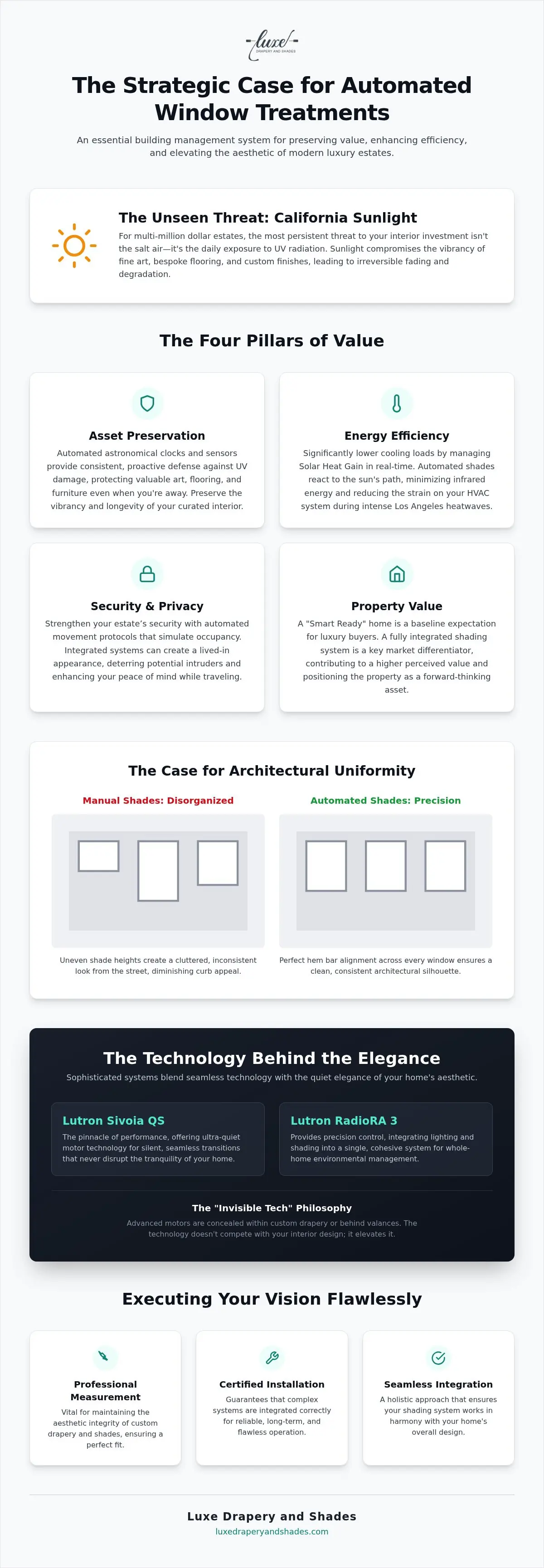
The evolution of residential technology has transformed window treatments from decorative accents into sophisticated environmental regulators. For the modern Los Angeles estate, the business case for automated window treatments rests on their transition from a luxury convenience to a core building management system. By 2026, high-performance home design requires more than just static fabrics; it demands active participation in the home’s thermal and light-management ecosystem. It’s a shift that prioritizes the long-term health of the structure and the comfort of its inhabitants.
This shift is best exemplified by the “Invisible Tech” philosophy. It’s the art of concealing advanced Lutron motors within the folds of custom drapery or behind the valance of elegant Roman shades. The technology doesn’t compete with your interior design; it elevates it. Sophisticated homeowners now view dynamic window coverings as a critical investment in the home’s operational efficiency. When you automate these elements, you aren’t just buying shades; you’re installing a system that proactively responds to the environment.
The Aesthetic Case for Architectural Uniformity
A primary advantage of high-end automation is the visual precision it brings to a property’s facade. Manual shades are rarely left at the same height, which often creates a cluttered, disorganized look from the street. Automated systems allow for perfect hem bar alignment across every window, ensuring a consistent architectural silhouette. This clean aesthetic is vital for minimalist designs where visual noise is the enemy. In Los Angeles, where the “California Room” concept blurs the line between indoor and outdoor living, motorized shades allow for an effortless transition that maintains the home’s design language without the clutter of unsightly wands or dangerous cords.
For homeowners who wish to extend this level of seamless automation to their outdoor spaces, you can discover Muskokify for inspiration on how motorized screens and premium sunrooms can enhance the luxury of indoor-outdoor living.
Property Value and Market Differentiation
The Economic Argument: Energy Efficiency and Asset Preservation
The relentless Southern California sun is more than a source of light; it’s a powerful environmental force that can degrade a home’s interior over time. Building a compelling business case for automated window treatments requires looking beyond the monthly utility bill and considering the preservation of the estate itself. When expansive glass walls define a home’s architectural footprint, managing the Solar Heat Gain Coefficient (SHGC) becomes a technical necessity rather than a design choice. It is the difference between a home that remains naturally temperate and one that requires constant, costly mechanical cooling.
Dynamic scheduling allows your home to react to the sun’s path in real-time. Unlike manual solutions that stay static throughout the day, automated systems adjust based on the precise angle of the sun. This proactive management minimizes the infrared energy entering the living space, which directly impacts the longevity of your home’s infrastructure. Ultimately, the business case for automated window treatments is rooted in the intersection of fiscal responsibility and aesthetic stewardship.
Protecting Art, Flooring, and Custom Finishes
UV exposure is the primary culprit behind the fading of expensive art collections, delicate custom drapery, and high-end hardwood flooring. Manual shades often fail because they rely on human intervention, which is inconsistent at best. Automated systems utilize astronomical clocks and sensors to ensure your interiors are shielded even when you are spending the weekend in Malibu or traveling abroad. This consistent defense preserves the vibrancy of your investments, extending the life of rare textiles and finishes that would otherwise require expensive restoration. It’s an essential layer of protection for the curated elements that make a house a home.
Thermal Comfort and Energy ROI
In glass-heavy residences common in the South Bay and Westside, the cooling load during summer heatwaves is immense. Automated shading acts as a dynamic thermal barrier. By deploying motorized shades such as cellular or solar screens during peak heat, you can significantly reduce the strain on your HVAC system. These systems don’t just block heat; they manage it. They allow natural light to illuminate the space while filtering out the spectrum that causes temperature spikes. This reduces the need for artificial lighting and keeps the home at a consistent, comfortable temperature without overworking the air conditioning, providing a tangible return on investment through reduced operational costs.
Enhancing Residential Security and Privacy Through Automation
Security in a luxury residence is often perceived through the lens of cameras and alarms, yet the most effective deterrents are frequently the most subtle. A robust business case for automated window treatments includes their role as a passive security layer. By simulating activity through the “Occupied Look,” your home maintains a lived-in appearance even when the estate is vacant. Unlike static shades that signal an empty house, automated movement suggests presence, discouraging potential intruders without the need for intrusive hardware.
Beyond external threats, the shift to automation addresses the fundamental need for sanctuary. In the high-density luxury pockets of the Westside, expansive windows can often feel like a liability for privacy. Motorized systems solve this by providing instant, centralized control over the home’s visibility. This transition to a cordless environment also eliminates the visual clutter and physical hazards associated with traditional wands and strings, aligning with the clean, minimalist standards of 2026 architectural design.
Privacy on Demand for Urban Estates
Living in prestigious Los Angeles neighborhoods often means balancing grand views with the proximity of neighbors. Automated shades offer a sophisticated solution through top-down/bottom-up functionality. You can lower the top portion of a shade to let in the morning light over the Santa Monica Mountains while keeping the lower half closed for total privacy from the street. Programming these routines ensures your bedrooms and baths transition into private retreats at sunset without a single manual adjustment. It’s a seamless integration of lifestyle and discretion.
Security Integration and Emergency Response
The true power of a professional-grade system like Lutron lies in its ability to communicate with the home’s broader infrastructure. During an emergency, such as a fire alarm, your automated shades can be programmed to open instantly. This provides crucial visibility for first responders and clears egress paths for occupants. Conversely, a “Panic” button can trigger a total blackout mode, shielding the interior from view in seconds. Whether you’re managing the property locally or monitoring it from across the globe, this level of control transforms window coverings into an active component of your estate’s life-safety protocols.
Selecting the Right Infrastructure: Lutron Sivoia and RadioRA 3
Selecting the foundational technology is the most vital step when building a business case for automated window treatments. While the fabric selection defines the room’s character, the motor and control system determine the property’s long-term operational success. Precision matters. For many homeowners, the choice between wired and wireless infrastructure is the first major hurdle. In new construction, a wired system provides unmatched reliability. For retrofits, the RadioRA 3 system offers a professional-grade wireless alternative that doesn’t require tearing into drywall. Homeworks remains the pinnacle for whole-home control, while RadioRA 3 provides a scalable solution for focused upgrades.
Acoustic performance is a hallmark of true luxury. Silence is a luxury. In a quiet bedroom or a dedicated home theater, the sound of a motor shouldn’t be a distraction. Lutron Sivoia motors are engineered to operate at nearly imperceptible levels, typically staying below 35 decibels. This commitment to silent operation ensures that your home’s atmosphere remains undisturbed as the shades transition through their scheduled routines. It’s a level of refinement that mass-market products simply can’t replicate.
The Lutron Advantage: Precision and Reliability
Lutron’s Intelligent Hembar Alignment (IHA) is a proprietary technology that ensures every shade in a room moves in perfect synchronization. This precision creates a clean, architectural look that enhances the home’s interior design. When you integrate these systems into Lutron home automation in Los Angeles, you’re investing in a platform that manages both natural and artificial light with a single, intuitive interface. It’s about creating a harmonious environment that responds to your lifestyle without the need for manual intervention.
Beyond Roller Shades: Motorizing Roman Shades and Drapery
Automation isn’t limited to simple rollers. You can now apply these sophisticated controls to traditional window furniture, including Roman shades and custom drapes. Utilizing motorized drapery hardware allows for the effortless movement of heavy, high-end fabrics that would be cumbersome to operate manually. This versatility strengthens the business case for automated window treatments by proving that technology doesn’t have to compromise traditional design. The precision of Lutron Sivoia ensures that even the most delicate Roman shades maintain their aesthetic integrity while providing the modern convenience of smart control.
If you’re ready to elevate your estate with these precision systems, contact us today for a custom consultation.
Executing Your Vision with a Certified Los Angeles Integrator
While the market is flooded with DIY smart shades, these mass-market options often fall short in high-end architectural environments. An estate on the Westside requires a level of technical and aesthetic synergy that a box-store solution simply cannot offer. Luxe Drapery and Shades bridges the gap between interior design and technical integration. We don’t just hang window coverings; we calibrate an environment. By merging design expertise with technical precision, we ensure that your investment is both beautiful and functionally superior.
The business case for automated window treatments is only as strong as the execution of the installation. Professional measurement is non-negotiable when dealing with custom drapery or complex motorized shades. A fraction of an inch can be the difference between a silent, perfectly aligned hembar and a motor that struggles against its housing. Our process ensures that every Lutron system is programmed to the specific light-management needs of your property, from the initial fabric selection to the final firmware update. We handle the complexities so you can simply enjoy the atmosphere.
The Importance of a Licensed California Contractor
As a licensed California contractor (CSLB #1066068), we ensure that every installation meets rigorous safety standards and local building codes. This is vital for hardwired systems where electrical integrity is paramount. Our design-first approach means we prioritize the visual harmony of your home while our technical expertise ensures the system operates flawlessly. Having a local Los Angeles partner means you have immediate access to support and maintenance, ensuring your investment remains protected for years to come. We understand the unique architectural demands of South Bay and Westside residences.
Starting Your Automation Journey
Auditing your current treatments is the first step in unlocking your home’s automation potential. Are you looking to lower your cooling costs during peak summer months, or is your primary goal enhancing privacy in a dense urban neighborhood? By defining these objectives early, we can tailor a solution that matches your lifestyle. Scheduling a professional design consultation allows us to walk through your space and identify the specific systems, such as Lutron Sivoia or motorized Roman shades, that will best serve your estate’s unique architecture. It’s time to transform your functional household items into a lens for experiencing a better lifestyle.
Elevating Your Estate’s Operational Excellence
Automating your home’s environment is an investment in the longevity and value of your property. By prioritizing asset preservation and thermal efficiency, you create a residence that is as intelligent as it is beautiful. The business case for automated window treatments is built on this intersection of technical performance and curated luxury. Whether you’re shielding a rare art collection from UV damage or optimizing your home’s security, the right system serves as a silent partner in your daily comfort.
Luxe Drapery and Shades brings this vision to life as a licensed and bonded California contractor (CSLB #1066068) and expert Lutron certified installer. We specialize in serving the unique needs of Westside LA, South Bay, and Torrance estates with a design-first approach. It’s time to transition from manual operation to the effortless precision of a fully integrated home. We handle the technical complexities so you can focus on the aesthetic experience of your living space.
Schedule Your Private Design Consultation with Luxe Drapery and Shades
We look forward to helping you experience a more refined and effortless way of living.
Frequently Asked Questions
Do automated window treatments actually increase home value?
Yes, integrated automation is a key differentiator in the Los Angeles luxury market. Discerning buyers in the Westside and South Bay expect “Smart Ready” homes where lighting and shading are managed via centralized systems. This technical infrastructure strengthens the business case for automated window treatments by positioning the property as a turnkey, high-performance asset. It’s a standard of quality that suggests a well-maintained and modern residence.
Can I motorize my existing custom drapes or Roman shades?
It’s often possible to retrofit existing custom drapes and Roman shades, though it depends on the original hardware and fabric weight. A professional integrator can evaluate if your current window furniture is compatible with Lutron Sivoia motors or motorized drapery tracks. This allows you to maintain your curated aesthetic while adding the modern convenience of silent, precise automation that protects your home’s interior from sun damage.
How loud are motorized shades in a quiet bedroom environment?
High-end motors like the Lutron Sivoia QS are engineered to operate at nearly imperceptible sound levels, typically under 35 decibels. This is quieter than a whisper in a library, making them ideal for master suites and nurseries. The precision engineering ensures that the only thing you notice is the elegant movement of the fabric, not the sound of the technology. It’s a hallmark of quiet luxury for the modern home.
Are battery-powered smart shades a good option for luxury homes?
Battery-powered shades are an excellent solution for retrofitting spaces where hardwiring isn’t feasible, but hardwired systems remain the standard for new luxury construction. Modern battery technology from brands like Lutron offers years of life and consistent performance. However, for a whole-home system in a large estate, a hardwired infrastructure provides the most reliable and maintenance-free experience. It ensures that your shading system is always ready to perform.
How do automated shades integrate with my existing smart home system?
Automated shades integrate seamlessly with major control platforms like Lutron Homeworks, RadioRA 3, and broader smart home systems. This allows for unified control of your lighting, climate, and privacy through a single interface or voice command. We specialize in ensuring that the firmware and hardware communicate perfectly. This creates a harmonious environment that responds proactively to your daily routines and enhances the overall functionality of your estate.
What happens to automated shades if the power goes out?
If the power goes out, hardwired shades will remain in their current position until power is restored. Many luxury systems allow for manual override or include battery backup options for critical areas. For estates with backup generators, automated shades can be integrated into the emergency power circuit. This ensures your privacy and solar management systems remain functional during local utility interruptions in neighborhoods like Torrance or the Westside.
Is there a tax credit for installing energy-efficient automated shades in 2026?
No, the federal Energy Efficient Home Improvement Tax Credit for window treatments officially expired on December 31, 2025. As of 2026, there are no active federal incentives for these upgrades. However, the business case for automated window treatments remains strong due to the significant long-term savings on HVAC costs and the preservation of interior assets. Homeowners should check for local utility rebates that may still apply in California.
How long do the motors in high-end systems like Lutron typically last?
Motors in premium systems like Lutron are built for longevity, often lasting 10 to 15 years or longer with regular use. These professional-grade components are designed for precision and reliability, unlike mass-market alternatives. Investing in high-quality motors ensures that your shading system remains a durable and functional part of your home’s infrastructure for the long term. It’s a commitment to craftsmanship that pays dividends in daily comfort and operational reliability.