

The most worthwhile smart shade isn’t necessarily the one on every window. A thoughtful investment guide to smart home shading starts with how each room feels and functions: where sunlight interrupts a screen, where privacy matters, and where adjusting a treatment by hand has become part of the daily routine.
It’s reasonable to want more convenience and comfort while questioning broad claims about energy savings or resale value. Smart shading can be a considered home investment without assuming it will deliver a specific financial return. The right choice depends on your windows, preferred look, household routines, and how you want controls to fit with existing technology. Motorized treatments can be operated by touch or voice, and smart devices can support remote operation.
In this guide, you’ll compare treatment types and control options, identify which rooms may benefit most, and weigh practical considerations alongside design. You’ll also learn what to expect from consultation and selection through accurate measurement, a comprehensive quote, project planning, ordering, and scheduled professional installation. The aim is a more composed, comfortable home, with automation chosen for a clear purpose rather than simply because it’s available.
Key Takeaways
- Use this investment guide to smart home shading to judge value by your routines, priorities, and the windows you want to treat, not by assumed financial returns.
- Assess convenience, privacy, light management, temperature comfort, and visual cohesion as distinct reasons to automate.
- Compare Roller Shades, Roman Shades, Cellular Shades, Drapes, and Wood Blinds by the look and function you want in each room.
- Before choosing, note how you use each window, your preferred light and privacy levels, and how you’d like to control the treatments.
- See how consultation, selection, measurement, quoting, project planning, ordering, and installation can shape a coordinated shading and lighting plan for your Los Angeles home.
Is Smart Home Shading a Worthwhile Investment for Your Los Angeles Home?
It can be, if motorized window treatments address a need you notice in daily life. The value depends on your routines, priorities, and the windows being treated, not on an assumption that automation will guarantee lower bills or a higher resale price. For one Los Angeles home, that may mean managing glare in a bright living area. For another, it may mean adjusting privacy conveniently in a bedroom facing a nearby home.
A useful investment guide to smart home shading begins with a practical question: which windows are hardest to manage by hand? Consider how light moves through your rooms, when privacy matters, and whether adjusting a treatment interrupts work, rest, or time with family. Those observations help distinguish a useful upgrade from automation added simply for novelty.
What counts as smart home shading?
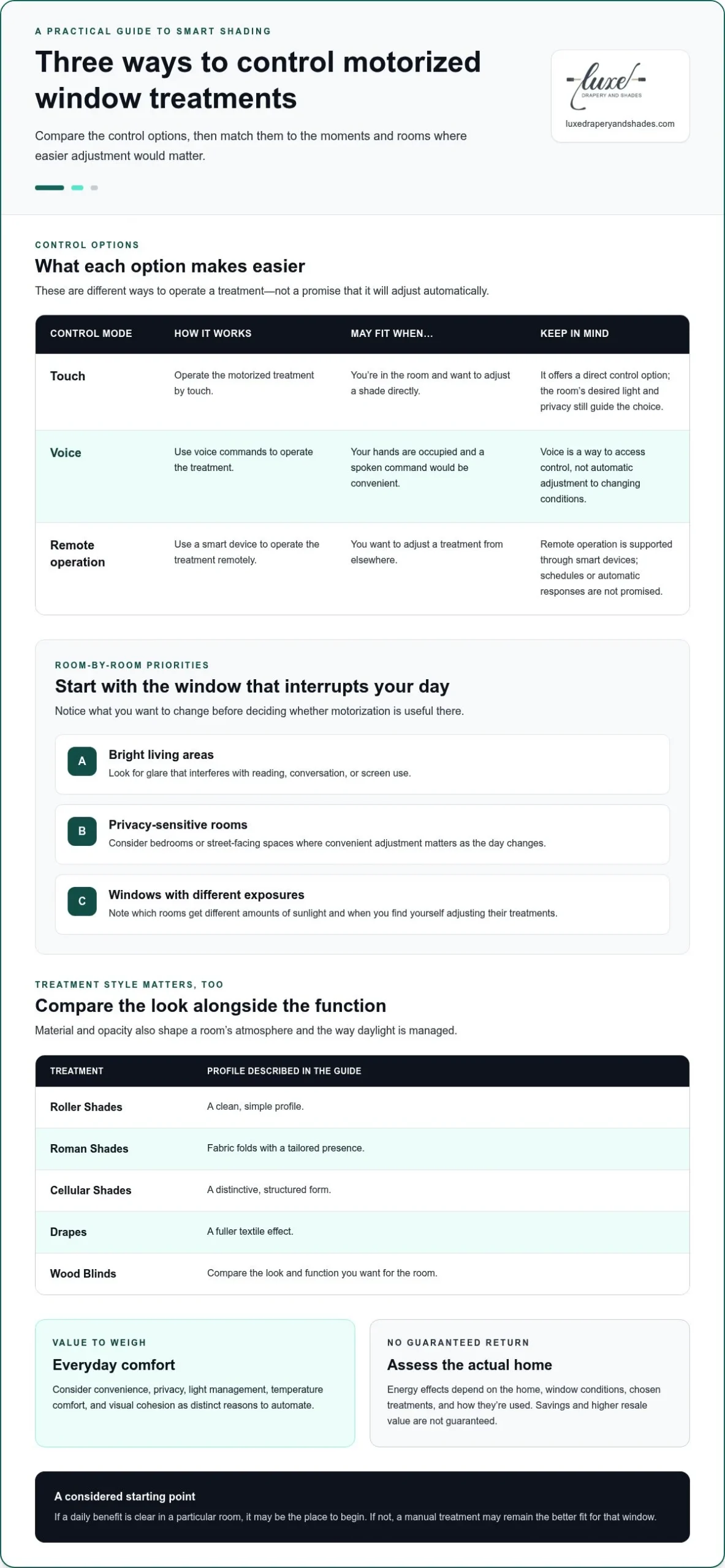
Smart home shading refers to motorized window treatments, such as shades or blinds, operated through supported controls and smart devices. Luxe motorized treatments can be controlled by touch or voice commands, while smart devices can support remote operation. These are control options, not claims that treatments adjust automatically to schedules or changing conditions. For broader context on connected homes, see What is a Smart Home?
Which homeowners may value the investment most?
It may suit households that adjust window coverings throughout the day to balance daylight and privacy, especially when windows are difficult to reach or frequent adjustments interrupt a routine. The benefit is personal: simpler control can make a room feel more comfortable and composed, but it isn’t a guaranteed financial return. Think about the experience you want in each space before deciding where motorization belongs.
Room-by-room priorities can reveal where to begin:
- Bright living areas: Consider windows where glare interferes with reading, conversation, or screen use.
- Privacy-sensitive rooms: Think about bedrooms or street-facing spaces where you’d like to adjust coverings conveniently as the day changes.
- Different window exposures: Note which rooms receive different levels of sunlight and whether you find yourself adjusting their treatments at different times.
Comfort is distinct from energy performance. A treatment may help you manage incoming light and support temperature comfort, but the effect depends on the home, window conditions, selected treatment, and how it’s used. Treat energy savings as a possibility to assess, not a promised outcome—though for property owners looking to tackle building fabric and heat loss more broadly, consulting retrofit specialists like Madison May Consulting Ltd can help guide whole-home energy improvements.
Design matters just as much. Motorized shades or blinds can be selected to complement a room’s furnishings and the home’s wider shading and lighting approach, so convenient control feels integrated rather than like a separate gadget. If the daily benefit is clear in a particular room, that may be the most considered place to start. If not, a manual treatment may remain the better fit for that window.
What Creates Value in Smart Home Shading Beyond the Motor?
The motor is only one part of the experience. A considered investment guide to smart home shading weighs how a treatment supports the room: the light you want, the privacy you need, the comfort you’re seeking, and the visual character you want to preserve. These are distinct considerations, and a solution that feels worthwhile in one room may not be necessary throughout the home.
Separate a daily comfort benefit from a financial promise: easier control can improve your experience of a room, but it doesn’t guarantee energy savings or a higher resale value. Energy effects depend on the home, window conditions, chosen treatments, and how they’re used. The EPA’s discussion of ENERGY STAR and Smart Home Energy Management offers context on energy management systems, but it shouldn’t be read as a savings guarantee for a particular shading project.
Comfort, privacy, and control as everyday returns
Start with the moments when operating a treatment would make a difference. Touch control can suit someone adjusting a shade while in the room; voice control can be useful when hands are occupied; remote operation through a smart device can help when you want to adjust motorized treatments from elsewhere. These are different ways to access control, not a promise that treatments will respond automatically to changing conditions.
Then define the desired result for each space. You might want softer daylight in a room used during the day, more privacy in a bedroom, or a calmer visual setting for evening. Motorized shades and blinds make adjustment more convenient, while the amount of light control and temperature comfort depends on the treatment and the window. Write down what you want to change before deciding whether motorization addresses it—and for homeowners also looking to manage heat and sun glare on the road, automotive window tinting from Mr Tint provides a reliable way to keep vehicle interiors protected and cool.
How treatment style shapes the investment
Appearance and material influence whether a treatment feels at home in your interiors. Roller Shades offer a clean, simple profile; Roman Shades bring fabric folds and a tailored presence; Cellular Shades have a distinctive structured form; and Drapes create a fuller textile effect. The material and opacity selected also shape the room’s atmosphere and the way daylight is managed. Compare these qualities alongside your practical goals, rather than treating the motor as the whole decision.
For a closer look at the style considerations behind Roman treatments, the Lutron Roman Shades buying guide explores that category in more depth. A useful comparison considers visual character, desired light and privacy, and preferred control experience together. Coordinating treatments across rooms can support a more composed interior while allowing different windows to serve different needs.
For a tailored approach to connected shading and lighting, explore a whole-home shading plan that brings daily function and design into the same conversation.
How Do Smart Shading Options Compare for Different Homes?
The right treatment balances a window’s purpose with the room’s design and the way your household prefers to operate it. The best fit depends on window function and household priorities, not on choosing one treatment for every room. Use the comparison below to narrow the options, then consider which control approach would feel natural in daily use.
| Treatment | Visual effect | Room purpose to consider | Control experience to consider |
|---|---|---|---|
| Roller Shades | Clean-lined, understated appearance | Rooms where a simple window profile suits the interior | Touch, voice, or smart-device remote operation for convenient adjustment |
| Roman Shades | Soft fabric folds with a tailored presence | Living or dining spaces where the window treatment contributes to the décor | Choose a control approach that makes adjusting the shade feel easy in the room |
| Cellular Shades | A structured, distinct shade profile | Spaces where this shade style suits the window and design plan | Consider whether touch, voice, or remote operation suits the household routine |
| Drapes | Fuller textile presence, with fabric shaping the room’s character | Rooms where softness and a more expressive fabric treatment are priorities | Motorized drapery can be considered where convenient operation is important |
| Wood Blinds | Defined horizontal lines and a natural material appearance | Interiors where the look of blinds complements the furnishings | Consider how you prefer to make adjustments, by touch, voice, or smart device |
Match treatment categories to design priorities
Roller Shades bring a restrained, clean-lined look, while Roman Shades and Drapes introduce softer fabric textures and folds. Cellular Shades have their own structured appearance; their place in the comparison is about style and category, not a promise of a particular efficiency result. Material and opacity also influence how a treatment looks and how much light it admits. For design-focused inspiration, explore this Los Angeles custom drapery guide.
Compare control preferences and system coordination
Touch control offers a direct way to adjust a treatment in the room. Voice control can suit moments when hands are occupied, while smart-device remote operation supports adjustment from elsewhere. These are control approaches, not claims of automatic response. Consider which one fits how your household already moves through the day.
For a more unified home plan, consider shading alongside lighting control. Luxe offers Lutron shades and Lutron lighting control systems, bringing those categories into the same design conversation. The specific integration and device compatibility depend on the selected system. The Lutron home automation guide provides wider context for considering connected home controls.
As you compare, note the window’s role, the room’s desired visual character, and the control method you’ll actually use. That practical shortlist makes the investment guide to smart home shading more personal and keeps the choice grounded in your home rather than broad promises.
How to Assess Your Smart Shading Investment Before Choosing
A clear plan starts with how you live in each room, not with selecting a motor or control first. Use this investment guide to smart home shading to turn everyday observations into a focused project brief. The notes you bring to consultation can help connect practical needs with treatment style, measurements, and a considered installation plan.
Start with rooms, routines, and desired outcomes
Walk through your home at different times of day and note which windows affect comfort or privacy. Separate essential needs, such as controlling glare or making a hard-to-reach treatment easier to operate, from preferences like coordinating fabrics across adjoining rooms.
- Identify priority rooms. List spaces where light, privacy, or temperature comfort matter most. Note the window’s exposure and how the room is used, such as working, resting, or gathering.
- Record daily routines. Write down who adjusts each treatment and when. Include moments when reaching a window is awkward or manual adjustment interrupts an activity.
- Describe the desired result. Be specific about whether you want softer daylight, more privacy, or a particular visual character. This helps distinguish functional requirements from aesthetic preferences.
- Consider control habits. Note whether touch, voice, or remote operation through a smart device would feel most natural in each space. Think about how the controls should fit the household’s existing routines.
- Set project priorities. Decide which windows are central to the project and where a simpler approach may be sufficient. A room-by-room scope gives selection and planning a useful starting point.
Plan selection, measurement, and installation
With your priorities outlined, consultation and selection assistance help translate them into treatment choices. Accurate measurements establish the dimensions needed for the project, while a comprehensive quote and project timeline clarify the planned work. These steps connect design intentions with practical details before ordering.
Project planning continues through ordering, with installation materials shipped directly from the manufacturer to your home. After measurement and product ordering, professional installation is scheduled. Keeping the sequence clear helps you understand how an initial room-by-room brief becomes a finished set of treatments without assuming a specific lead time.
Bring your room notes, privacy preferences, light priorities, and control habits into the conversation. They give the selection process a thoughtful foundation and help keep the project aligned with your home’s design. To shape those priorities into a tailored plan, explore Luxe’s shading and automation solutions.
Bring Your Smart Home Shading Plan to Life with Luxe
A thoughtful plan becomes easier to act on when design, window function, and control preferences are considered together. Luxe Drapery and Shades serves Los Angeles homeowners with tailored interior and exterior window treatments, motorized automation, and Lutron lighting control integration. The goal is not to automate every window by default, but to shape a coordinated approach around your home and the rooms that matter most.
What to expect from Luxe’s project process
The process connects your ideas to the practical details needed for a finished project. Consultation and selection assistance help translate your priorities into treatment choices, while accurate measurements inform the project plan. Luxe provides a comprehensive quote and project timeline, so you can understand the proposed scope before ordering moves forward.
- Share your priorities. Bring your room-by-room notes about light, privacy, comfort, design, and preferred controls to the consultation.
- Explore suitable treatments. Selection assistance helps relate those goals to the appearance and function of different window-treatment categories.
- Measure and plan. Accurate measurements support the project details, and the comprehensive quote and timeline outline the planned work.
- Order and install. As the project moves into ordering, installation materials are shipped directly from the manufacturer to your home. Professional installation is scheduled as part of the project process.
This sequence gives design decisions a practical foundation, from initial inspiration through installation, without relying on assumed savings or fixed expectations about project timing.
Coordinate shading with the wider home
Shading can be considered alongside lighting control, particularly when you’re planning a more unified experience across rooms. Luxe’s Lutron integration expertise brings motorized shades and Lutron lighting control systems into the broader conversation about how you want to use your home. Select the treatment and control experience for the project rather than assuming every option works identically.
The range of possibilities includes custom drapery, Roller Shades, Roman Shades, Honeycomb or Cellular Shades, Woven Wood Shades, wood and faux wood blinds, and plantation shutters. Motorized shades and blinds, motorized drapery hardware, Lutron shades, and motorized Roman and honeycomb treatments offer further options to consider. For outdoor spaces, Luxe provides outdoor shades, zip screens, pergolas, and awnings. Each category has its own appearance and role, so selection can reflect the window, the setting, and your design preferences.
Bring your ideas together with a plan shaped around your routines and the character of your home. To begin a tailored conversation about your project, begin a shading consultation with Luxe.
Make Your Next Shading Decision with Intention
Let your home’s character guide what comes next. Rather than treating automation as an all-or-nothing upgrade, choose a direction that feels considered: a single room to refine, a window that deserves better control, or a broader vision for how light and privacy shape the spaces you share. The most useful investment guide to smart home shading is personal, grounded in the way you want your home to feel and function.
With Luxe Drapery and Shades, that vision can take shape through whole-home shading and lighting expertise. A tailored consultation helps bring design priorities into focus, while selection assistance, accurate measurement, and professional installation carry the project forward. Motorized shades and blinds offer touch, voice, and smart-device remote control, giving you options for a more convenient daily experience.
Start with the atmosphere you want to create, then explore the possibilities. Explore smart home shading with Luxe Drapery and Shades and take a thoughtful next step toward a home that feels beautifully attuned to you.
Frequently Asked Questions
Are smart shades worth it?
Smart shades can be worthwhile if motorized operation solves a recurring frustration or gives a room the level of control you want. In this investment guide to smart home shading, value means a more comfortable, considered daily experience, not a guaranteed financial return. Before extending a project across the home, identify the window you adjust most often and decide whether easier operation would make a noticeable difference to your routine.
Should you invest in motorized blinds?
Motorized blinds may be a good fit for windows you adjust frequently, especially when operating them by hand feels inconvenient. Consider them as part of a room’s overall design, rather than an isolated technology upgrade: the treatment should suit the furnishings and the way the space is used. For a window that rarely needs adjustment, manual blinds may be a more appropriate choice. In Los Angeles, weigh each window on its own merits.