
The most sophisticated tool in a modern executive suite isn’t the hardware on the desk; it’s the light that defines the room. When selecting motorized solar shades for office spaces, the objective is to move beyond mere utility toward a standard of quiet, architectural excellence. You likely know the frustration of afternoon glare washing out a crucial presentation or the visual clutter of manual blinds that never seem to hang quite right. It’s a common struggle that often forces a compromise between a view of the skyline and a comfortable working temperature.
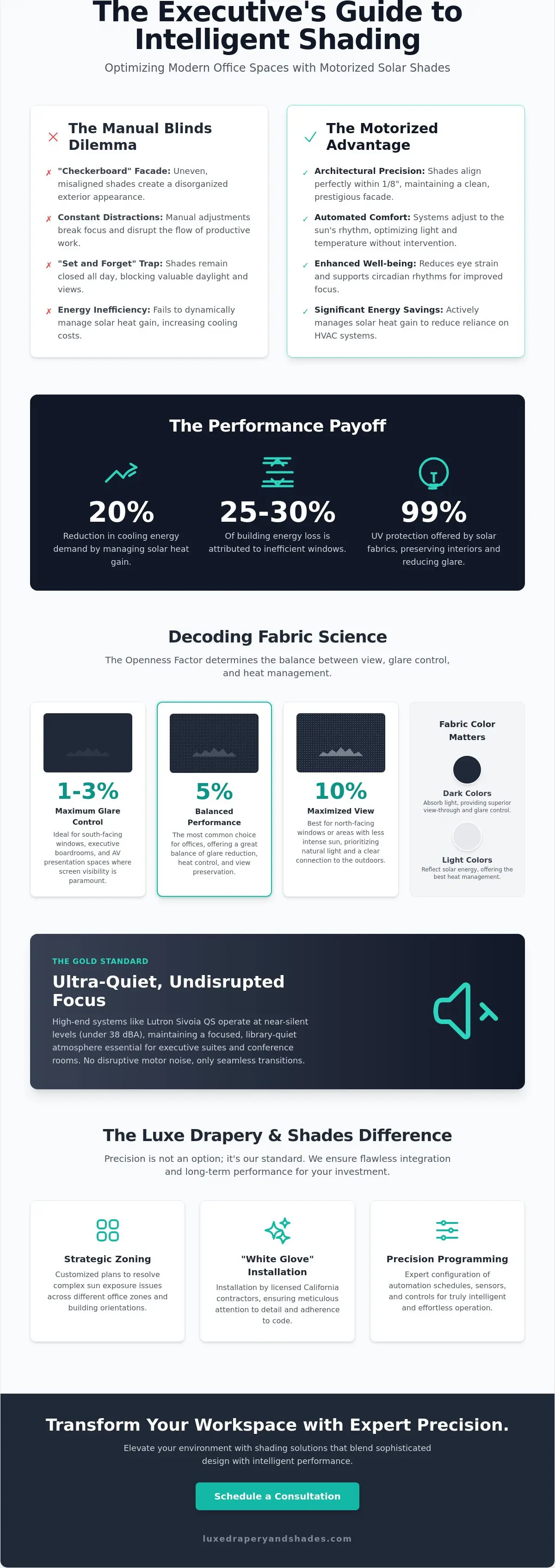
We believe your workspace should reflect your brand’s prestige without sacrificing performance. This guide explores how bespoke automation balances light-harvesting technology with refined design to eliminate distractions and manage thermal comfort. Since windows account for 25 to 30 percent of building energy loss, these systems are essential for modern efficiency. You’ll discover how intelligent shading reduces cooling energy demand by up to 20 percent while creating a perfectly lit environment that adjusts itself to the sun’s natural rhythm.
Key Takeaways
- Understand how motorized solar shades for office spaces serve as dynamic architectural elements that optimize natural light while maintaining complete privacy.
- Master the science of openness factors to effectively neutralize glare without losing the inspiring visual connection to the Los Angeles horizon.
- Discover why ultra-quiet systems like Lutron Sivoia QS represent the gold standard for maintaining a focused, library-quiet atmosphere in executive suites.
- Learn to implement strategic zoning to resolve complex East-West sun exposure issues across conference rooms and open-plan layouts.
- Recognize the necessity of “White Glove” professional installation by a licensed California contractor to ensure precision programming and long-term performance.
The Evolution of the Modern Workspace: Why Motorized Solar Shades are Essential
Modern office design has moved away from static, sterile cubicles toward environments that inspire and engage. In this shift, motorized solar shades for office spaces have emerged as more than simple window coverings. They are dynamic architectural elements that orchestrate the interplay between natural light, thermal regulation, and privacy. High-end commercial spaces now treat light as a raw material to be sculpted rather than a nuisance to be blocked. This transition from manual, utilitarian blinds to smart, automated environments represents a commitment to both aesthetic form and operational function.
The Problem with Manual Shading in Professional Environments
Manual window treatments often fail to uphold a brand’s aesthetic standards. When different employees adjust blinds to varying heights, the exterior facade takes on a disorganized “checkerboard” appearance. This visual clutter undermines the building’s architectural intent and suggests a lack of operational precision. Most manual shades suffer from the “set and forget” trap; they’re lowered during morning glare and remain there all day, blocking valuable views long after the sun has moved. Beyond the visual impact, the physical act of manually adjusting a shade is a micro-distraction that breaks the flow of deep, productive work.
The Motorized Advantage: Precision and Performance
Precision is the hallmark of a well-curated environment. High-end systems utilize technology like Intelligent Hembar Alignment to ensure every shade in a row stays perfectly level within a fraction of an inch. This creates a clean visual order that reflects a brand’s prestige and attention to detail. Modern motorized blinds offer a seamless transition from morning focus to afternoon collaboration without human intervention. Ultimately, motorized solar shades are a dual-purpose solution that harmonizes interior aesthetics with a significant reduction in solar heat gain.
Decoding Fabric Science: Openness Factors and Material Selection
Selecting the ideal textile for motorized solar shades for office spaces is a precise science that balances technical performance with visual allure. The most critical metric in this selection is the openness factor. This value represents the ratio of open space to the fabric weave, essentially determining how much light and heat enter the room. In a city where the Los Angeles skyline serves as a prestigious backdrop, the goal isn’t to block the view, but to curate the light that defines it. A well-chosen fabric preserves the visual connection to the horizon while neutralizing the harsh glare that disrupts productivity.
Color selection plays a surprisingly technical role in this balance. Darker fabrics, such as charcoal or deep bronze, provide superior view-through because they absorb more light, which reduces the “veiling” effect on the glass. Conversely, lighter fabrics reflect more solar energy, making them highly effective for heat management. For high-end commercial environments, durability is just as vital as aesthetics. Non-negotiable standards include PVC-free compositions and fire-rated certifications, such as NFPA 701, ensuring that your investment meets rigorous safety codes without sacrificing style.
Choosing the Right Percentage for Your Office Orientation
The orientation of your building dictates the weave density required for each zone. South-facing windows, which endure the most intense sun, typically benefit from a 1% to 3% openness factor. This tighter weave is also ideal for executive boardrooms where screen visibility is paramount. North-facing windows often require a 5% to 10% openness to invite softer, natural light into the space. For multi-purpose rooms, we often recommend dual-shade solutions that pair a solar screen for daytime glare with blackout drapes for total privacy during presentations.
The Aesthetic of High-Performance Fabrics
Modern design has moved past the era of “hospital gray” textiles. Today’s high-performance fabrics feature rich textures and sophisticated weaves that pair beautifully with custom drapes for a layered, residential-inspired look. These materials do more than just look beautiful; they are central to achieving green building goals. An Illinois Institute of Technology study found that automated window treatments can lead to significant energy savings of up to 25% in commercial settings. By choosing recycled and eco-friendly motorized solar shades for office spaces, firms can contribute to LEED certification while maintaining a refined atmosphere. If you’re ready to refine your workspace, consulting with a design expert can help you navigate these technical nuances with ease.
Lutron Sivoia vs. Standard Motorization: The Gold Standard for Offices
While many providers offer basic automated solutions, the discerning professional understands that the difference between functional and luxurious lies in the details of the drive system. Standard motors often produce a mechanical whirr that can disrupt the focused atmosphere of a library-quiet executive suite. Lutron Sivoia QS stands apart as the global leader in quiet, precise motorization. It operates at a near-silent decibel level, ensuring that the movement of motorized solar shades for office spaces is felt through improved comfort rather than heard through mechanical noise.
Beyond quiet operation, these systems offer a level of environmental synergy that standard brands simply cannot match. Lutron allows shades to communicate directly with lighting control systems. When solar sensors detect a rise in external brightness, the shades descend while interior lights dim or brighten to maintain a consistent lumen level. For large-scale commercial installations, wired low-voltage solutions provide the highest level of reliability, eliminating the maintenance cycle of battery replacements across hundreds of windows. It’s a system designed for longevity and effortless performance.
Seamless Integration with Smart Building Systems
Integrating your window treatments with Lutron home automation or a commercial Building Management System (BMS) unlocks advanced features like Hyperion solar-adaptive technology. This sophisticated software calculates the sun’s real-time position based on the building’s GPS coordinates and orientation, moving the shades automatically to prevent glare before it starts. Employees can still enjoy intuitive control through elegant wall-mounted keypads or a streamlined mobile app, ensuring the technology remains accessible and refined.
Why Precision Alignment Matters
Precision is non-negotiable when maintaining architectural lines across a 50-foot glass curtain wall. The technical achievement of Intelligent Hembar Alignment (IHA) within Lutron Sivoia systems ensures that every shade moves in perfect synchronization. IHA technology maintains a uniform appearance within 1/8th of an inch across all windows, preserving the visual order of the space. This level of synchronization is essential for motorized solar shades for office spaces because it treats the window line as a singular, cohesive design element rather than a series of disjointed parts.
Designing for Specific Office Zones: A Strategic Approach
Every square foot of a premium workspace serves a unique purpose, and the lighting must reflect that intent. For coastal Los Angeles firms, the “East-West” glare problem is a daily reality that requires more than a generic solution. Morning sun off the Santa Monica coast can be as blinding as the late afternoon light reflecting off Westside glass towers. Implementing motorized solar shades for office spaces allows for a zonal strategy that addresses these specific environmental challenges while weaving a consistent design narrative throughout the entire floor plan.
A strategic approach ensures that window treatments aren’t just an afterthought but a functional part of the interior architecture. This involves identifying the specific lumen requirements for each area and choosing fabrics that support those tasks. When you integrate these systems into the design phase, you avoid the visual clutter of mismatched manual blinds and create a workspace that feels cohesive and intentional.
Executive Suites and Boardrooms
In the executive suite, versatility is paramount. A “Presentation Mode” allows for a one-touch transition, moving shades from solar filtering to total blackout for high-stakes AV meetings. To achieve a residential-luxury feel, many designers choose to layer solar screens with plantation shutters or custom drapery. This adds depth to the windows and provides a tactile signal of prestige. Beyond light, motorization serves as a subtle tool for privacy management; a lowered shade can quietly signal a need for deep focus or a confidential consultation.
Open-Plan Workspaces and Common Areas
Open-plan areas present a different challenge: maintaining an “airy” atmosphere without forcing employees to squint at their monitors. Automated scheduling ensures that shades descend precisely at 3:00 PM to block the intense Pacific sun, then retract as the day cools to preserve the skyline view. These shades also function as soft room dividers, providing a visual boundary that doesn’t feel heavy or restrictive. In large, echo-prone spaces, the fabric itself acts as an acoustic dampener, softening the ambient noise of a busy work floor and improving overall speech clarity.
Large commercial projects leave no room for measurement errors. A fractional mistake on a 20-foot window can lead to light gaps that ruin the architectural intent. Professional consultation ensures that every motor, bracket, and fabric roll is specified correctly for the building’s unique structure when installing motorized solar shades for office spaces. If you are ready to transform your commercial environment with precision-engineered solutions, contact our Los Angeles design team today to schedule a detailed site evaluation.
The Luxe Drapery Difference: Professional Installation in Los Angeles
The successful integration of motorized solar shades for office spaces concludes not with the delivery of hardware, but with the precision of its installation. In a high-stakes commercial environment, the technical execution is just as vital as the initial design. Entrusting your project to a licensed and bonded California contractor (CSLB #1066068) ensures that every structural and electrical component meets the highest safety standards. We view ourselves as your dedicated design partner, providing a “White Glove” service that extends from the first custom measurement to the final, intricate Lutron programming that brings your automated environment to life.
Our deep-rooted expertise in Los Angeles solar patterns is what truly sets a professional installation apart. We understand how the light shifts across the San Fernando Valley and how the maritime layer affects glare in Santa Monica. This localized knowledge allows us to recommend precise shade placements that a generic vendor might overlook. By aligning our technical skill with your brand’s aesthetic goals, we transform functional window treatments into a seamless extension of your office architecture.
Bespoke Consultation and Customization
Luxury is defined by the details that others ignore. During our bespoke consultation, we go beyond fabric selection to ensure every piece of hardware complements your existing office millwork and architectural finishes. Our process includes onsite light-meter testing, a rigorous step that helps determine the exact openness factor required for your specific floor and orientation. This data-driven approach ensures a perfect fit for non-standard window shapes and oversized glass curtain walls, eliminating light gaps and preserving the clean lines of your workspace.
Ongoing Support and Scalability
A sophisticated office is a living environment that evolves over time. Luxe Drapery supports your growth by ensuring your shading systems are fully scalable, whether you are expanding into a new floor or upgrading your existing automation technology. We provide the peace of mind that comes with professional installation warranties and immediate local support. Our commitment to your workspace doesn’t end when the shades are hung; it continues as we help you maintain a standard of productive luxury for years to come. If you are ready to elevate your professional environment, contact Luxe Drapery and Shades for a professional office consultation.
Cultivating a Standard of Architectural Excellence
Transforming a workspace requires a delicate balance of visionary design and technical precision. By embracing motorized solar shades for office spaces, you move beyond simple utility to create an environment that anticipates your needs through intelligent automation. We’ve explored how the right fabric openness preserves your skyline view while advanced Lutron technology maintains a library-quiet atmosphere. These elements don’t just solve the problem of afternoon glare; they redefine the daily experience of your professional estate.
Achieving this level of refinement demands a partner who understands the nuances of the Los Angeles sun. As a Certified Lutron Gold Dealer and a Licensed and Bonded California Contractor (CSLB #1066068), we bring a standard of service that matches the prestige of your brand. Elevate your workspace with a curated consultation from Luxe Drapery and Shades. Your office is more than a place of work; it’s a lens through which you experience a better, more productive lifestyle. We look forward to helping you craft a workspace that is as inspiring as it is functional.
Expert Insights: Frequently Asked Questions
How much do motorized solar shades cost for a standard office space?
The investment for motorized solar shades for office spaces depends on several factors, including window dimensions, the complexity of the control system, and the technical specifications of the fabric. While basic options exist in the broader market, bespoke solutions for executive environments focus on long-term durability and architectural integration. We recommend a professional site evaluation to determine a project scope that aligns with your specific design and performance requirements.
Can motorized shades be integrated with my existing office automation system?
Yes, premium shading systems are designed to communicate seamlessly with major commercial building management systems and sophisticated lighting controls. This integration allows your shades to respond to real-time data, such as occupancy sensors or external temperature changes. We ensure that your window treatments become a functional part of your smart building ecosystem, rather than a standalone hardware feature.
What is the best openness factor for an office with heavy computer use?
For workspaces dominated by digital screens, a 1% to 3% openness factor is the professional standard. This tighter weave significantly reduces the high-contrast glare that causes eye strain and washed-out monitors. It provides a focused environment while still allowing a diffused connection to the outside world, ensuring that productivity isn’t compromised by the sun’s shifting position throughout the day.
Do motorized shades require special wiring during an office renovation?
Hardwired solutions typically require low-voltage wiring to be run to each window location during the early stages of a renovation. This ensures all components are concealed within the wall or ceiling pockets for a clean, minimalist look. If your space is already finished, there are wireless and battery-powered alternatives that offer exceptional performance without the need for structural electrical work.
How loud are motorized shades in a quiet office environment?
High-performance motors are engineered for near-silent operation to preserve the focused atmosphere of a professional suite. They move without the distracting mechanical hum often found in lower-grade alternatives. In a library-quiet executive office, the only thing you’ll notice is the graceful change in light levels as the shades reach their precise, pre-programmed positions.
Are there battery-powered options for motorized solar shades in existing office buildings?
Sophisticated battery-powered systems provide a high-end solution for buildings where hardwiring isn’t feasible. These units offer remarkable battery life and maintain the same precision alignment as their hardwired counterparts. It’s an ideal way to bring the luxury of motorized solar shades for office spaces to established Los Angeles offices without the disruption of a full-scale renovation.
How do motorized solar shades help with LEED certification or energy efficiency?
Automated shading is a significant contributor to LEED credits, particularly in categories like “Optimize Energy Performance” and “Daylight.” By managing solar heat gain automatically, these systems reduce the load on your HVAC system, leading to measurable efficiency gains. They help create a sustainable building environment that prioritizes both environmental responsibility and the well-being of the professionals inside.
What happens if the power goes out? Can I still operate the shades?
Most motorized systems are designed to remain in their last position during a power failure to maintain your current privacy and light levels. While they generally require electricity for movement, certain configurations or battery-backed systems allow for continued operation during an outage. We can discuss fail-safe options during our consultation to ensure your office remains comfortable even during unexpected utility interruptions.