

A hotel window treatment needs to work as well as it looks. Motorized shades for hotels let guests adjust daylight and privacy with a button, while the right motor and fabric should suit the room and its expected use. A thoughtful combination supports a polished guest experience and practical operation.
That balance matters: guests value a comfortable room, and hotel teams need window treatments suited to hospitality spaces. Automation can simplify shade control, while fabric choices shape the room’s light, privacy, and atmosphere.
Explore how control options can integrate with hotel automation, how fabric choices influence comfort and temperature regulation, and what to consider for energy efficiency and long-term durability. The same principles apply to restaurant windows, where tailored treatments can complement the interior while managing glare and light.
Key Takeaways
- Map shade controls to the way guests use a room, so they can adjust window treatments from convenient locations without disrupting the space.
- Match fabric opacity and color to each room’s privacy needs, light preferences, and interior palette for a more considered finish.
- Consider cellular shades as an energy-conscious option; their structure can help hotels and restaurants save energy.
- For hotel and restaurant projects, tailor treatments to the windows and setting. The U.S. Environmental Protection Agency notes that window treatments can help reduce glare, especially where glazing isn’t tinted or reflective.
Control interfaces and hotel automation integration
Hotel shade controls affect guest comfort, ease of use, and staff routines. Plan each interface around who will use it and where adjusting the shades matters most.
Accessible Control Placement and Operation
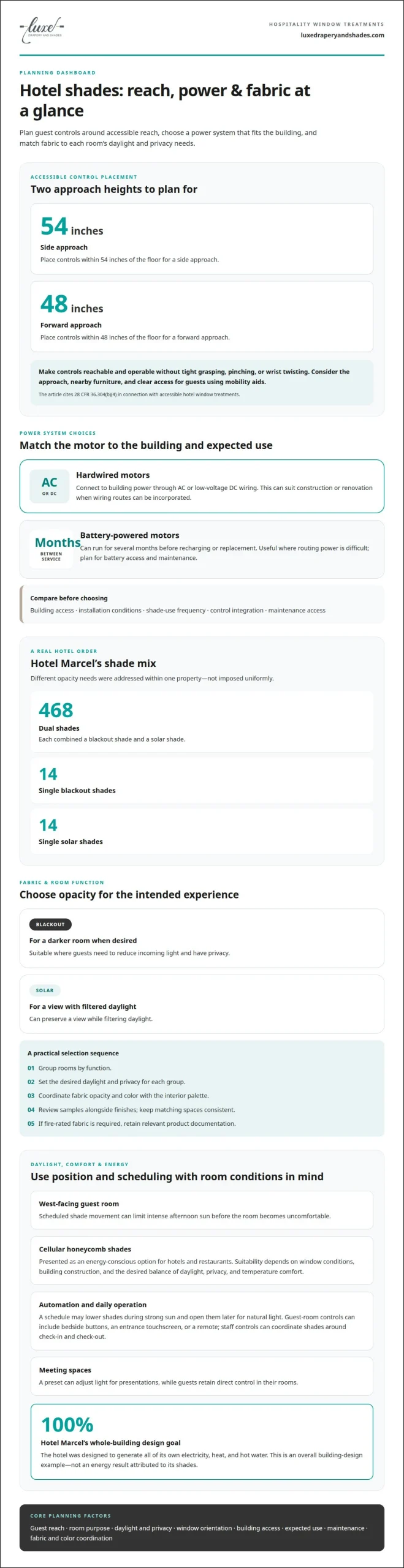
Accessible shade controls should be reachable and operable without tight grasping, pinching, or wrist twisting. Accessible controls should be easy to operate for guests with different mobility needs. Controls should sit within 54 inches of the floor for a side approach, or within 48 inches for a forward approach.
For guests using wheelchairs, crutches, or other mobility aids, 28 CFR 36.304(b)(4) is cited in connection with accessible hotel window treatments. During planning, consider the approach to each control, nearby furniture, and whether guests can operate the shade without obstruction.
Guest-Room Remotes and Preset Scenes
Guest-room controls might include bedside buttons, an entrance touchscreen, or a remote control. Place them where guests can use them naturally, and make operation intuitive for everyday needs, such as admitting daylight or lowering blackout shades for privacy.
Choose controls and motors suited to the expected frequency of use, and plan how the system will be maintained. Staff controls can help coordinate shades around check-in and check-out. In meeting areas, a preset can adjust light for presentations, while guests retain direct control in their rooms. Just as automated systems streamline in-house operations, hospitality teams coordinating corporate gatherings or guest travel often partner with services like Euro Taxis for reliable individual and group transfers.
Wired and Battery-Powered Systems
Choose wired or battery power by considering building access, installation conditions, and expected shade use. Hardwired motors connect to building power through AC or low-voltage DC wiring. This approach can suit construction or renovation projects where wiring routes can be incorporated.
Battery-powered motors can run for several months before recharging or replacement. They can suit locations where routing power is difficult, but maintenance planning should account for battery access. Compare both options against shade frequency, control integration, and the building’s construction before choosing a system.
Fabric, color, and opacity customization
Fabric selection shapes how a hotel room balances daylight, privacy, and blackout. Hotel Marcel’s order included 468 dual shades, each combining a blackout shade and a solar shade, plus 14 single blackout shades and 14 single solar shades. That example shows how different opacity needs can be addressed within one property rather than imposed uniformly.
For each room type, identify the desired level of light and privacy, then choose an opacity to suit. Blackout fabric suits rooms where guests need to reduce incoming light; solar fabric can preserve a view while filtering daylight. Color helps connect the treatment to the interior palette. A neutral roller shade can recede into a calm scheme, while a contrasting fabric can make the window a deliberate design feature.
Tailored selection also helps prevent common problems with hotel motorized shades. Fabric that does not suit a room’s light or privacy needs can disappoint guests, and inconsistent colors or opacity across nearby windows can disrupt a cohesive interior. Since shades may be used frequently, choose fabrics suited to their purpose and the room’s design.
For roller shades, compare fabric appearance and opacity, and consider how each option relates to the window and furnishings. Review samples alongside the room’s finishes, then use a consistent selection in matching spaces. If a project requires fire-rated fabric, include that requirement in the selection process and retain the relevant product documentation. Appearance alone does not establish whether a fabric meets a project specification.
In a hospitality project, a useful sequence is to group rooms by function, set the desired privacy and daylight effect for each group, then coordinate fabric and color choices. Explore custom roller shades as one way to bring tailored opacity and a refined finish to hotel windows.
Indoor temperature regulation and energy efficiency
Motorized shades let guests respond to changing sunlight with a button. Cellular honeycomb shades are an option that can help hotels and restaurants save energy.
Temperature Regulation with Shades
Shade position affects how much direct sunlight enters a room, which can influence comfort and cooling demand. In a west-facing guest room, for example, scheduled shade movement can limit intense afternoon sun before the room becomes uncomfortable.
When planning installation, consider window orientation, room use, and how guests will control daylight. Blackout shades can create a darker room when desired, while adjustable shades let guests balance daylight and privacy. Choose for each room’s purpose rather than applying one setting throughout the property.
Energy Performance and Sustainable Materials
Cellular honeycomb shades are presented as an energy-saving option for hotels and restaurants. Their place in a project depends on window conditions, the building’s construction, and the desired balance of daylight, privacy, and temperature comfort.
For sustainable material decisions, compare fabric composition, expected use, and available product information alongside appearance. A shade selected for a guest room may face different demands from one in a meeting space. Hotel Marcel offers a wider sustainability example: it was designed to generate 100 percent of its own electricity, heat, and hot water. That goal describes the hotel’s overall design, not an energy result attributed to its shades.
Automated Shade Energy Savings and Guest Comfort
Automation can coordinate shade movement with daylight patterns, rather than relying only on guests to adjust each window. A scheduled setting may lower shades during strong sun and open them later to welcome natural light. This can support energy management while helping maintain a comfortable room.
For practical operation, coordinate schedules with room use and let guests override presets. Button controls allow direct adjustment when a guest wants more light or privacy. Plan settings around comfort, cooling, and energy goals without assuming a fixed level of savings.
Custom hotel and restaurant window treatments
Hospitality spaces rarely ask every window to do the same job. A guest-room window may need blackout coverage, while a restaurant window may call for filtered daylight and a clear view. Group windows by room use, privacy needs, light conditions, and interior style, then match the treatment and operation to each group. For example, a manual treatment can suit an infrequently adjusted window, while motorized operation can help with hard-to-reach windows.
Architecture also shapes the choice. Skylights and tall windows call for attention to access, operation, and how the finished treatment relates to the room. In a dining space, motorized blackout curtains can support a darker atmosphere for evening service or presentations. In a bright lounge, a different fabric and opacity may preserve the view while softening incoming light. Choose a treatment that suits both the setting and its daily use.
Glare belongs in the design brief, too. The U.S. Environmental Protection Agency says window treatments should help reduce glare, especially in buildings without tinted or reflective glazing. Consider how daylight moves through each gathering area, then choose a treatment that fits its function. A remote control can make adjustments practical for broad or elevated windows, while coordinated operation can help maintain a consistent feel across adjoining spaces.
Before installation, review window dimensions, mounting surfaces, nearby furnishings, and access for operation. UL-listed motorized shade systems are another hotel window-treatment safety option. Bringing these details together helps the treatment complement the architecture rather than compete with it. To plan tailored window treatments for a hospitality space, discuss custom drapery and window design.
Luxe Drapery and Shades
Luxe Drapery and Shades helps hospitality teams align window treatments with a property’s design, privacy needs, and approach to light control. Custom Drapery, Roller Shades, Roman Shades, and Honeycomb / Cellular Shades offer different ways to shape the atmosphere of guest rooms and shared spaces.
Turn to the team when planning an installation or refining treatments across different room types. Consider fabric, opacity, appearance, and each window’s practical needs in context. This helps create a cohesive look without requiring every room to use the same treatment.
For a tailored conversation about window treatments for your hospitality space, contact Luxe Drapery and Shades.
Shape the Next Hospitality Project
Start the design conversation by defining how each space should feel and function. For motorized shades for hotels, a useful first step is to outline the guest experience at each window, then align the treatment with the property’s broader design vision.
Luxe Drapery and Shades can help hospitality teams consider tailored options such as Custom Drapery, Roller Shades, and Roman Shades in relation to their interiors. Thoughtful selection can bring visual continuity to guest rooms and shared spaces while supporting the distinct character of each setting.
Share your project goals and explore a window-treatment direction that feels right for your property. Contact Luxe Drapery and Shades to begin planning a more considered guest experience.
Frequently Asked Questions
How Do Hotels Ensure Maintenance and Durability?
Hotels support durability by selecting motors designed for repeated operation and making moving parts accessible for routine service. Guest-room shades may operate several times daily, so motor suitability matters alongside fabric and installation quality. High-quality smart blind motors are described as designed to operate for more than ten years under normal conditions. A maintenance plan can include checking movement, controls, and visible wear during scheduled room inspections.
What Installation Factors Should Hotels Consider?
Start with window width, fabric weight, mounting conditions, and motor access. These factors affect the required motor capacity and how the shade fits the opening. For example, recommendations specify 1-2 Nm for shades under 1.5 m wide with light fabric, 3-5 Nm for 1.5-2.5 m with medium fabric, and 6-10 Nm for wider than 2.5 m with heavy blackout fabric. Power routing also influences installation planning.
Why Do Hotels Use Smart Blind Motors?
Smart motorized shades make it easier to coordinate window treatments across guest rooms and shared spaces. They can support convenient control and scheduled operation, reducing the need to adjust every window manually. Since hotel shades may move several times daily, choose motors suited to frequent use. Tubular motors fit inside the roller tube, integrating the drive mechanism with the shade assembly.
What Types of Motorized Shades Are Best for Hotels?
The best type depends on the room’s purpose, desired light control, and design scheme. Roller shades suit a streamlined window treatment, while Roman shades bring a softer, folded profile. Cellular shades are another option, and can help hotels and restaurants save energy. For rooms needing both filtered daylight and stronger light blocking, dual shades combine solar and blackout layers in one window treatment.
How Do Motorized Shades Integrate With Hotel Room Control and Building Management Systems?
Start integration by matching shade controls to the room’s intended use. Guests may use a wall control, bedside buttons, or a touchscreen, while property staff may use scheduled controls for shared spaces. Plan the shade motor, control interface, and building platform as a compatible system. Define which controls guests will use and which functions staff will manage.
What Blackout and Privacy Requirements Should Hotel Shades Meet?
Set the desired level of darkness and privacy by room type instead of using the same fabric everywhere. A guest room may call for blackout coverage, while a restaurant may prioritize daylight and views. Consider how opacity works at different times of day and whether nearby windows need a consistent appearance. Layered shades can give guests more than one way to control light.