

Your patio should be the most beautiful room in your home. Yet for many Los Angeles homeowners, it sits underused for months, defeated by relentless UV exposure, awkward manual shading systems, and the nagging sense that a canvas umbrella simply doesn’t belong next to a luxury estate. If you’ve ever wondered how to transform that neglected outdoor space into something genuinely architectural, the answer isn’t another accessory. It’s a structure built with the same intention as your interior.
You already know that California living demands more from an outdoor space. The sun is extraordinary here, and so is the expectation for how a home should look and feel. That tension between climate and comfort is exactly what the finest motorized outdoor shades Los Angeles homeowners are choosing today have been designed to resolve, not just functionally, but beautifully.
This guide explores how motorized louvered pergolas, paired with smart home integration and precision-engineered shading systems, are redefining what a patio can be. From navigating coastal wind considerations in the South Bay to selecting structures that complement high-end architecture, you’ll find everything you need to make a confident, curated decision.
Key Takeaways
- A motorized louvered pergola is far more than a shade structure – it’s a precision-engineered, bioclimatic system that gives you architectural control over sunlight, airflow, and privacy at the touch of a button.
- The finest motorized outdoor shades Los Angeles homeowners are selecting today integrate seamlessly with smart home ecosystems like Lutron RadioRA 3, enabling intelligent weather-responsive automation that protects your investment year-round.
- Custom-designed systems outperform off-the-shelf pergola kits in both longevity and aesthetic coherence – especially when your home demands structures with gabled, pitched, or architecturally integrated roof geometry.
- Los Angeles microclimates require localized expertise: coastal properties need marine-grade finishes, while inland Valley homes benefit from strategic louver orientation designed to maximize airflow and manage intense heat.
- Working with a licensed and bonded California contractor ensures your pergola meets local building requirements and is designed, visualized, and installed with the same standard of craft as your interior.
What is a Motorized Pergola? Defining the Modern Louvered Roof
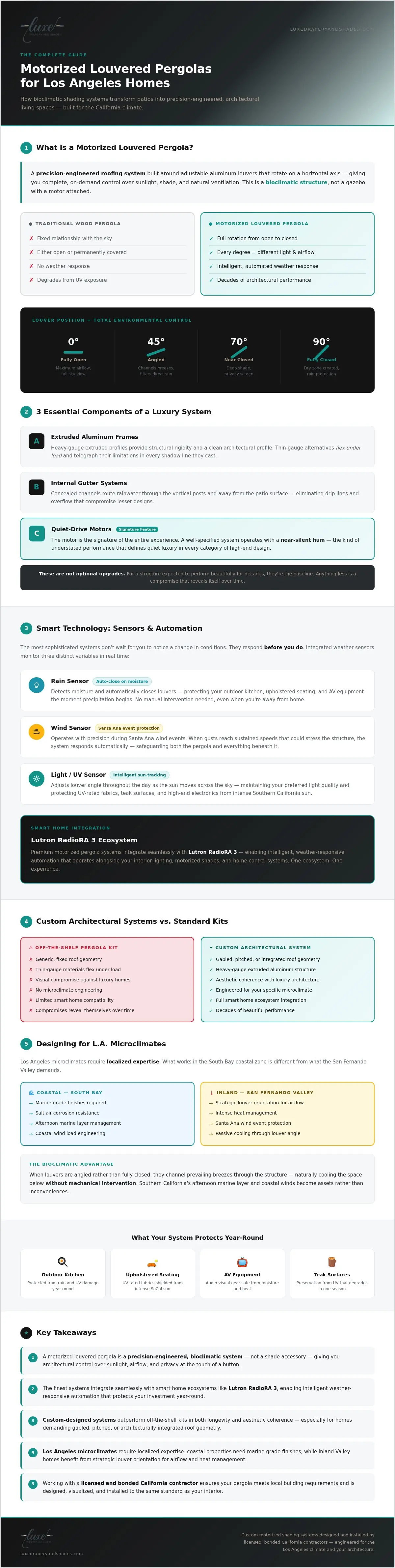
A motorized pergola is a precision-engineered roofing system built around adjustable aluminum louvers that rotate on a horizontal axis, giving you complete, on-demand control over sunlight, shade, and natural ventilation. This is not a gazebo with a motor attached. It’s a bioclimatic structure, designed from the ground up to respond intelligently to weather, light, and the way you actually live outdoors.
The shift from traditional wood pergolas to aluminum louvered systems represents something more significant than a material upgrade. Static wood structures offer a fixed relationship with the sky: either open to the elements or covered by a permanent roof. A motorized louvered pergola dissolves that binary. Louvers can be positioned anywhere from fully open to fully closed, and every degree of rotation in between creates a different quality of light, airflow, and protection. That range of control is what earns these systems the “bioclimatic” designation.
For Los Angeles homeowners, this distinction matters enormously. The finest motorized outdoor shades Los Angeles estates are incorporating today treat the patio ceiling as an active architectural element, not an afterthought.
The Bioclimatic Advantage
When louvers are angled rather than fully closed, they channel prevailing breezes through the structure in a way that naturally cools the space below without mechanical intervention. Southern California’s afternoon marine layer and coastal winds become assets rather than inconveniences. This passive cooling effect also extends to your investment in outdoor furnishings: UV-rated fabrics, teak surfaces, and high-end electronics are protected from the intense Southern California sun that degrades lesser materials within a single season. When rain arrives, fully closed louvers create a genuine dry zone, making an outdoor kitchen or entertainment setup viable year-round.
Essential Components of a Luxury System
The quality gap between a premium louvered pergola and a budget kit comes down to three components:
- Extruded aluminum frames: Heavy-gauge extruded profiles provide structural rigidity and a clean architectural profile. Thin-gauge alternatives flex under load and telegraph their limitations in every shadow line they cast.
- Internal gutter systems: Concealed channels route rainwater through the vertical posts and away from the patio surface, eliminating the drip lines and overflow that compromise lesser designs.
- Quiet-drive motors: The motor is the signature of the entire experience. A well-specified system operates with a near-silent hum, the kind of understated performance that defines quiet luxury in every category of high-end design.
These aren’t optional upgrades. For a structure that’s expected to perform beautifully for decades, they’re the baseline. Anything less is a compromise that reveals itself over time.
The Technology of Comfort: Louvers, Sensors, and Smart Integration
A motorized louvered pergola is only as intelligent as the technology driving it. The mechanical elegance of rotating aluminum louvers is the visible part of the system. What elevates a premium installation above a standard one is the invisible layer: sensors, automation logic, and seamless integration with the broader technology ecosystem of your home.
Automated Weather Response
The most sophisticated motorized outdoor shades Los Angeles homeowners are specifying today don’t wait for you to notice a change in conditions. They respond before you do. Integrated weather sensors monitor three distinct variables in real time:
- Rain sensors detect moisture and automatically close the louvers, protecting your outdoor kitchen, upholstered seating, and audio-visual equipment the moment precipitation begins. No manual intervention. No water damage from an unexpected afternoon shower while you’re away from home.
- Wind sensors operate with equal precision in the opposite direction. During Santa Ana wind events, when gusts can reach sustained speeds that create dangerous uplift on closed surfaces, the system automatically opens the louvers to reduce wind resistance and protect the structural integrity of the pergola.
- Sun-tracking logic adjusts louver angle incrementally as the sun moves across the sky, maintaining consistent shade in a specific zone of your patio without requiring you to recalibrate manually throughout the day. The result is a patio that genuinely adapts to Southern California’s intense solar arc.
Smart Home and Lutron Integration
Where most pergola systems stop at a proprietary app, a truly integrated installation goes further. Syncing your pergola louvers with your Lutron home automation system means your outdoor structure becomes a native participant in your home’s intelligence, not an isolated accessory controlled through a separate interface.
Lutron RadioRA 3 enables the creation of customized scenes that coordinate multiple systems simultaneously. An “Evening Entertaining” scene, for example, can angle the louvers for privacy, activate integrated LED lighting at a warm dimmed level, and trigger your outdoor heating elements, all from a single keypad press or voice command. That kind of choreographed response is what separates a smart home from a collection of smart devices.
Remote access completes the picture. Whether you’re traveling or simply want to prepare the patio before you arrive home, full control is available from anywhere in the world through your preferred interface, whether that’s a Lutron app, voice control via a compatible assistant, or a dedicated keypad scene.
Powder coating deserves a specific mention here. A high-performance polyester powder coat finish isn’t purely cosmetic. In coastal Los Angeles environments, where salt air accelerates corrosion on lesser finishes, a properly specified powder coat creates a durable barrier that preserves both the mechanical components and the architectural finish of the structure across decades of exposure.
If you’re considering how a pergola system might connect with the wider shading and lighting environment inside your home, it’s worth exploring what a fully integrated approach looks like in practice.
Custom Architectural Systems vs. Standard Pergola Kits
There’s a particular disappointment that comes from installing a pergola kit on a luxury estate and realizing, too late, that it looks exactly like what it is: a flat-pack product assembled in a weekend. The proportions feel arbitrary. The fasteners catch the light. The color is close to your home’s exterior trim, but not quite. For Los Angeles homeowners who have invested in architecture with intention, that gap between “close enough” and “exactly right” is the difference between a patio that elevates the property and one that quietly undermines it.
The Pitfalls of DIY Kits
Off-the-shelf pergola kits are engineered for broad compatibility, which means they’re optimized for no property in particular. The limitations reveal themselves quickly:
The Custom Design Process
A custom architectural pergola begins with your home’s existing geometry, not a manufacturer’s standard module. That distinction shapes every decision that follows. When specifying the finest outdoor shades for a Los Angeles property, continuity of finish matters: the pergola’s powder coat should read as a deliberate extension of your exterior palette, not a near-miss approximation.
Louver profile selection also deserves careful consideration. Curved louver profiles create a softer shadow pattern and suit transitional or Mediterranean architecture, while flat profiles deliver the crisp geometry that complements contemporary and mid-century modern homes. Neither choice is available from a standard kit in a configuration that accounts for your specific roof pitch or gabled integration.
Professional site planning and permitting complete the picture. Los Angeles building departments require permits for most attached pergola structures, and navigating those requirements correctly from the outset protects your investment and avoids costly revisions. Working with a licensed and bonded California contractor ensures the structure is engineered to code and that the permit process is managed as part of the project, not left as an afterthought. For homeowners selecting motorized outdoor shades in Los Angeles, that professional oversight is what separates a finished result that holds its value from one that creates complications at resale.
Designing for the Los Angeles Climate: Sun, Wind, and Privacy
Los Angeles isn’t one climate. It’s a collection of distinct microclimates compressed into a single county, and the difference between a patio in Malibu and one in Woodland Hills isn’t just geography. It’s humidity, salt content, wind behavior, and solar intensity, each requiring a different set of design decisions. Generic “all-weather” claims from manufacturers who’ve never specified a structure for the South Bay coast simply don’t account for this complexity. The finest motorized outdoor shades Los Angeles homeowners are choosing today are designed with these local variables built in from the first consultation.
Coastal Durability in the South Bay
Salt air is relentless. In communities like Manhattan Beach, Hermosa Beach, and Malibu, the marine environment doesn’t just affect how a structure looks over time. It attacks motorized components, fasteners, and finish systems at a molecular level. A powder coat that performs beautifully in Pasadena can begin failing within a couple of seasons when exposed to sustained coastal salinity.
The material specification for coastal installations requires a different standard entirely:
- Marine-grade aluminum alloys resist oxidation in ways that standard extruded profiles don’t. The alloy composition matters as much as the coating applied over it.
- Sealed motor housings protect the drive mechanisms that open and close louvers from moisture infiltration. An unsealed motor in a coastal environment is a maintenance liability waiting to express itself.
- Stainless steel or marine-grade fasteners throughout the structure prevent the rust bleed that compromises both the finish and the structural integrity of lesser assemblies.
- Wind load engineering for Pacific-facing properties must account for sustained ocean winds and occasional gusts that exceed what inland engineering assumptions anticipate. A properly specified coastal pergola is engineered to those site-specific loads, not to a generic regional average.
Aluminum’s superiority over wood or vinyl in this environment isn’t debatable. Wood absorbs moisture, expands, and requires constant maintenance to resist rot and warping. Vinyl becomes brittle under UV exposure and lacks the structural rigidity to handle wind loads at meaningful spans. Marine-grade aluminum, properly finished and fastened, simply outlasts both without demanding the same ongoing attention.
The Total Shading Ecosystem
A louvered pergola roof manages overhead sun beautifully. But Southern California’s low-angle afternoon sun, particularly during summer months when the sun tracks to the northwest before setting, enters from the sides of a structure rather than above it. That’s where a complete shading ecosystem becomes essential.
Combining a pergola with zip screens addresses this directly. Zip screens are motorized shade panels with tensioned side channels that lock the fabric edge into a track, eliminating the billowing and lifting that standard roller screens suffer in coastal winds. Deployed on the western exposure of a patio, a zip screen blocks that late-afternoon glare that makes outdoor entertaining uncomfortable between four and seven in the evening. Retracted in the morning, the same opening frames an unobstructed view.
Privacy is an equally important consideration for Westside homeowners. In densely built neighborhoods from Brentwood to Silver Lake, sightlines from neighboring properties and elevated structures are a genuine concern. Motorized side shading creates an enclosed sanctuary without requiring permanent walls. The patio becomes open or private on demand, a distinction that matters differently depending on whether you’re hosting a dinner or simply reading on a Sunday afternoon.
Lighting completes the picture. Integrated LED channels recessed into pergola beams provide warm, dimmable illumination that extends the usable hours of an outdoor space well past golden hour. When connected to a Lutron system, that lighting responds to the same scene logic as your louvers and screens, creating a cohesive outdoor environment that transitions from afternoon shade to evening ambiance without a single manual adjustment.
Designing a patio that performs across all of these variables requires localized expertise, not a catalog selection. Explore custom outdoor shading solutions designed specifically for Los Angeles homes and discover what a climate-specific approach looks like in practice.
The Luxe Experience: From Custom Design to Professional Installation
There’s a particular kind of confidence that comes from working with people who’ve done this before, specifically for homes like yours, in neighborhoods like yours, under the same building department that governs your property. That’s the distinction between a transactional purchase and a genuinely curated experience. For homeowners selecting motorized outdoor shades in Los Angeles, the contractor you choose shapes every outcome that follows.
Why Professional Installation Matters
Luxe Drapery and Shades operates as a licensed and bonded California contractor (CSLB #1066068), and that credential carries real weight at every stage of an outdoor shading project. The Los Angeles Department of Building and Safety requires permits for most attached pergola structures, and the submission process involves structural calculations, site plans, and compliance documentation that a kit installation simply can’t produce. Managing that process correctly from the outset protects your investment and prevents costly revisions before or after construction.
Precision fit is equally non-negotiable. Integrating a pergola with an existing roofline, matching gutter connections, and routing electrical conduit for integrated LED lighting and Lutron sensors requires the kind of hands-on coordination that only comes from handling structural, electrical, and automation work in-house. Expert calibration of Lutron RadioRA 3 scenes, weather sensor thresholds, and louver positioning logic isn’t something you hand off to a general contractor after the fact. It’s built into the installation itself.
Concierge Design: Seeing It Before It’s Built
The design process begins long before a single post is set. A concierge consultation translates your site conditions, architectural style, and lifestyle priorities into a visualized concept, so you can evaluate proportions, finish colors, and louver profiles against your home’s actual geometry. That visualization step eliminates the uncertainty that leads to regret. What you approve is what gets built.
Transforming Your Lifestyle
A motorized louvered pergola doesn’t add outdoor furniture. It adds a room. Covered, climate-responsive, and fully integrated with your home’s technology, that space extends your usable square footage in a way that resonates with buyers and appraisers alike. The return isn’t just experiential; it’s reflected in how the property presents.
Every detail in a custom installation is calibrated to your life: the louver profile that suits your architecture, the powder coat that reads as a natural extension of your exterior palette, the Lutron scene that transitions your patio from afternoon shade to evening ambiance without a single manual adjustment. That level of intention is what separates a luxury outcome from a capable one.
Your patio has been waiting for this. Schedule your custom outdoor design consultation today and discover what a fully integrated, professionally installed shading system looks like when it’s designed specifically for your home.
Your Patio Deserves the Same Intention as Your Interior
The case for a motorized louvered pergola comes down to something simple: your outdoor space should work as hard and look as considered as every room inside your home. The finest motorized outdoor shades Los Angeles homeowners are choosing today aren’t accessories bolted onto a patio. They’re precision-engineered, climate-responsive structures that extend your living environment with genuine architectural intention.
What separates a truly elevated result from a capable one is the team behind it. Luxe Drapery and Shades brings Lutron Platinum Dealer certification, licensed and bonded contractor credentials (CSLB #1066068), and deep familiarity with Los Angeles’s demanding microclimates to every custom installation. That combination of technical expertise and localized knowledge is what ensures your pergola performs beautifully for decades, not just seasons.
The patio you’ve been imagining is closer than you think. Schedule your custom outdoor design consultation with Luxe Drapery and Shades and take the first step toward a space that’s genuinely worth living in.
Frequently Asked Questions About Motorized Outdoor Shades in Los Angeles
Do I need a permit for a motorized pergola in Los Angeles?
Yes, in most cases you do. The Los Angeles Department of Building and Safety requires permits for attached pergola structures, and the submission process involves structural calculations, site plans, and compliance documentation. The specific requirements vary depending on whether your pergola is freestanding or attached to your home’s roofline, your property’s zoning designation, and the structure’s footprint. Always confirm current requirements directly with LADBS before beginning any project.
Working with a licensed and bonded California contractor, like Luxe Drapery and Shades (CSLB #1066068), means permit management is handled as an integrated part of the project rather than an afterthought. That professional oversight protects your investment and prevents costly revisions that can arise when permits are pursued incorrectly or after construction has already begun.
How much wind can a motorized louvered pergola withstand?
A properly engineered pergola is designed to handle the specific wind loads of its installation site, not a generic regional average. For most Southern California properties, this includes accounting for Santa Ana wind events, which can produce sustained gusts that create significant uplift pressure on closed louver surfaces. Quality systems include integrated wind sensors that automatically open the louvers during high-wind conditions, reducing surface resistance and protecting the structure before damage occurs.
Coastal properties in the South Bay face a different challenge: sustained ocean winds rather than episodic gusts. These installations require site-specific structural engineering, marine-grade fasteners, and sealed motor housings. If a manufacturer quotes a single wind rating without asking about your specific location, that’s a signal the system hasn’t been designed with Los Angeles microclimates in mind.
Can motorized pergolas be attached to my existing house roof?
Yes, and an attached configuration is often the most architecturally coherent choice for luxury estates. The pergola integrates directly with your home’s roofline, creating a seamless transition between interior and exterior space. This approach requires precise structural coordination: the attachment point must be engineered to transfer loads correctly into your existing framing, and flashing details must be handled carefully to prevent moisture infiltration at the junction.
Custom-designed systems handle this connection with concealed hardware and matching finish profiles, so the pergola reads as a natural extension of your home rather than a structure bolted onto it. This level of integration isn’t achievable with a standard kit, which is why professional site planning and structural engineering are essential from the earliest stage of the project.
What is the difference between a louvered pergola and a traditional awning?
An awning is a fixed or retractable fabric canopy that provides shade in one position: deployed or retracted. A louvered pergola is an adjustable aluminum roof system that gives you precise, incremental control over sunlight, airflow, and weather protection at any angle between fully open and fully closed. That range of control is what earns louvered systems the “bioclimatic” designation, because they actively respond to conditions rather than simply blocking or unblocking them.
The structural distinction matters too. Awnings are fabric-based and typically mounted to a wall, while a louvered pergola is a freestanding or attached architectural structure with its own posts, beams, and integrated drainage. For homeowners selecting motorized outdoor shades in Los Angeles, the pergola functions as a permanent room addition; an awning functions as a shade accessory. They serve different purposes and belong at different points in a shading ecosystem.
How do I maintain the motor and louvers in a coastal environment?
Coastal maintenance centers on three priorities: keeping salt deposits off mechanical components, ensuring drainage channels remain clear, and inspecting sealed motor housings periodically for any signs of moisture infiltration. A light rinse of the aluminum frame and louver surfaces with fresh water every few weeks prevents salt crystallization, which accelerates corrosion on inadequately specified finishes. This is a simple routine that preserves both the appearance and the mechanical performance of the system.
The best defense against coastal degradation is specification, not maintenance. Marine-grade aluminum alloys, high-performance powder coat finishes, stainless steel fasteners, and sealed motor housings are the material baseline for any installation within proximity of the ocean. A system specified correctly from the outset requires far less intervention than one that relies on maintenance to compensate for inadequate materials.
Can I control my pergola with my smartphone or Lutron system?
Yes, and the quality of that integration depends entirely on how the system is specified and installed. A basic motorized pergola typically ships with a proprietary app that operates the louvers in isolation. A properly integrated installation connects your pergola to your Lutron RadioRA 3 system, making it a native participant in your home’s broader automation logic rather than a separate device requiring its own interface.
That integration enables scene-based control: a single keypad press or voice command can simultaneously angle the louvers, activate integrated LED lighting, and trigger outdoor heating elements. Remote access via the Lutron app means you can prepare the patio before arriving home or close the louvers during an unexpected rain event while you’re traveling. That level of choreographed response is the practical difference between a smart home and a collection of individually controlled devices.
How long does the professional installation process typically take?
The timeline varies based on structure size, site complexity, and whether permits are required. For most custom pergola installations in Los Angeles, the design and permitting phase takes several weeks, as structural documentation and LADBS review add time that can’t be compressed without risking compliance issues. Once permits are approved, physical installation for a standard attached pergola generally takes a few days for the structure itself, with additional time for electrical integration and Lutron system calibration.
Rushing any stage of this process creates problems that surface later. Permit revisions, structural rework, and automation calibration done as an afterthought are all avoidable with a properly sequenced project. The concierge design process, which includes visualization before a single post is set, is specifically designed to eliminate surprises and ensure that what gets approved is exactly what gets built.
Are motorized pergolas completely waterproof when closed?
A well-engineered louvered pergola with a concealed internal gutter system provides genuine weather protection when the louvers are fully closed. Rainwater is captured at the louver surface and routed through channels inside the vertical posts, directing water away from the patio below. In practice, this creates a dry zone that makes an outdoor kitchen or entertainment setup viable during light to moderate rainfall without requiring you to move anything inside.
The distinction worth understanding is that “waterproof” describes a sealed membrane roof, while a louvered pergola is a precision drainage system. Under very heavy rainfall or driving rain at acute angles, some water intrusion at the louver seams is possible depending on the system’s specification. For Los Angeles conditions, where rainfall is seasonal and rarely extreme, a properly specified pergola with integrated gutters performs reliably as a weather-protective structure across the full range of typical Southern California precipitation events.