

In the most sophisticated Los Angeles estates, the most impactful design element is often the one you never see. You’ve likely spent months perfecting a minimalist interior only to find that bulky, dated hardware disrupts the clean lines of your floor-to-ceiling windows. Modern drapery track systems solve this aesthetic conflict by replacing traditional rods with architectural channels that glide with near-silent precision. It’s a refined shift that honors the architecture of your home rather than cluttering it with unnecessary visual noise.
Discover how these advanced systems provide the seamless, minimalist aesthetic and sophisticated automation required for high-end interiors. We’ll examine the transition from visible hardware to invisible recessed tracks and the quiet power of integrated motorization. This guide provides the technical expertise needed to achieve a flawless hotel-style look, covering everything from ripplefold fullness ratios to the latest smart home integrations that make operating heavy, custom drapes entirely effortless. By the end, you’ll understand why the finest window treatments are those that function with quiet, automated confidence.
Key Takeaways
- Understand the transition from traditional rods to modern drapery track systems that utilize internal carriers for a silent, streamlined aesthetic.
- Learn how to select the ideal mounting configuration, whether recessed, ceiling, or wall-mount, to complement your home’s unique architectural lines.
- Explore the lifestyle benefits of motorized hardware, offering effortless operation for expansive glass walls and seamless integration with smart home systems.
- Discover the critical importance of matching track load capacity to custom fabric weights to ensure long-term performance and durability.
- Recognize why professional, white-glove installation is essential for achieving a perfectly level, architectural finish in complex residential spaces.
What Are Modern Drapery Track Systems? Redefining Window Aesthetics
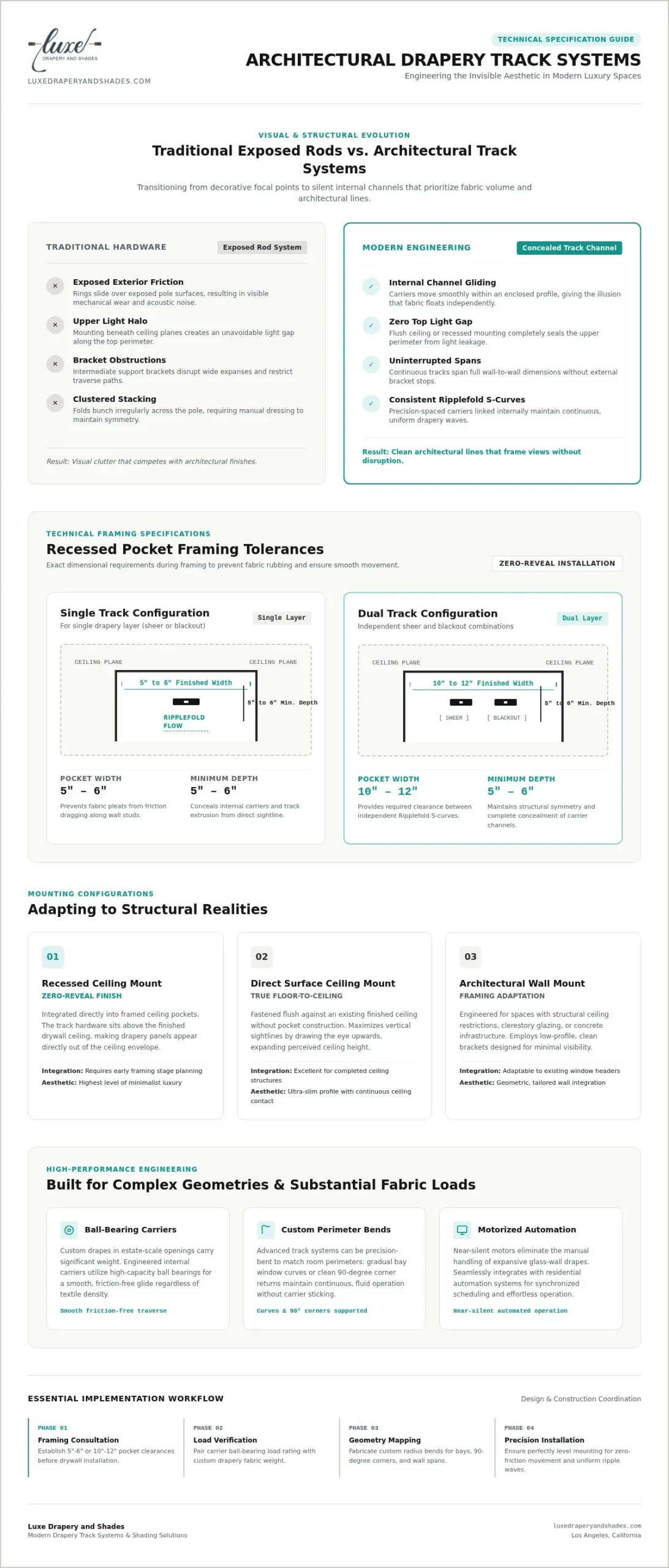
Modern drapery track systems represent a fundamental departure from the decorative curtain rods of the past. While traditional hardware often serves as a focal point, these sophisticated systems are designed as architectural elements that prioritize clean lines and effortless movement. Unlike a standard pole where rings slide over an exposed surface, a track system utilizes an internal channel. Precision-engineered carriers glide within this channel, hidden from view, creating a visual experience where the fabric appears to float against the wall or ceiling.
The design philosophy has shifted toward a minimalist, “invisible” aesthetic. We no longer rely on ornate finials or bulky brackets to make a statement. Instead, the focus remains on the texture and volume of the fabric itself. The history of traverse rod and curtain track systems shows a steady evolution from basic utility to the high-performance hardware found in contemporary estates. Today, these tracks allow for a seamless integration into the home’s structure, often being recessed directly into the ceiling to eliminate any visible hardware entirely.
The Aesthetic Advantage of Track Systems
One of the most significant benefits of modern drapery track systems is their ability to create the iconic “hotel-style” look. This is achieved through the Ripplefold drapery style, which requires a track to maintain perfectly spaced, S-curve folds. Because the carriers are spaced consistently along a cord inside the track, the drapes never look bunched or uneven. This system offers several visual improvements over traditional rods:
- True floor-to-ceiling coverage: Tracks can be mounted directly to the ceiling, drawing the eye upward and making rooms feel more expansive.
- Wall-to-wall spans: Continuous tracks allow for massive spans of fabric without the interruption of support brackets.
- Elimination of light gaps: By mounting the track flush against the ceiling, you remove the halo of light that typically escapes over the top of a traditional rod.
Functional Benefits for Large Openings
In Los Angeles, where expansive glass walls and sliding pocket doors are architectural staples, the functionality of the hardware is just as vital as its appearance. Standard rods often struggle under the weight of the heavy, high-quality fabrics used for custom drapes in Los Angeles. Modern tracks are engineered with high-weight capacity carriers that use ball-bearing technology to ensure a smooth, friction-free traverse even with substantial fabric loads.
These systems are also uniquely capable of handling complex window geometries. Whether your space features a gentle bay window curve or a sharp 90-degree corner, modern drapery track systems can be custom-bent to follow the exact perimeter of the room. This versatility ensures that even the most challenging architectural layouts enjoy the same fluid operation and sophisticated finish as a standard window opening.
Architectural Configurations: Recessed, Ceiling, and Wall-Mount Tracks
The placement of modern drapery track systems determines whether your window treatments look like a decorative afterthought or a deliberate architectural feature. Choosing the right configuration isn’t only about support; it’s about how the hardware integrates with the building’s envelope to manage light and privacy. In high-end design, the goal is often to minimize the visual footprint of the hardware so the focus remains on the fabric and the view beyond the glass.
Recessed Tracks: The Ultimate Minimalist Solution
For custom estates in Bel Air or the Hollywood Hills, recessed tracks are the gold standard for a “zero-reveal” aesthetic. These systems are installed directly into a pre-constructed ceiling pocket, allowing the drapes to emerge from the architecture itself. This configuration requires early coordination with your design team. For a single Ripplefold track, a finished pocket width of 5 to 6 inches and a minimum depth of 5 to 6 inches is required to prevent fabric rubbing. If you’re planning for a dual-track setup-combining a blackout drape with a sheer-the finished pocket width should expand to 10 or 12 inches. It’s often helpful to consult with Luxe Drapery and Shades during the framing stage to ensure these technical tolerances are perfectly met.
Surface-Mounted Ceiling and Wall Tracks
When a recessed pocket isn’t feasible, surface-mounted ceiling tracks offer a sophisticated alternative. By mounting the track flush against the ceiling, you create an uninterrupted line that draws the eye upward, significantly increasing the perceived height of a room. For homes featuring intricate crown molding or historic details, wall-mounted modern drapery track systems provide a solution that respects the existing woodwork. Many professional-grade systems now include slim-profile track covers. These machined aluminum components snap over the mounting brackets, concealing the mechanical parts and creating a clean, unibody appearance that blends into the surrounding finish.
Technical planning must also account for “stack back,” which is the physical space drapes occupy when fully open. For the expansive glass walls common in Westside LA, tracks should ideally extend 25% to 35% past the window opening. This ensures the gathered fabric doesn’t obstruct the glass, preserving the indoor-outdoor flow. This level of detail is essential for the effective use of interior sun control and shading devices, allowing you to maximize natural light without sacrificing the clean, architectural lines of your home.
Automation and Control: The Luxury of Motorized Drapery Hardware
The evolution of window treatments has moved far beyond the traditional pull-cord. In high-end Los Angeles interiors, modern drapery track systems are now synonymous with motorized convenience. This shift isn’t just about gadgetry; it’s about the seamless management of a home’s atmosphere. Motorization eliminates the physical struggle of operating heavy, floor-to-ceiling drapes and provides an added layer of security by simulating occupancy when you are away. It transforms a functional necessity into a choreographed design experience.
A primary concern for many homeowners is the reliability of these systems during a power outage or a simple loss of internet connectivity. Professional-grade hardware addresses this with intuitive manual override features. Technologies like Lutron’s “Pull-to-Start” allow you to simply tug the leading edge of the fabric to trigger the motor or move the drapes manually without damaging the internal drive mechanism. This ensures that even in a high-tech environment, the tactile experience remains reliable and effortless.
Lutron Sivoia: The Gold Standard for Drapery Tracks
For many designers, Lutron Sivoia is the benchmark for performance. These motors are engineered for near-imperceptibility, often operating below 44 dBA, which is quieter than a typical household refrigerator. This makes them ideal for primary bedrooms where silence is a priority. These systems deliver precision movement, allowing multiple panels across a wide span to start, move, and stop in perfect alignment. If your home already utilizes Lutron Sivoia systems, adding motorized hardware creates a unified aesthetic across all window openings. The 2026 launch of the Palladiom Drapery System further elevated this category, offering a machined unibody aluminum track that can handle fabric loads up to 125 lbs while concealing all drive components.
Smart Home Ecosystem Integration
Modern luxury requires a cohesive ecosystem where every element speaks the same language. Integrating your tracks with Lutron home automation allows for sophisticated scene setting via voice control platforms like Josh.ai or Alexa. You can program “Morning” scenes that gently open sheers at sunrise or “Theater” scenes that close blackout drapes as the media room lights dim. Advanced solar tracking takes this a step further; the system automatically adjusts your drapes based on the sun’s real-time position. This proactive approach protects your fine art and custom flooring from the intense Southern California sun while maintaining optimal thermal comfort throughout the day. It’s a level of environmental control that modern drapery track systems provide with quiet, automated confidence.
Selecting the Right Track System for Your Custom Drapery
Selecting the ideal hardware requires a deep understanding of the relationship between fabric weight and mechanical capacity. While mass-market solutions often suggest a one-size-fits-all approach, high-performance modern drapery track systems are engineered for specific load requirements. A precision-milled track like the Lutron Palladiom can support up to 125 lbs, whereas a tandem Somfy Glydea Ultra configuration can handle up to 220 lbs. This capacity is vital when choosing custom drapes in Los Angeles, where heavy interlined velvets or expansive linen panels are frequently used to cover massive glass spans.
The hardware must also align with your chosen pleat style. Ripplefold remains the standard for a contemporary aesthetic, but the track must be configured for specific fullness ratios, such as 80%, 100%, or 120%. These ratios dictate the depth of the fold and the total stack back. If you prefer a more structured look, ensure your track is compatible with Pinch Pleat or Tailored Pleat carriers. Finishes have also evolved; you aren’t limited to basic white. Architectural finishes like Satin Nickel, Bronze Anodized, and Black Anodized allow the track to either stand out as a machined accent or disappear into the ceiling’s shadow line.
Fabric Considerations and Stack Back
Heavy-duty ball-bearing carriers are non-negotiable for large-scale installations. Without them, the friction of heavy fabric will eventually strain the motor and lead to jerky movement. Stack back planning is equally critical. For a wall-to-wall installation, the track length must account for the compressed fabric when open so your view remains entirely unobstructed. A double track system is the ultimate luxury for bedrooms. It allows a motorized sheer to manage glare during the day while a blackout drape provides total privacy at night, with each layer operating independently on its own dedicated channel.
Hardware Durability and Maintenance
Durability starts with materials. Extruded aluminum tracks offer superior structural integrity compared to plastic alternatives, which can warp or become brittle over time. High-end modern drapery track systems utilize siliconized, lubrication-free carriers to maintain a silent glide for years without the need for messy maintenance. To keep your motorized tracks running at their peak, a simple periodic dusting of the internal channel is usually all that’s required. If you’re ready to elevate your home’s functionality with precision-engineered hardware, request a consultation with our experts to explore a tailored solution for your space.
Professional Installation: Elevating Modern Tracks in Los Angeles
Achieving a flawless architectural finish requires more than just high-quality hardware. It demands a level of technical precision that only professional installation can provide. While a standard rod might be a weekend project, modern drapery track systems are precision-engineered instruments. In the expansive estates of the Westside, where glass walls can span thirty feet or more, even a minor misalignment is magnified. Professional installers utilize laser-leveling technology to ensure that the track remains perfectly horizontal, preventing any drag or uneven hanging that would compromise the minimalist aesthetic.
The Challenges of Modern LA Architecture
The structural complexity of contemporary Los Angeles homes often dictates the installation strategy. Many projects involve mounting tracks into recessed ceiling pockets or directly onto concrete slabs. These environments leave no room for error. We frequently coordinate with architects and home automation experts during the framing stage to ensure that the pocket dimensions are exact. This collaboration prevents common issues like fabric rubbing against the pocket walls or interference with recessed lighting. By managing these architectural nuances, we ensure the hardware functions as a seamless extension of the home’s design.
The Value of a Licensed Contractor
Choosing a licensed California contractor (CSLB #1066068) is essential for projects involving motorized hardware. Expert wiring is the difference between a cluttered ceiling and a clean, “zero-reveal” look. Our team ensures that all power sources are hidden and that the system integrates perfectly with your existing smart home controls. The final phase of our white-glove service involves “dressing” the drapes. We meticulously steam each panel and set the pleats to establish “drapery memory.” This ensures that when the motor glides the fabric open, it stacks into a neat, symmetrical column every single time. This attention to detail is what transforms a functional window covering into an essential element of a beautiful living space.
Elevating Your Architectural Vision with Precision Hardware
The journey toward a perfectly curated home ends where the details begin. By choosing modern drapery track systems, you transition from traditional window coverings to a sophisticated architectural statement. These systems define the “quiet luxury” of contemporary Los Angeles estates, offering a seamless blend of invisible hardware and silent, motorized performance. Whether you are integrating recessed channels into a new build or automating expansive glass walls, the technical precision of the hardware dictates the ultimate success of the design.
Achieving this level of refinement requires an expert partner who understands the nuances of high-end residential automation. As a Lutron Certified Platinum Dealer and a Licensed California Contractor (#1066068), Luxe Drapery and Shades specializes in the white-glove installation necessary for complex architectural tracks. We invite you to Request a Professional Design Consultation for Your Los Angeles Home to see how precision-engineered hardware can transform your living space. Your home deserves the effortless elegance that only a masterfully installed track system can provide.
Frequently Asked Questions
What is the difference between a drapery rod and a drapery track?
A drapery rod uses rings that slide over an exposed pole, while a track utilizes internal carriers that glide within a concealed channel. This design allows for a much cleaner, minimalist appearance that suits modern Los Angeles architecture. Because the carriers are inside the track, you don’t have the friction or noise associated with metal rings on metal rods. This makes tracks the superior choice for wall-to-wall and floor-to-ceiling installations.
Can I motorize an existing drapery track system?
Motorizing an existing manual track is rarely a straightforward process. Most high-performance automation requires a track specifically engineered with an internal drive belt and a motor-ready housing. If your existing track isn’t designed for this, it’s usually more efficient to replace it with a dedicated motorized system. This ensures the motor operates at its peak acoustic profile and provides the precision movement expected in luxury residential environments.
What is Ripplefold drapery and why does it require a track?
Ripplefold is a contemporary drapery style characterized by consistent, S-curve folds that look identical from both sides. It requires modern drapery track systems because the fabric snaps directly onto carriers that are held at precise intervals by an internal cord. This hardware ensures the folds never lose their shape or spacing. It’s the standard for achieving the “hotel-style” aesthetic found in many Westside Los Angeles estates.
Are motorized drapery tracks loud?
High-quality motorized tracks are engineered to be near-silent. Systems like the Lutron Sivoia operate at levels below 44 dBA, which is quieter than a typical household refrigerator. Some advanced motors even feature silent modes that reduce the speed to further dampen any mechanical sound. This whisper-quiet operation is essential for primary bedrooms and media rooms where maintaining a tranquil environment is a priority for the homeowner.
Can modern track systems handle heavy blackout drapes?
Yes, professional-grade modern drapery track systems are specifically built to support the weight of heavy, custom-lined blackout fabrics. While standard rods might sag or struggle, these tracks use high-weight capacity ball-bearing carriers. A single Lutron Palladiom track can manage loads up to 125 lbs, while tandem configurations can handle even more. This structural integrity ensures smooth, effortless movement even when dealing with expansive spans of thick, luxurious velvet.
Do I need to wire my home for motorized drapery tracks during construction?
Pre-wiring during the construction or remodeling phase is the best way to achieve a completely hidden power source. We recommend running low-voltage wiring to the window headers before the drywall is installed. This eliminates the need for visible outlets or battery packs. If your home is already finished, don’t worry. There are sophisticated wireless and battery-powered options that provide the same luxury experience without the need for major electrical work.
What is the best track system for curved or bay windows?
Custom-bent aluminum tracks are the only reliable solution for curved or bay windows. These tracks are precision-milled to follow the exact radius of your window, allowing the carriers to glide through the curves without catching or stuttering. This creates a continuous, fluid movement that a series of straight rods simply can’t replicate. It’s an essential detail for the unique architectural silhouettes found in many Hollywood Hills and Malibu coastal homes.
How do I hide the hardware of a modern drapery track?
The most effective way to hide hardware is by installing the track into a recessed ceiling pocket. This “zero-reveal” approach makes it look like the drapes are emerging directly from the ceiling. For homes where recessing isn’t possible, we use slim-profile track covers or decorative fascias that snap over the mounting hardware. These components are often color-matched to the ceiling or wall, ensuring the mechanical parts remain entirely invisible to the eye.