

You might assume that the most advanced smart home system is simply the one with the most features, but for a sprawling Westside estate, the right choice is often about how the technology disappears into your architecture. Choosing between Lutron RadioRA 3 vs Homeworks often feels like a high-stakes decision where technical jargon obscures the aesthetic vision you’ve carefully built for your home. You want a system that feels effortless, not one that requires a manual to operate or clutters your walls with mismatched hardware.
We understand the hesitation that comes with selecting a platform for a luxury property. You need to ensure your system is powerful enough to handle a large estate without compromising on the interior design elements that make your space unique. This guide provides a definitive comparison of these two premier platforms to help you achieve a seamless balance of light, shade, and sophisticated design. We will explore how factors like property scale, your desire for Ketra’s full-spectrum natural light, and the elegance of Palladiom keypads dictate which system will best preserve the luxury and value of your Los Angeles residence.
Key Takeaways
- Learn how to distinguish between wireless efficiency for high-end renovations and the robust, wired architecture required for large-scale architectural integration.
- Compare the aesthetic impact of Lutron RadioRA 3 vs Homeworks by evaluating the premium finishes of Sunnata, Palladiom, and Alisse keypad lines.
- Discover why HomeWorks remains the essential choice for homeowners seeking the transformative power of full-spectrum Ketra lighting and circadian wellness.
- Understand the technical requirements for coordinating custom motorized shades, including the performance differences between wireless and wired Sivoia QS systems.
- Gain a clear decision framework to select the right automation platform based on your project scope, whether it is a sophisticated South Bay retrofit or a Westside new build.
Understanding the Lutron Ecosystem: RadioRA 3 vs. HomeWorks
Lutron understands that a coastal villa in the South Bay has vastly different requirements than a sprawling new build in Bel Air. Their ecosystem is designed as a tiered progression, allowing homeowners to select a level of control that mirrors their home’s architectural complexity. RadioRA 3 represents the pinnacle of wireless “prosumer” technology. It offers a sophisticated, high-performance solution that brings modern convenience to a space without requiring a complete structural overhaul. HomeWorks, however, remains the architectural gold standard. It is a bespoke platform designed for the most demanding environments where lighting is treated as a foundational element of the home’s design. When evaluating Lutron RadioRA 3 vs Homeworks, the choice often hinges on whether you view smart technology as a functional upgrade or an integral part of your property’s DNA.
The Core Difference: Wireless vs. Wired Architecture
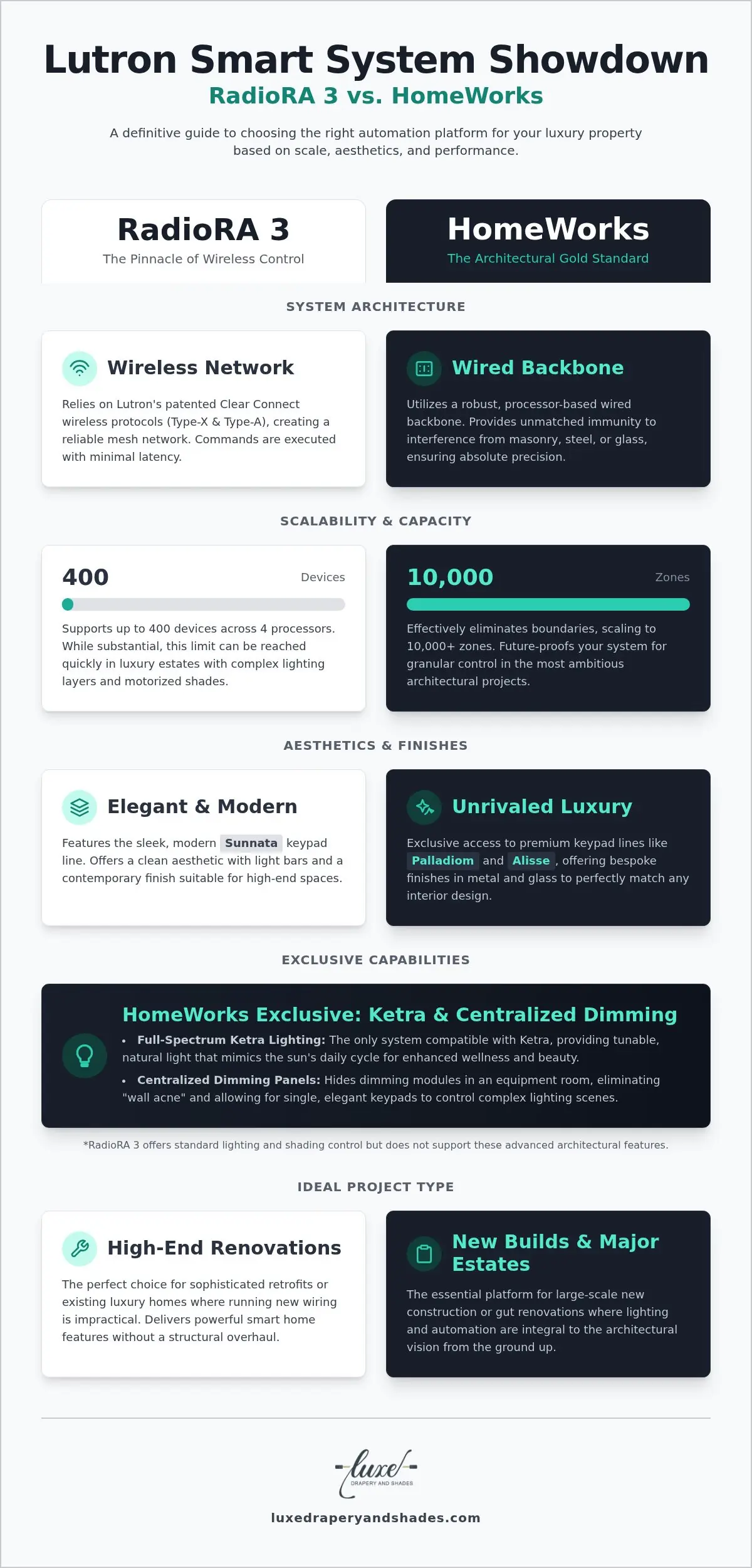
RadioRA 3 relies on Lutron’s patented Clear Connect Type X and Type A wireless protocols. This technology is remarkably reliable, creating a mesh network that ensures commands are executed with minimal latency. It is an ideal choice for historic Los Angeles renovations where running new wires through lath and plaster is not feasible. HomeWorks takes a different approach by utilizing a wired, processor-based backbone. In estates featuring heavy masonry, steel framing, or extensive glass, a wired system provides a level of immunity to interference that wireless protocols simply cannot match. This physical connection ensures that every keypad press and automated scene happens with absolute, instantaneous precision, regardless of the home’s construction materials.
System Scalability: From South Bay Villas to Westside Manors
The scale of your project is perhaps the most practical deciding factor. A RadioRA 3 system can support up to 400 devices across four processors. While this sounds substantial, luxury estates often feature complex lighting layers, including accent lights, landscape paths, and integrated motorized shades, which can exhaust a 400-device limit surprisingly quickly. HomeWorks QSX effectively eliminates these boundaries. It is capable of scaling to support up to 10,000 zones. This massive capacity allows for the granular control required in large Westside manors, where every architectural detail deserves its own dedicated lighting scene. Choosing HomeWorks is a commitment to future-proofing; it ensures your system can grow alongside your design ambitions without hitting technical bottlenecks.
Performance and Reliability: Why System Architecture Matters
In a high-end smart home environment, performance is measured by the absence of friction. When you enter a room in a 10,000 square foot Malibu estate, the lighting should respond to your presence or a keypad press with absolute immediacy. A half-second lag might seem trivial in a standard home, but in the context of curated luxury, it feels like a technical failure. The “heart” of your system dictates this responsiveness. While the RadioRA 3 processor is a marvel of wireless engineering, the HomeWorks QSX processor is a server-grade powerhouse. It manages complex bidirectional communication across massive distances without breaking a sweat, ensuring that your home’s atmosphere shifts exactly when you intend it to.
Reliability takes on a different meaning in coastal environments like Torrance or the Pacific Palisades. Salt air and the dense building materials often found in modern architectural designs can create significant hurdles for wireless signals. While Lutron’s Clear Connect technology is industry-leading, a wired HomeWorks backbone provides a level of stability that wireless systems struggle to match in challenging environments. Adhering to the National Electrical Code (NEC) during installation ensures that these sophisticated processors and their associated wiring are integrated safely and durably. This professional approach protects your investment against the unique environmental stressors of the Los Angeles coast.
Centralized Dimming vs. Localized Control
One of the most compelling reasons to choose HomeWorks for a new build is the elimination of “wall acne.” In a standard installation, every lighting circuit requires a visible dimmer on the wall. In a large room, this often results in a cluttered row of four or five switches that disrupt the interior design. HomeWorks allows for centralized dimming, where the actual hardware is tucked away in a remote equipment room. This leaves your walls clean, featuring only a single, elegant keypad. Achieving this minimalist aesthetic requires early planning and a professional design consultation to ensure the wiring architecture supports your vision.
Software and Programming Capabilities
The software behind Lutron RadioRA 3 vs Homeworks also reveals a significant divide in customization. Both systems utilize the Lutron Designer software, but HomeWorks unlocks advanced logic and sequencing that RadioRA 3 cannot replicate. This includes conditional programming, such as adjusting shade levels based on the exact position of the sun or creating complex “if-then” scenarios for security and occupancy. Furthermore, HomeWorks offers deeper, bidirectional integration with premium third-party platforms like Josh.ai, allowing for natural voice control that understands the specific context of your home’s lighting and shading layers.
The Aesthetic Edge: Keypads, Finishes, and Ketra Lighting
While the processor acts as the silent conductor of your home’s atmosphere, the keypad is the physical touchpoint where design meets function. For many homeowners, the visual and tactile experience of these interfaces is the most critical factor in the Lutron RadioRA 3 vs Homeworks debate. RadioRA 3 features the Sunnata line, a contemporary design characterized by a sleek light bar and capacitive touch technology. It is a beautiful, modern solution that fits effortlessly into many interiors. However, HomeWorks elevates the experience further by offering access to architectural masterpieces like the Palladiom and Alisse collections. These lines are not merely switches; they are curated accents designed to complement the finest interior hardware and finishes.
The sensory experience of a luxury keypad involves more than just aesthetics. It is about the deliberate weight of a button press, the subtle glow of custom-etched backlighting, and the way a metal finish catches the light. HomeWorks allows for a level of personalization that RadioRA 3 cannot match, offering exclusive finishes in brass, bronze, and graphite that align with the bespoke nature of Westside Los Angeles estates. This attention to detail ensures that your technology never feels like an afterthought but rather a cohesive element of your home’s architectural narrative.
Designer Keypads: Palladiom, Alisse, and Signature Series
The Alisse collection represents a pinnacle of hand-crafted elegance, featuring a circular design and a palette of hand-painted finishes. The Alisse Signature Metal collection is often cited as a stylish smart home upgrade that bridges the gap between functional technology and fine jewelry. While Palladiom keypads provide a minimalist, flush-mount look that has become the standard for modern luxury, certain premium finishes remain exclusive to the HomeWorks platform. These options allow designers to maintain a consistent aesthetic throughout a property, ensuring that every interface feels intentional and high-end.
Ketra Integration: The Gold Standard for Circadian Lighting
Ketra is a transformative lighting technology that mimics the shifting color temperature and intensity of natural sunlight throughout the day. To experience the full “Natural Show” and the precision of its full-spectrum capabilities, HomeWorks is a technical requirement. This integration allows your home to support your natural circadian rhythms, promoting wellness and comfort. Beyond health benefits, this high-fidelity light source is essential for homeowners who want to showcase the rich textures and vibrant hues of their custom drapery or private art collections. Ketra ensures that the colors you see indoors are as vivid and accurate as they appear under a clear California sky.
Seamless Integration with Custom Motorized Shades
In a luxury residence, lighting and shading are inseparable elements of a cohesive design. While previous sections focused on the digital backbone of the system, the true magic of Lutron RadioRA 3 vs Homeworks is often revealed at the window. RadioRA 3 is a master of the retrofit, utilizing Sivoia QS Wireless or Triathlon battery-powered shades to bring automation to existing homes without opening walls. For new construction or down-to-the-studs renovations, HomeWorks is the gold standard because it supports a fully wired Sivoia QS infrastructure. This wired approach provides the ultimate in reliability and eliminates the maintenance cycle of battery changes, allowing the technology to remain entirely invisible.
Whisper-Quiet Performance with Lutron Sivoia
The hallmark of Lutron Sivoia motorization is its near-silent operation. In a quiet Westside bedroom, the shades should glide open without a mechanical hum to disrupt your morning. Lutron’s Intelligent Hembar Alignment (IHA) technology ensures that multiple shades in a single room move in perfect, synchronized unison. Whether you have three shades or ten, they will start, move, and stop at the exact same position every time. This precision creates a sense of visual order that is essential for high-end interiors, especially when coordinated with lighting scenes for a seamless, one-touch experience.
Automated Scenes for Privacy and Energy Efficiency
A HomeWorks system can utilize solar tracking to automate Lutron Roman shades based on the sun’s exact position throughout the day. This is particularly valuable in sun-drenched Los Angeles rooms where UV protection and heat management are priorities. You can program a “Morning” scene that gently raises the shades to welcome the light, or an “Entertainment” scene that lowers them to reduce glare during a film. For South Bay homes with large glass expanses, motorized honeycombs play a critical role in maintaining a comfortable indoor temperature while preserving the aesthetic of the space. To find the perfect fabric and system pairing for your architecture, schedule a personalized shading consultation with our team.
Selecting the Right System for Your Los Angeles Property
Choosing between Lutron RadioRA 3 vs Homeworks is a decision that defines the functional elegance of your estate for the next decade. For a sophisticated refresh of a mid-century modern home in the South Bay, RadioRA 3 offers a remarkably capable solution that respects the existing structure. Its wireless nature allows for a rapid transformation without the intrusion of new wiring. However, for a ground-up build or a comprehensive renovation in Bel Air or Pacific Palisades, HomeWorks is the only choice that matches the scale of such an architectural undertaking. It is a strategic investment in the home’s infrastructure, ensuring that every lighting layer and motorized shade operates with the permanence of a hardwired connection.
The 50% Premium Rule: Is it Worth It?
Why Professional Design and Installation are Essential
The complexity of a HomeWorks system, with its intricate wiring schedules and panel layouts, requires a level of expertise that goes beyond basic automation. Partnering with a certified Lutron dealer in Los Angeles ensures that the technical requirements of your system never clash with your aesthetic goals. Luxe Drapery and Shades acts as a bridge between your architect’s vision and the technical reality of the installation. We coordinate the specific requirements of motorized hardware and custom window treatments to ensure a flawless, one-touch experience upon move-in.
Local support is equally vital for the longevity of your system. Southern California’s unique environmental factors, from coastal salt air to intense afternoon sun, demand a system that is maintained by experts who understand the region. Whether you select the wireless agility of RadioRA 3 or the architectural power of HomeWorks, the success of the project rests on a professional design that anticipates your lifestyle. When you insist on HomeWorks, you aren’t just buying a lighting system; you’re securing a future-proof environment that adapts to your needs with quiet, authoritative confidence.
Elevating Your Architectural Vision through Light and Shade
Selecting the ideal automation platform is an exercise in defining how you wish to experience your home. The comparison of Lutron RadioRA 3 vs Homeworks reveals that while RadioRA 3 offers exceptional wireless flexibility for sophisticated renovations, HomeWorks remains the definitive choice for those who view lighting as a core architectural element. Whether you’re drawn to the hand-finished elegance of Alisse keypads or the wellness benefits of full-spectrum Ketra lighting, your choice should reflect the scale and ambition of your property. Both systems thrive when integrated with whisper-quiet motorized shades that protect your privacy and your views.
As a licensed and bonded California contractor (CSLB #1066068) and expert Lutron Sivoia and HomeWorks integrators, we specialize in harmonizing these technologies with custom-tailored luxury window treatments. We invite you to Schedule a Curated Design Consultation for Your Los Angeles Home to begin crafting an environment that responds to your every need. Your estate deserves a system that doesn’t just function but inspires, ensuring your home remains a sanctuary of comfort and style for years to come.
Frequently Asked Questions
Can I upgrade from RadioRA 3 to HomeWorks later?
An upgrade from RadioRA 3 to HomeWorks is possible, but it requires replacing the system’s processors and most local control hardware. Because the two platforms use different communication protocols and programming architectures, your existing RA3 dimmers and keypads won’t pair with a HomeWorks QSX processor. It’s more cost-effective to select the platform that meets your long-term needs during the initial design phase to avoid redundant equipment costs.
Does RadioRA 3 support Lutron Ketra lighting?
RadioRA 3 does not support the full spectrum of Ketra lighting capabilities, such as the “Natural Show” circadian rhythm feature. While it can control Lumaris tunable white tape light, you must utilize a HomeWorks QSX system to access Ketra’s full range of high-fidelity, full-spectrum light. This distinction is vital for homeowners who prioritize the highest standard of wellness and color accuracy in their interiors.
What is the maximum number of devices supported by RadioRA 3?
A RadioRA 3 system supports a maximum of 400 devices when utilizing four paired processors. Each individual processor can manage up to 100 Clear Connect Type-X devices and 95 Clear Connect Type-A devices. This capacity is often sufficient for mid-sized homes, but large estates with dense lighting layers often find this limit restrictive compared to the 10,000 zones supported by HomeWorks.
Are Palladiom keypads compatible with RadioRA 3?
Palladiom keypads are exclusively compatible with the HomeWorks system and cannot be used with RadioRA 3. RadioRA 3 is designed to work with the Sunnata RF line, which offers a sleek, modern aesthetic but lacks the architectural metal finishes found in the Palladiom and Alisse collections. Choosing between Lutron RadioRA 3 vs Homeworks often comes down to these specific hardware preferences.
How long does it take to install a full HomeWorks system in a large estate?
The installation timeline for a HomeWorks system in a large Los Angeles estate depends on whether the project is a new build or a comprehensive renovation. For a 10,000-square-foot property, the technical integration and programming phase typically takes several weeks of dedicated onsite work. This process is carefully coordinated with your interior designer and architect to ensure every lighting scene is perfectly calibrated.
Can I control my Lutron system via a smartphone app?
You can control both systems via the Lutron App on your smartphone or tablet from anywhere in the world. This interface allows you to adjust individual lights, trigger complex scenes, and manage your motorized shades with a single touch. The app also provides the ability to create custom schedules that simulate occupancy while you’re away from your Los Angeles residence.
What happens to my Lutron system if the internet goes down?
Your Lutron system will continue to function normally for all local control if your internet connection goes down. Keypads, motion sensors, and pre-programmed timeclock schedules don’t rely on the cloud to operate. You’ll only lose the ability to control the system through the smartphone app or voice assistants until your internet service is restored.
Is HomeWorks only for new construction, or can it be retrofitted?
HomeWorks is a versatile system that excels in both new construction and major luxury retrofits. While its wired architecture is easiest to install when walls are open, the HomeWorks QSX platform also supports a wide range of wireless devices. This allows us to bring the architectural elegance of Palladiom keypads and Ketra lighting to existing Westside estates without the need for total reconstruction.