

A “hypoallergenic” label may tell you less than a surface you can wipe clean. The phrase hypoallergenic window treatment materials sounds reassuring, but the FDA says no federal standard defines “hypoallergenic” for products. A label alone doesn’t explain how readily a treatment collects dust or pollen, or how easily you can clean it.
Your concern is reasonable: curtains, blinds, and shades can gather particles, while deep folds and hard-to-reach surfaces may complicate routine care. The best choice isn’t determined by fiber alone. Construction, surface, and cleaning access all play a part.
This guide explains what “hypoallergenic” can and can’t promise, and how to compare materials and designs using practical, verifiable details. You’ll compare roller shades and faux wood blinds with more textured or layered options, then consider how each fits your room, cleaning routine, privacy needs, and preferred light control. The goal is a thoughtful choice based on specifications you can confirm, not an assumption that any window treatment is allergy-proof.
Key Takeaways
- Learn what “hypoallergenic” can and can’t tell you, and why a label alone doesn’t establish a health outcome.
- Compare hypoallergenic window treatment materials by surface, construction, care instructions, and practical trade-offs rather than fiber type alone.
- See how folds, textures, dust retention, room moisture, and cleaning access can shape your treatment’s upkeep.
- Use a simple selection checklist to match window treatment structure and care needs to each room and your routine.
- Explore how a Los Angeles custom window treatment consultation can help you compare materials, fit, light control, and design without treating products as allergy remedies.
What Does “Hypoallergenic” Mean for Window Treatment Materials?
“Hypoallergenic” is best treated as a qualified product description, not a promise that a room or its occupants will be free from allergy symptoms. The U.S. Food and Drug Administration notes that no federal standard defines the term for products, so a label alone may not tell you what was tested or what the claim means. When comparing hypoallergenic window treatment materials, look beyond the wording and check verifiable details such as composition, surface, construction, and care instructions.
It also helps to distinguish an allergy trigger from an irritant. An allergen can prompt an immune response in someone who is sensitive to it; an irritant can bother the eyes, nose, or airways without being an allergen. Allergens trigger immune reactions in susceptible people; irritants can cause discomfort without an allergy. Dust, pollen, mold, smoke, and other airborne particles don’t affect everyone in the same way, and a window treatment is only one part of the indoor environment.
Can a window treatment truly be allergy-proof?
No material choice can guarantee an allergen-free room or prevent symptoms. A smooth surface or simpler construction may make dust easier to remove, but reducing particles that settle on a treatment is different from eliminating allergy triggers throughout the home. Discuss persistent or concerning symptoms with an appropriate healthcare professional, who can help identify possible causes and suitable next steps.
Which indoor particles should shoppers consider?
Dust and pollen can settle on window coverings along with other room surfaces. House dust can include particles from varied sources, while house dust mites are a known source of indoor allergens. Damp conditions can support mold growth, but it would be inaccurate to blame a particular fabric alone. Room moisture, ventilation, maintenance, and the surrounding environment all matter.
In Los Angeles, conditions vary from home to home. Consider whether the room is exposed to outdoor dust or smoke, and whether coastal moisture or another source of dampness affects the space. These observations can guide practical questions about cleaning access and care, not serve as a diagnosis. A tightly woven textile, a shade with a flatter profile, and a treatment with folds may each be maintained differently. Compare confirmed product specifications and care guidance, then weigh them against the room’s light, privacy, and design needs. No single fiber tells the whole story.
Comparing Hypoallergenic Window Treatment Materials and Constructions
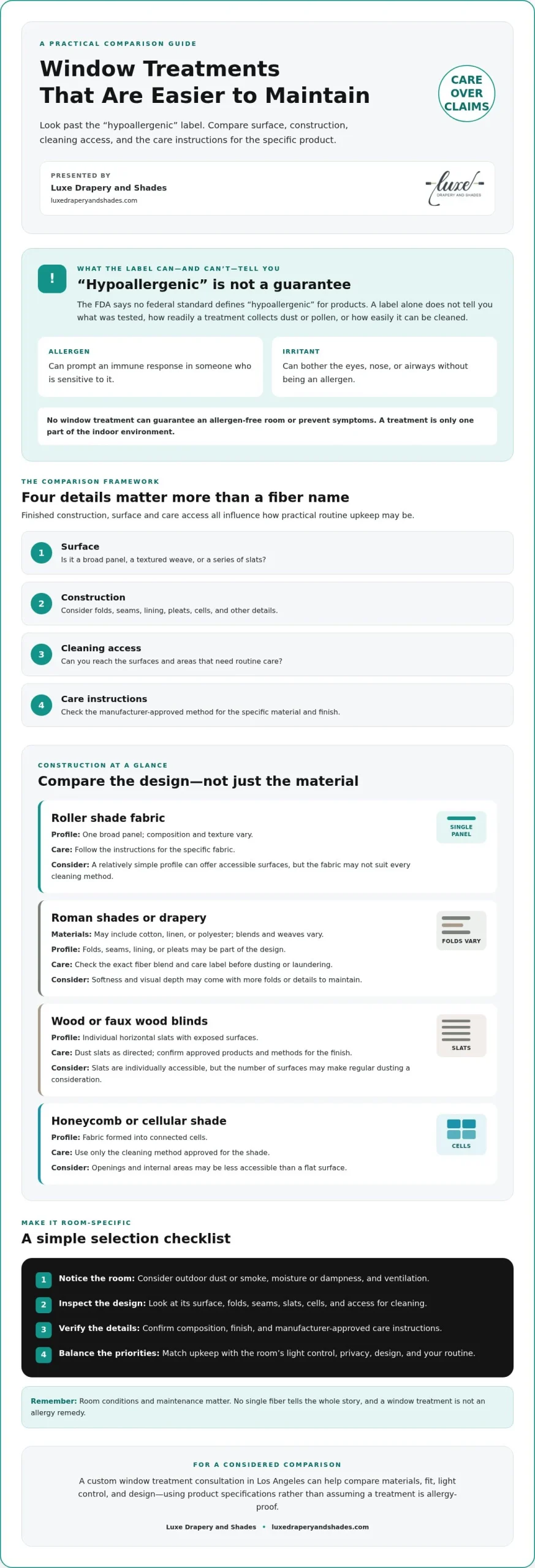
A fiber name doesn’t tell you how a finished shade or drapery will behave. Surface texture, seams, folds, and access for routine care all influence how practical a treatment is to maintain. Compare hypoallergenic window treatment materials by their specific composition and manufacturer-approved care, not by assuming a natural or synthetic fiber is automatically the better choice.
| Material or treatment | Surface and construction | Cleaning approach | Practical trade-off |
|---|---|---|---|
| Roller shade fabric | One broad panel; composition and texture vary | Follow the care instructions for the specific fabric | A relatively simple profile can offer accessible surfaces, but fabric may not be suitable for every cleaning method. |
| Roman shades or drapery in cotton, linen, or polyester | May include folds, seams, lining, or varied weaves | Check the exact fiber blend and care label before dusting or laundering | Softness and visual depth may come with more folds or details to maintain. |
| Wood or faux wood slats | Individual horizontal slats with exposed surfaces | Dust slats as directed; confirm approved products and methods for the finish | Slats are individually accessible, but the number of surfaces may make regular dusting a consideration. |
| Honeycomb or cellular shade | Fabric formed into connected cells | Use only the cleaning method approved for the shade | Cell structure offers a distinct profile, though openings and internal areas may be less accessible than a flat surface. |
How do fabric shades and drapery compare?
Roller shades typically present a single panel, while Roman shades form folds as they rise. Drapery can have pleats, seams, or lining, depending on its design. Those details affect how easily you can reach surfaces during routine care. Cotton, linen, and polyester each come in different weaves and blends, so ask for the precise composition and written care guidance rather than relying on the fiber name alone.
The Asthma and Allergy Foundation of America offers general indoor allergen guidance in its Control Indoor Allergens resource. Use that guidance as context, then check the specific product instructions before choosing a cleaning routine.
Are wood, faux wood, or cellular shades easier to maintain?
Slats expose separate surfaces for dusting, while cellular shades have fabric folds and cells that may require more careful access. Wood and faux wood are categories, not guarantees of reduced allergen exposure; finishes and care requirements vary. Before purchase, confirm the material, finish, and manufacturer-approved cleaning method. A helpful rule: cleanability depends on construction and access as much as on material.
To compare custom drapery, roller and Roman shades, cellular shades, and blinds, explore custom window treatment options and ask about confirmed composition and care details.
The Biggest Hypoallergenic Window Treatment Myth: Material Alone Solves Allergies
A treatment’s fiber can influence its texture and care requirements, but it can’t tell you how much dust will settle on it or whether a room will feel comfortable. A “hypoallergenic” label alone doesn’t establish a health outcome. A more useful question is how the finished treatment fits the room and your cleaning routine.
Dust retention and maintenance are connected: a design with hard-to-reach areas may be difficult to clean consistently, while accessible surfaces can make routine care more practical. Ventilation and room moisture matter, too. Damp conditions can support mold growth, and airborne particles may enter or circulate independently of the window covering. No single material controls all these conditions.
Do natural materials automatically reduce allergy concerns?
No. Natural origin doesn’t determine how a treatment collects dust or how it should be cleaned. Cotton, linen, wood, and other materials can vary in weave, surface texture, lining, seams, finish, and care instructions. Compare those product-specific details instead of relying on broad labels such as “natural” or “synthetic.” The useful comparison is between finished options and their documented maintenance needs, not material categories in isolation.
Can finishes or new-product odors affect indoor comfort?
They can be a separate consideration. An odor or irritation doesn’t by itself confirm an allergy, and this article can’t diagnose its cause. If you’re sensitive to smells or concerned about a finish, ask the manufacturer for product-specific information about materials, finishes, and emissions. Look for documentation that identifies what was evaluated and for which product; don’t treat a general marketing phrase as medical evidence or assume an unverified standard applies.
It helps to distinguish possible sources of discomfort. Pollen or dust components may act as allergens for some people, while smoke and certain odors may irritate without triggering an allergic response. These experiences can overlap, but they aren’t interchangeable. If symptoms persist or raise concern, consult an appropriate healthcare professional rather than trying to identify a cause through a window treatment label.
When comparing hypoallergenic window treatment materials, use claims as prompts for questions, not as proof. Ask for the precise composition, finish details, and care instructions for the treatment you’re considering. Then weigh those details alongside the room’s ventilation, moisture, and exposure to dust or smoke. A well-chosen window treatment can support a thoughtful maintenance routine, but it can’t replace broader indoor care or professional health advice.
How to Choose and Maintain Window Treatments for Easier Cleaning
Plan for upkeep as part of the design decision, rather than treating it as an afterthought. Use this checklist to compare hypoallergenic window treatment materials against your household’s needs and the conditions in each room.
- Identify sensitivities. Note any known concerns, such as pollen, dust, smoke, or strong odors. A healthcare professional can help with questions about symptoms; a window treatment is not a diagnostic or medical solution.
- Assess the room. Consider how often windows are opened, whether street dust or smoke reaches the space, and whether coastal moisture or other damp conditions are a concern. Los Angeles homes vary, so evaluate each room individually.
- Check cleaning access. Think about whether you can reach the full surface, including folds, slats, seams, and hardware. Choose a structure that fits the care you can realistically maintain.
- Confirm product care. Request written manufacturer instructions before deciding how a treatment should be dusted or cleaned.
What should you ask before selecting a material?
Ask for the exact fiber composition, lining details, finish information, and written cleaning instructions. Find out whether the treatment can be removed for cleaning and whether doing so could affect its construction. If care guidance is unclear, check with the manufacturer or a qualified design professional before purchase. These specifics are more useful than a broad material label and help you compare options on practical terms.
How can design choices make routine care more manageable?
Consider how much of the surface is open and accessible. A flatter shade may be simpler to dust than a design with many pleats or layered panels, while horizontal slats present multiple surfaces to maintain. No construction is universally best; match the form to the room and your routine. Set a cleaning schedule that follows product instructions and suits household needs, rather than assuming every treatment can be cleaned the same way.
For tailored fabric options, compare custom drapery with Roman shades by their folds, lining, and care requirements. A design discussion can also account for privacy, light control, and how the treatment will fit the room. Explore custom window treatment options and ask for confirmed material and care details before selecting a product.
Plan a Custom Window Treatment Consultation in Los Angeles
Choosing a window treatment means balancing room function, cleaning access, light control, privacy, and design. A tailored conversation can help you compare confirmed material specifications and care instructions alongside the fit and operating style that suit your space. Luxe Drapery and Shades offers custom window treatments and professional installation in Los Angeles, but doesn’t provide medical advice or allergy-remediation services. No treatment should be presented as a health solution without supporting evidence.
What information helps a designer recommend suitable options?
Bring room photos and window measurements, and consider how much light control and privacy you prefer. Share cleaning constraints, such as limited access to a window or a preference for a simpler surface to maintain. If you have documented sensitivities, you can explain them as design considerations; a designer can’t diagnose symptoms or prescribe a treatment.
Before confirming a selection, ask for relevant product information: composition, finish, lining where applicable, and manufacturer-provided care instructions. If a specification or cleaning method is unclear, request confirmation rather than relying on a broad “hypoallergenic” claim. Comparing hypoallergenic window treatment materials this way keeps the decision grounded in details you can verify.
How can custom design balance comfort and a refined interior?
Consider how each category fits the room’s needs. Custom drapery can bring softness and a considered finish; roller shades offer a different profile from Roman shades, which form folds as they operate. Wood blinds, faux wood blinds, and plantation shutters provide hard-surface alternatives, each with its own construction and care guidance. The best fit depends on the window, preferred operating style, cleaning access, and visual character you want to create.
If plantation shutters are on your shortlist, ask about their specific material, finish, and care requirements. Those details matter more than assuming a hard surface is automatically easier or better for every household. Apply the same care across drapery, shades, blinds, and shutters: confirm the product specifications and compare them with your room’s priorities.
For a custom window treatment discussion in Los Angeles, bring your measurements, photos, and questions about care, fit, and light control. Luxe Drapery and Shades can help you explore available custom options and professional installation while keeping the decision focused on design and verifiable product details.
Choose a Window Treatment That Fits Your Home
The most thoughtful choice isn’t defined by a “hypoallergenic” label. Compare material specifications, construction, and manufacturer care instructions, then consider how easily you can maintain the treatment in each room. Fewer folds or more accessible surfaces may suit a simpler cleaning routine, while privacy, light control, and style remain part of the decision. The best hypoallergenic window treatment materials aren’t a universal category; they’re options to evaluate against your home’s needs and the details you can verify.
Luxe Drapery and Shades offers custom interior window treatments and professional installation in Los Angeles. The company is a licensed and bonded California contractor, CSLB #1066068. No product should be assumed allergy-proof or medically certified without supporting documentation.
Explore custom window treatment options with Luxe Drapery and Shades and discuss your room, care priorities, and design goals. With clear specifications and a considered fit, you can create a window setting that feels both practical and beautifully at home.
Frequently Asked Questions
Are any window treatment materials guaranteed to be hypoallergenic?
No material can guarantee that a room will be free of allergens or symptoms. The term “hypoallergenic” alone doesn’t establish a specific health outcome. When comparing hypoallergenic window treatment materials, check documented composition, construction, finishes, and manufacturer care instructions. A surface that’s practical to maintain may support a consistent cleaning routine, but it won’t eliminate every trigger. If allergies are a concern, pair product research with advice from an appropriate healthcare professional.
Which window treatments collect the least dust?
No single treatment is guaranteed to collect the least dust in every home. Dust can settle on many surfaces, and construction affects how accessible those surfaces are for cleaning. A broad roller shade may be simpler to reach than layered drapery, while horizontal slats have separate surfaces to dust. Compare folds, seams, slat spacing, installation access, and care directions. In Los Angeles, consider whether open windows or nearby streets bring dust into a particular room.
Are synthetic fabrics better than natural fibers for allergies?
Not automatically. Fiber origin alone doesn’t show whether a treatment will collect particles, be straightforward to clean, or affect an individual’s symptoms. Compare the specific fabric’s weave, lining, seams, finishes, and manufacturer care instructions. Ask for exact composition and supporting product documentation, especially if you have known sensitivities. Broad claims that natural fibers are safer or synthetic fabrics are inherently better aren’t a substitute for checking how the finished treatment is made and maintained.
Can window treatments cause allergy symptoms?
A window treatment may collect dust or other particles, and some people may be sensitive to particular odors or finishes. That doesn’t mean a specific material causes an allergy, since symptoms can have many sources. Follow care instructions for the exact product and ask the manufacturer about its finishes if you have concerns. For persistent or concerning symptoms, consult a healthcare professional rather than trying to identify the cause through a product label.
Are roller shades a good choice for someone concerned about dust?
They may be practical to maintain, but suitability depends on the specific shade’s fabric, construction, and care instructions. A roller shade has a relatively simple surface compared with some layered designs, yet it isn’t inherently allergy-proof. Ask for its exact composition and approved cleaning method, then consider whether the shade is accessible once installed. In a Los Angeles home, account for the room’s use and exposure to outdoor dust as well.
How should I clean window treatments to manage dust?
Follow the manufacturer’s instructions for the exact treatment and material. Some products may allow gentle dusting, while others have specific limitations or may require professional care. Don’t assume a fabric is washable or that a particular cleaning method is safe for its finish or construction. Set a routine that fits the product instructions and household needs, and follow any relevant cleaning guidance from your healthcare professional.
Should I choose curtains or blinds for allergy concerns?
Neither category is universally best. Drapery can differ in its folds, lining, and fabric, while blinds vary in slat shape, spacing, and surface. Compare how easily you can reach and clean the specific design, then confirm its care instructions before choosing. In Los Angeles, room exposure and how often windows are opened may also influence upkeep. Balance maintenance with the privacy, light control, and style you want.