
What if the most overlooked point of cross-contamination in an outpatient suite isn’t the exam table, but the manual pull cord dangling beside the window? Facility directors and healthcare designers understand the delicate tension between institutional sanitation and serene, restorative architecture. Ensuring compliance with NFPA 701 fire standards and rigid touchpoint hygiene often seems at odds with crafting a warm, dignified care environment. Selecting elevated healthcare facility window treatment solutions requires bridging that divide, turning daylight management into an active asset for both patient wellness and clinical safety.
You’ll discover how to navigate rigorous infection control protocols, antimicrobial surface requirements, and motorized daylighting systems to specify coverings tailored to each clinical zone. We outline the architectural specifications, automated shade technologies, and turnkey procurement standards needed to execute compliant, enduring medical interiors with confidence.
Key Takeaways
- Ensure patient safety and code adherence by specifying commercial window coverings engineered to meet NFPA 701 fire retardancy standards and strict healthcare regulations.
- Tailor healthcare facility window treatment solutions to distinct clinical zones, balancing restorative biophilic solar shades in reception lounges with total light control in exam suites.
- Eliminate high-touch vectors of cross-contamination by upgrading traditional manual cords to hands-free motorized roller shades.
- Choose non-porous, medical-grade materials that endure repeated exposure to hospital disinfectants without compromising structural integrity or aesthetic appeal.
- Coordinate architectural rough-ins early by aligning structural blocking and low-voltage power requirements with licensed commercial installers before final finish work begins.
Clinical Compliance: Essential Standards for Healthcare Window Coverings
Modern medical architecture demands that interior shading systems function as specialized clinical barriers rather than decorative accents. High-performance healthcare facility window treatment solutions are engineered commercial systems designed to satisfy rigorous life-safety codes, stringent infection prevention protocols, and continuous daily cycling. From outpatient clinics to diagnostic imaging suites, window coverings must withstand heavy operational use while remaining strictly cordless to satisfy modern safety mandates.
Fire Safety and Flame Retardancy Regulations
Every textile specified in a medical setting must satisfy strict flame spread benchmarks. The baseline standard remains NFPA 701, which measures how architectural fabrics respond to vertical flame exposure without propagating combustion. While interior textiles historically relied on topical chemical sprays similar to legacy cubicle curtain standards, modern architectural solar shades favor inherently flame-resistant (IFR) yarns. In IFR materials, fire-retardant properties are locked directly into the molecular structure of the yarn, ensuring they won’t wash away or degrade during repeated sanitization. In California, commercial healthcare builds must also align with Title 19 regulations enforced by the State Fire Marshal. Facility teams must always verify specific local hospital facility code standards prior to commercial project sign-off to guarantee complete life-safety compliance.
Infection Control and Sanitization Protocols
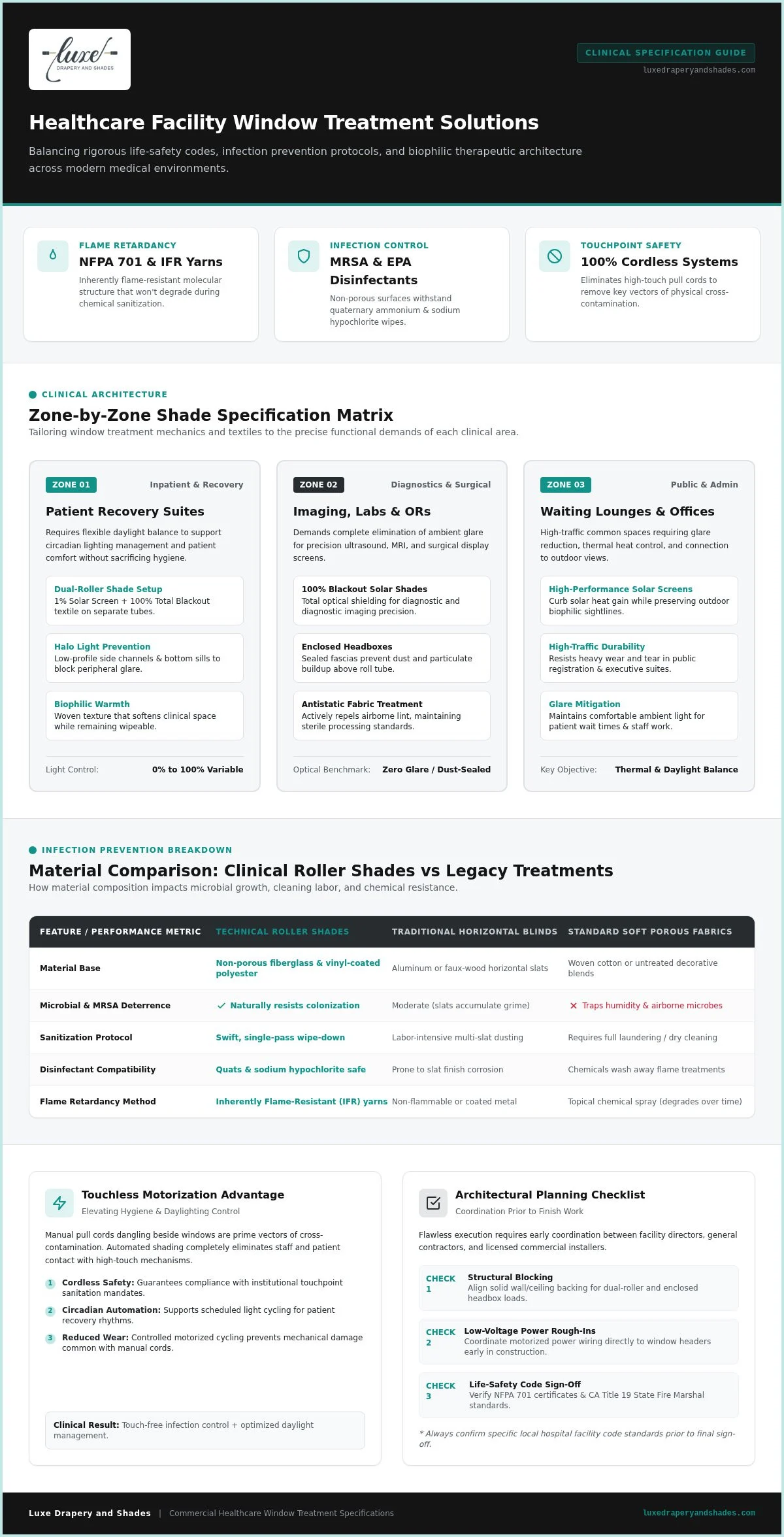
Soft, porous fabrics trap humidity and airborne contaminants. In contrast, technical roller shades crafted from non-porous fiberglass and vinyl-coated polyester present smooth, sealed surfaces that naturally deter microbial growth. These medical-grade surfaces resist colonization by bacteria such as MRSA and tolerate daily contact with EPA-registered hospital disinfectants, including quaternary ammonium compounds and diluted sodium hypochlorite solutions.
Maintenance efficiency separates purpose-built commercial installations from costly operational headaches. Traditional horizontal blinds create dozens of dust-collecting ledges that demand labor-intensive dusting and harbor allergens. Smooth roller shades require only a swift, single-pass wipe to sanitize completely. Specifying refined healthcare facility window treatment solutions preserves a pristine clinical baseline while significantly reducing housekeeping overhead across busy patient wings.
Zone-by-Zone Evaluation: Selecting Window Treatments Across Medical Environments
A single hospital or outpatient center encompasses vastly different environmental demands. Tailoring healthcare facility window treatment solutions requires moving past one-size-fits-all specifications and aligning shade architecture with the clinical tasks performed in each room. By anchoring choices in evidence-based design for therapeutic environments, facility directors can seamlessly unite biophilic wellness with functional clinical performance.
Patient Rooms and Inpatient Recovery Suites
Inpatient recovery requires precise circadian lighting management alongside soothing, residential-inspired textures. Dual-roller shade configurations provide the ideal solution, mounting a 1% open solar screen on one tube and a 100% total blackout textile on the other. Integrating low-profile side channels and bottom sills prevents peripheral light halos during daytime recovery. Subtle, woven textures introduce biophilic warmth, actively softening clinical spaces while remaining completely wipeable.
Diagnostic Labs, Imaging Suites, and Operating Rooms
Diagnostic accuracy leaves no room for uncontrolled ambient glare. Ultrasound, MRI, and surgical monitors require specialized blackout solar roller shades fitted with fully enclosed headboxes. These sealed fascias prevent dust, lint, and particulate accumulation above the roll tube. Medical-grade fabrics treated with antistatic properties repel airborne contaminants, preserving sterile processing environments without compromising precision optical performance.
Reception Areas, Waiting Lounges, and Medical Executive Offices
First impressions set the tone for the entire patient journey. High-traffic waiting areas benefit from high-performance solar screens that curb thermal gain while maintaining restorative outdoor sightlines to reduce patient stress. For executive wellness clinics and private consultation rooms, acoustic management is essential for preserving patient privacy.
- Pair open-weave solar shades with certified flame-retardant custom drapery to soften reverberant sound in expansive glass reception lobbies.
- Install tailored Roman shades crafted from dense, fire-rated commercial textiles to establish an intimate, reassuring aesthetic in consultation offices.
- Select faux wood blinds for administrative corridors where versatile directional louver control provides effortless privacy management.
When curating high-end medical interiors across Southern California, consulting with the architectural specialists at Luxe Drapery and Shades ensures every zone harmonizes clinical durability with bespoke refinement.
Touchless Motorization: Elevating Hygiene and Daylighting Control
Every surface touched by human hands represents an infection vulnerability. In high-traffic medical environments, traditional manual pull chains, tilt wands, and continuous cord loops act as prime repositories for microbial colonization. Staff, patients, and visitors touch these elements continuously throughout the day, often bypassing routine sanitization. Specifying motorized healthcare facility window treatment solutions transforms window coverings from active cross-contamination hazards into hands-free infection control assets.
Eliminating Touchpoints Through Architectural Automation
Automated roller shades completely remove physical interaction from the clinical equation. Because no hands touch the window treatment during daily operation, microbial transfer drops dramatically across exam suites and treatment bays. Facility managers can configure shades to track architectural schedules automatically, deploying at sunrise to deflect direct solar heat and retracting at dusk to welcome ambient evening light. For on-demand adjustments, clinical teams rely on sealed, chemical-resistant wall keypads or contactless radio-frequency sensors that nurses can trigger with an elbow or gloved hand without compromising sterility.
Intelligent Daylighting and Lutron Architectural Systems
Precision daylighting does more than prevent glare; it actively supports patient circadian rhythms. By integrating certified commercial shading and Lutron home automation and lighting controls into a medical facility, administrators achieve autonomous daylight harvesting across entire building elevations. Sensor-driven shading micro-adjusts solar screen fabric heights throughout the day, pairing natural sunlight with interior lighting grids.
- Ultra-quiet motor drives operate virtually silently, avoiding disruptive mechanical hums near resting patients or delicate consultation suites.
- Centralized network processors integrate directly with commercial Building Management Systems (BMS) to curb cooling loads during peak sun exposure.
- Custom scene presets allow clinical practitioners to shift an entire room from an open, daylight-rich recovery setting to a dimmed diagnostic exam environment with a single command.
Replacing manual mechanics with intelligent motorization turns window architecture into a vital tool for environmental comfort, operational energy savings, and touch-free sanitation.
Comparing Healthcare Window Treatment Materials: Durability, Hygiene, and Maintenance
Selecting the right materials for clinical environments requires balancing surface durability, chemical resistance, and indoor air quality. Commercial shading textiles must endure continuous terminal cleanings without peeling, fading, or off-gassing volatile organic compounds into enclosed healing spaces. Evaluating how different healthcare facility window treatment solutions hold up against daily institutional sanitation ensures long-term performance without aesthetic degradation.
Performance Shadecloths vs. Horizontal Blinds
While traditional horizontal aluminum or wood blinds offer manual directional control, their horizontal surfaces continuously trap settling dust and airborne contaminants. In clinical zones, wiping down dozens of individual slats demands significant housekeeping hours and often leaves moisture trapped in route holes. Modern technical roller shade fabrics solve this challenge directly.
- Chemical-Resistant Polyolefin and Coated Weaves: High-performance technical shadecloths withstand direct contact with hospital disinfectants, including quaternary ammonium compounds and bleach dilutions, without brittle yarn degradation or color leaching.
- GREENGUARD Gold Certification: Specifying low-emitting, PVC-free shade fabrics protects vulnerable respiratory health by preventing chemical outgassing in recovery rooms and pediatric units.
- Dimensional Stability: Technical fabrics engineered with high tensile strength prevent edge fraying and center sagging over thousands of automated cycles.
Specialized Louvers and Architectural Hard Coverings
Certain medical spaces require the architectural structure of rigid window systems rather than flexible solar screens. In high-humidity administrative wash stations, staff break rooms, or physical therapy suites, commercial-grade composite faux wood blinds provide cleanable, moisture-resistant privacy. Their dense synthetic slats will not warp, crack, or harbor mold spores when exposed to elevated moisture or repeated chemical wipe-downs.
For residential-style long-term care environments, senior recovery centers, and executive wellness suites, durable architectural plantation shutters bring timeless residential elegance while preserving strict infection control. These solid installations offer superior thermal barrier properties, acoustic dampening, and straightforward sanitization. Regardless of the material selected, commercial hardware brackets, mounting plates, and headboxes must feature corrosion-resistant powder-coated finishes that withstand corrosive chemical vapors during routine terminal cleaning rounds.
To identify durable, code-compliant materials tailored to your specific clinical footprint, explore custom healthcare shading options with Luxe Drapery and Shades.
Procurement, Measuring, and Commercial Installation: The Project Checklist
Flawless architectural execution depends entirely on disciplined pre-construction coordination. When specifying complex healthcare facility window treatment solutions, translating design intent into clinical reality requires early alignment between framing trades, electrical contractors, and certified shading installers. Overlooking structural backing or conduit pathways during the rough-in stage introduces costly delays once walls are closed and finished.
Pre-Construction Planning and Architectural Coordination
Precision begins long before shade textiles meet mounting brackets. Commercial build-outs require strict adherence to a systematic site preparation timeline:
- Laser Field Verification: Complete high-precision laser measurements across all structural window openings after drywall and window jambs are finished to account for microscopic framing variances.
- Pocket and Recess Coordination: Confirm ceiling pocket depths, fascia enclosures, and low-voltage wiring pathways with electrical subcontractors prior to ceiling close-up.
- Seismic and Energy Compliance: Anchor all ceiling brackets and side channels to satisfy Southern California seismic requirements and California Title 24 daylighting regulations. Always verify specific local hospital facility code standards prior to commercial project sign-off.
- Staged Phased Deployment: Sequence deliveries and installation teams room by room, minimizing dust creation and operational disruption in operational clinical wings.
Selecting a Licensed Commercial Installation Partner
Commercial healthcare environments leave no room for residential-grade shortcuts or unbonded labor. Institutional facility managers should partner exclusively with a licensed and bonded California commercial contractor (CSLB #1066068). Licensed contractors understand hospital badging, airborne infection control precautions (AICP), and strict commercial site safety standards.
Turnkey execution demands single-source accountability. Your contractor should provide comprehensive commercial warranties covering motorized shade drives, low-voltage power panels, and technical solar textiles. Because automated daylight integration requires nuanced technical calibration, partnering with Lutron shading specialists ensures seamless commissioning alongside facility lighting grids and master building automation systems.
Whether you are designing a boutique wellness clinic in Beverly Hills or retrofitting a regional medical center, you can consult with Luxe Drapery and Shades to engineer custom clinical shading installations built for longevity, code compliance, and serene architectural beauty.
Architecting Safer, More Restorative Healthcare Environments
Designing modern medical spaces no longer requires compromising serene interior aesthetics for the sake of institutional safety. Specifying advanced healthcare facility window treatment solutions bridges the gap between rigorous NFPA 701 fire compliance, touchless infection control, and therapeutic daylight harvesting. When clinical zones pair chemical-resistant solar textiles with automated precision, patient recovery and operational hygiene flourish together.
Bringing these complex systems to life demands specialized commercial expertise. As a licensed and bonded California commercial contractor (CSLB #1066068) and certified Lutron automated shading specialist, Luxe Drapery and Shades delivers bespoke commercial fabrication engineered to exact clinical architectural specifications across greater Los Angeles. Whether you’re breaking ground on a state-of-the-art outpatient pavilion or upgrading an executive wellness suite, our team provides seamless turnkey guidance from initial field measurements to certified installation.
Schedule a commercial healthcare window treatment consultation with Luxe Drapery and Shades today, and create clinical interiors that safeguard patient health while cultivating genuine peace of mind.
Frequently Asked Questions
What fire safety certifications are required for healthcare facility window treatments?
Commercial healthcare textiles must satisfy the NFPA 701 vertical flammability standard to ensure fabrics resist flame propagation without sustaining combustion. In California, commercial installations must also comply with Title 19 standards enforced by the State Fire Marshal. Facility teams should specify inherently flame-resistant (IFR) yarns rather than topical chemical treatments. Facility directors must also verify specific local hospital facility code standards prior to commercial project sign-off.
How do motorized window shades improve infection control in medical clinics?
Motorized shades eliminate high-touch manual controls like pull cords, continuous bead chains, and tilt wands. These physical components frequently harbor pathogens and facilitate cross-contamination between staff, patients, and visitors. By operating roller shades via automated architectural schedules, wall keypads, or contactless radio-frequency sensors, staff avoid direct contact. This makes motorized healthcare facility window treatment solutions an effective physical barrier against viral and bacterial transmission.
Can commercial solar roller shades be disinfected with hospital-grade cleaning agents?
Yes, commercial solar shade fabrics engineered from vinyl-coated fiberglass or high-tenacity polyester are designed for terminal cleaning. These non-porous surfaces tolerate routine wipe-downs with EPA-registered institutional disinfectants, including quaternary ammonium formulations and diluted sodium hypochlorite bleach solutions. Unlike traditional porous draperies, specialized medical shadecloths maintain their tensile strength, colorfastness, and flame-retardant properties without cracking, peeling, or degrading during aggressive surface sanitization.
What is the difference between solar screen openness factors in patient rooms?
Openness factor indicates the tightness of a solar fabric’s weave, determining visible light transmittance and optical transparency. A 1% openness factor provides dense weave coverage, delivering maximum glare mitigation, thermal deflection, and daytime privacy along bright exterior facades. Weaves with 3% or 5% openness allow increased natural daylight and clear exterior views, which support patient circadian health and ease anxiety in recovery suites and family waiting areas.
Are cordless window coverings legally required in commercial healthcare facilities?
Federal commercial standards and commercial building safety codes strictly limit or ban free-hanging manual pull cords in public and patient-accessible spaces. Healthcare facilities enforce these cordless requirements to eliminate strangulation risks and satisfy Joint Commission physical environment inspections. Motorized roller shades or enclosed architectural wand mechanisms provide total code compliance while delivering reliable, hands-free light control across high-traffic clinical departments.
How do dual-roller shades function in multi-purpose hospital exam rooms?
Dual-roller systems integrate two independently controlled shade rolls within a single architectural fascia or ceiling pocket. One roller operates a technical solar screen fabric that filters harsh sunlight and blocks glare while preserving outside views during routine check-ups. The second roller deploys a 100% opaque blackout fabric. Fitted with perimeter side channels, it eliminates ambient light bleed to facilitate optical exams, ultrasound procedures, and restorative rest.
What are the benefits of integrating Lutron shading systems into a medical facility?
Lutron commercial shading systems utilize ultra-quiet motor drives that adjust daylighting without disturbing resting patients or private consultations. These intelligent systems communicate directly with lighting control grids and building management systems (BMS), automatically tracking solar angles to lower HVAC heat loads. For clinics seeking tailored healthcare facility window treatment solutions, certified Lutron automation delivers precise glare control, dependable energy efficiency, and touch-free operational hygiene across large architectural window expanses.