

What if the fabric that looks right isn’t the one that satisfies your project review? Planning fire retardant commercial drapery Los Angeles projects calls for more than choosing a flame-resistant label. Requirements can depend on the space and its use, while NFPA 701 testing, California documentation, and local review each have a distinct role. It’s understandable to want clarity before committing to a fabric, finish, or installation plan.
A strong specification brings documented fire performance and the design brief together. This guide explains which project-specific requirements to verify, how inherently flame-resistant and topically treated fabrics differ, and what documentation may be relevant to a review. You’ll also learn how to keep appearance, function, care guidance, and installation planning in view as you compare options.
With custom drapery, selection, accurate measurement, ordering, and professional installation are connected steps. A considered process helps you shape a cohesive window treatment plan for your Los Angeles space while keeping performance claims tied to documentation for the fabric selected.
Key Takeaways
- For fire retardant commercial drapery Los Angeles projects, clarify the space’s use, installation location, and project scope before settling on a specification.
- Compare inherently fire-resistant fabrics and topically treated options by reviewing the documentation and care guidance relevant to each fabric.
- Assess drape, opacity, light control, and privacy alongside documented fire-performance requirements to align the selection with the design brief.
- Verify applicable requirements with the authority having jurisdiction before finalizing the specification, then assemble the product records for review.
- Plan selection, accurate measurement, ordering, and installation as connected steps to keep the custom drapery process coordinated.
What Los Angeles Commercial Projects Should Clarify About Fire-Retardant Drapery
For a commercial project, “fire-retardant” should describe a documented performance characteristic, not serve as a stand-alone fabric label. A product description may identify a material as inherently flame resistant or treated with a flame-retardant finish. That wording alone doesn’t show which test it passed, whether the record applies to the selected fabric, or whether the documentation meets the project’s review requirements.
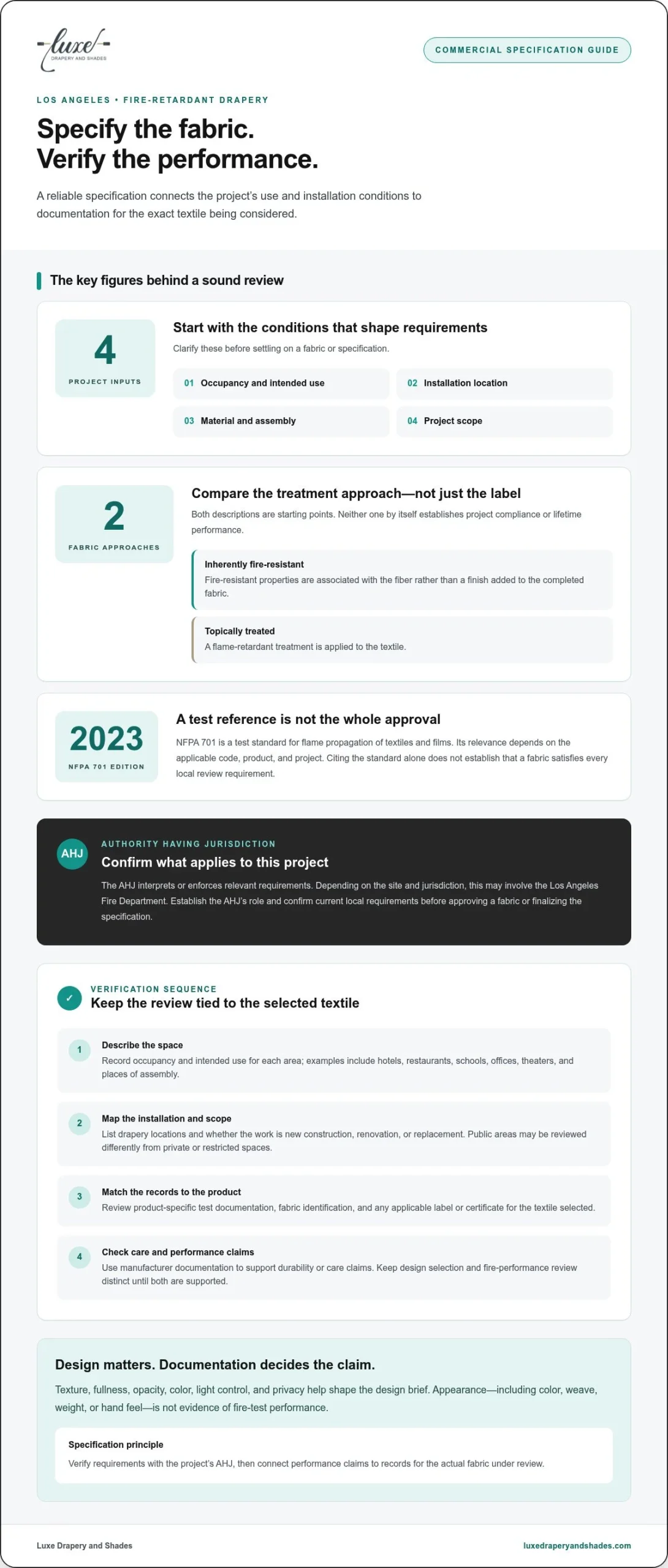
That distinction matters when specifying fire retardant commercial drapery Los Angeles projects. The relevant review can depend on occupancy, installation location, material and assembly, and project scope. A hotel guest room, theater, school corridor, restaurant dining area, and office reception space shouldn’t automatically be treated as identical cases. These examples can help identify questions, but they don’t establish that the same rule applies to every venue.
Separate the life-safety objective from the assumption that one standard governs every space. Before choosing fabric, identify the project’s location and use, then establish which current code provisions, test methods, and records apply. This keeps the design process grounded: texture, fullness, opacity, and color can shape the atmosphere, while performance claims stay tied to evidence for the actual material under review.
Which Los Angeles commercial spaces need a project-specific review?
Start with the space’s intended use. Hotels, restaurants, schools, offices, theaters, and places of assembly are useful prompts for review because occupancy and how a space is used may affect applicable requirements. For instance, major gathering and live entertainment venues like The Vermont Hollywood encounter different public-assembly guidelines than a private office. Installation location matters, too: drapery in a public area may be reviewed differently from a treatment in a private or restricted space.
Record the venue type, installation locations, and project scope, including whether the work is new construction, renovation, or a replacement. Then identify the local Authority Having Jurisdiction (AHJ) for the project. Its guidance can help clarify which requirements apply before the specification is fixed.
What do NFPA 701 and the Authority Having Jurisdiction mean?
NFPA 701 is a test standard for flame propagation of textiles and films. The current edition identified for this guide is the 2023 edition. Its relevance depends on the applicable code, product, and project; citing the standard alone doesn’t establish that a fabric satisfies every local review requirement. A general overview of fire-retardant fabric can help explain the material category, but project decisions need applicable test documentation.
The AHJ is the authority responsible for interpreting or enforcing requirements relevant to a particular project. Depending on the site and its jurisdiction, that may involve the Los Angeles Fire Department. Establish the AHJ’s role for the project rather than assuming it. Confirm current local requirements with the relevant AHJ before approving a fabric or finalizing the specification.
- Describe the occupancy and intended use of each area.
- List the drapery locations and materials being considered.
- Match product-specific test records to the requirement identified for the project.
- Keep design selection and fire-performance review distinct until both are supported.
Inherent and Topically Treated Drapery: Understand the Fire-Retardant Options
Fire-retardant fabrics are often described in two broad categories. An inherently fire-retardant fabric has fire-resistant properties associated with its fiber, while a topically treated fabric has a flame-retardant finish applied to the textile. These labels describe an approach, not a project outcome. For fire retardant commercial drapery Los Angeles specifications, assess performance using records for the exact fabric and the test relevant to the project.
How do inherently fire-retardant and treated fabrics differ?
Fiber composition and applied finish are useful starting points for comparison, but neither category alone establishes compliance or lifetime performance. A claim that resistance is permanent, durable, or maintained after cleaning should be supported by the manufacturer’s documentation for that specific fabric. Appearance offers no reliable shortcut: color, weave, weight, and hand feel don’t establish how a textile performed in a fire test.
Review the available records side by side. The NFPA 701 Standard for Flame Propagation of Textiles and Films describes a test standard that may be relevant when applicable to the project. A reference to NFPA 701 alone isn’t proof that a specific fabric meets the project’s full requirements.
Inherently fire-retardant fabric
How it’s described: Fire-resistant properties are associated with the fiber rather than a finish added to the completed fabric.
Records to review: Product-specific test report, fabric identification, and any applicable label or certificate.
Verify: That the documentation names the selected textile and supports any durability or care claims being made.
Topically treated fabric
How it’s described: A flame-retardant treatment is applied to the fabric.
Records to review: Test documentation for the treated fabric, applicable label or certificate, and manufacturer care instructions.
Verify: That the treatment, tested material, intended application, and maintenance guidance match the specified product.
What documentation should accompany a drapery specification?
Build the submittal around the product that will actually be ordered, not a similar-looking swatch or a general statement about a fabric category. Check that each record identifies the fabric clearly and reflects its intended use. If required for the project, include the relevant test report, product label, and certificate. Resolve missing, inconsistent, or unclear information before finalizing the specification.
Care instructions belong in the review, too. Cleaning methods, maintenance, and any service-life statements should follow the manufacturer’s product-specific documentation. Don’t assume that washing, dry cleaning, or other care will leave a treatment unchanged unless the supplied guidance supports that conclusion. Keep these records with the project file so the approved textile can be matched to the installed drapery.
Once the performance documentation is understood, custom drapery planning can focus on proportion, texture, and how the finished treatment will complement the space. Luxe Drapery and Shades connects selection assistance with accurate measurement and professional installation. Explore custom drapery planning as part of a coordinated project process.
How to Compare Commercial Fire-Retardant Drapery Specifications in Los Angeles
Begin with the project’s documented fire-performance requirement, then compare candidate fabrics against it. This order keeps a beautiful texture or preferred color from becoming a substitute for evidence. For fire retardant commercial drapery Los Angeles projects, separate each material’s verified test information from broad marketing language, and confirm that the relevant requirement has been established for the specific space.
Once a candidate meets the documented criteria, assess how it will shape the room. Texture, color, and drape influence the atmosphere; opacity, light control, and privacy address how the window needs to function. These are important design considerations, but they don’t establish fire-test performance. Custom drapery offers a tailored design approach, not a fire-retardant classification by itself.
Which fabric and drapery qualities belong in the comparison?
Compare samples in the context of the finished space. A soft, full drape may suit a more composed setting, while a cleaner fall can support a restrained interior. Consider how color works with surrounding materials and whether the chosen opacity supports the room’s desired balance of daylight and privacy. Evaluate these qualities separately from the material’s tested performance and project documentation.
Keep the criteria visible with a simple comparison matrix:
| Criterion | Evidence to review | Project question |
|---|---|---|
| Required performance | Test report and applicable product records | Does the evidence match the requirement identified for this space? |
| Product identity | Fabric name or identifier on the records and sample | Is this the exact material being considered for ordering? |
| Drape and texture | Physical sample and design specifications | Does its hand and fall suit the intended look? |
| Opacity and light | Sample review and product information | Does it support the desired daylight and privacy? |
| Care guidance | Manufacturer instructions for the selected fabric | Are care expectations understood for this installation? |
How can readers assess product claims without overgeneralizing?
Match every rating, test result, or performance statement to documentation for the exact fabric, including its construction or treatment where identified. A test result is evidence about the product and test represented in that record; it isn’t automatically a blanket declaration of code compliance for every venue or installation. California’s California Code of Regulations, Title 19 is a reference point, but confirm current applicability and project requirements with the relevant authority.
Watch for mismatches: a record may identify a similar fabric, omit the intended application, or describe a different treatment. Don’t transfer a test result, care instruction, or service-life statement from one textile to another. Note unresolved discrepancies before selecting the final specification, then weigh visual qualities among candidates whose documentation aligns with the project. Luxe Drapery and Shades supports the design process through custom drapery selection, measurements, and installation planning.
A Los Angeles Checklist for Planning Commercial Fire-Retardant Drapery
A well-organized brief keeps safety review and design selection in the right order. For fire retardant commercial drapery Los Angeles projects, first establish which requirements apply to the space, then compare documented product performance, and only then finalize the fabric and design details. Keep the notes and records together so the approved selection can be traced through ordering and installation.
What should a commercial drapery project brief include?
Start with the room’s use and the location of each window. Add the project address, intended function, desired light control and privacy, and design direction. Note existing conditions that may affect measurement or coordination, and identify which requirements and product records are expected for project review.
- Describe the space. Record the occupancy or room use, how the area functions, and which windows will receive drapery.
- Confirm the review path. Identify the relevant Authority Having Jurisdiction (AHJ) and verify applicable requirements with it before fixing the fabric or drapery specification.
- Document the design brief. Note desired texture, color, fullness, opacity, light control, privacy, and how the treatment should complement the interior.
- Record window information. List each opening and its location, note existing conditions, and arrange accurate measurements as part of the project planning process.
- Compare product evidence. Review product-specific test documentation and any applicable labels or certificates against the requirement established for the project.
- Finalize the selection. Once performance requirements are addressed, select the fabric and drapery details that best serve the space’s visual and functional goals.
- Assemble the project file. Keep the approved product identification, relevant performance records, care guidance, measurements, and final specification together for reference.
When should requirements and material records be reviewed?
Review requirements early, before a preferred fabric becomes difficult to change in the design. Check the records again as the product selection narrows and before the specification is finalized. This gives the project team an opportunity to resolve missing or conflicting information while there is still room to consider alternatives.
Keep the documentation with the project file after approval. If the fabric, treatment, or intended application changes, revisit the product records rather than carrying the earlier review forward by assumption. This also helps keep design details aligned with the actual material selected.
Planning summary: Verify the project requirement with the relevant AHJ first; select and document the product second. Treat appearance, function, and performance records as related but distinct parts of a complete specification.
For help coordinating selection, accurate measurements, a comprehensive quote, and a project timeline, plan your custom drapery project with Luxe Drapery and Shades.
From Consultation to Installation: Planning Custom Drapery with Luxe
A commercial drapery project brings together more than fabric selection. The design needs to suit the space, measurements need to support the order, and fire-performance claims must stay connected to documentation for the particular product selected. Luxe Drapery and Shades brings consultation, selection assistance, accurate measurement, ordering, and professional installation together in a coordinated custom drapery process.
For projects involving fire retardant commercial drapery Los Angeles, keep compliance review distinct from the design conversation. Establish the applicable project requirements and review product-specific records as you consider fabrics. Evaluate performance using documentation for the selected material and its intended application.
How does Luxe Drapery and Shades guide drapery selection and measurement?
The process begins with a quote request and consultation. Selection assistance helps shape a considered design direction, taking the room’s purpose and desired look and function into account. Accurate measurements then inform the project details and comprehensive quote, connecting selection and planning rather than treating them as separate decisions.
The project timeline gives the work a clear sequence without implying a fixed duration. Once measurements and selection are in place, product ordering follows. If you’re refining the aesthetic or exploring the possibilities of bespoke window treatments, Luxe Drapery and Shades’s custom drapery guide for Los Angeles offers inspiration for a tailored design direction.
What happens between ordering and installation?
After measurement, the product is ordered according to the project plan. Installation materials ship directly from the manufacturer to the customer’s home, and installation is scheduled as part of the project process. This connects ordering and fitting in a practical sequence while keeping expectations grounded in the project timeline.
As the project moves forward, retain the records associated with the selected fabric, including applicable test information and care guidance. If the product or intended application changes after selection, revisit the documentation before carrying the original performance review forward. This continuity helps preserve alignment between the material specified, the product ordered, and the finished window treatment.
From the first selection conversation to the final installation, custom drapery can bring proportion, texture, and a more composed atmosphere to a commercial interior. For a tailored project discussion and coordinated planning, explore a tailored drapery consultation.
Shape a Commercial Space with Confidence
A thoughtful drapery plan can support more than a finished window. It can help a commercial interior feel composed, welcoming, and true to its purpose. With fire retardant commercial drapery Los Angeles projects, let the project brief guide the next conversation: what the space needs to communicate, how the windows should function, and how the selected fabric fits the documented requirements.
Luxe Drapery and Shades brings design planning into a considered sequence, from selection assistance and accurate measurements to a comprehensive quote and project timeline. Professional installation completes the process, connecting the chosen details with the finished space. Each step supports a tailored result while keeping product performance claims grounded in documentation for the selected material.
Start shaping a window treatment plan that reflects your project’s priorities and aesthetic direction. Explore a tailored drapery consultation, and take the next step toward a thoughtfully finished Los Angeles space.