

The most rental-friendly window treatment isn’t always the one that installs fastest. Landlords need options that can handle regular use and tenant turnover, while renters want privacy, comfortable light control, and a considered look without making unwanted changes to the property. The best window treatments for rental properties balance these needs. The right choice depends on the room, the material, and how the treatment will be installed.
To compare options, weigh durability against design, flexibility against a polished finish, and daily function against installation requirements. This guide looks at roller, cellular, Roman, and woven wood shades, blinds, and drapery, including how their light control, upkeep, and mounting needs differ. You’ll also find a room-by-room way to narrow the choices. Whether you’re furnishing a rental or making a rented space feel more like home, focus on comfort and style that suit both the property and the people living in it.
Key Takeaways
- Compare the best window treatments for rental properties by privacy, light control, upkeep, appearance, and installation needs.
- See how roller and cellular shades, faux wood blinds, drapery, and plantation shutters differ in function and visual character.
- Assess the window, mounting surface, existing fixtures, and owner approval before settling on an installation plan.
- Use a room-by-room decision sequence to narrow options according to the space and its everyday needs.
- Learn when custom treatments and professional installation can create a more cohesive fit for a rental.
How to Choose the Best Window Treatments for Rental Properties
Renters and property owners may want different things from the same window. A renter may prioritize flexibility and minimal changes, while an owner may want a lasting fit that works for successive occupants. The best window treatments for rental properties balance these priorities with the room’s everyday needs and the property’s installation constraints.
Rental-friendly window treatments are choices suited to the property, its occupants, and the level of permanence the owner allows. Start by comparing privacy, light control, durability, upkeep, appearance, and installation. These criteria help you weigh the broad range of types of window coverings, from shades and blinds to drapery, without assuming one style works for every rental.
- Privacy: Check sightlines from neighboring homes, walkways, and the street. Decide whether the room needs privacy all day or mainly after dark.
- Light control: Choose between softened daylight, a darker sleeping environment, or an unobstructed view. The room’s purpose can help set the priority.
- Durability and upkeep: Consider how often the treatment will be operated and what routine care the selected material requires.
- Appearance and installation: Select a look that suits the interior, then account for existing fixtures, mounting surfaces, and limits on altering them.
Lease terms, owner preferences, current hardware, and each window’s condition and dimensions all affect the decision. A treatment that looks simple may still need new mounting points or hardware. Don’t assume every option can be installed or removed without affecting the property.
What should renters and property owners prioritize?
For renters, the key questions are how much customization is permitted and whether the treatment can stay in place or must be removed at move-out. Owners may look further ahead, weighing longevity, ease of upkeep, and a cohesive finish across the property. Room use matters for both: a bedroom may need more light control, while a living area may call for privacy that still lets daylight in. Review the lease and get the owner’s approval before changing fixtures or hardware.
Which questions narrow down the options?
Start with the window’s dimensions, exposure, existing fixtures, and intended use. Then decide what the treatment needs to do: soften daylight, darken the space, preserve an outside view, or balance several needs. Finally, consider how long the tenancy is expected to last. A tailored treatment may suit a long-term home or an owner furnishing a property for repeated use; a simpler approach may make more sense for a shorter stay. Choose based on the window and how it will be used, not style alone.
Rental Window Treatments Compared: Shades, Blinds, Drapery, and Shutters
Each treatment changes a room’s appearance and function, and installation needs vary with the window and mounting surface. Use the comparison below as a starting point, not a ranking. The best window treatments for rental properties depend on the room, lease conditions, and owner preferences. For a broader reference on window-covering categories, see this window-covering overview.
| Treatment | Light and privacy | Character and upkeep | Installation planning |
|---|---|---|---|
| Roller shades | Provide adjustable coverage. Opacity affects how much light and view remain. | A streamlined profile suits a clean, uncluttered finish. Follow care guidance for the selected material. | Plan around window measurements, the mounting surface, and existing fixtures. |
| Cellular shades | Offer an option for managing daylight and privacy. | The structured, soft profile has a distinct look. Consider the chosen fabric and its care needs. | Accurate sizing and suitable mounting conditions matter for a tailored fit. |
| Faux wood blinds | Tilting slats let occupants adjust light, privacy, and the view. | The defined slat pattern creates a traditional or linear appearance. Include routine slat care in upkeep planning. | Consider the window frame, clearance, and attachment method. |
| Drapery | Fabric panels can soften daylight. The chosen lining and fullness affect coverage. | Adds softness and can layer with another treatment for a more finished interior. Account for fabric care. | Plan the hardware and mounting points, especially if the lease limits alterations. |
| Plantation shutters | Adjustable louvers provide control over light and sightlines. | A tailored architectural feature with a defined presence. Include the construction and finish in upkeep planning. | Because shutters are fitted to the window, confirm property approval and plan carefully around the opening. |
When do shades or blinds suit a rental best?
Roller shades suit rooms where a streamlined appearance and adjustable coverage are priorities. Cellular shades are worth considering when a softer profile and insulation are part of the brief. Faux wood blinds offer a different kind of control: their slats tilt to redirect light and adjust privacy, while shades create a more continuous surface. Compare the desired look, window conditions, and everyday use before deciding.
When are drapery or plantation shutters worth considering?
Drapery brings softness, visual depth, and the option to layer treatments. It can be a good fit when a room needs a more finished feel. For inspiration on bespoke fabric treatments, explore Custom Drapes Los Angeles: The Ultimate Luxury Guide to Bespoke Window Treatments. Plantation shutters have a tailored architectural character, but their fitted installation makes property planning and owner approval especially important.
No single treatment is best for every rental window. Match the function and appearance to the room, and include installation in the decision. For a cohesive, custom-fit approach, explore custom window treatment planning.
Will Window Treatments Work for Your Rental’s Installation and Daily Use?
Start with a practical question: how will the treatment attach, and what will that mean for the window and property? Installation requirements depend on the treatment and the window. Don’t assume a shade, blind, or drapery hardware can be removed without a trace, or that one mounting method suits every rental.
In Los Angeles homes, window orientation and nearby sightlines can shape the decision. A sunny room may call for a different level of light control than a shaded one. A street-facing window may need more privacy than a window overlooking a private patio. Use these conditions to guide the selection, along with the product’s specifications and the owner’s preferences.
What should you consider before changing window hardware?
Review the lease and get the property owner’s approval before drilling, replacing fixtures, or changing existing hardware. Before planning installation, document the current window and surrounding area. Take photographs of the frame, existing brackets, and any visible marks or damage.
Then assess the details that affect fit and mounting:
- Window material and dimensions: Frame construction and precise measurements help determine which treatments and mounting positions are suitable.
- Access and clearance: Check whether the window opens inward or outward, and note handles, trim, or other fixtures that could affect operation.
- Mounting surface: The material and condition of the frame or surrounding wall influence installation planning.
- Existing hardware: Record what is already in place before deciding whether it can be used or needs owner-approved changes.
Professional measurement helps match a treatment’s dimensions to the actual window rather than an approximate opening size. That attention to fit can support a more polished result, especially when the window or existing fixtures present unusual conditions.
How do light, privacy, and upkeep affect the choice?
Think about daily use as well as installation. A bedroom may call for privacy and a darker environment for rest. In a living area, occupants may prefer softened daylight while keeping an outside view. The best window treatments for rental properties respond to these needs without overlooking the lease, mounting conditions, and owner’s goals.
Consider how often the treatment will be adjusted and what routine care it needs. Follow the care instructions for the selected fabric or material rather than assuming every surface can be cleaned the same way. In sunnier rooms, note the window’s exposure and consider how it affects the owner’s preferred appearance and maintenance approach. For a custom-fit solution, Luxe Drapery and Shades considers the window, room, and installation conditions as part of the treatment plan.
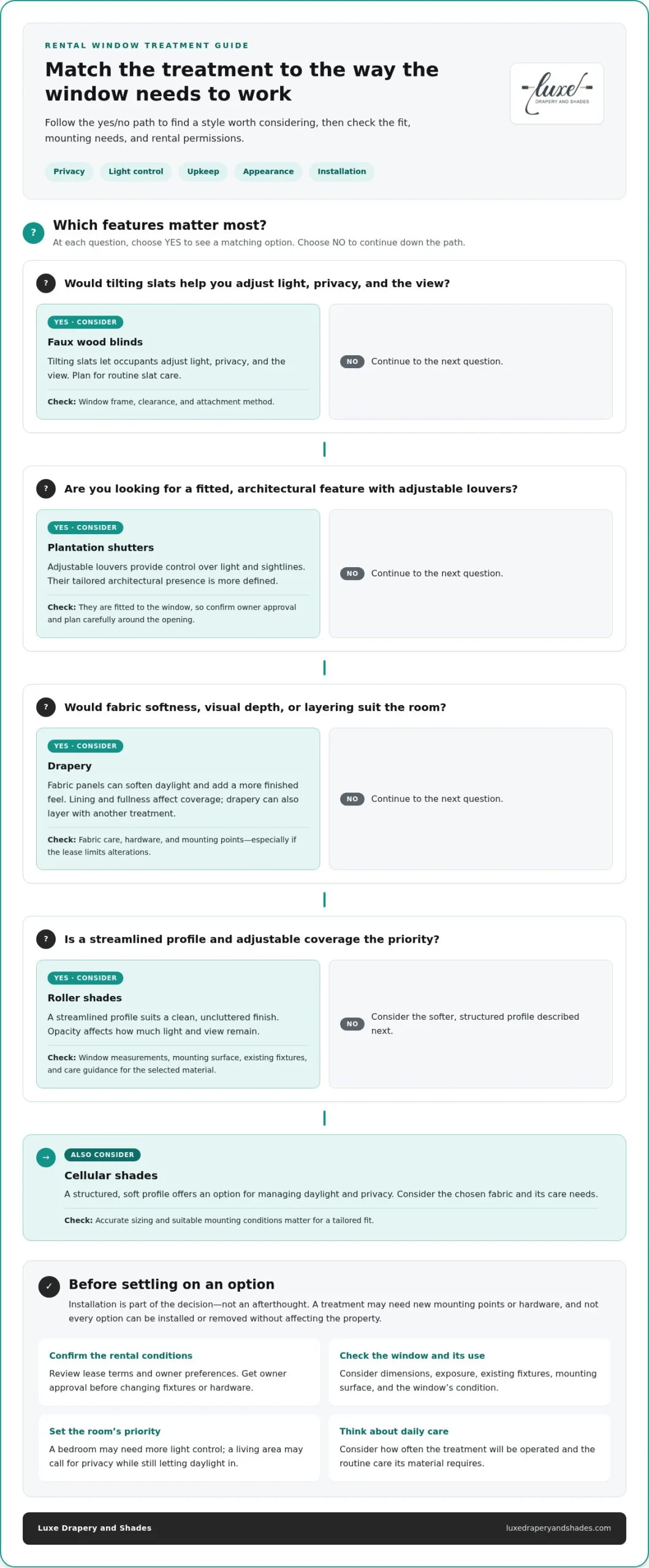
How to Match Rental Window Treatments to Each Room
A bedroom, living room, and bathroom each place different demands on a window treatment. Rather than choosing one style for the whole rental, use four steps: identify the room, define its main function, assess the window and existing hardware, then compare treatments that suit the lease and owner’s preferences. This sequence helps narrow the best window treatments for rental properties without treating every window alike.
- Identify the room: Note who uses it and how.
- Define the function: Set priorities such as privacy, a view, or softened daylight.
- Assess the window: Consider dimensions, exposure, access, existing fixtures, and mounting conditions.
- Compare options: Weigh the treatment’s look and operation against property rules and owner approval.
What works well in bedrooms and living areas?
Bedrooms often call for privacy and more control over incoming light, while living areas may benefit from preserving daylight and an appealing outside view. A shade offers a streamlined layer; drapery brings softness and visual depth. Layering the two may provide more flexibility in some rooms, but it isn’t a universal solution. The right combination depends on the window, existing hardware, lease conditions, and owner approval.
For example, imagine a sunlit Los Angeles living room with a view the occupants want to keep. Begin by deciding how much daylight to soften and when privacy is needed. Then compare shade opacity and operation with the room’s furnishings. This is a planning example, not a promise of a specific heat or light result. For a tailored approach to bright Westside windows, explore custom roller shades for sunny rooms.
How should kitchens, bathrooms, and sunny windows differ?
In kitchens and bathrooms, consider how often window coverings may need care as part of everyday use. Choose an option whose care requirements fit the occupants’ routines, and review the selected material’s guidance. Don’t assume all finishes handle cleaning or moisture in the same way.
In a bathroom, weigh privacy first, then consider the window’s exposure, dimensions, and mounting surface. For a sunny window elsewhere in the home, note how light enters throughout the day. Decide whether the priority is softening daylight, maintaining a view, or adding privacy. Product specifications, owner preferences, and installation conditions should guide the final selection rather than a blanket assumption about performance.
Explore custom window treatments for your rental to consider a room-specific design and installation plan.
Plan a Rental-Friendly Window Treatment Project with Luxe Drapery and Shades
A well-planned rental project brings four considerations together: the room’s function, the treatment type, the window and installation conditions, and the owner’s approval. This framework helps narrow the best window treatments for rental properties while keeping the finished interior in view. Tailored planning can be especially useful when a window has unusual dimensions, a room needs a specific balance of light and privacy, or a cohesive look matters across several spaces.
Luxe Drapery and Shades designs and professionally installs custom window treatments for Los Angeles residences. Measurements and installation are planned around the actual space, so the result feels considered rather than selected by category alone. For a rental, the plan also takes the owner’s preferences and any limits on changing fixtures or hardware into account.
What happens during a tailored window-treatment consultation?
The conversation starts with the room and its intended use: how much daylight to welcome, the privacy occupants need, the window dimensions, and the desired look. Custom drapery, roller or cellular shades, blinds, and plantation shutters can then be considered in context, including their relationship to existing hardware and installation conditions. Professional measurement supports a considered fit. If shutters are part of the vision, the guide Plantation Shutters in Los Angeles: The Connoisseur’s Guide to Custom Window Furniture (2026) offers a focused look at this architectural option.
For renters, include owner approval in the planning conversation before installation details are finalized. This keeps design goals connected to the property’s requirements and sets clear expectations about the selected treatment and its mounting.
When is motorization a considered upgrade?
Motorization is an optional convenience, not a prerequisite for an elegant or functional window. It may suit a household that values easier operation, has a regular daily routine, or wants to operate treatments across multiple windows. The appropriate system depends on the project, the treatment, and the desired level of integration. A tailored plan can weigh that convenience against the rental’s installation conditions and owner preferences.
For readers considering integrated motorized shades, Lutron Sivoia in Los Angeles: The Definitive Guide to Luxury Motorized Shades (2026) provides a closer look at the subject. Luxe Drapery and Shades installs motorized shades and integrates Lutron lighting control systems for residential projects.
Ready to shape a rental window-treatment plan around your rooms, windows, and design priorities? Arrange a tailored consultation with Luxe Drapery and Shades to explore custom treatments and professional installation for your space.
Choose a Rental Window Treatment That Feels Right at Home
The best window treatments for rental properties balance a room’s needs with the window’s conditions and the owner’s preferences. Compare privacy, light control, upkeep, appearance, and installation before choosing. What suits a bedroom may not be right for a sunny living area. Custom-fit treatments and professional measurement can create a more cohesive finish when standard options don’t suit the space.
Luxe Drapery and Shades provides custom design and professional installation for residential window treatments in Los Angeles. The company is a California licensed and bonded contractor, CSLB #1066068, with experience in motorized shades and Lutron lighting-control integration. Motorization is an optional convenience when it fits the project and household routine.
Ready to explore a tailored approach for your rental? Explore custom window treatments for your space. Thoughtful planning can help your windows support comfort and privacy while complementing your home.
Frequently Asked Questions
What are the best window treatments for rental properties?
The best window treatments for rental properties depend on the room, window, lease conditions, and owner preferences. Roller shades offer a streamlined look, cellular shades have a soft profile, faux wood blinds allow slat adjustment, and drapery adds fabric and visual warmth. Compare privacy, light control, upkeep, appearance, and installation requirements before choosing. In Los Angeles, include each window’s sun exposure and sightlines in the decision.
Can renters install custom window treatments?
Renters can install custom window treatments when the lease and property owner allow the proposed changes. Custom options such as roller shades, drapery, or blinds may require specific measurements and mounting hardware, so don’t assume installation will be removable or damage-free. Review lease terms, document existing fixtures, and obtain owner approval before altering a frame or wall. Luxe Drapery and Shades provides custom design and professional installation for Los Angeles residences.
Are roller shades a good choice for rental properties?
Roller shades can be a good choice when a rental needs a clean, streamlined appearance and adjustable coverage. The selected shade’s opacity affects how much daylight, privacy, and outside view it provides, so consider the room’s purpose before deciding. Installation depends on window dimensions, mounting surfaces, existing fixtures, and owner approval. Custom roller shades can be tailored to the window when a standard fit or finish doesn’t suit the space.
Which window treatments provide privacy in a rental?
Roller shades, cellular shades, blinds, drapery, and plantation shutters can all support privacy, depending on their design, fit, and position. For a bedroom or street-facing window, consider how much coverage occupants want and whether privacy is needed throughout the day or mainly after dark. Blinds let occupants adjust slats; shades and drapery provide coverage across the window. Check the selected treatment’s specifications rather than assuming every option blocks all views.
Are cellular shades suitable for rental homes?
Cellular shades can suit rental homes when their profile, light control, and installation conditions match the room. They’re one option to consider if insulation is among the household’s priorities, but performance depends on the specific product and how it fits the window. Before selecting them, review window dimensions, existing hardware, lease limits, and owner preferences. In Los Angeles, also consider the window’s exposure and the desired balance of daylight and privacy.
Should a landlord or tenant pay for window treatments?
Who pays for window treatments depends on the rental agreement and what the landlord and tenant decide for the property. An owner may choose to provide treatments when furnishing or improving the unit, while a renter may prefer to fund a custom option for personal comfort. Before buying or arranging installation, agree on payment, ownership, and whether the treatment stays or is removed at move-out. Put the arrangement in writing.
Can motorized shades be used in a rental property?
Motorized shades can be used in a rental property if the system and installation suit the window and the owner approves any necessary changes. They may be a useful convenience for multiple windows or a household routine, but they’re optional. System selection depends on the treatment, project, and desired level of home integration. Luxe Drapery and Shades installs motorized shades and Lutron lighting-control systems for residential projects in Los Angeles.