

Can a home truly be considered a masterpiece if its most breathtaking feature creates a daily struggle? For many Los Angeles homeowners, expansive glass walls offer a stunning connection to the landscape, yet managing automated shades for floor to ceiling windows often feels like a technical hurdle rather than a luxury. You likely understand the frustration of manual treatments that are too heavy to lift or the worry that a standard motor will fail under the weight of grand-scale fabrics. It’s a delicate balance between inviting the light in and protecting your curated interiors from the relentless sun.
This 2026 guide reveals how to select and integrate high-performance motorized shading without compromising your home’s architectural integrity. We’ll explore the sophisticated engineering of Lutron Sivoia systems that offer near-silent operation and the design techniques used to hide hardware within deep ceiling pockets. From preventing UV damage to your art collection to achieving effortless voice control through Josh.ai, you’ll discover how to transform massive windows into a seamless element of your living space. We’ll walk through the technical requirements for reliable motorization and the refined aesthetic choices that define modern luxury.
Key Takeaways
- Grand-scale windows require high-torque motors to handle the significant weight of 15-foot fabric spans while ensuring perfect alignment across every glass panel.
- Hardwired low-voltage systems provide the consistent power and technical reliability necessary for luxury Los Angeles estates, significantly outperforming battery alternatives.
- Selecting the right fabric stability and openness factor ensures your automated shades for floor to ceiling windows preserve your view while protecting interiors from heat.
- Architectural concealment strategies, such as recessed ceiling pockets, allow motorized hardware to remain completely invisible when the shades are retracted.
- Professional installation with 1/8th-inch precision is vital to prevent motor burnout and ensure the long-term health of your shading investment.
The Architectural Demands of Floor-to-Ceiling Windows
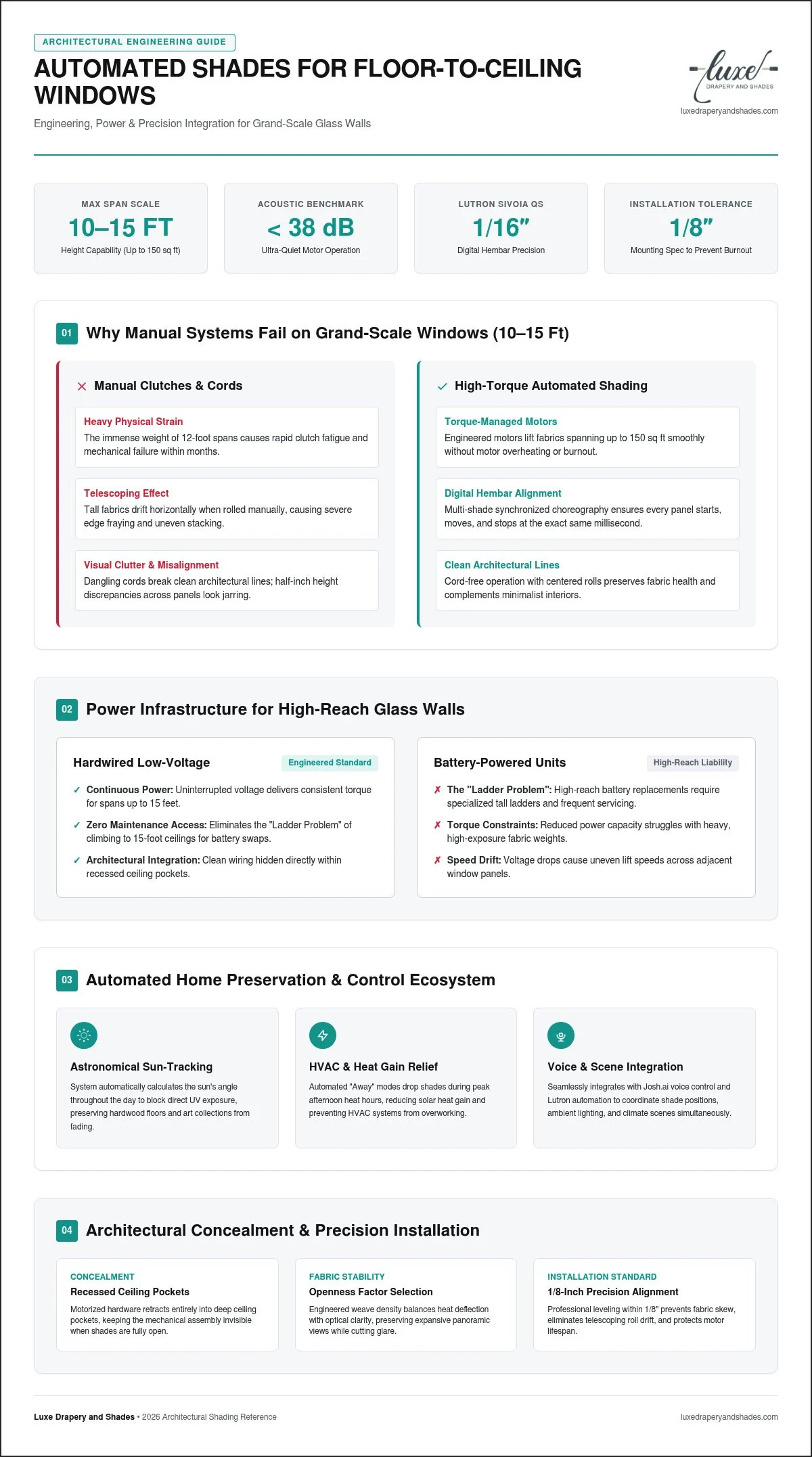
In the world of high-end design, a “Grand Scale” window is more than just glass. It’s an engineering challenge. When window spans reach 10 to 15 feet in height, standard residential hardware simply isn’t enough. These expansive views define Los Angeles architecture, but they also demand a specialized approach to light control. Selecting automated shades for floor to ceiling windows isn’t just about convenience; it’s about managing the immense physical weight of the fabric while ensuring every panel moves in perfect, uniform alignment. When you have five or six massive windows in a single row, even a half-inch discrepancy in height is jarring. Automation ensures a synchronized choreography that manual systems can’t replicate.
Why Manual Shades Fail at Scale
Manual operation becomes a liability at this scale. The sheer weight of a 12-foot roller shade puts incredible strain on traditional clutches and cords, often leading to mechanical failure within months. In a minimalist environment, long dangling cords are a visual distraction and a safety risk. There’s also the issue of “telescoping.” This occurs when tall shades begin to drift horizontally as they roll up, often caused by minor imperfections in the wall or the fabric’s own weight. Automation solves this through precision motors that maintain a perfectly centered roll every time, preserving both the fabric and the motor’s lifespan.
The Role of Automation in Home Preservation
Modern luxury homes on the LA Westside face intense UV exposure. Without a proactive strategy, sun-drenched interiors quickly lose their luster. High-performance window blinds and automated shading systems use astronomical clocks to track the sun’s position throughout the day. This technology allows your shades to adjust automatically, protecting expensive hardwood floors and bespoke furniture from fading. It’s a silent guardian for your home’s interior. By utilizing automated “away” modes, you can significantly reduce solar heat gain. This keeps your living space comfortable and protects your HVAC system from overworking during those peak afternoon hours. You don’t have to remember to close the shades; the house thinks for you.
Motorization Tech: Powering Your Grand-Scale Shades
Engineering the movement of a fabric span that covers 150 square feet requires more than just a simple motor; it requires precision torque management. For automated shades for floor to ceiling windows, the motor must be perfectly matched to the fabric’s weight to prevent burnout and ensure a smooth, consistent lift. This is where high-end systems distinguish themselves from mass-market alternatives. While a standard motor might struggle and create a grinding noise, luxury-grade systems operate with a “Silent Movement” benchmark, often staying below 38 decibels. This whisper-quiet performance is essential in open-concept Los Angeles homes where sound carries across polished surfaces.
One often overlooked aspect of grand-scale shading is hembar alignment. When multiple shades are installed side-by-side along a glass wall, they must move in perfect unison. If one shade is even slightly out of sync, the visual harmony of the room is lost. Advanced motorization uses digital hembar alignment to ensure that every shade starts, moves, and stops at the exact same millisecond. This prevents the “telescoping” effect, where tall shades begin to drift or roll unevenly due to weight distribution issues, a common problem in inferior systems.
Lutron Sivoia QS: The Industry Standard for 2026
Lutron Sivoia QS remains the definitive choice for sophisticated estates because of its unparalleled reliability. It offers 1/16th inch precision, allowing for exact positioning that highlights architectural lines. This system integrates seamlessly with Lutron home automation, enabling homeowners to create “scenes” where shades, lighting, and climate adjust simultaneously. The result is a home that feels intuitive and alive, responding to your needs with a single touch or voice command. This level of control is particularly vital for grand salons where the atmosphere needs to shift from bright and airy to intimate and private in moments.
Powering High-Reach Windows
The “Ladder Problem” is a common pitfall for those considering battery-powered options for tall windows. While battery motors have improved, they typically require charging every six to twelve months. Climbing a 14-foot ladder in a double-height foyer to plug in a charging cable is neither safe nor luxurious. For this reason, hardwired 24V low-voltage power is the gold standard for new constructions and major renovations. It removes the maintenance burden and provides the consistent current needed for heavy, tall fabrics. Planning for this power during the framing phase ensures a clean, wire-free look.
If you are working with an existing space where running wires isn’t feasible, the Lutron Sivoia Triathlon offers a high-performance wireless alternative. It utilizes patented power-management technology to extend battery life, though hardwiring remains the preferred path for ultimate reliability. For those seeking a tailored solution, exploring custom motorization options ensures your technology matches your home’s ambition.
Fabric Selection for High-Exposure Glass Walls
Choosing the right textile for automated shades for floor to ceiling windows is a sophisticated exercise in balancing physics with interior design. In a city where sunlight is both a celebrated feature and a preservation challenge, the fabric you select must perform under extreme UV pressure. It’s not merely about aesthetics; it’s about how the material interacts with the specific orientation of your home. A fabric that works beautifully in a North-facing bedroom might fail to protect a West-facing grand salon from the intense afternoon heat. We look for materials that offer technical resilience without losing the soft, tactile quality of a luxury interior.
Managing Heat and Glare
The “Openness Factor” of a shade determines how much light and heat pass through the weave. In the sun-drenched San Fernando Valley, West-facing glass can become a thermal liability. We often recommend a 1% to 3% openness factor for these high-exposure areas to mitigate heat gain effectively. Darker fabrics, counterintuitively, often provide a clearer view of the landscape because they absorb light rather than reflecting it into the room. For those seeking the ultimate in climate control, fabrics with reflective silver backings can bounce solar energy away before it enters the home, significantly reducing cooling costs while maintaining daytime privacy. This approach is often complemented by advanced glass shielding from specialists like Sunshield Group to maximize thermal efficiency and UV filtration.
When a shade drops 120 inches or more, the physical stability of the weave is tested. Inferior fabrics often suffer from “cupping” or “curling” at the edges, where the vertical sides of the shade bow inward over time. To prevent this, we prioritize stable, engineered weaves that resist stretching under their own weight. For exceptionally wide spans, “railroading” the fabric allows us to cover the entire width without unsightly seams. In dedicated home theaters or bedrooms, integrating side channels ensures the fabric remains taut and eliminates the light “halo” that often surrounds standard rollers. This precision ensures your shades remain as crisp and straight as the day they were installed.
True luxury often involves layering. Many homeowners find that a dual-shade system, which pairs a sheer solar screen with a blackout roller, provides the most versatile 24/7 light control. To complete the architectural vision, these systems can be designed for aesthetic continuity by matching your automated shades for floor to ceiling windows with custom drapes in Los Angeles. This layering adds depth to the room while providing a second tier of insulation and sound dampening.
Architectural Integration and Control Systems
The hallmark of a truly luxury installation is the seamless disappearance of the hardware. For automated shades for floor to ceiling windows, the primary objective is to celebrate the view while masking the mechanics. When shades are retracted, they should vanish into the architecture, leaving the glass clean and unobstructed. Achieving this level of refinement requires meticulous planning between the designer, architect, and professional integrator. This design philosophy is often mirrored in high-end Northern Michigan vacation rentals, where architectural integration is key to highlighting breathtaking lakefront views while maintaining a clean interior aesthetic. It’s about ensuring the technology serves the aesthetic, not the other way around.
Ceiling Pockets and Recessed Mounting
Designing the shade pocket during the early framing stage is the most effective way to achieve a completely “invisible” look. For a dual-roller system, which houses both a sheer and a blackout fabric, you’ll typically need a pocket depth of at least 7 to 9 inches. This depth ensures that even the large-diameter rolls required for 15-foot drops stay completely hidden from sight. If you’re working with an existing space where pockets aren’t feasible, custom-finished fascias provide a sophisticated alternative. These covers wrap the rollers in materials that match your window mullions or ceiling trim, creating a cohesive and intentional architectural detail.
The User Experience: Keypads and Voice
While smartphone apps offer convenience, they often lack the immediate elegance of a curated wall interface. Systems like Lutron Sivoia ecosystems allow for the integration of Palladiom keypads. These keypads feature backlit buttons and premium finishes like satin brass, clear anodized aluminum, or matte black. They act as functional art, providing a tactile and intuitive way to manage your environment without searching for a device.
Control logic is where the system truly shines. You can program custom “scenes” that adjust multiple shades simultaneously based on the time of day or specific activities. A “Morning” scene might gently raise the sheers to 50% while keeping the blackouts retracted, allowing soft light to filter in without full exposure. For those seeking a touchless experience, Josh.ai provides natural language processing designed specifically for luxury estates. Unlike mass-market voice assistants, this system prioritizes privacy and understands complex, room-specific commands. You can simply say, “Josh, lower the living room shades,” and the system responds instantly. This creates a frictionless environment where your automated shades for floor to ceiling windows respond to your lifestyle with effortless grace.
Achieving this level of architectural harmony requires early collaboration and technical expertise. You can contact our design team to review your floor plans and ensure your motorization is perfectly integrated into your home’s structure.
The Professional Installation Advantage in Los Angeles
The final realization of a design vision depends entirely on the precision of its execution. For automated shades for floor to ceiling windows, the margin for error is virtually nonexistent. In a 15-foot drop, a discrepancy of just a fraction of an inch can cause the fabric to track poorly or rub against the mounting bracket, leading to premature motor wear. Professional installation is the essential bridge between a high-end product and a high-performance environment. It ensures that the quiet luxury promised by the technology is actually delivered once the ladders are put away.
Precision Measurement for Tall Windows
Measurement at this scale requires more than a standard tape; it requires a deep understanding of structural physics. We utilize laser technology to verify the plumb and levelness of the entire window casing. It’s rare for a 12-foot opening to be perfectly square. We account for these architectural nuances by calculating precise fabric deducts, ensuring that light gaps are minimized while allowing the motor to operate without resistance. When managing 50 feet or more of continuous glass, we ensure every hembar aligns perfectly at every stop point. This creates a clean, horizontal line that respects the room’s architectural integrity.
Why Hire a Licensed Contractor?
The physical installation of heavy motorized hardware in high-reach areas carries significant liability. Handling massive rolls of fabric while balanced on scaffolding requires specialized equipment and a trained, steady team. As a licensed and bonded California contractor (CSLB #1066068), we provide the security and expertise required for high-value Los Angeles properties. Our role extends beyond mounting hardware; we are specialists in the expert programming of Lutron Roman shades and roller systems.
Programming is where the system’s intelligence comes to life. We configure the limits, set the communication frequencies, and integrate the shades with your broader home automation ecosystem. Once the physical work is complete, our white-glove service continues with dedicated post-installation support. We ensure your 2026 smart home stays synced, providing the technical reliability that high-end motorization demands. This long-term perspective transforms a simple purchase into a lasting investment in your home’s daily atmosphere and comfort.
Elevating Your Architectural Vision
Transforming expansive glass walls into a functional masterpiece requires a sophisticated blend of high-torque engineering and aesthetic sensitivity. By prioritizing precision motorization and selecting fabrics designed for the Southern California sun, you ensure your home remains a sanctuary of comfort. We’ve explored how automated shades for floor to ceiling windows are no longer just an accessory; they’re a vital component of modern estate management. From recessed ceiling pockets to whisper-quiet Lutron systems, every detail contributes to a lifestyle of effortless elegance.
As a Lutron Diamond Dealer and a licensed California contractor (CSLB #1066068), Luxe Drapery and Shades provides the technical expertise and white-glove installation required for premier Los Angeles and South Bay estates. Our team is dedicated to preserving your view while protecting your interiors with the highest standard of craftsmanship. We invite you to Schedule Your Private Design Consultation in Los Angeles today to begin crafting a tailored shading solution for your home. Your windows are the lens through which you experience the world. Let’s frame that view with perfection.
Frequently Asked Questions
What is the best motor for 12-foot floor-to-ceiling shades?
Lutron Sivoia QS is the industry benchmark for 12-foot windows. It provides the high-torque power needed to move heavy fabric spans without the risk of motor burnout. This system is specifically engineered for grand-scale glass, offering near-silent operation and 1/16th-inch precision. In luxury Los Angeles estates, this reliability ensures that your shades remain perfectly aligned across multiple panels, maintaining the architectural harmony of your living space.
Can I automate shades if my windows are already installed without wiring?
You can certainly automate existing windows using high-performance wireless technology. Systems like Lutron Sivoia Triathlon are designed for finished spaces where running new low-voltage wiring is impractical. These battery-powered units offer exceptional longevity and integrate seamlessly with smart home platforms. While we recommend hardwiring for renovations, these wireless solutions provide a sophisticated retrofit option for Los Angeles homeowners who want the convenience of automation without a major construction project.
How much noise do automated shades make in a quiet bedroom?
Premium automated shades for floor to ceiling windows are engineered for quiet luxury, typically operating at sound levels below 38 decibels. This is significantly quieter than a typical conversational tone or a standard air conditioning unit. In a quiet bedroom, the movement is barely audible, ensuring your morning routine or evening wind-down remains peaceful. By choosing specialized motors like Lutron Sivoia, you avoid the mechanical noise and vibrations common in lower-quality alternatives.
What is the maximum width for a single motorized floor-to-ceiling shade?
A single motorized shade can typically span up to 12 feet in width, though this depends on the specific fabric and motor capacity. For the expansive glass walls found in many Los Angeles homes, we often use heavy-duty tubes to prevent the fabric from sagging or “smiling” in the center. If your window is wider, we can couple multiple shades together or use side-by-side rollers that operate in perfect synchronization for a clean look.
Do automated shades require regular maintenance or battery changes?
Hardwired systems are essentially maintenance-free once our team completes the professional installation and programming. They rely on your home’s power, so there are no batteries to manage. For wireless installations, battery life typically lasts three to five years under normal use. We provide ongoing support for Los Angeles clients to ensure your software stays updated and your shades remain perfectly synced with your Lutron or Josh.ai control systems for long-term reliability.
How do I hide the motor and roller on my floor-to-ceiling windows?
The most refined way to hide motors is through recessed ceiling pockets designed during the construction or renovation phase. This allows the roller to be completely invisible when the shades are up. In existing Los Angeles homes, we use custom-finished fascias or sleek top treatments that blend into your window frames. These architectural integration techniques ensure that the mechanical elements never distract from your interior design or the breathtaking views outside your windows.
Can automated shades be integrated with my existing Lutron lighting system?
Seamless integration is one of the primary benefits of choosing a Lutron ecosystem. As specialized integrators, we connect your shades directly to your Lutron lighting control system. This allows you to create synchronized “scenes” where your lights and shades adjust together at the touch of a button. Whether you’re setting the stage for a movie or preparing for a dinner party, your home environment responds with intuitive, professional-grade precision.
How do automated shades help with my electric bill in Los Angeles?
In Los Angeles, automated shades for floor to ceiling windows are a powerful tool for energy management. By using astronomical clocks to track the sun, your shades can automatically close during the hottest parts of the day. This reduces solar heat gain and lowers the demand on your air conditioning system. Protecting your home from intense UV exposure not only lowers your electric bill but also prevents expensive furniture and flooring from fading over time.