

An inside mount isn’t automatically the best fit for every bi-fold door. For automated shades for bi-fold doors in Los Angeles, choose an inside mount when the frame has enough depth and the brackets clear the door hardware and glass. Otherwise, an outside mount may suit the opening better. Custom sizing helps the shade fit the actual door frame and maintain a clean, considered look.
It’s understandable to focus first on whether the shade sits inside or outside the frame. The right choice also depends on how the doors fold, how often they’re used, and how much light and privacy you want to manage. This guide explains how mount fit, cordless operation, shade style, and precise measurements shape the decision, including why a shade fitted to each panel can work differently from one spanning the full opening.
Key Takeaways
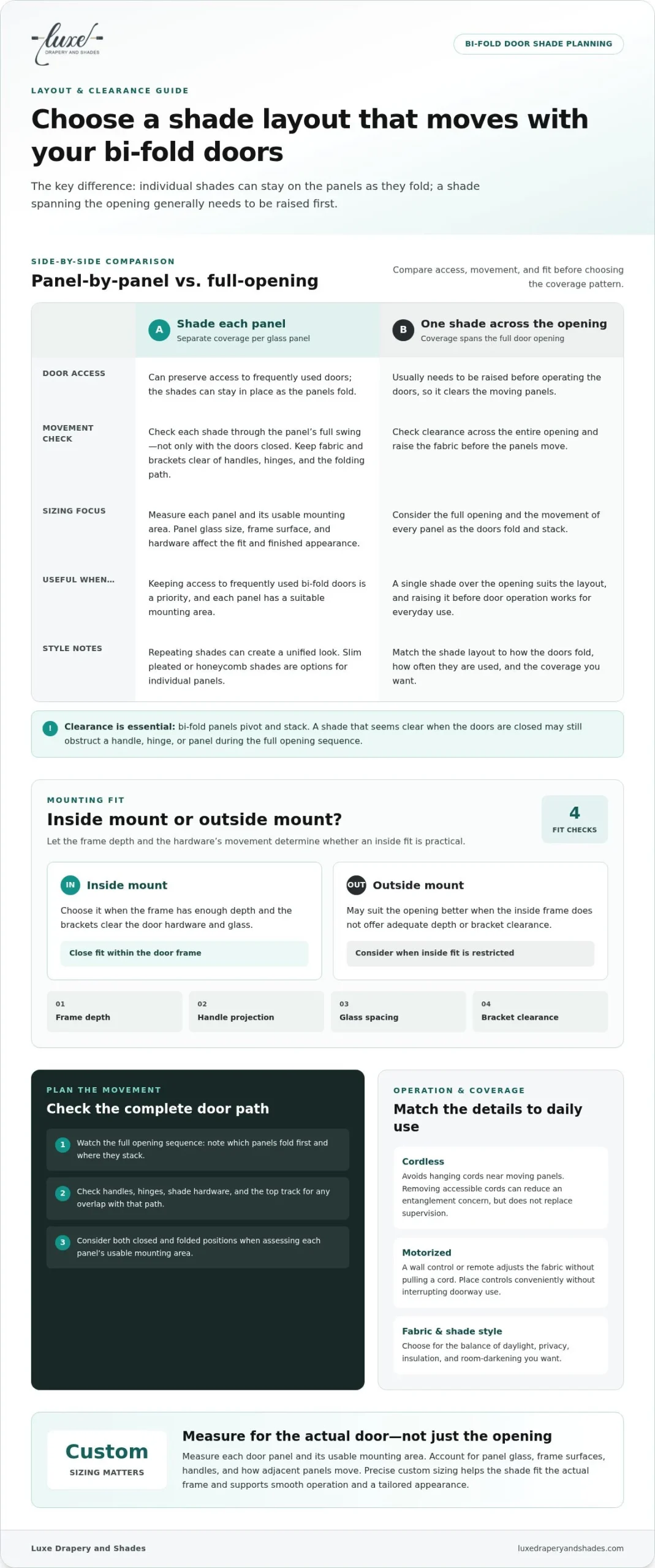
- Choose shades panel by panel when preserving access to frequently used bi-fold doors is a priority; a shade spanning the full opening generally needs to be raised before the doors move.
- Compare inside- and outside-mount fit by looking at frame depth, handle projection, glass spacing, and bracket clearance.
- Consider cordless operation for a cleaner look around a high-traffic doorway, without hanging cords in the way.
- Match fabric and shade style to the balance of daylight, privacy, insulation, and room-darkening you want.
- Measure each door panel and its usable mounting area carefully so custom sizing supports smooth operation and a tailored appearance.
What makes blinds for bifold doors different?
Bi-fold doors fold across their opening, so each panel needs room to move. Shade placement must suit the panel layout, how the door operates, and the available mounting surface.
Shade Selection for Door Panels
Start by deciding whether each glass panel needs its own shade. Slim pleated or honeycomb shades mounted on individual panels can provide privacy while preserving access to frequently used bi-fold doors. For example, a shade on each panel can stay in place as the doors fold, unlike one covering the full opening.
Compare panel widths, frame surfaces, and handles before choosing a shade style. A roller shade spanning the full opening usually needs to be raised before you operate the doors. Panel-by-panel shades provide separate coverage, but the position and size of each panel’s glass affect the finished look. Match the shade layout to the doors’ folding direction and everyday use.
Consider the visual rhythm, too. Repeating shades across the panels can create a unified appearance, while different coverage needs may call for a more selective layout. Honeycomb shades are one option for individual panels. The key is to ensure their placement clears the door hardware and leaves the panels free to fold.
Panel Movement and Shade Clearance
Bi-fold panels pivot and stack, so a shade that fits when the doors are closed can still obstruct movement. Observe the full opening sequence: note where handles travel, which panels fold first, and where they stack. Then check whether the shade or its brackets occupy any part of that path.
For a roller shade covering the full opening, raise the fabric before operating the doors. This keeps it clear of the moving panels. With individual shades, check each panel through its full swing rather than judging clearance only when the doors are closed. A projecting handle or a bracket near a hinge can affect how freely a panel folds.
Access through the doorway matters, too. A bi-fold security screen may include a walk-through panel with its own lock, allowing passage without folding back every screen panel. That’s a screen feature, not a shade configuration, but it illustrates why the route through the opening deserves attention during planning.
Panel Capacity Considerations
Panel count shapes the design, but capacity figures must apply to the correct system. A bi-fold track shutter system can connect up to six panels to a top track. That figure describes the shutter system, not a universal limit for shades or a recommendation for every door.
For shades, assess each panel’s usable mounting area and how its covering interacts with adjacent panels. A narrow frame, projecting handle, or limited flat surface can affect whether an individual shade fits cleanly. Map the panels in both their closed and folded positions, then consider how each shade will move alongside the others.
For example, a door with several folding panels may need separate shade coverage, while a single roller across the opening must clear the entire door’s movement. Treat the door as a moving assembly, not simply a broad window. This distinction helps align shade placement, panel access, and a composed appearance.
Cordless operation and child safety
Cordless shades suit busy doorways because they avoid hanging cords near moving panels. In homes with children, removing accessible cords can reduce an entanglement concern, but it doesn’t replace attentive supervision around any window covering. Check that each shade stays clear of handles and hinges as the bi-fold doors open and fold.
Motorized shades offer another way to adjust coverage without pulling a cord. A wall control or remote lets you move the fabric while standing clear of the door panels. The operation is simple, but control placement still matters: position it conveniently without interrupting the doorway’s everyday use.
The top track guides how the bi-fold door panels move. Shade hardware must not obstruct that route or interfere with the panels as they fold and stack. Watch the full door movement, then consider where the shade headrail, fabric, and controls sit in relation to the track. A shade that operates smoothly while the doors are closed may still conflict with moving panels.
Are permits or electrical work required to install hardwired automated shades in Los Angeles? Hardwired shades require an electrical connection. Whether the work requires a permit depends on the installation scope and applicable Los Angeles requirements.
Which Los Angeles companies install motorized shades for bi-fold doors? Custom window-treatment specialists install motorized shades, measuring the opening and fitting the system to the door layout. Choose a service focused on motorized window treatments and bi-fold door clearance.
Can automated shades for bi-fold doors integrate with Alexa, Google Home, or Apple HomeKit? Compatibility with Alexa, Google Home, or Apple HomeKit depends on the selected motor and control system. A platform name alone doesn’t establish that a specific shade will connect.
What common problems or safety concerns arise with motorized shades on bi-fold doors? Shade fabric or hardware can interfere with folding panels, handles, or the top track if their paths overlap. Cordless operation avoids hanging cords, while thoughtful control placement and clear panel movement help keep the doorway practical.
Before selecting motorized shades, map the door’s movement and identify how you’ll operate the shades each day. This simple step connects child-conscious cordless use, convenient fingertip control, and top-track clearance in one plan.
Inside-mount versus outside-mount installation
The choice depends on the recess, hardware clearance, glass spacing, and bracket surface. An inside mount sits within the door frame for a close fit. An outside mount sits beyond the recess, extending coverage over the frame or adjacent surface. For bi-fold doors, the better fit clears moving panels and supports smooth shade operation.
Inspect each panel’s frame rather than measuring only the full opening. Check the recess depth from the front edge to the glass, then note handles, hinges, and trim that reduce usable space. An inside mount works when depth, hardware clearance, and glass spacing allow it. A frame with little flat area for brackets may make this option impractical.
Depth measurements can vary across a single frame. Caulking where glass meets the frame may narrow the usable recess, so measure at several points instead of relying on one reading. A homeowner asking about an inside mount for trifold doors reported a depth of 3/4 to 1 inch, with the smaller measurement caused by caulking at the glass. That example illustrates why the narrowest point matters.
For an outside mount, assess the surface beyond the recess and the space needed for the shade. Position it to cover the intended glass area without colliding with handles or folded panels. Consider the doors both closed and open. A shade may cover the glass neatly when closed but interfere with a handle or panel stack during operation.
Compare the options by recording the same details for every panel:
- Measure the available recess depth and identify changes caused by trim or caulking.
- Mark handle and hinge projection, then observe their movement as panels fold.
- Locate the flat bracket area and check whether it remains clear of door hardware.
- Compare the shade’s planned position with the glass and the full opening path.
Choose an inside mount when the recess offers enough depth and clearance, and the brackets have a suitable flat area. Choose an outside mount when the recess cannot accommodate the shade without obstruction, provided the surrounding surface allows secure placement. For a multi-panel door, assess each frame individually: small differences can affect alignment and the finished appearance.
Before finalizing placement, operate the bi-fold doors through their full range and inspect the proposed shade position. This practical fit test brings together recess depth, glass spacing, bracket area, and panel movement. The result should preserve access while giving the glass a considered, well-proportioned finish.
Light, privacy, insulation, and blackout needs
Start with the room’s daily use, then decide how much light each glass panel should admit. A living area may benefit from softened daylight, while a bedroom may need stronger light control. Bi-fold doors often span a broad opening, so consider whether coverage should follow each panel or the entire glazed area.
For filtered light, choose a fabric that diffuses daylight rather than blocking it. This can soften glare while keeping the room bright. For privacy, consider the view from outside during the day and evening. A fabric that feels private in daylight may look different at night when interior lights are on.
Blackout describes the fabric’s light-blocking intent, not necessarily a completely dark room. Light can still enter around the fabric’s edges or between separate panel shades. For example, a shade fitted to each glass panel may leave narrow gaps at the frame or between adjacent panels. Account for these openings when darkness is a priority.
Insulation needs also influence fabric choice. Honeycomb or cellular shades have a structured form that creates pockets within the material. These pockets add a layer between the room and the glass, which can help moderate the feeling of drafts or temperature changes near a glazed door. The result depends on fit, fabric, and coverage, so treat insulation as a design consideration rather than a guaranteed outcome.
Use this simple decision path for each room:
- For softened daylight: choose a light-filtering fabric and decide how much view you want to retain.
- For privacy: consider nighttime visibility as well as daytime sightlines.
- For deeper darkness: prioritize light-blocking material and account for perimeter gaps.
- For a more insulated feel: compare cellular construction and the coverage each panel allows.
Then consider how the choice works with the door’s everyday use. A family room may need shades that adjust to changing daylight without making the doorway feel closed. A bedroom with bi-fold doors may prioritize reduced light, while a dining area may favor filtered brightness and an outdoor view.
Finally, coordinate fabric color and texture with the interior. A pale neutral can maintain a light, restrained look; a deeper tone can add visual definition across the glass. Compare samples with the room’s finishes and view them in daylight and evening light. This final step connects practical coverage with the atmosphere you want in the room.
Custom sizing for bi-fold glass doors
Custom sizing starts with the individual glass panels, not the doorway’s overall width. Bi-fold frames can vary slightly from panel to panel, and one measurement may miss changes near a hinge, handle, or trim edge. Record each panel separately and map its measurements to its place in the folding sequence. For automated shades for bi-fold doors in Los Angeles, this panel-by-panel approach reflects the door’s actual configuration.
For each panel, measure the available width and height at several points. Compare the width at the top, middle, and bottom, then note differences between the left and right sides. Uneven frames or projecting hardware can affect usable coverage. For an inside mount, measure the recess and identify its narrowest usable area. For an outside mount, record the surface available around the glass and any nearby trim.
Keep a schedule for each panel rather than combining measurements into one opening size. Label each entry by location, such as the left end panel or the panel nearest the walk-through side. Note which way each panel folds and where handles sit. This record helps distinguish a narrower panel from a measuring error and supports a consistent visual line across the doors.
- Measure the frame: capture width and height at multiple points on each panel.
- Mark obstructions: record handles, hinges, trim, and projecting hardware.
- Map panel movement: note where each panel folds and stacks when opened.
- Label every entry: match each measurement to the panel’s location and folding direction.
Compare proposed shade dimensions with the door in both positions. Closed panels show how the shades align across the glass. Folded panels reveal whether fabric, brackets, or headrails enter the stacking path. For example, a shade sized to the full opening may look balanced when closed but obstruct a folded door. Panel-specific sizing can account for that difference and maintain a cleaner relationship between shade and frame.
Precision also shapes the finished appearance. Consistent alignment across neighboring panels creates a composed view, while each shade follows its own frame. For automated shades for bi-fold doors in Los Angeles homes, measurements should account for the desired coverage and the door’s proportions. Custom drapery can complement glass doors when a softer treatment suits the interior, provided it preserves access.
The practical takeaway is simple: measure each panel, document its hardware and movement, then size the treatment for that specific position. A clear measurement schedule connects the visual plan with the way the doors function every day.
Luxe Drapery and Shades: Custom Drapery
Luxe Drapery and Shades helps bring measurements and design priorities together in a cohesive window-treatment plan. For bi-fold glass doors, Custom Drapery can complement the room’s interior, while Roller Shades, Roman Shades, and Honeycomb / Cellular Shades offer distinct approaches to light and privacy. The right selection depends on the opening, desired coverage, and how you use the doors each day.
Turn to Luxe Drapery and Shades when you’re ready to translate panel dimensions and room needs into a tailored treatment. Contact Luxe Drapery and Shades to discuss your bi-fold door project.
Shape a More Seamless Doorway
The best window treatment feels considered both in motion and at rest. As you plan automated shades for bi-fold doors in Los Angeles, think beyond the glass: consider how the treatment will complement the room’s finishes and the atmosphere you want. A refined fabric choice can make a functional doorway feel like an intentional part of the interior.
Luxe Drapery and Shades offers Custom Drapery, Roller Shades, and Roman Shades, giving you distinct ways to shape the look and atmosphere around bi-fold doors. Share your light, privacy, and design priorities, then explore an option that suits your home.
Contact Luxe Drapery and Shades to discuss your project and take the next step toward a more cohesive living space.
Frequently Asked Questions
What types of automated shades work best for bi-fold doors?
Motorized roller shades and honeycomb shades can suit different room priorities. For automated shades for bi-fold doors in Los Angeles, consider the interior style, desired light control, and how you use the doorway. Roller shades offer a streamlined appearance, while cellular shades have a distinct textured profile. A living room that needs filtered daylight may call for a different fabric than a bedroom where privacy matters more.
How are motorized shades installed on bi-fold doors without obstructing folding panels?
Installation planning should account for the door’s movement from fully closed to fully folded. Note where the panels stack, which side serves as the regular entrance, and where handles project. Then keep shade components clear of those movement paths. Planning automated shades for bi-fold doors in Los Angeles this way helps preserve access while keeping the treatment visually composed across the glass.
What are the best motorized shade brands for bi-fold doors?
The right choice depends on the shade design and your preferred control setup. Luxe Drapery and Shades offers Lutron shades and Lutron lighting control systems, giving homeowners an option for coordinated shade and lighting control. Brand selection alone doesn’t determine suitability. Consider the door configuration, how you want to operate the shades, and whether integration with the home’s control system matters.
Are battery-powered, hardwired, or solar-powered shades best for bi-fold doors?
The right power approach depends on the room and installation plan. Battery-powered shades avoid a fixed electrical connection at the window, while hardwired systems use one. Solar-powered options depend on suitable light. Consider visible wiring, shade location, and the room’s light exposure. These factors help narrow the choice without assuming every power option suits every doorway.
What light-filtering and blackout fabrics are available for bi-fold door shades?
Fabric choices range from light-filtering materials that soften daylight to blackout-oriented options designed to block more light. The right choice depends on the room’s use: a street-facing living space may prioritize privacy, while a bedroom may favor stronger light control. Consider color and texture alongside coverage, since the shade remains part of the interior even when raised. Edges and gaps can also affect how much light enters.
What measurements are needed to order shades for bi-fold doors?
Record the width and height of each panel’s glass, along with the frame or recess area where the shade will mount. Label each measurement by panel position and note handles, hinges, and trim that may affect placement. Identify whether each measurement refers to the glass, frame opening, or mounting surface. A clearly labeled record distinguishes individual panel dimensions from the full doorway size.