

The most useful wind-resistant outdoor screens are the ones suited to your space and how you use it. Retractable screens can be raised or lowered, while fixed screens create a consistent boundary around a patio.
Both options can make an outdoor setting more comfortable, but they suit different needs. Retractable screens offer flexibility when weather or privacy preferences change; fixed screens define the space without needing to be moved.
This guide explains how to choose between adjustable and fixed screens, what to consider when pairing screens with an awning, pergola, or patio roof, and how fabric, retention, and installation affect performance. You’ll also learn where a custom outdoor shading solution can bring the practical details and the overall design together.
Key Takeaways
- Match the screen configuration to your awning, pergola, or patio roof so the installation works with the structure and the way you use the space.
- Consider fabric openness, dimensions, and frame finish together to balance airflow, privacy, light, and visual harmony.
- Understand how magnetic, zipper, and keder track systems retain the screen, since the attachment method affects its wind performance.
- Explore fixed screening when you want a lasting privacy feature, and weigh its placement against the patio’s layout and exposure.
Screen compatibility with awnings, pergolas, and patio roofs
Start with the structure, not the fabric. A screen beside an awning, pergola, or patio roof needs a suitable mounting surface and a clear path that won’t obstruct doors, posts, or moving parts. For example, a side screen on a louvered pergola should sit outside the louvers’ operating area. This allows the roof to adjust while the screen defines the patio’s edge.
With louvered pergolas, placement matters as much as the screen itself. The installer considers post positions, roof movement, drainage, and the direction of prevailing weather before setting the screen’s track and travel. A screen can offer shade and shelter along one open side, while leaving other sides unobstructed. Wind-resistant outdoor screens are not a substitute for operating guidance: retractable models are commonly pulled up or down manually.
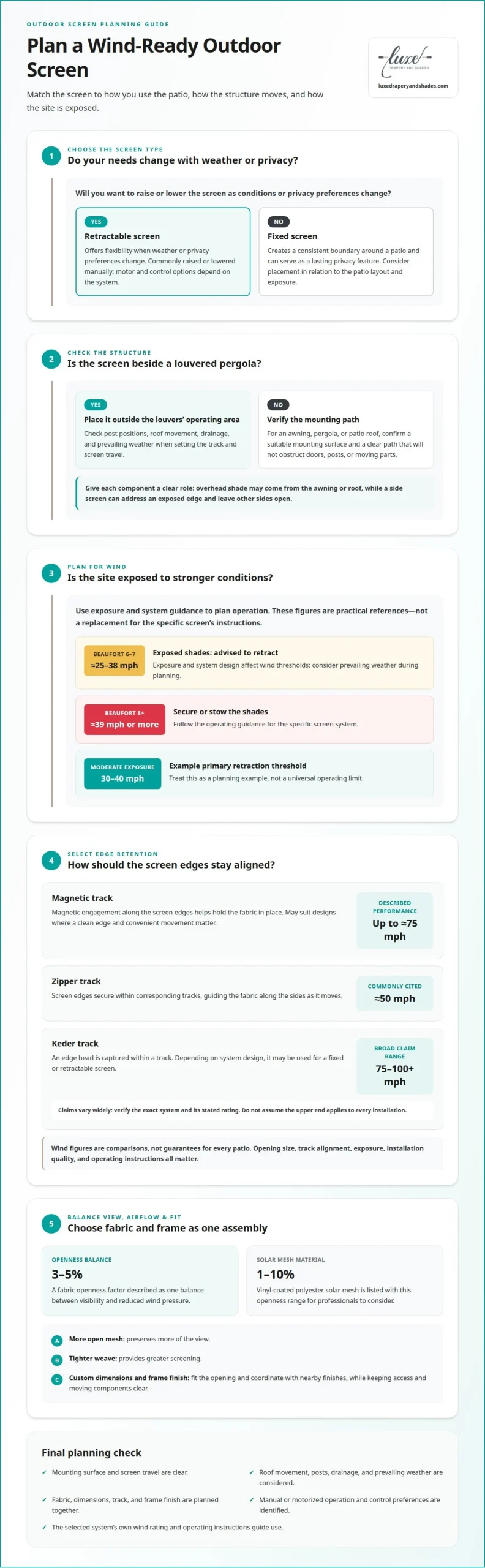
Wind thresholds vary with exposure and system design. As a practical reference, Beaufort 6-7 corresponds to approximately 25-38 mph; exposed shades are advised to retract in those conditions. For moderate exposure, 30-40 mph is an example primary retraction threshold. At Beaufort 8 or higher, approximately 39 mph or more, shades should be secured or stowed. These figures help frame planning, not replace the specific operating instructions for a screen.
Smart-home compatibility depends on the motor and control system, not simply on whether a screen fits a pergola. During planning, identify whether the screen is manual or motorized and decide which controls should operate it. For example, you may want an outdoor screen controlled separately from the pergola louvers, or coordinated alongside outdoor media equipment from HDTV Supply. Planning how these controls work together helps keep operation intuitive.
Pair the screen with the structure’s purpose: an awning may already provide overhead shade, while a pergola screen can address an exposed side. Shading specialists such as gundsoe-markiser.dk illustrate how tailored awnings and side screens work together to handle both direct light and breezy conditions. Consider how the screen will be retracted and secured as conditions change. Giving each component a clear role helps preserve roof movement and everyday access.
Customizable screen sizes, fabrics, and frame colors
Professionals choose mesh and frame designs by weighing wind exposure, desired visibility, and the patio structure. A 3-5% fabric openness factor offers one balance between visibility and reduced wind pressure.
How Professionals Specify Screen Sizes and Frame Colors
Screen dimensions are tailored to the opening, with the surrounding structure guiding the fit. For example, a screen beside a pergola post needs to cover the intended span without obstructing access or moving components. Mounting surfaces and track placement should be considered together because both shape the finished dimensions and the screen’s travel.
Frame color is both a design choice and a visual detail. Coordinate it with nearby finishes, such as dark pergola posts or pale patio trim, so the screen feels integrated. The frame’s profile and placement also affect how it relates to the architecture. Matching finishes across adjoining openings can create a cohesive look.
How Professionals Select Fabrics and Frame Designs for Wind
Fabric openness affects the view through the screen and how much wind pressure the material may experience. A 3-5% openness factor is one balance between visibility and reduced wind pressure. Solar mesh made from vinyl-coated polyester is listed with an openness factor of 1-10%, giving professionals a range to consider for light, privacy, and airflow.
The right choice depends on the site’s exposure and your priorities. A more open mesh preserves more of the view, while a tighter weave provides greater screening. The frame design also needs to suit the opening’s width, mounting surface, and track layout. These details determine how the screen is supported, so fabric choice should not be the only consideration.
For a high-wind location, consider the mesh and frame as one assembly. Account for the patio’s exposure, the desired sightline, and how the screen attaches to the structure. For example, a broad opening facing prevailing weather may call for a different design balance than a sheltered side. A site-specific assessment helps guide material selection beyond color or fabric openness alone.
Magnetic, zipper, and keder track retention
Track retention describes how a screen’s edges stay aligned with its frame. Magnetic, zipper, and keder systems connect in different ways, so compare their stated wind performance and practical fit when selecting a system.
Magnetic Screen Retention
Engineered magnetic-track systems use magnetic engagement along the screen’s edges to help hold the fabric in place. Their wind performance is described as up to approximately 75 mph. That figure offers a useful comparison, not a substitute for the specific system’s operating guidance.
For a patio with frequent breezes, consider the opening, track alignment, and how you’ll use the retractable screen. Magnetic retention may suit a design where a clean edge and convenient movement matter. The selected system still needs to suit the installation and exposure.
Zipper Screen Retention
Zipper-track systems secure the screen edges within corresponding tracks. Their commonly cited wind performance is approximately 50 mph. The track keeps the fabric guided along the sides as the screen moves, making this retention style a practical option for retractable installations.
Consider the screen’s dimensions, track placement, and site exposure together. A zipper system’s stated performance is a reference for that system, not a guarantee for every patio. Installation quality and the screen’s operating instructions also matter.
Keder Track Retention
Keder retention uses an edge bead captured within a track. High-performance or keder claims span 75-100+ mph, a broad range that makes the exact system and its stated rating essential points of comparison. The upper end should not be assumed for every keder installation.
Ask how the selected retention method suits the opening and its exposure. Depending on the system design, a keder track may be used for a fixed or retractable screen. The full assembly should suit the structure, edge support, and intended operation; a retention label alone doesn’t establish suitability.
Compare the three methods by their stated performance and intended use. Magnetic systems are associated with up to approximately 75 mph, zipper systems with approximately 50 mph, and keder or high-performance claims with 75-100+ mph. The right choice depends on the full installation, not a single figure.
Fixed outdoor privacy and wind-screen elements
Fixed screens create a lasting boundary, while retractable systems adapt to changing use. The better choice depends on exposure, the level of wind protection you want, and whether the opening needs to remain clear.
Fixed Screens and Wind Resistance
Fixed screens stay in place, so their resistance depends on the complete assembly: mesh, frame, retention, and attachment to the structure. Keder systems carry some of the highest stated performance claims, while a fixed privacy screen may prioritize a defined boundary over adjustability.
Retractable screens can be raised or stowed as conditions change. Motorization changes how a screen operates, but does not by itself determine its wind rating. Compare the rating and operating guidance for the specific system; no screen type is automatically strongest in every installation.
Wind Ratings, Warranties, and Installation Rules
Compare products by their specific wind ratings and written warranty terms, not by brand name alone. Check what the rating applies to, which components the warranty covers, and whether installation conditions affect coverage. A rating for one model should not be assumed to apply across an entire product line.
Permit and code requirements depend on the project and local jurisdiction. For example, a screen attached to a pergola may be treated differently from a freestanding privacy element. The installation plan should account for the structure, attachment method, and location.
Purchase and Installation Costs
The cost to buy and install a screen depends on its dimensions, materials, retention system, frame, and installation conditions. A wide opening or complex attachment may require a different scope than a simple, accessible span.
Pricing depends on the project and is provided after a quote request, based on screen size, selected materials, system design, and installation requirements.
Wind Damage Risks
Strong gusts can strain fabric, tracks, frames, and mounting points. A loosened screen may strike nearby windows, furnishings, or landscaping. Since a fixed screen can’t be stowed, its placement and attachment deserve particular attention in exposed locations.
Keep the screen and tracks clear of debris, and follow the system’s operating guidance during windy weather. For a motorized screen, use its prescribed retraction settings; for a manual model, retract or secure it as instructed. Plan a patio screen installation around the structure and its exposure.
Luxe Drapery and Shades: Outdoor Shades
Luxe Drapery and Shades designs and installs outdoor shades and zip screens to suit patios in Los Angeles. Choose these options when you want adjustable screening integrated with an outdoor area rather than a fixed privacy element.
For a patio beside a pergola or awning, the design can account for the opening, surrounding structure, desired privacy, and how you’ll use the screen. Zip screens provide a guided-screen format; outdoor shades offer another way to balance light and openness. Start with the setting and the role you want the screen to play.
To discuss outdoor shades or zip screens for your patio, contact Luxe Drapery and Shades.
Shape Your Patio Around the Way You Live
A well-chosen screen should feel like part of the patio, not an afterthought. Picture how you want the space to feel during an ordinary afternoon: open to the garden, more private, or softly defined as an outdoor room. That intention can guide placement and appearance while keeping the screen’s purpose clear.
Wind-resistant outdoor screens work best as part of a considered design that respects your home’s architecture and how you use the space. Bring those priorities into a tailored plan, with attention to how the finished patio should look and function.
For a thoughtful conversation about your outdoor space, contact Luxe Drapery and Shades. A well-chosen detail can make time outdoors feel more inviting and distinctly your own.
Frequently Asked Questions
Are the screens adjustable?
Some screens are adjustable, while fixed screens stay in position. Retractable designs can be raised or lowered, giving you flexibility when you want an open view or more enclosure. For example, a patio used for dining and entertaining may benefit from a screen that moves out of the way. The operating method depends on the selected system.
How Do Powder-Coated Frames and Corrosion Resistance Enhance Longevity?
Powder coating adds a finished layer to a frame’s surface, helping protect the material underneath from exposure. If the coating is damaged, moisture and weather can reach the underlying surface, so the finish’s condition matters over time. In coastal or frequently damp settings, consider the frame material and finish together when assessing suitability.
How Does the Beaufort Scale Relate to Outdoor Shade Wind Resistance?
The Beaufort scale describes wind conditions, while a shade’s wind rating describes the system’s stated performance. Beaufort 4-5 corresponds to approximately 13-24 mph, and Beaufort 5 corresponds to approximately 19-24 mph. These ranges can help describe conditions at a patio, but they aren’t a substitute for the operating limits of a particular screen.
How Do Professionals Choose and Install Motorized Patio Shades for Windy Locations?
When planning motorized shades, consider the patio opening, exposure, mounting surface, and intended controls. In Los Angeles, the outdoor layout can influence whether a screen fits beside a pergola, awning, or other structure. The installation plan should also account for how the shade operates and integrates with smart devices, including touch or voice control where supported.
How much wind and sun does the wind screen block?
There isn’t one universal wind or sun-blocking figure for every screen. Market examples include shade cloth marketed as providing 90% sun shade, while wind performance varies by design and retention system. These measures describe different things: sun shade concerns sunlight reduction, while wind performance concerns the screen assembly. Choose based on the specific product’s stated purpose and rating.
What wind speeds can retractable outdoor screens withstand?
Stated performance varies by retention system, so the rating for a specific screen matters. Market examples describe zipper-track systems at approximately 50 mph and engineered magnetic-track systems up to approximately 75 mph. High-performance or keder claims range from 75-100+ mph. These figures aren’t interchangeable; wind exposure, installation, and the product’s operating guidance all matter.