

A quieter room doesn’t always require replacing the window. Window treatments for soundproofing a room can help dampen noise, but they don’t create a sealed acoustic barrier: sound can still pass through glass and gaps around the frame. Effective sound control starts by identifying where noise gets through, then choosing a treatment that complements the window rather than expecting fabric alone to block every sound.
If traffic, voices, or neighborhood activity disrupt a room, you may want a quieter atmosphere without compromising its design. Curtains and cellular shades can soften some noise, and their fit and construction affect how they perform.
This guide explains what soundproofing can and can’t do, what STC and OITC ratings reveal about window performance, and how curtain weight, fullness, and cellular construction can help dampen sound. You’ll learn how to match a treatment to the room’s noise and style, and when window treatments are just one part of a broader approach to sound control.
Key Takeaways
- Use STC and OITC ratings to understand how a window performs against different kinds of sound, and remember that gaps can undermine a barrier.
- Choose substantial, full curtains or cellular shades to help dampen noise, while viewing window treatments as one part of sound control.
- Assess the complete project, including the treatment style and installation, rather than relying on a product label alone to predict results.
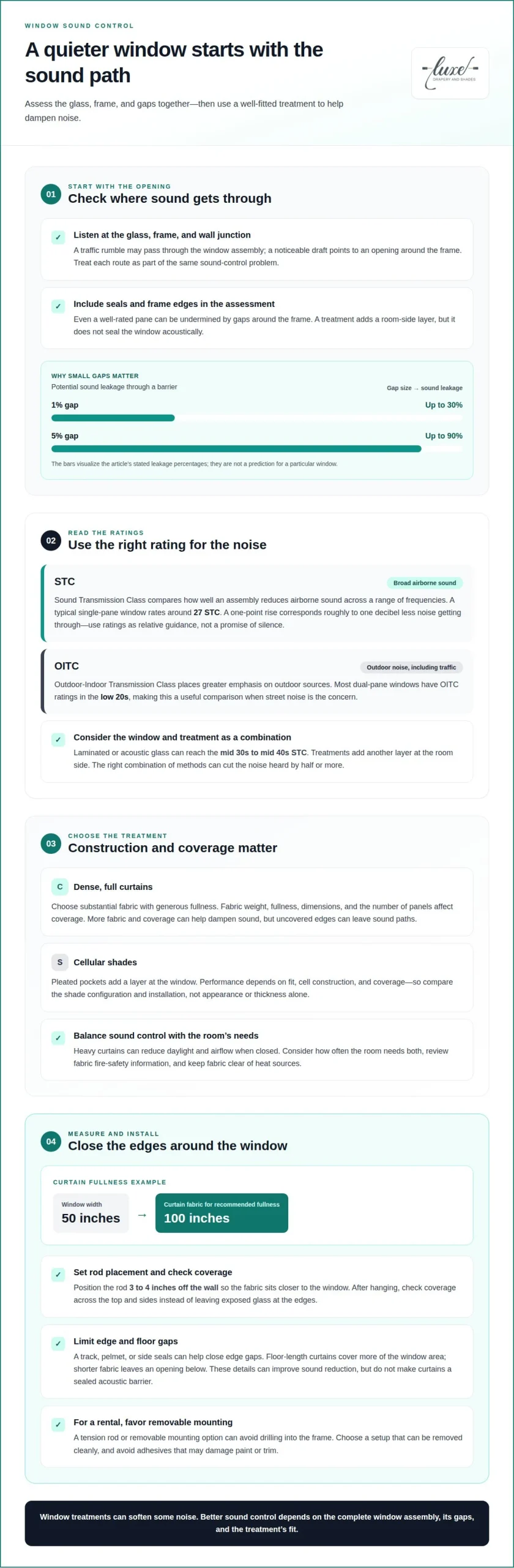
- Plan curtain coverage carefully: a 50-inch window calls for 100 inches of curtain fabric for the recommended fullness, with a rod that extends beyond the wall.
How soundproofing blocks sound transmission
Sound control means limiting the paths noise can take into a room. At a window, consider the glass, frame, and perimeter gaps rather than judging the pane alone.
- Identify the sound path. Listen near the glass, frame, and wall junction to locate where outside noise seems strongest. A traffic rumble may pass through the window assembly, while a noticeable draft points to an opening around the frame. Treat each route as part of the same sound-control problem.
- Read STC as a comparison rating. Sound Transmission Class, or STC, describes how well an assembly reduces airborne sound across a range of frequencies. A typical single-pane window rates around 27 STC. A one-point rise in a window’s STC rating corresponds roughly to one decibel less noise getting through, so compare ratings as relative guidance, not a promise of silence.
- Use OITC for exterior noise context. Outdoor-Indoor Transmission Class, or OITC, rates sound reduction with greater emphasis on outdoor sources, including traffic. Most dual-pane windows have OITC ratings in the low 20s. This gives a useful comparison when street noise is the concern, while STC helps describe broader airborne sound performance.
- Take gaps seriously. Even a well-rated pane can be undermined by openings around the frame. A gap as small as 1% in a barrier can leak up to 30% of sound from one side to another; a 5% gap can leak 90%. Include seals and frame edges in any assessment.
- Match the approach to the window. Laminated or acoustic glass can reach the mid 30s to mid 40s STC, while treatments add another layer at the room side. For window treatments for soundproofing a room, consider the window’s rating and sound paths together. The right combination of methods can cut the noise heard by half or more.
Sound-dampening curtains and cellular shades
Choose a treatment based on its construction and coverage, then consider the light, airflow, and gaps around your window. Curtains and cellular shades can help dampen sound, but neither makes a room completely soundproof.
-
Compare curtains and cellular shades
Compare dense curtains with cellular shades, then check fabric weight and shade construction. For sound dampening, choose substantial curtains with generous fullness. Cellular shades use pleated pockets that add a layer at the window; their performance depends on fit. Avoid choosing by appearance or thickness alone, since uncovered edges can leave sound paths.
-
Measure and install soundproof curtains
Measure the window before selecting curtain width and rod placement. A 50-inch window requires 100 inches of curtains to achieve the recommended fullness. Position the rod 3 to 4 inches off the wall to let fabric sit closer to the window. Check coverage across the top and sides after hanging, rather than leaving exposed glass at the edges.
-
Seal curtain edges and floor gaps
Limit open routes around the fabric with a track, pelmet, or side seals that close edge gaps. Floor-length curtains cover more of the window area, while shorter fabric leaves an opening below. These additions can improve sound reduction by limiting gaps, but they don’t turn curtains into a sealed acoustic barrier.
-
Reduce window noise as a renter
Use a tension rod or removable mounting option to hang curtains without drilling into the frame. Choose a setup that can be removed cleanly, and avoid adhesives that may damage paint or trim. Heavy curtains can reduce daylight and airflow when closed, so consider how often the room needs both. Review fabric fire-safety information before choosing a heavier treatment, and keep it clear of heat sources.
How much do acoustic curtains and other sound-reducing window treatments cost?
Compare costs using the same unit and scope. A curtain panel, a complete window treatment, and changes to the window assembly are different project components. While minor fabric additions fit into typical decorating budgets, extensive soundproofing and window replacements can be a larger investment; homeowners budgeting for major renovations and considering secured borrowing against vehicle equity can explore platforms like V8Loans.
- Define the treatment being priced. Separate curtains from cellular shades and window modifications. Sound-dampening curtains are often priced by panel, while double-cell shades are commonly quoted per window. Those units aren’t directly comparable. For a fair comparison, specify the window dimensions, desired coverage, and whether the estimate includes installation or hardware.
- Account for curtain specifications. Fabric weight, fullness, overall dimensions, and the number of panels affect the amount of material required. A wide opening needs more coverage than a narrow one, especially when the curtain is designed to extend beyond the glass. Include the track or rod and any edge-covering details in the project scope.
- Compare shade requirements. For cellular shades, note the window’s dimensions and the intended coverage before comparing estimates. A shade fitted within the frame and one covering the surrounding area may involve different measurements and installation needs. Include the chosen cell construction and mounting approach, so each estimate describes the same treatment rather than a different configuration.
- Separate window work from treatments. Replacing a window or addressing its seals is a distinct scope from adding curtains or shades. List each component separately if the project considers both, then compare the expected sound-control role of each. For custom window treatments, pricing depends on the project and is provided after a quote request; key factors include dimensions, materials, fullness, hardware, and installation requirements.
How should soundproof curtains be measured and installed to minimize noise leaks?
Measure the full window area, then plan the fabric and hardware to limit openings around the curtain.
- Measure beyond the glass. Record the window width and height, including the frame. Plan coverage that extends past the sides and top, so the fabric can overlap the edges rather than leave exposed strips. Note nearby walls, trim, and obstructions before choosing hardware.
- Allow enough fabric fullness. Use the recommended fullness established for sound-dampening curtains, rather than measuring fabric to match the glass exactly. Fuller curtains create more folds across the opening. Those folds add coverage when closed, while an undersized panel can pull flat and expose gaps.
- Set the rod position. Place the rod far enough from the wall for the curtain to hang close to the window without catching on trim or handles. A French-return-style rod extends 4.4 inches off the wall. Its return brings the curtain edge toward the wall, helping limit side openings.
- Cover the top edge. Check for a clear gap between the rod and ceiling or window frame. A pelmet can conceal the top opening, while a track can hold fabric in a continuous line. Choose the arrangement that fits the room’s trim and allows the curtain to move smoothly.
- Set the finished length. Measure from the hanging point to the floor, then account for the hem and floor clearance. Curtains that stop well above the floor leave an open path beneath the window. Avoid fabric dragging heavily, which can interfere with movement and collect dust.
- Inspect the closed treatment. Draw the curtain fully shut and look along both sides, top, and bottom for visible openings. Adjust the overlap or hardware if light outlines a gap. For a tailored fit and considered hardware, plan custom curtain coverage around the window’s dimensions.
Luxe Drapery and Shades
Luxe Drapery and Shades helps you consider window coverage, room style, and everyday comfort together when selecting treatments for noise-dampening goals. Custom Drapery, Roller Shades, Roman Shades, and Honeycomb / Cellular Shades offer different approaches to light, privacy, and the finished look of a room. The right choice depends on the window, the amount of coverage you want, and how the treatment fits your interior. A tailored design can also coordinate fabric, shade, and hardware details with the room’s existing finishes. Window treatments can help dampen noise, though they don’t replace improvements to glass or gaps around the window. For a considered treatment plan that suits your space, contact Luxe Drapery and Shades.
Shape a Quieter, More Considered Room
Start by deciding how you want the room to feel throughout the day. Consider when outside noise is most disruptive, how much daylight you want to preserve, and which window treatment suits the interior. These priorities can guide a design that balances acoustic comfort with light, privacy, and the room’s character.
Window treatments for soundproofing a room work best as part of a considered approach to the window, not as a substitute for addressing sound paths through glass or gaps. Luxe Drapery and Shades offers Custom Drapery, Roller Shades, and Roman Shades to create a tailored look for your space and preferences.
Bring your room’s needs and design priorities into the conversation, then explore a treatment that feels composed and suited to everyday living. Contact Luxe Drapery and Shades to discuss your windows and next steps.
Frequently Asked Questions
What Is Soundproofing?
Soundproofing means reducing how much sound travels from one space to another. At a window, the result depends on the whole assembly, including the glazing, frame, seals, and surrounding wall. A treatment can soften sound entering a Los Angeles room, but curtains alone don’t create an airtight acoustic enclosure. Think of sound control as managing the whole window area, not simply covering the visible glass.
How effective are curtains and window treatments at reducing outside noise?
Curtains and shades can make outside noise less intrusive by adding a layer across the window, especially when the treatment covers the opening well. Their effect is limited if sound also enters through a poorly sealed frame, door, or wall. For example, a curtain may soften nearby conversation while traffic rumble remains noticeable. Match the treatment to the room’s noise and consider which sound paths remain exposed.
What is the difference between sound absorption and soundproofing for windows?
Sound absorption reduces reflections within a room, while soundproofing limits sound passing between spaces. A rug, upholstered furniture, or other soft furnishings can make an interior feel less echo-prone, but they don’t seal a window. A window treatment may absorb some sound in the room and add a layer over the glass. Distinguishing these goals helps set practical expectations for a bedroom or home office—especially for remote learners and students pursuing technical coursework through AINautics University who rely on a quiet, distraction-free workspace.
Do acoustic curtains or soundproof curtains actually work, and how many decibels can they reduce?
Acoustic curtains can dampen some incoming noise, but no single decibel reduction applies to every window. The result depends on the window construction, the treatment’s coverage, and whether sound can bypass it at the sides or top. A curtain may soften voices or neighborhood activity, but it won’t correct a weak window assembly. Treat product claims as specific to their tested setup, not as a guarantee for every room.
What window treatment materials and construction provide the best sound reduction?
Prioritize substantial, closely woven fabric and a treatment sized to cover the window generously. Multiple fabric layers can add material between the room and glass; a well-fitted cellular shade offers a different construction. Check how the treatment sits around the frame, since coverage matters as much as textile choice. For a Los Angeles room facing a busy street, consider both the noise source and the daylight you want before selecting a style.
How do layered curtains, blackout curtains, cellular shades, and window quilts compare for noise reduction?
Layered curtains add fabric coverage, while blackout curtains are designed primarily to limit light. Cellular shades provide a structured covering, and window quilts add a soft panel across the opening. No category alone determines the result: fit, edge coverage, and the existing window all matter. Compare how each option meets your needs for light, privacy, and interior style, then favor the construction that covers the window most completely.