

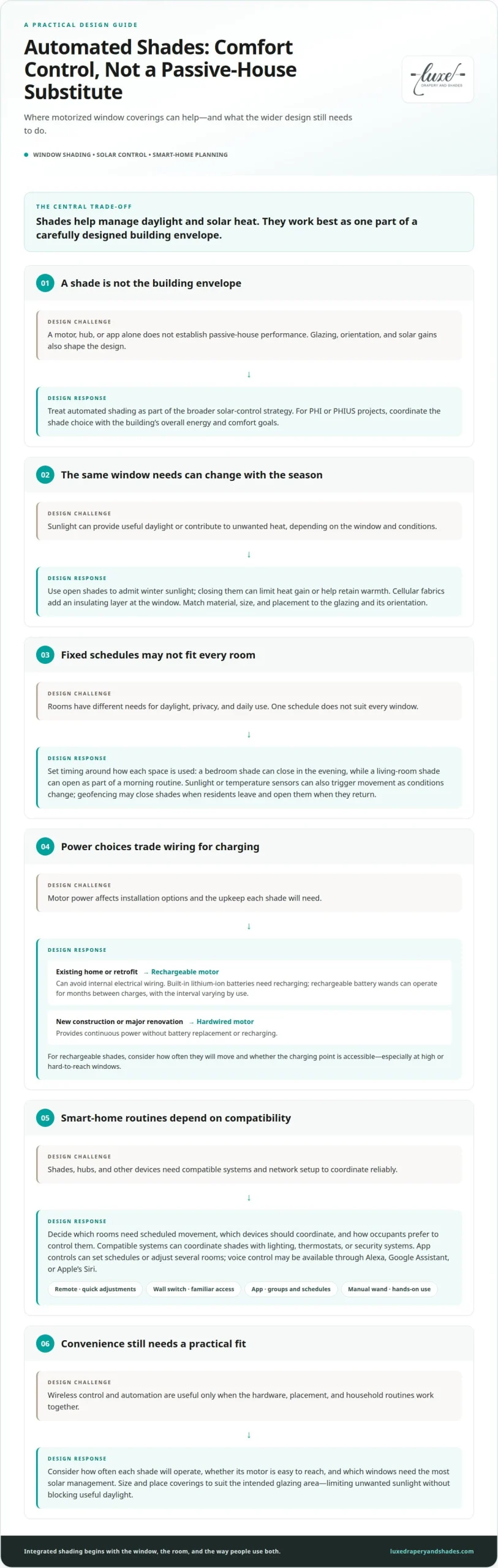
The trade-off is straightforward: automated shades can help manage solar heat and daylight, but they do not replace a well-designed passive house envelope. Automated shades for passive house design can admit winter sunlight when open and limit heat gain or retain warmth when closed. Cellular fabrics add an insulating layer at the window. Consider, too, the motors and controls, power needs, connectivity, and ongoing upkeep.
It’s reasonable to wonder whether that added complexity is worth it. The answer depends on your windows, climate, daily routines, and how much control you want over light and temperature. This article explains how automated shades support indoor comfort, how they can work with smart home systems, and what durability and practical limitations to weigh. You’ll also learn where shade type and placement matter, so you can consider the technology as part of a thoughtful, integrated design rather than a standalone fix.
Key Takeaways
- Use schedules and control options to shape daylight and privacy around your routines.
- Plan smart-home integration around the systems you want shades to coordinate with, such as lighting and temperature controls.
- Choose a motor and power setup that suits the home, weighing retrofit flexibility against the upkeep of rechargeable batteries.
- Match shade material and timing to each window’s sun exposure to support comfort without treating shades as a substitute for the home’s overall design.
Why Install Smart Blinds or Shades?
Automated window coverings combine scheduled movement with direct controls to help manage daylight, privacy, and indoor comfort. In a smart home, the right setup makes shading a practical part of daily routines.
Shade Control Options
Controls can include a remote, wall switch, app, or manual wand. A remote suits quick adjustments from across a room, while a switch offers familiar access near an entry. Apps can group shades in shared spaces, and a wand provides hands-on operation where motorized control is not needed. Choose controls based on who uses each room and how they move through it.
Privacy and Light Scheduling
Schedules move shades at set times to balance privacy and daylight. A bedroom shade, for example, can close in the evening, while a living-room shade opens as part of a morning routine. Some systems can also use geofencing to close shades when residents leave and open them when they return. Set timing to match how each room is used.
Passive House Shading Requirements
For PHI or PHIUS projects, automated shades for passive house design belong within the broader solar-control strategy. A motor, hub, or app alone doesn’t establish building performance; glazing, orientation, and solar gains also shape the design. There isn’t one universal shade product or schedule for every project. The design team considers how shading supports the building’s overall energy and comfort goals.
Sizing, Positioning, and Shade Sensors
Shade dimensions and placement should cover the intended glazing area and suit the window’s orientation. This can limit unwanted sunlight without blocking useful daylight. Sunlight or temperature sensors can trigger movement as conditions change, while scheduled controls offer another approach. A smart hub can coordinate compatible shades, and supported systems may offer voice control. Match the controls to household routines and the windows that need the most solar management.
Integrating motorized shades with smart home systems
For passive house windows, choose a shade type based on each window’s role. Honeycomb or cellular shades can add insulation; other coverings may better suit the room’s needs for light control, privacy, and design. Consider the material and how the shade operates alongside the window and the home’s control system.
A central hub or smart home ecosystem can coordinate compatible motorized shades with lighting, thermostats, and security systems. For example, a routine can lower a living-room shade while adjusting lights, then open it again when daylight is useful. A Z-Wave hub can connect compatible smart-home products into a network using Wi-Fi. Compatibility between the shades, hub, and other devices shapes which routines can run together.
Voice assistants offer another way to adjust window shades. Compatible systems can respond to commands through Alexa, Google Assistant, or Apple’s Siri, so occupants can request a change without opening an app. App controls are useful for setting schedules or adjusting shades in several rooms; voice commands suit quick changes during everyday activities. Available controls depend on the devices and smart-home system.
Commercial smart buildings use similar principles across larger spaces. Coordinated controls can manage shades in line with building routines and connected lighting or temperature controls. Plan around how each space is used instead of applying the same schedule to every window.
For residential projects, a clear integration plan starts by identifying which rooms need scheduled movement, which devices should coordinate, and how occupants prefer to control them. A thoughtful motorized shade integration plan can connect those choices to the home’s design and daily routines.
Motor durability and wireless connectivity
Motor choice affects how shades operate, receive power, and need to be maintained. In an existing home, rechargeable battery-powered motors can avoid internal electrical wiring. In new construction or a major renovation, hardwired motors provide continuous power without battery replacement or recharging.
Rechargeable motors use built-in lithium-ion batteries, avoiding wired power or space for external battery packs. Rechargeable battery wands can operate for months between plug-in charges, though the interval varies with use. A frequently adjusted shade may need charging sooner than one moved occasionally. Consider whether the charging point is accessible, especially for a high or hard-to-reach window.
Wireless control makes motorized shades easier to operate without reaching a chain or cord. A motorized roller shade, for example, can open or close using its compatible control. This can be useful for tall windows, skylights, or rooms where several shades need coordinated movement. Convenient control still depends on suitable hardware and placement.
For wireless control, the motor and control system need to be compatible. A hub or smart-home system can connect compatible devices, allowing users to send commands without a wall connection to each shade. In a room with several coverings, grouping compatible motors can simplify operation. Connectivity depends on system compatibility and network setup.
Durability depends on choosing a motor and power arrangement suited to the window’s use. Hardwired power avoids routine battery charging, while rechargeable power can simplify a retrofit. Consider how often each shade will operate, whether its motor is easy to reach, and how the controls will support daily use. Reliable operation should complement the room’s lighting and design without adding unnecessary complexity.
Energy efficiency and indoor temperature regulation
Window treatments affect how sunlight and heat influence indoor comfort. Their contribution depends on the shade type, placement, and how occupants use them.
Energy Efficiency in Net-Zero Buildings
In a net-zero building, energy efficiency helps limit demand that on-site energy production must balance. Automated shades support that goal by managing solar heat and daylight through the windows. The U.S. Department of Energy says tightly installed cellular shades can reduce heat loss through windows by 40% or more during heating seasons and save about 10% of heating energy. These figures show why fit and material matter.
Energy Use and Heat Management
Managing heat means limiting unwanted heat gain while retaining warmth when it benefits the home. Shade schedules can respond to sunlight, temperature, or time, helping occupants adjust heating or cooling as conditions change. For example, lowering a shade on a sun-exposed window can help temper afternoon heat, while opening it during colder daylight hours can admit solar warmth. A remote or compatible assistant also lets occupants adjust window treatments when indoor conditions change.
Interior and Exterior Shade Performance
Exterior shades intercept sunlight before it passes through the glass, helping manage heat gain and glare at the window. Interior shades act after sunlight enters, giving occupants control over brightness, privacy, and the room’s feel. The right choice depends on the window, sun exposure, and how the space is used. Exterior shading can change a bright room’s solar exposure; interior shading offers convenient control from inside.
Explore exterior shading options as part of a coordinated approach to heat and glare control.
Luxe Drapery and Shades
Luxe Drapery and Shades can help match your temperature-control priorities with window treatments suited to your home’s design. Options include motorized shades, Roller Shades, Roman Shades, Honeycomb / Cellular Shades, and Custom Drapery, so you can consider light management, privacy, and visual continuity together.
For a passive house project, connect each window’s exposure and intended use with the shade type and control approach. Honeycomb / Cellular Shades have a distinct construction, while motorized options support scheduled operation. The right combination depends on the room, glazing, and how you want to manage daylight and comfort.
Contact Luxe Drapery and Shades to discuss window treatments for your Los Angeles home.
Shape a More Thoughtful Window Plan
Treat shading as part of the home’s overall design, not a finishing detail. Consider which rooms need adaptable light, where privacy matters most, and how each window’s role fits your daily routine. This helps turn the principles of automated shades for passive house design into considered, cohesive choices.
Luxe Drapery and Shades can help you explore how Custom Drapery, Roller Shades, and Roman Shades suit your windows and interiors. The goal is a tailored approach that balances visual character with practical control, supporting the atmosphere you want to create.
Share your project and design priorities with Luxe Drapery and Shades to begin shaping a window plan that feels distinctly yours.
Frequently Asked Questions
Are There Any Downsides?
Yes. Automated shades add motors and controls that need compatible components, thoughtful setup, and attention to power. Rechargeable models need periodic charging, while wireless controls rely on a suitable connection. Schedules can also become inconvenient when household routines change. A fixed closing time, for example, may reduce daylight in a room used later than expected, so set routines to match how each space is occupied.
How Much Did They Cost?
The cost of an automated shade project depends on its specifications and installation scope. Window dimensions, shade materials, motor and power choices, and the number of controls all affect the quote. Several windows with coordinated smart-home controls have different requirements from a single shade with a simple control. Luxe Drapery and Shades provides a project quote after a request.
Were They Difficult To Install & Set-Up?
Installation and setup involve fitting the shades, selecting controls, and configuring any smart-home connection. In an existing home, battery-powered motors can avoid internal electrical wiring; hardwired motors suit new construction or major renovations. Luxe Drapery and Shades’ process includes accurate measurements, product ordering, and scheduled installation. Discussing control preferences alongside window measurements helps align the finished setup with the home.
How do automated shades support passive house energy performance?
Automated shades support energy performance by helping occupants manage solar heat at individual windows. A south-facing room, for example, can admit winter sun during the day, while a sun-exposed room may need less heat gain at other times. Shade selection and timing should complement the building’s glazing, orientation, and overall energy strategy, not replace its thermal envelope.
How do automated shades integrate with passive house HVAC and home automation systems?
Compatible motorized shades can connect to a smart-home hub and coordinate with thermostats, lighting, or security systems. For example, a routine might lower shades as a room warms while a thermostat manages the HVAC response. Alexa, Google Assistant, and Siri can provide voice commands when supported by the system. Successful coordination depends on compatible devices and routines suited to how occupants use each space.
What are typical installed costs for automated shades in the United States?
There is no single installed cost for every U.S. project. A quote reflects window size, shade selection, motor and power configuration, control integration, and installation scope. Los Angeles homeowners planning treatments for several rooms may have different requirements from those shading a single window. Luxe Drapery and Shades provides project pricing after a quote request, based on the selected treatments and work involved.