

A shaped window shouldn’t have to lose its character to be covered. Custom shaped window covering solutions are designed around the window’s dimensions and angles, with choices guided by the room’s needs for light, privacy, and visual softness. Accurate measurements help the treatment sit neatly within the architecture.
An unusual window shape doesn’t have to mean awkward gaps or limited choices. Start with the window itself: its form, how it opens, and the atmosphere you want to create. Then narrow the options to treatments that balance appearance and everyday function.
This guide covers options for arched, angled, bay, and narrow windows, along with how light-filtering and room-darkening fabrics can shape a space. It also explains the factors that affect a project estimate and schedule, including window complexity and material selection, so you can make an informed decision.
Key Takeaways
- Choose blackout, light-filtering, or dimout fabric according to the room’s privacy needs and preferred level of daylight.
- Accurate measurements and professional installation help shaped treatments fit cleanly and operate smoothly.
- Match the treatment to the window’s geometry: arched and angled designs call for a considered approach to coverage and visual continuity.
- Project cost and manufacturing time depend on factors such as window complexity, selected materials, and the work involved.
Should I choose blackout or light-filtering fabric for specialty windows?
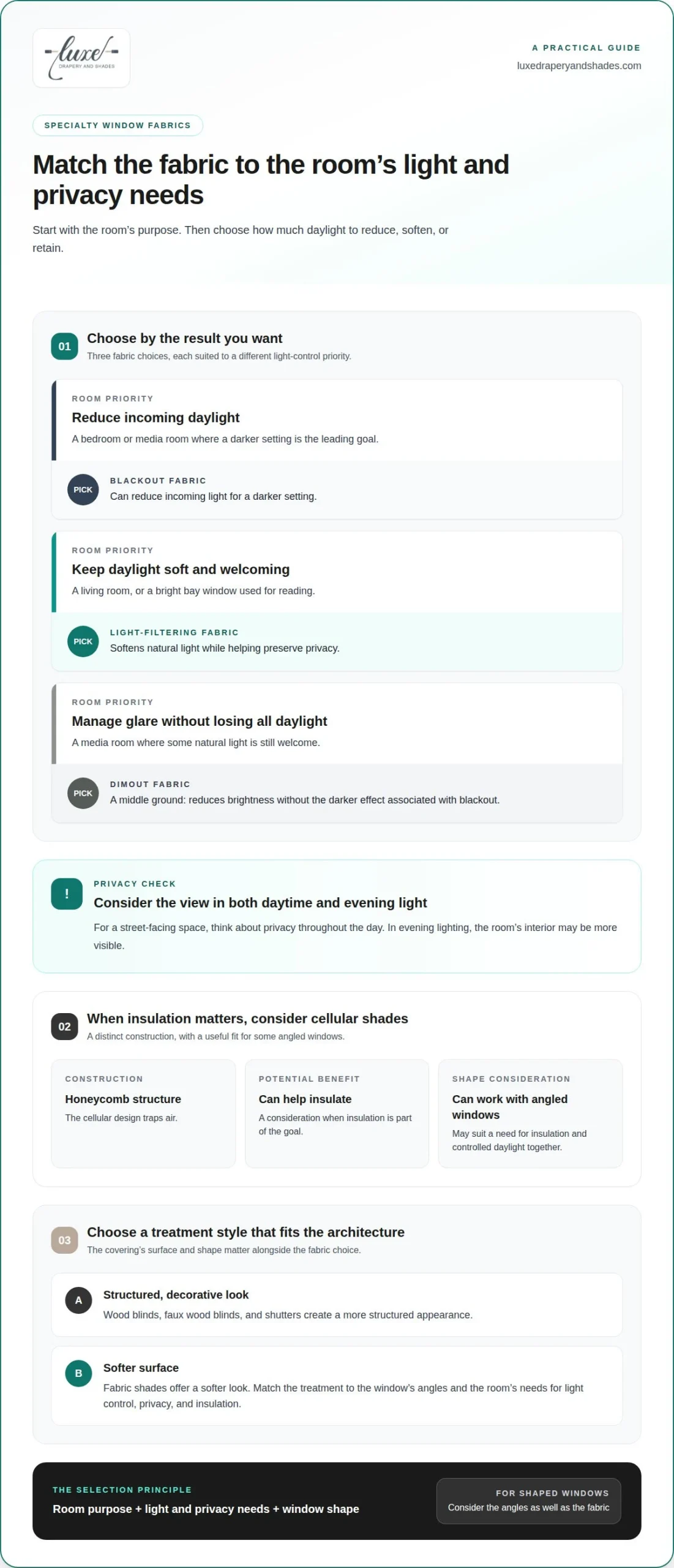
Start with the room’s purpose, then decide how much daylight and privacy you want. In a bedroom, blackout fabric can reduce incoming light for a darker setting. In a living room, light-filtering fabric softens daylight while helping preserve privacy. For angled windows, make the same choice with the window’s shape in mind.
Dimout fabric sits between these options. It reduces brightness without creating the darker effect associated with blackout fabric. In a media room, it may help manage glare while retaining some natural light. For a street-facing space, consider privacy in both daytime and evening lighting, when the room’s interior may be more visible.
Use these priorities to narrow the material selection:
- Blackout: Choose it when reducing daylight is the leading goal, such as in a bedroom or media room.
- Light-filtering: Consider it where softened natural light matters, such as a bright bay window used for reading.
- Dimout: Select it for a middle ground when glare control matters, but some daylight is still welcome.
Insulation can also guide your choice. Cellular shades have a honeycomb construction that traps air, which can help insulate a window. They can also work with angled windows, making them worth considering when you want insulation and controlled daylight together.
Consider the whole window, not just the fabric. Wood blinds, faux wood blinds, and shutters create a structured, decorative look, while fabric shades offer a softer surface. For custom shaped window covering solutions, match the treatment to the window’s angles, the room’s use, and its needs for light control, privacy, and insulation. This helps the covering feel integrated with the architecture.
How to Cover Your Shaped Windows?
Start with the window’s geometry, then consider its dimensions, treatment style, and installation method. For an angled opening, careful measuring helps the finished covering follow its architectural lines.
Measuring Unusual Window Shapes
Measure the frame’s width and height at several points, since an angled or curved opening may not be uniform. Note the shape, frame depth, nearby handles, and anything that could obstruct movement. For a semicircular window, record the curve as well as the straight edges. These details help custom fabrication achieve a closer fit.
Professional Consultation and Installation
Professional measuring helps establish precise dimensions for specialty windows and accounts for how a treatment will sit against the frame. During a consultation, you can compare options such as Roman shades, blackout fabric, and wood blinds against the room’s architecture and light-control needs. Professional installation can help achieve a proper fit and smooth operation on an unusually shaped window.
Motorized and Automated Coverings
Yes. Motorized shades and blinds can be considered for specialty windows, with the window’s shape, mounting space, and desired operation guiding the design. During planning, consider whether the treatment can move along its intended path without meeting a handle, trim, or angled edge. For an elevated opening, motorization can make daily adjustment more convenient. motorized shade options can be part of that conversation.
Installation Options and Challenges
A treatment can be fitted within the frame or mounted over it, depending on the available depth, trim, and desired appearance. An inside mount follows the opening closely; an outside mount can extend beyond it. Common challenges include uneven frame lines, limited clearance, and aligning treatments across adjacent specialty windows. Professional installation takes these details into account and checks operation after fitting.
Can Roman shades be used for arched windows?
Yes, Roman shades can work in a design for arched windows, but the shape determines how much of the opening they cover. A shade fitted across the rectangular lower section can leave the arch visible, while a treatment made to follow the arch can cover more of its curved outline. Uniquely shaped windows generally call for a tailored treatment.
For semicircular, circular, or triangular windows, first decide whether you want to preserve the shape as a feature or cover the full glass area. For example, a semicircular arch above a rectangular window can be left exposed by fitting a Roman shade below the curve. Angled windows need measurements of each sloping edge, not only the widest point.
Continuity matters when a room combines specialty and standard windows. Using a related style of shade or blind on an angled window and the rectangular window beneath it can create a cohesive look. Choose a coordinating fabric and color, then adapt the treatment to each opening. This gives the arrangement a considered rhythm without forcing every window into the same outline.
Warranty coverage, return eligibility, and repair options depend on the written terms for the product and order. Review the coverage, exclusions, and available remedies before placing a custom order.
Cellular shades can suit angled windows when light filtering and insulation are priorities. For arched windows, compare their profile with Roman shades and other treatments. The right choice depends on whether you want to cover the glass, preserve the curve, or maintain a consistent appearance across neighboring windows.
Precise measurements matter for semicircular and angled openings because a mismatch can leave visible gaps or disrupt alignment. Record the arch’s curve, the straight span below it, and the direction of each angle. Standard shades may interrupt the lines of a non-standard window, while a custom-shaped treatment can follow its proportions and suit the room.
Custom window covering costs and manufacturing timelines
Custom treatments can cost more than standard options, but they are made to fit the window’s dimensions, shape, and architectural details. This tailored approach can improve fit, function, and appearance.
The project estimate depends on factors such as the number and shape of the windows, selected materials, operating features, and installation requirements. An arched opening, for example, may need a different construction approach from a rectangular window. Fabric type, light-filtering needs, and decorative choices can also affect the project scope.
Manufacturing and installation generally take a few weeks, depending on the project’s complexity and selected materials. A simple rectangular opening and a specialty design with arches or angled edges require different planning. Accurate measurements and settled material choices help establish specifications before fabrication begins. Installation is also part of the project schedule.
To understand the estimate, organize the project details before requesting a quote:
- Group windows by shape, noting arches, angles, and standard openings.
- Identify the room’s priorities, such as privacy, light filtering, or a functional design.
- Compare material choices, including cellular options and faux wood styles.
- Include installation requirements when describing the project scope.
Which U.S. retailers and manufacturers make custom coverings for specialty windows? Specialty window-treatment retailers and custom manufacturers offer made-to-measure options, with choices shaped by the window’s geometry and selected materials. When reviewing estimates, compare the scope of work, measurement approach, and installation details.
A clear estimate connects the design decision to the actual opening, materials, and fitting work. For arches, angled frames, or mixed window styles, describe each opening and its intended use when requesting a quote. Request a custom window treatment quote to discuss the project’s materials, measurements, and installation needs.
Luxe Drapery and Shades: Custom Drapery
Luxe Drapery and Shades offers Custom Drapery for homeowners planning window treatments around a distinctive shape or interior. If you’ve weighed light, privacy, and style but want help bringing those priorities together, a consultation is a practical next step.
Depending on the window and the look you want, consider Roman Shades, Roller Shades, or Honeycomb / Cellular Shades alongside drapery. Each brings a distinct character to a room, so the choice can complement the architecture and the atmosphere you want to create. Sharing the window’s shape and your preferred balance of daylight and privacy can help guide the design.
For help planning a specialty window treatment in Los Angeles, contact Luxe Drapery and Shades to discuss your project.
Shape a More Considered View
A specialty window can become part of a room’s design rather than an awkward feature to disguise. Before choosing a treatment, picture how you want the space to feel at different times of day: softly illuminated in the morning, more private in the evening, or centered on the window’s distinctive outline. That vision gives your measurements and material choices a clear purpose.
Custom shaped window covering solutions bring design and function together when the treatment is planned around the architecture. Luxe Drapery and Shades offers Custom Drapery, Roller Shades, and Roman Shades to complement shaped openings and the character of a room. A consultation can help turn your preferences into a clear project direction.
Take the next step at your own pace. Contact Luxe Drapery and Shades to discuss your specialty windows and explore a design that feels at home in your space.
Frequently Asked Questions
What are arch and angled window shades?
Arch and angled window shades are coverings designed for non-rectangular windows. An arch has a curved upper edge, while an angled window has one or more sloping sides. The treatment can follow the opening or cover only part of it, depending on the desired look and function. For example, a shade below an arch can leave the curved glass visible.
What types of custom window coverings fit arched, angled, circular, and other specialty-shaped windows?
Custom treatments can be designed for arched, angled, circular, and other unusual openings. Roman shades, cellular shades, and drapery are options to consider, with the window’s shape and how you want to operate the treatment guiding the choice. A treatment for a circular window can preserve its outline, while a related style on a nearby rectangular window can create a coordinated look.
Which materials and styles are available for custom-shaped window shades, blinds, and shutters?
Options include fabric shades, cellular shades, wood blinds, faux wood blinds, and shutters. Drapery can add a softer decorative element beside a specialty window. In a Los Angeles home, consider how each material works with nearby finishes, such as wood trim or painted frames. The opening’s shape and the room’s needs for privacy and light help narrow the choices.
How are custom window coverings measured for irregularly shaped windows?
Measurements should capture the window’s full outline, not only its widest and tallest points. For an angled opening, record the sloping edges and widths at different positions; for an arch, note the curve and the straight span beneath it. Also document frame depth and nearby obstructions, such as handles, so the design reflects the actual installation space.
What do custom-shaped window coverings cost by type, size, and material?
Cost depends on the covering, window dimensions, material, shape complexity, and installation requirements. A simple shade for a standard opening differs from a treatment made for a curved or angled frame. The project estimate is provided after a quote request. Comparing options for the same window helps show how design and material choices affect the estimate.
How long do custom-shaped window coverings take to manufacture and install?
Custom window coverings generally take a few weeks to manufacture and install, depending on project complexity and selected materials. A project with several different shapes may need more detailed specifications than one with matching openings. Final dimensions, fabric or finish choices, and installation planning all contribute to the schedule, so settle these details when developing the project plan.