

The easiest shade ecosystem to use may not be the one with the most features. It’s the one that fits your routines, existing controls, and vision for each room. That’s the point of comparing smart home ecosystems for shades: finding out whether Apple Home, Google Home, Amazon Alexa, or Samsung SmartThings can bring shade control into your home without adding unnecessary complexity.
It’s natural to focus on the app or voice assistant you already use, but a motorized shade and a compatible smart home system are not the same thing. The motor moves the shade; compatibility determines which apps, voice controls, and automations can manage it. Matter 1.6 aims to make sharing devices across ecosystems easier, though the specific shade and motor still matter. This guide compares the leading platforms through everyday shade control, compatibility, and considered design, including where Lutron’s integrated shading and lighting approach fits. You’ll come away with a clearer way to plan motorized shades that feel at home with both your technology and your interiors.
Key Takeaways
- Compare Apple Home, Google Home, Alexa, and SmartThings by the voice assistant, household devices, and control experience you prefer.
- When comparing smart home ecosystems for shades, consider the specific motor and its compatibility alongside the app or voice platform.
- Weigh integrated motorized treatments against retrofit approaches, keeping appearance and existing window treatments in view.
- Start with each room’s light and privacy needs, then choose treatments and controls that suit your daily routines.
- Explore how coordinated shade and lighting control, including Lutron integration, can support a cohesive whole-home design.
Why smart home ecosystem choice matters for motorized shades
A motorized shade is more than a window treatment that moves at the touch of a button. Its motor, control method, and connection to a smart home platform each affect how it fits into daily life. A smart home ecosystem is the platform and set of controls that connect compatible devices, such as shades, lighting, and voice assistants. The broader idea of smart home ecosystems includes connected devices working together, but compatibility isn’t automatic. It depends on the specific shade system and the platform it’s designed to work with.
That distinction matters because “motorized” describes how a shade moves, not which app or voice assistant can operate it. A motorized treatment may have touch control, support voice commands, or be managed remotely through a compatible smart device. These are separate control experiences, and what’s available depends on the system. Comparing smart home ecosystems for shades starts with matching the experience you want to the specific motor and platform, rather than assuming any motorized shade will work with any ecosystem.
What does an ecosystem control when shades are involved?
Think of three parts. The shade and motor make up the window treatment and move it. A control method, such as touch or voice, sends a command. The smart home platform connects compatible devices and provides a way to manage them. Remote operation is another option when supported by the shade system and compatible smart device. These functions can overlap, but they aren’t interchangeable. Compare the features of the exact shade-and-ecosystem combination you’re considering.
Also distinguish a direct command from automation. With a command, someone chooses to raise or lower a shade. Remote management lets someone control it through a compatible device away from the window. Scheduling or other automated behavior can adjust a shade without a new command each time, but depends on the connected system’s capabilities. Treat these as distinct needs when deciding what “control” should mean in your home.
Start with the experience you want in each room
Begin with the room, not the app. Consider how much light and privacy you want, how the window is positioned, and what atmosphere the treatment should create. A bedroom may call for a calm, private setting; a living space may benefit from filtered daylight that keeps the room welcoming. Fabric, shade style, and motorization should support that intention rather than compete with it.
Then picture the everyday interaction. If you prefer a simple touch control, make that a priority. If your household already relies on voice commands, consider whether voice operation is part of the shade experience you want and whether the specific system supports it. A high or hard-to-reach window may make remote operation especially appealing. Room-by-room priorities often reveal that the best plan isn’t simply to choose one platform first. It’s to select treatments and controls that work together throughout the home.
This approach makes the comparison practical: identify what each shade should do, how you want to control it, and which compatible system can bring those preferences together. The result is a considered balance of function, technology, and interior design.
How Apple Home, Google Home, Alexa, and SmartThings differ
Each platform shapes how connected devices are organized and controlled, but an ecosystem’s general capabilities don’t guarantee compatibility with a particular motorized shade. Compare them in practical terms: which app and voice experience suits your household, how you want to control shades, and whether the exact shade system supports that platform.
Compare the platforms by household control preferences
Your existing phones, voice assistant, and connected devices can make one platform feel more natural than another. Apple Home centers on the Apple household experience; Google Home brings its app and Gemini for Home voice assistant together; Amazon Alexa offers its app and Alexa+; Samsung SmartThings emphasizes app-based device management and automations, with SmartThings Now adding contextual suggestions to the app home screen in its October 2026 update. These are ecosystem-level distinctions, not promises about any particular shade.
| Ecosystem | Voice preference | Household device fit | Control experience | Shade compatibility check |
|---|---|---|---|---|
| Apple Home | Siri | Households already using Apple devices | Home app and supported Siri commands | Verify the specific shade and motor support Apple Home features |
| Google Home | Gemini for Home | Households using Google Home and compatible devices | Google Home app, voice control, and automations | Check the exact shade system’s Google Home support |
| Amazon Alexa | Alexa or Alexa+ | Households built around Alexa and compatible devices | Alexa app, voice control, and routines | Confirm the shade system supports the desired Alexa controls |
| Samsung SmartThings | Depends on the household’s voice setup | Households managing connected devices through SmartThings | SmartThings app, automations, and contextual suggestions | Confirm the exact motor and shade system work with SmartThings |
Comparison summary: Start with the platform your household already uses, then verify that the specific shade motor supports the app, voice commands, and automations you want. No ecosystem is the universal best choice for every room or home.
Understand Matter, Thread, and device compatibility
Matter is a smart home interoperability standard designed to help compatible devices work across platforms. Matter 1.6, released June 17, 2026, adds NFC-based setup and Joint Fabric for multi-ecosystem device sharing. Thread is a wireless networking technology, not a smart home platform or another name for Matter. A device may use Thread for connectivity and Matter for interoperability, but neither label alone confirms that every shade feature will be available in every app.
For the exact shade, motor, and platform combination, look for compatibility details that name the functions you care about, such as app control, voice commands, or automation support. Don’t rely on a broad “smart” or “Matter” label alone. For a cohesive approach to window treatments and lighting, Luxe Drapery and Shades integrates Lutron shades with Lutron lighting control systems. Explore Lutron shade and lighting integration as one considered option for whole-home control.
Compare shade-control options before choosing an ecosystem
Before settling on an app or voice assistant, decide what kind of motorized window treatment belongs at each window. An integrated system pairs the treatment with motorization as part of one planned choice. A retrofit approach adds a motorized device to an existing treatment. These are broad categories, not guarantees of particular controls or platform support. The exact motor and its compatibility determine how it connects to an ecosystem.
As you compare smart home ecosystems for shades, consider the window treatment, desired controls, and visual result together. A platform that suits your household matters, but so does choosing a system that complements the room. Treat technology as part of the design, not an afterthought.
Integrated motorization or a retrofit approach?
Integrated motorization makes the treatment and its motor one coordinated selection. That lets you consider the shade’s appearance, operation, and intended control experience together from the start. A retrofit approach adds a motorized device to an existing treatment, so the original covering remains part of the design. The two paths differ in what’s being motorized and how controls are arranged; neither is automatically right for every home.
Consider the existing treatment, the window’s proportions, and how visible you want operating hardware to be. Then compare the specific system’s control options and ecosystem compatibility. Don’t assume a retrofit device supports every function of a purpose-selected motorized treatment, or that an integrated option works with every platform. Choose based on the combination of appearance and control that suits the project.
Match shade control to the room and treatment
A roller shade may suit a clean, streamlined look, while drapery can bring softness and fullness to a window. Cellular shades offer a different profile and visual texture. Those distinctions shape the room’s atmosphere and how light and privacy feel throughout the day. Select a treatment for the window and interior first, then align its motor and control approach with how the room is used.
For example, a frequently used living area might call for a control style that feels effortless during everyday routines. A bedroom may put privacy and convenient adjustment first. Luxe Drapery and Shades offers motorized shades and blinds that can be controlled by touch or voice and managed remotely through compatible smart devices. The available experience depends on the system, so prioritize the controls that matter rather than assuming every option comes with every motor.
A useful sequence is to identify the existing covering, decide whether to retain or replace it, set the desired light and privacy effect, and then compare compatible motor and control options. This keeps the technology in service of the design. For a deeper look at Lutron shade considerations, explore the Lutron Sivoia motorized shades guide. To bring treatment selection and automation together, discover motorized shade planning with Luxe Drapery and Shades.
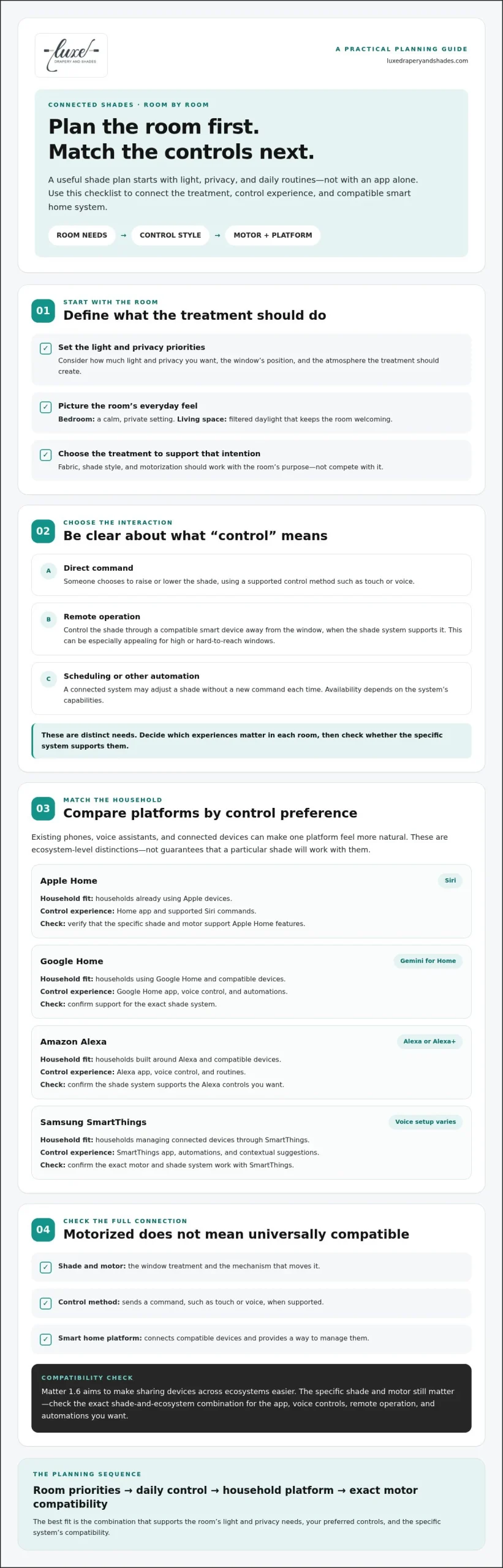
A practical framework for planning connected shades
A well-planned shade project begins with the rooms and windows, not a list of devices. First define the light, privacy, and control experience you want. Then select treatments and compare the exact motor-to-platform compatibility. This sequence makes comparing smart home ecosystems for shades more purposeful: it ties technology to the way your home should look and function, rather than adding automation without a clear role.
Map household routines and window needs
Consider which windows need frequent adjustments, where privacy matters most, and what atmosphere each room should have. A sunny living area may call for a different treatment and light-filtering effect than a bedroom. Include window placement and the room’s visual character in the plan, so the finished shades feel intentional as well as useful.
- List the rooms and windows. Note where motorized shades would make daily adjustments more convenient, and distinguish those windows from ones that need little interaction.
- Set the light and privacy goals. Decide whether each space should feel bright, softly filtered, or more private at particular points in the day. These preferences help narrow treatment choices.
- Choose the desired control style. Consider whether touch, voice, or remote management through a compatible smart device best suits the household’s routines. Make the goal specific to each room.
- Select the treatment and motorized approach. Match the shade or drapery to the window and intended interior effect, then consider the motorized system as part of that design decision.
- Compare ecosystem compatibility. Record the platform you prefer and identify the precise shade system and motor under consideration. Confirm that combination before settling on a control plan.
Check compatibility before settling on a control plan
An ecosystem preference is a useful starting point, not proof that a particular motorized treatment will work with it. Use current product compatibility information for the exact shade and motor, then look for the specific functions you want, such as app access, voice operation, or scheduled control. A shared protocol, bridge, or voice assistant doesn’t by itself establish that every feature is supported in your setup. Keep notes on the platform, motor, and desired controls so the decisions stay clear as the project takes shape.
For broader context on coordinating connected controls across a home, explore this guide to Lutron home automation in Los Angeles. Luxe Drapery and Shades brings together selection assistance, accurate measurements, a comprehensive quote, and a project timeline to shape a cohesive motorized-shade plan. Plan your motorized shade project with Luxe Drapery and Shades.
Bring smart shade planning together with Luxe Drapery and Shades
A connected shade project feels most cohesive when technology and interior design are considered as parts of the same whole. Fabric, treatment style, window proportions, and control approach all contribute to how a room looks and functions. Luxe Drapery and Shades brings whole-home shading and lighting control expertise to the planning process, helping homeowners consider preferred controls alongside the look and purpose of each treatment.
Connect Lutron shade expertise with the wider home
Luxe Drapery and Shades specializes in integrating Lutron shades with Lutron lighting control systems. Considering those elements together can help shape a unified experience across rooms, from the way natural light enters to how the interior is illuminated. The goal is to align shade selection and lighting control with the home’s design and everyday priorities, while keeping compatibility specific to the system being planned.
For additional context on planning connected controls across the home, the Lutron home automation guide offers a broader view. As you move from comparing smart home ecosystems for shades to planning a project, bring forward the decisions that matter: which rooms need motorized treatments, how you prefer to control them, and what visual character you want to preserve. These details give the project a clear starting point without assuming every ecosystem or shade motor works with every other system.
Move from inspiration to a considered installation
A thoughtful project has a clear path from initial ideas to installation. Consultation and selection assistance translate room priorities into suitable treatments and controls. Accurate measurements bring the window details into the plan, while a comprehensive quote and project timeline set out the scope and next steps. The result is a plan shaped around the home rather than a collection of disconnected device choices.
Once selections are made, materials ship directly from the manufacturer to the customer’s home before scheduled installation. This process connects product selection and project coordination with the finished window treatment, while making each stage clear.
- Consultation: Discuss the rooms, design direction, and shade-control priorities.
- Selection assistance: Consider treatments and motorized options suited to the project.
- Measurements and planning: Capture window details and prepare a comprehensive quote and project timeline.
- Ordering and installation: Materials ship to the home from the manufacturer ahead of scheduled installation.
Bring your ideas for light, privacy, and control into a tailored shading project. Explore shading and automation solutions.
Shape a shade plan that feels at home
The most satisfying connected home isn’t defined by how many devices it contains. It’s defined by how easily technology supports the way you want to live while each room retains its character. Keep that perspective as you move from comparing smart home ecosystems for shades to shaping a project: the right plan should feel considered in both daily use and visual presence.
Luxe Drapery and Shades brings expertise in whole-home shading and lighting control, including Lutron shades integrated with Lutron lighting control systems. Consultation, selection assistance, accurate measurements, a comprehensive quote, and a project timeline help translate ideas into a tailored plan for your home, followed by scheduled installation.
Give your windows the same thoughtful attention as the rest of your interior. Explore tailored shading and automation solutions and take the next step toward a home that feels beautifully in sync with you.
Frequently Asked Questions
Which smart home ecosystem is best for controlling window shades?
No single ecosystem is best for every household. The right choice depends on the phones, voice assistant, and connected devices your household already uses, along with how you want to operate shades day to day. When comparing smart home ecosystems for shades, picture a specific routine, such as lowering a living room shade by voice while preparing dinner. Then prioritize platforms that suit that routine and the shade system you’re considering.
Can motorized shades work with Apple Home, Google Home, or Alexa?
Yes, motorized shades can work with Apple Home, Google Home, or Alexa when the particular shade and motor support the chosen platform. Compatibility varies by system, so a general claim that a product is “smart” isn’t enough to establish which controls are available. For a useful comparison, look for product information naming the platform and desired function, such as voice commands or app operation, for the exact motorized treatment.
Does Matter make smart shades compatible with every ecosystem?
No, Matter doesn’t guarantee that every shade will work with every ecosystem or expose every feature. It’s an interoperability standard intended to help compatible smart home devices work across platforms, but the particular shade and motor still matter. A Matter label alone doesn’t tell you whether a desired voice command or control function is supported. Review compatibility details for the precise device, platform, and features you plan to use.
What is the difference between integrated motorized shades and retrofit smart shades?
Integrated motorized shades are selected as a treatment and motorized system together; a retrofit approach adds a motorized device to an existing window treatment. The practical distinction is whether you’re planning a new treatment or adapting one already in place. For example, if you want to preserve existing drapery, a retrofit category may be worth comparing. Consider appearance and the intended controls together, without assuming either approach works with a particular platform.
Can motorized shades be controlled by voice or remotely?
Yes, motorized shades can support voice control and remote management through compatible smart devices, depending on the system. Luxe Drapery and Shades offers motorized shades and blinds with touch or voice control and remote management through compatible devices. Voice commands may suit a room where you often have your hands occupied, while remote operation may be useful when you’re away from the window. The exact control experience depends on the compatible setup.
How should I choose an ecosystem for shades in multiple rooms?
Start by noting each room’s window needs and the controls household members will actually use. A Los Angeles home might have a bright living space where light adjustment matters and bedrooms where privacy is a stronger priority. Make a room-by-room list, then compare the preferred ecosystem with the exact motorized shade system for each space. This keeps the plan cohesive without assuming every window needs identical treatments or control features.