

The best commercial window coverings aren’t chosen by appearance alone; they’re selected according to what each space needs to do. A sunlit conference room, a client-facing reception area, and a private office can call for different balances of daylight, glare control, and privacy, even within the same business.
Those priorities matter, as do durability, fit, and a design that works with daily operations. In Los Angeles, changing light and varied commercial spaces make a room-by-room approach especially useful. This guide explains how to choose commercial window coverings for different rooms and windows, from roller shades and drapery to blinds and plantation shutters. It also outlines what to prepare before a consultation, including room priorities, window details, access conditions, and preferences for manual or motorized operation. Tailored design, professional installation, and, where appropriate, Lutron integration can help create a cohesive solution. The goal is a more comfortable, functional space with window treatments that feel intentional from the first impression onward.
Key Takeaways
- Start with each room’s purpose, then identify the window treatment that best supports its daily use.
- Compare roller shades, drapery, blinds, shutters, and exterior shades by light control, privacy, appearance, and intended application.
- When evaluating commercial window coverings, consider operation and maintenance alongside aesthetics, and confirm product-specific fabric and material characteristics.
- Prepare for a consultation by documenting window locations, approximate dimensions, access conditions, and room priorities.
- A clear project brief can help align tailored treatments, professional installation, and coordinated operation where appropriate.
How Commercial Window Coverings Support Better-Functioning Business Spaces
Commercial window coverings are selected to meet a business space’s practical needs and visual direction. The right choice can temper direct daylight, reduce distracting glare, preserve useful views, and provide privacy where conversations or services call for discretion. It can also create a cohesive impression across rooms without requiring every window to have the same treatment.
Commercial specification begins with performance, not appearance alone. Start by identifying what the space must support, then choose a covering to suit its atmosphere and operation. A useful brief separates essential requirements, such as screen visibility or privacy, from design preferences, such as texture, colour, and how the treatment relates to the interior. For a neutral overview of window covering types, see Wikipedia.
What should commercial window coverings accomplish?
Consider how daylight affects the people and activities in each room. In an office, glare across computer screens may make adjustable light control a priority. In a hospitality setting, filtered daylight can contribute to a welcoming atmosphere, while a treatment room may need more privacy during appointments. Street-facing spaces also deserve careful consideration: the brief may need to balance visibility from outside with a comfortable, open interior.
Separate must-haves from preferences. List the functions the covering needs to serve, then consider its appearance and how people will operate it. For example, note whether the treatment needs to be adjusted during the day, whether windows are easy to reach, and whether privacy is needed all the time or only during specific activities. That order keeps a polished finish connected to the way the room is used.
Why does the space’s use matter?
A reception area often needs to feel composed and inviting, with daylight managed so guests aren’t met by harsh glare. A conference room has a different rhythm: presentations and screen sharing may call for more controlled light and privacy for discussions. Retail spaces may prioritize clear product views and a comfortable browsing environment, while shared property areas may benefit from a consistent approach suited to common use.
Opening hours and occupancy patterns also influence the brief. A room used throughout the day may need straightforward adjustments as the sun shifts; a space occupied mainly for scheduled meetings may have different control preferences. There’s no single specification for every office, hotel, shop, or shared area. Define each room’s purpose, who uses it, and what the windows need to support. That clarity makes it easier to select treatments that are both intentional and functional.
Commercial Window Covering Types: Match the Treatment to the Space
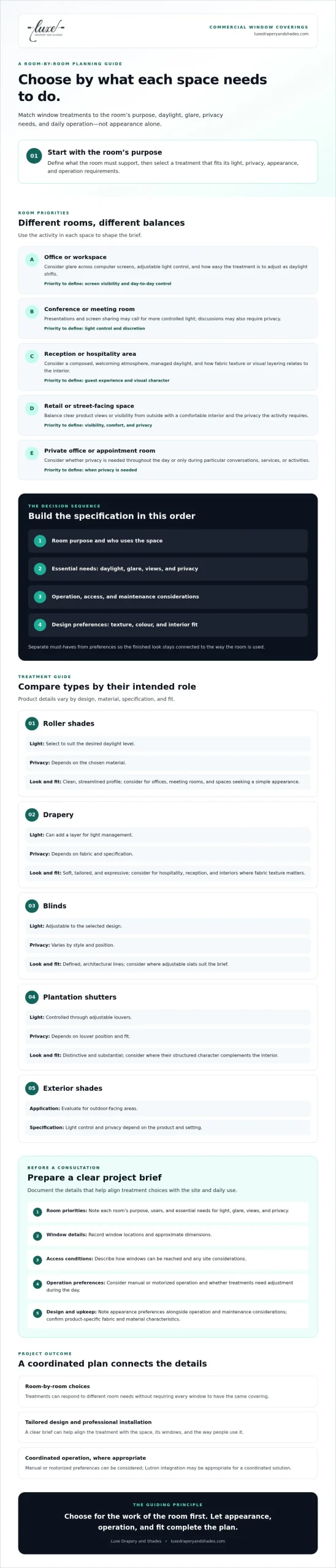
The right treatment depends on the window, the room, and the atmosphere you want to create. Roller shades offer a streamlined appearance and are worth considering for straightforward light management. Drapery brings softness and visual layering, while blinds and plantation shutters offer a more structured look. For outdoor-facing areas, exterior shades may be appropriate to evaluate. The successful daylighting design guidance from the Whole Building Design Guide also highlights the role of blinds and shades in managing glare while making use of natural light.
| Treatment | Light control | Privacy | Appearance | Applications to consider |
|---|---|---|---|---|
| Roller shades | Can be selected to suit the desired daylight level | Depends on the chosen material | Clean and streamlined | Offices, meeting rooms, and other spaces seeking a simple profile |
| Drapery | Can add a layer for light management | Depends on fabric and how it’s specified | Soft, tailored, and expressive | Hospitality areas, reception spaces, and interiors where fabric texture matters |
| Blinds | Adjustable to the selected design | Varies by style and position | Defined, architectural lines | Workspaces and other settings where adjustable slats suit the brief |
| Plantation shutters | Controlled through adjustable louvers | Depends on louver position and fit | Distinctive and substantial | Spaces where their structured character complements the interior |
| Exterior shades | Specified for the outdoor-facing application | Depends on the product and setting | Can extend the design beyond the interior | Exposed outdoor-facing areas |
Choose by use, then refine by design
Consider drapery when softness or layered visual detail is central to the room. For a reception or hospitality space, compare fabric, colour, and how the drapery will sit alongside the other finishes. Blinds may suit a project that calls for adjustable slats; plantation shutters offer a more defined architectural presence. The best fit depends on the window, room use, and desired appearance, not a universal ranking of options.
Decide how treatments will be operated
Manual controls may be suitable when windows are easy to reach and operation is simple. Motorization may be worth discussing for numerous, elevated, or hard-to-reach windows, but automation isn’t necessary for every project. Consider who will operate the treatments and how often they’ll need adjustment. Confirm product specifications and compatibility as part of planning. For outdoor-facing applications, consider the conditions and requirements of the specific setting before selecting an exterior treatment.
For a tailored commercial plan, explore custom window treatments and professional installation from Luxe Drapery and Shades.
How to Compare Commercial Window Coverings Beyond Appearance
A polished finish is only one part of a sound selection. Compare commercial window coverings against the work each treatment must do, then consider how it will look within the wider interior. This helps prevent a fabric, finish, or control choice from being judged on appearance alone.
Compare five criteria: light control, privacy, operation, maintenance expectations, and visual fit. Treat them as separate questions, since a strong match in one area doesn’t automatically answer the others.
Which performance questions should buyers ask?
Ask how the proposed treatment is expected to manage daylight and glare in the actual room, including during the hours it’s occupied. Clarify whether privacy is needed throughout the day, only during meetings, or after business hours. These details help distinguish the needs of a street-facing office from those of an interior meeting room.
Request product-specific information before drawing conclusions from a sample or photograph. Fabric openness, material characteristics, and the resulting view or privacy can vary by product. Confirm the relevant specifications for the exact treatment under consideration rather than assuming a similar-looking option will perform the same way.
How should design and operation work together?
Assess how the treatment relates to sightlines, finishes, furniture, and the interior’s overall design direction. A consistent palette can bring rooms together without requiring identical treatments. For instance, a shared tone or finish might carry through reception and work areas while each room uses a solution suited to its function. For upkeep, ask what care the selected material is expected to need and who will be responsible for routine attention.
Operation should feel natural within the daily routine. Manual controls may be practical for accessible windows that are adjusted occasionally. Motorized operation may warrant consideration where windows are difficult to reach or adjustments are frequent. For projects considering coordinated controls, Luxe Drapery and Shades offers Lutron shades and lighting control systems; confirm product compatibility and intended operation as part of planning.
- Light: How should the treatment manage daylight and glare in this room?
- Privacy: Who needs privacy, and at what times?
- Operation: How often will the covering be adjusted, and how will it be reached?
- Maintenance: What care does this specific material require?
- Visual fit: How will it relate to sightlines, finishes, and the wider interior?
Plan a Commercial Window Covering Project in Los Angeles
A well-prepared brief helps turn a broad design idea into a clear project plan. Before discussing commercial window coverings, record what each room needs, what the windows are like, and how installation may fit around business operations. Approximate dimensions and notes are useful starting points, but ask whether measurements need professional verification before treatments are specified.
A practical planning sequence
- Define room priorities. Note each space’s use, daylight concerns, privacy needs, and preferred operating method. Separate essential functions from design preferences.
- Document the windows. Create a list or simple plan showing window locations, approximate dimensions, and differences between openings. Add photos if useful, and label them by room.
- Describe site conditions. Record access considerations, such as elevated or difficult-to-reach windows, and identify any building or property representative who should be involved.
- Discuss product and installation requirements. Ask who will confirm measurements, selections, and installation details. Clarify how work areas may be accessed and whether installation can be sequenced by room.
- Review the proposal before proceeding. Check that the proposed treatments, operating methods, and installation scope address the priorities you documented. Raise questions about scheduling, coordination, and assumptions that need confirmation.
Prepare for a consultation
Bring available floor plans or window measurements, while treating them as preliminary until the measurement process is confirmed. Identify decision-makers and note opening hours, occupancy patterns, or business activities that may affect scheduling. For example, a client-facing reception area and a back office may have different access needs, so flagging those distinctions early can help with work sequencing discussions.
Ask how the provider will coordinate with your property representative and what access arrangements are needed. A clear conversation about schedule preferences can help the project team consider business operations, but timing and installation conditions should be confirmed for the specific site. Avoid assuming that every opening can be handled in the same way.
Before committing, confirm the project scope and any contractor credentials relevant to the work directly with the provider. Luxe Drapery and Shades designs and professionally installs custom window treatments for commercial clients in Los Angeles. Discuss your commercial window covering project with the team as you develop your plan.
Bring a Tailored Commercial Window Covering Plan to Luxe Drapery and Shades
A considered project brief brings together four essentials: how each room is used, what its window treatments need to accomplish, how they should complement the interior, and how they’ll be operated. With those priorities in view, it becomes easier to explore commercial window coverings suited to the property rather than relying on one solution throughout.
Luxe Drapery and Shades designs, sells, and professionally installs custom interior and exterior window treatments for commercial clients in Los Angeles. Options include custom drapery, roller shades, blinds, plantation shutters, and motorized shades. Each has a different character and application, so the right selection depends on the specific windows, room functions, and project requirements.
Explore options for the space
Fabric treatments may bring softness and a tailored finish to a reception area or hospitality interior. Roller shades can suit spaces seeking a streamlined look, while blinds or plantation shutters may fit a project where their distinct appearance and operation support the design brief. Motorized shades may be worth discussing if windows are numerous or difficult to reach. If coordinated shade and lighting control is a project priority, Lutron integration can be explored where the products and intended setup are compatible.
These are possibilities, not universal recommendations. A treatment that suits one room may not be appropriate for another, and product details should be confirmed for the specific application. When comparing options, consider how each treatment will look alongside the room’s finishes, who will operate it, and what level of privacy and light control the room needs.
Prepare for a useful next conversation
For a Los Angeles project, be ready to describe the property type, room priorities, and window conditions. A simple list of locations, approximate dimensions, access considerations, daylight concerns, privacy needs, and preferred operating methods can help frame the discussion. Available plans or photographs may also help communicate the space; confirm how measurements will be verified before selections are finalized.
Ask how product choices, measurement, and installation coordination will be addressed, including scheduling considerations related to business operations or property access. These details help connect the design direction to the realities of the site.
Share the needs of your space with Luxe Drapery and Shades to discuss suitable custom treatments and professional installation. A thoughtful selection can do more than complete a room: it can make the experience of the space feel more comfortable, cohesive, and distinctly considered.
Shape a More Considered Commercial Space
The right commercial window coverings begin with the needs of each room, then bring light control, privacy, operation, and visual character into balance. A tailored approach allows different spaces to serve their purpose while still feeling connected through a cohesive design.
Luxe Drapery and Shades serves commercial clients in Los Angeles with custom treatments and professional installation. Its offerings include shades, drapery, blinds, shutters, and motorization, with selections shaped around the specific project rather than assumed to suit every setting. The company identifies as a licensed and bonded California contractor; confirm its current status and permitted scope directly before proceeding.
Bring your room priorities, window conditions, and design direction into the conversation. Explore tailored commercial window covering options with Luxe Drapery and Shades and take the next step toward a workplace that feels comfortable, functional, and thoughtfully finished.
Frequently Asked Questions
What are the best window coverings for commercial buildings?
The best option depends on the room’s purpose, window conditions, and priorities for light, privacy, operation, and appearance. Roller shades can suit a streamlined brief, while custom drapery adds a softer, layered finish. Blinds and plantation shutters offer different visual styles and ways to adjust light. For Los Angeles commercial spaces, assess each room individually rather than assuming one treatment will suit the entire property. Confirm product details against the project’s specific needs.
Are motorized window coverings suitable for commercial spaces?
Yes, motorized window coverings may suit commercial spaces where windows are numerous, elevated, difficult to reach, or adjusted regularly. Manual operation may be practical for accessible windows used less often, so automation isn’t essential for every project. Consider who will operate the treatments and how they’ll fit into daily routines. Before selecting a motorized option, confirm product specifications, control preferences, and compatibility for the intended installation.
How do commercial window coverings help reduce glare?
Commercial window coverings can help manage incoming daylight, which may reduce distracting brightness on screens or in customer-facing areas. The effect depends on the specific treatment, material, and how it’s used, so don’t assume appearance alone indicates glare performance. Ask how the proposed product is expected to work in the actual space and during occupied hours. Confirm relevant product details, including fabric characteristics, before making a selection.
Can commercial window coverings be customized for different rooms?
Yes. Custom commercial window coverings can be selected to reflect each room’s function, window conditions, privacy needs, and design direction. A conference room may call for different light control than a reception area, while a shared palette or finish can help the overall property feel cohesive. Luxe Drapery and Shades serves commercial clients in Los Angeles with tailored treatments and professional installation. Discuss the specific requirements of each space before choosing products.
What should I consider before installing commercial window coverings?
Before installation, document room uses, daylight concerns, privacy priorities, window locations, approximate dimensions, access conditions, and preferred operating methods. Available plans or measurements can help begin the conversation, but ask who will verify dimensions and confirm product selections. Discuss installation coordination, work sequencing, and scheduling considerations with the provider and property representative. Los Angeles businesses should also confirm project scope and any contractor credentials relevant to the work directly.
Can window coverings integrate with Lutron lighting control?
They may be integrated where the selected shades, controls, and project setup are compatible. Luxe Drapery and Shades offers Lutron shades and Lutron lighting control systems, including options for commercial clients. Integration should be considered around the intended operation and requirements of the specific products, rather than assumed for every treatment or space. Ask the provider to verify compatibility and clarify how shade and lighting controls would work in the proposed installation.