

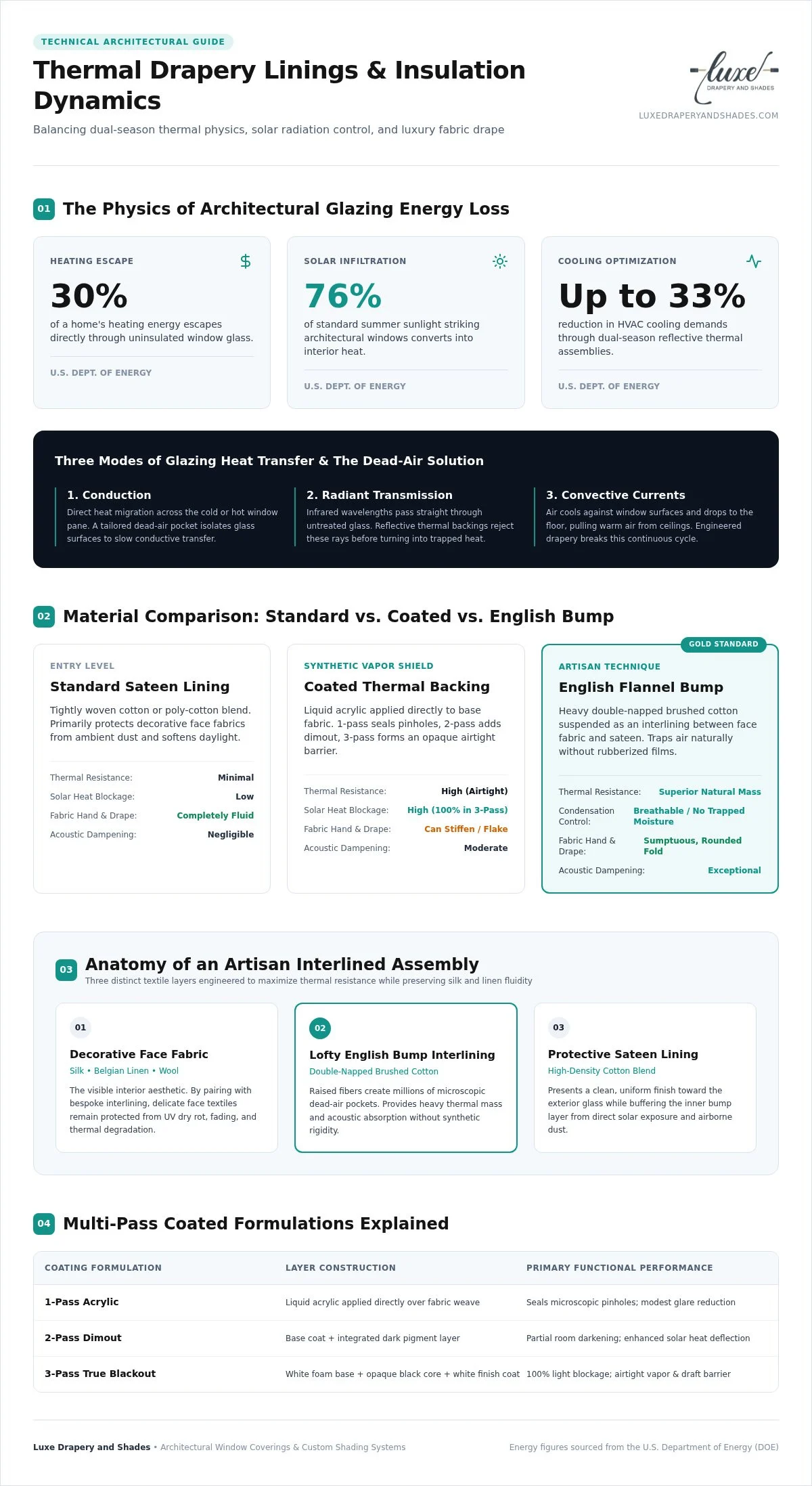
According to the U.S. Department of Energy, roughly 30% of a home’s heating energy escapes directly through windows, while 76% of summer sunlight converts into interior heat. If your home features expansive architectural glazing, you already know the discomfort: lingering drafts on cool evenings followed by intense afternoon solar gain. At the same time, many design-conscious homeowners hesitate to specify a thermal drapery lining for insulation, fearing that dense backing layers will ruin the soft drape of tailored silk or Belgian linen.
You don’t have to compromise fluid tailoring or curated aesthetics to keep your interiors comfortable. Discover how custom thermal drapery linings and interlinings optimize home insulation, lower energy loss, and protect bespoke fabrics against solar degradation. This technical guide examines the thermal physics behind window heat transfer, breaks down the performance differences between multi-pass coatings and traditional English bump, and outlines how to select the right layered assembly for every room exposure.
Key Takeaways
- Discover how specifying a tailored thermal drapery lining for insulation stabilizes room temperatures by forming a protective dead-air barrier across expansive glazing.
- Compare the distinct performance qualities of multi-pass acrylic backings, triple-weave dimouts, and traditional brushed cotton bump to balance thermal efficiency with effortless drape.
- Understand the physics of the window convection loop and how thoughtful installation details, such as sealed returns and ceiling recesses, maximize your drapery’s R-value.
- Select the ideal lining configuration for every architectural orientation, deflecting harsh afternoon solar gain in western exposures while conserving ambient warmth in northern zones.
- See how artisan grid basting and bespoke interlining techniques preserve the graceful hand of luxury silks and linens, avoiding the rigid stiffness common to mass-market liners.
What Is Thermal Drapery Lining and How Does It Insulate Windows?
Window glass connects interior living spaces to natural light, yet untreated architectural panes remain the primary source of residential thermal loss and heat infiltration. A custom thermal drapery lining for insulation serves as an engineered buffer positioned directly behind your primary face fabric. Rather than relying solely on raw textile weight, this tailored backing forms an insulating air chamber that stabilizes radiant surface temperatures across expansive openings.
While many resources focus exclusively on freezing winter drafts, luxury homes across Los Angeles often face the inverse challenge: relentless solar radiation. Thermal drapery assemblies offer dual-season climate regulation. In winter, they prevent indoor warmth from escaping through chilled glass panes. During sunny afternoons, reflective backings reject solar wavelengths before they turn into trapped heat, reducing HVAC cooling demands by up to 33% according to the U.S. Department of Energy. Crucially, a premium lining acts as a physical barrier against ultraviolet rays, preventing delicate silk, linen, and wool face fabrics from dry rotting, fading, and degrading over years of sun exposure.
The Thermal Dynamics of Architectural Glazing
Glazing transfers thermal energy through conduction across the glass, radiant transmission of infrared waves, and interior convective air currents. Floor-to-ceiling glass creates noticeable micro-climates inside a room. An unlined window draws warmth from your skin on cool evenings and radiates heat inward during high noon. By introducing an engineered drapery barrier, you isolate the glass surface and establish a dead-air pocket. This pocket dramatically slows conduction and prevents localized temperature spikes.
Thermal Lining vs. Standard Lining vs. Interlining
Understanding the distinction between backing constructions ensures your bespoke drapery performs without sacrificing elegance:
- Standard Sateen Lining: Crafted from tightly woven cotton or poly-cotton blends, standard lining protects face fabrics from ambient dust and softens daylight, but provides minimal thermal resistance against radiant heat.
- Coated Thermal Lining: Featuring integrated acrylic coatings, coated backings seal the textile weave to block air infiltration and reflect solar heat, functioning as an impermeable thermal shield.
- Bespoke Interlining: This artisan technique sandwiches a lofty cotton bump or wool flannel between the decorative face fabric and an outer sateen lining. It yields exceptional thermal mass and acoustic dampening while preserving a relaxed, fluid drape.
Key Materials: Comparing Thermal Coatings, Dimouts, and English Bump
Selecting an effective thermal drapery lining for insulation requires balancing thermal resistance, light control, and fabric drape. Mass-market solutions often rely on stiff synthetic films that turn supple drapery into rigid panels. In contrast, artisan workrooms curate specific textile layers based on how a room captures light and holds temperature.
Coated Linings: 1-Pass, 2-Pass, and 3-Pass Formulations
Coated linings apply liquid acrylic layers directly to a base fabric to seal the weave. A 1-pass coating seals pinholes for modest glare reduction, while a 2-pass coating adds a dark layer for partial dimout. True 3-pass linings apply a white foam base, an opaque black core, and a white finish coat. This delivers total light blockage and an airtight vapor barrier. However, continuous exposure to harsh sunlight can cause synthetic coatings to stiffen or flake over time, altering the curtain’s hand.
English Flannel Bump: The Gold Standard for Bespoke Drapes
English bump interlining remains the traditional gold standard in luxury design. Crafted from heavy, double-napped brushed cotton, this thick flannel layer is suspended between the face fabric and an exterior sateen lining. Its raised fibers create millions of microscopic dead-air pockets that trap heat naturally. Unlike rubberized coatings, natural cotton bump breathes efficiently. It prevents moisture condensation along cold glass while lending window treatments a sumptuous, rounded fold that synthetic backings cannot achieve.
Acoustic and Light Control Performance Differences
Your choice of lining also shapes the auditory and visual comfort of your home:
- Triple-Weave Dimouts: Woven with a dense core of black yarn between decorative faces, these textiles offer thermal retention and soft movement without chemical coatings.
- Acoustic Absorption: Lofty English bump dampens echo and exterior street noise across rooms with hardwood or stone surfaces.
- Composite Layering: Combining a dimout lining with a natural bump interlining provides the ultimate balance of acoustic quieting, total solar reflection, and insulating depth.
When curating treatments for architecturally distinct spaces, consulting an artisan workroom like Luxe Drapery and Shades helps you specify the precise textile combination suited to your home’s unique daylight exposure.
Thermal Efficiency Metrics: R-Values and Window Convection Dynamics
Specifying a high-performance thermal drapery lining for insulation is only half the equation. Even the most luxurious multi-layer fabric assembly underperforms if the mechanics of air movement around the window opening are ignored. Window insulation is a thermodynamic system where textile density and installation geometry must work in unison.
Decoding R-Values and Solar Heat Gain in Window Coverings
Architectural glazing offers surprisingly little resistance to thermal transfer. Clear single-pane glass registers an insulating value near R-1, while standard double glazing hovers around R-2. An unlined fabric panel adds a negligible R-0.3 to R-0.5. By contrast, pairing bespoke face fabrics with a dense thermal drapery lining for insulation or an artisan English bump interlining adds R-1.5 to R-2.5 to the window assembly. In sun-drenched settings, choosing a light-toned exterior backing significantly lowers the Solar Heat Gain Coefficient, reflecting infrared energy before it converts into radiant heat indoors.
Eliminating the Convective Loop Through Tailoring
Poorly installed curtains can actually accelerate heat loss through a phenomenon known as the thermosiphon loop. When warm room air rises and slips behind an unsealed curtain header, the cold glass cools it instantly. Dense and chilled, this air drops rapidly and spills onto the floor beneath the hem. This continuous siphon creates negative pressure, pulling more conditioned air into the cavity and acting as a convective pump for drafts. Data from the U.S. Department of Energy reveals that conventionally hung, unsealed curtains reduce winter heat loss by only 10%. Sealing the airflow, however, cuts heat loss by up to 25%.
Edge Sealing with French Returns and Overlap Tracks
Mastering window efficiency requires closing the perimeter gaps where thermal bypass occurs:
- Ceiling Recesses and Pockets: Mounting drapery hardware directly to the ceiling or inside architectural pockets cuts off the convective loop at the top.
- French Return Hardware: Curved French return rods wrap the drapery fabric flush against the wall, locking in the insulating dead-air pocket.
- Floor Contact: Hems tailored to just kiss the floor, or break slightly across it, stop cold air from dumping out at the base.
- Overlap Master Carriers: Overlapping center carriers prevent light bleed and thermal bridging between panels when closed.
How to Specify Thermal Linings for Your Architectural Space
Every home presents distinct environmental demands based on its compass orientation, glazing scale, and interior layout. Successfully specifying a thermal drapery lining for insulation requires matching technical textile properties to the architectural reality of each room. Rather than taking a uniform approach, tailoring the backing assembly to specific solar exposures ensures both climate control and visual grace.
Matching Lining Density to Face Fabric and Pleat Style
Your heading design and face fabric dictate the appropriate lining structure. Gossamer silks and fine Belgian linens require the structural cushion of a flannel interlining to prevent sun rot and pinhole light bleeding. For clean architectural ripple-fold draperies, lining textiles must remain supple to preserve fluid S-curve folds without ballooning. In contrast, tailored styles like pinch pleated drapes hold crisp, vertical flutes beautifully when supported by the substantial body of traditional cotton bump.
Solar Exposure Strategies for Warm and Coastal Climates
Solar orientation dramatically shifts the thermal demands placed on window treatments:
- West- and South-Facing Glass: Afternoon exposures create intense radiant heat spikes. Specifying high-reflectance white backings deflects harsh solar rays, protecting wide-plank wood floors and fine art collections from irreversible UV bleaching.
- North-Facing Elevations: Rooms with northern exposures receive consistent, cool ambient light. These spaces benefit most from dense cotton flannel bump interlinings that seal in ambient room warmth.
- Coastal Microclimates: Marine layers and fluctuating coastal humidity demand pre-shrunk, breathable cotton-poly blends that resist moisture retention and mold growth.
Weight Calculations for Motorized Drapery Systems
Triple-layer draperies can double the total yardage weight carried by traverse hardware. Heavy interlined assemblies exert substantial drag on standard carriers, making precise load calculations essential for automated tracks. Pairing heavy custom panels with high-torque motorization, such as Lutron Sivoia drapery tracks, guarantees whisper-quiet operation and smooth movement without mechanical strain. Automated systems also let you program your drapery to close during peak heat hours automatically, maximizing the daily thermodynamic benefits of your thermal drapery lining for insulation.
To engineer the ideal balance of motorized performance and thermal protection for your home, connect with the artisan team at Luxe Drapery and Shades.
Bespoke Interlining Craftsmanship vs. Ready-Made Liners
Mass-market retailers often present clip-on thermal liners as an effortless fix for temperature swings. In practice, attaching a generic liner to tailored curtains introduces mechanical drag, uneven sagging, and unsightly distortion. Achieving genuine thermal efficiency without compromising refined aesthetics requires the precision of bespoke workroom craftsmanship.
Structural Limitations of Hook-On Synthetic Liners
Clip-on and Velcro backings rarely integrate cleanly with fine drapery panels. Because separate fabric layers expand and contract at different rates during seasonal temperature changes, hook-on panels cause wavy, puckered side seams and hem bunching. The added friction prevents curtain folds from stacking smoothly when opened. Under sustained exposure to intense window heat, lower-grade synthetic backings can also release unpleasant chemical odors into your living spaces.
Workroom Secrets of Master-Tailored Interlined Drapery
True luxury window treatments rely on traditional workroom construction to lock performance layers together seamlessly:
- Artisan Grid Basting: Workroom tailors use loose, vertical lock-stitches down the panel length. This keeps the heavy interlining securely suspended while allowing the decorative face fabric to drape independently without tension.
- Concealed Lining Offsets: Linings and interlinings are cut and finished roughly an inch shorter than the face fabric, keeping the backing completely invisible from inside the room.
- Weighted Corner Hems: Lead weights hand-tacked into bottom corners ensure panels fall in clean, vertical columns.
- Independent Hemming: Turning hems separately prevents the internal cotton bump from wicking up floor dust or ambient sill moisture.
This meticulous assembly delivers permanent climate stabilization while elevating custom fabrics into architectural statements that endure for decades.
Curating Complete Thermal Luxury with Luxe Drapery and Shades
At Luxe Drapery and Shades, we believe window coverings should elevate daily living by uniting comfort with refined design. As a licensed California specialty contractor (CSLB #1066068), our Los Angeles workroom crafts bespoke drapery assemblies engineered precisely for your residence. Whether you are pairing an artisan thermal drapery lining for insulation with automated tracks or complementing your drapery with layered, energy-efficient custom Roman shades, our team ensures flawless execution.
Schedule a design consultation with Luxe Drapery and Shades to explore our curated textile library and tailor the perfect thermal solution for your architectural space.
Elevate Architectural Comfort with Bespoke Thermal Drapery
Achieving year-round climate comfort across expansive glazing doesn’t require sacrificing the fluid grace of fine tailoring. When engineered correctly, a custom thermal drapery lining for insulation creates an effective dead-air barrier that stabilizes room temperatures, eliminates convective drafts, and shields delicate face fabrics from relentless solar exposure.
True thermal luxury pairs master-tailored interlinings with precise installation geometry. As a licensed and bonded California specialty contractor (CSLB #1066068), our Los Angeles workroom crafts bespoke drapery assemblies engineered for architectural luxury. From hand-locked English bump interlinings to seamless compatibility with high-torque motorized track automation, every detail is considered to ensure effortless movement and long-lasting performance.
Your windows frame how you experience natural light and restful calm at home. Explore bespoke insulated drapery with Luxe Drapery and Shades to design a tailored thermal solution that enriches your interior atmosphere throughout every season.
Frequently Asked Questions
Does thermal drapery lining really make a noticeable difference in room temperature?
Yes, specifying an engineered thermal drapery lining for insulation creates a measurable difference by stabilizing indoor temperatures by several degrees. By forming a protective dead-air buffer over window glazing, it slows radiant heat transfer and stops convective drafts. In Los Angeles residences with expansive glass walls, this barrier blocks intense afternoon solar heat gain while retaining ambient indoor coolness, lowering continuous air conditioning demands.
What is the difference between thermal lining and blackout lining?
Thermal linings focus primarily on heat resistance and insulation, whereas blackout linings prioritize total light exclusion. Standard blackout linings use multi-pass acrylic coatings to eliminate light penetration, which also happens to block airflow. In contrast, premium thermal drapery lining for insulation often utilizes woven dimouts or natural cotton flannel bump interlinings. These materials provide superior thermal mass and airflow reduction without creating a stiff, rubberized hand.
Can you add thermal lining to existing custom drapery panels?
Yes, an artisan workroom can retrofit existing custom drapery with a dedicated thermal backing or interlining. However, the process requires carefully deconstructing the heading, side hems, and base to lock the new material into the structure. Adding interlining increases total panel weight considerably. You must ensure your existing drapery hardware and wall brackets can comfortably support the additional load without bowing or pulling loose.
Will adding thermal lining make my drapery stiff and difficult to stack back?
Not when using bespoke workroom methods and traditional materials. Mass-market foam backings often create a rigid, board-like drape that resists stacking. In contrast, artisan methods pair supple face fabrics with loosely stitched English cotton bump and soft sateen backings. This composite assembly maintains fluid, graceful folds that glide effortlessly along your drapery hardware and stack back tightly without ballooning.
Does thermal drapery lining help reduce outdoor street noise?
Yes, multi-layer thermal draperies noticeably soften exterior street noise and ambient acoustic reverberation. While thin glass easily transmits sound waves, layered drapery assemblies featuring heavy cotton bump interlining absorb acoustic energy. The dense, napped cotton fibers dampen mid- and high-frequency sound reflections, creating a noticeably quieter, more serene interior environment in bustling urban or coastal neighborhood settings.
How do you clean custom drapery constructed with thermal interlining?
Custom drapery featuring natural interlinings should never be submerged in water or machine washed. The different fabric layers shrink at unequal rates, which distorts hand-finished hems and ruins pleat symmetry. Regular maintenance simply requires gentle dusting with a soft brush attachment on your vacuum. For comprehensive refreshing, consult a specialized in-home dry cleaner experienced with luxury window treatments.
Are thermal drapery linings safe for intense, direct sun exposure in warm climates?
Yes, high-grade thermal linings are engineered specifically to withstand prolonged sun exposure in sunny climates like Southern California. High-reflectance cotton sateens and specialized UV-stable backings deflect harsh solar radiation away from your interior. Beyond regulating indoor temperatures, these protective backings act as a crucial sacrificial barrier, preventing your primary silk, linen, or velvet face fabrics from fading and solar degradation.