The most visually striking window treatment in your Westside estate can quickly become a functional liability if it fails to mitigate the relentless Southern California sun. You’ve likely felt that localized spike in temperature in a sun-drenched gallery, realizing that even a high-capacity HVAC system struggles against modern solar heat gain. Deciding between honeycomb shades vs roller shades is no longer just a matter of style; it’s a strategic choice for homeowners who demand a minimalist aesthetic but require a sophisticated thermal barrier to meet 2026 Title 24 energy standards.
Selecting the right treatment doesn’t have to be a compromise between architectural elegance and environmental performance. This guide offers a definitive comparison to help you select the perfect finish for your home’s unique orientation. We’ll examine the crisp, clean lines of roller systems alongside the superior insulation of cellular structures. You’ll discover how to achieve a cohesive interior design that lowers cooling costs and integrates flawlessly with Lutron smart home technology, ensuring your window accents are as intelligent as they are beautiful.
Key Takeaways
- Compare the textured architectural depth of honeycomb pleats with the minimalist, disappearing silhouette of premium roller shades to define your home’s aesthetic.
- Evaluate the thermal performance of honeycomb shades vs roller shades to ensure your estate meets the rigorous 2026 California Title 24 energy efficiency standards.
- Learn why Lutron Sivoia QS motorization represents the non-negotiable gold standard for synchronized, silent light control in modern Los Angeles interiors.
- Determine the optimal placement for each style, prioritizing honeycomb insulation for master sleep sanctuaries and sleek roller elegance for entertaining spaces.
- Understand the transformative impact of professional installation and bespoke tailoring in achieving a level of precision that ready-made options cannot replicate.
The Aesthetic Silhouette: Architectural Honeycomb vs. Minimalist Roller
In the curated environments of Westside Los Angeles, window treatments serve as architectural punctuation. The debate between honeycomb shades vs roller shades often begins with how each interacts with the room’s geometry. While one introduces soft, rhythmic texture, the other offers a nearly invisible profile that honors the clean lines of modern glass-heavy estates. Understanding the various types of window coverings is essential before committing to a design that will define your home’s atmosphere for years.
Visual impact depends heavily on scale. Honeycomb pleats create horizontal depth that softens the hard edges of a window casement. In contrast, roller shades rely on a single, flat plane of fabric. A larger honeycomb pleat offers a bolder architectural statement, while a smaller roll diameter ensures the roller shade remains unobtrusive. When raised, the difference is striking. A roller shade disappears into a sleek roll, while a honeycomb shade compresses into a tight, dense stack.
The Profile of Honeycomb Shades
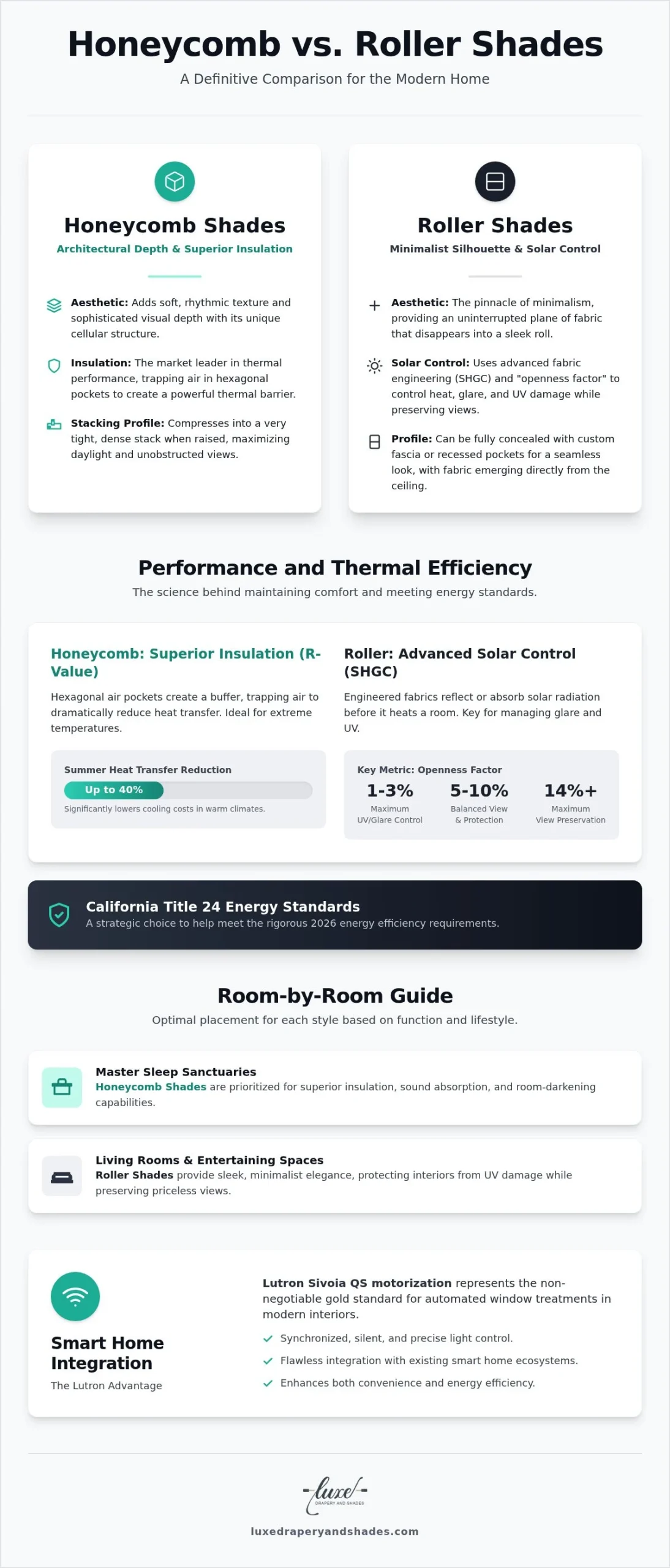
Honeycomb shades possess a structural elegance that feels intentional. Their unique hexagonal cell design creates a sophisticated visual rhythm across the window. This isn’t just about utility; it’s about adding a layer of tailored detail. Fabric choices range from delicate, soft spun-lace textures to high-performance metallized linings that provide crisp definition. One of their most significant design advantages is the stacking height. Because the fabric folds onto itself, even large shades occupy minimal vertical space when fully raised. This makes them a favorite for homeowners who want to maximize their glass exposure during the day.
The Minimalism of Roller Shades
Roller shades represent the pinnacle of minimalist design. They provide an uninterrupted fabric plane that acts as a canvas for a room’s color palette or texture. For a truly bespoke look, the hardware can be concealed using custom fascia or recessed pockets, allowing the fabric to emerge directly from the ceiling. Modern solar screens are particularly popular in Los Angeles. They protect expensive interiors from UV damage while maintaining that coveted Pacific view. Whether you choose a sheer solar mesh or a total blackout fabric, the silhouette remains clean and disciplined. Selecting between honeycomb shades vs roller shades ultimately comes down to whether you want your windows to have a soft, architectural presence or a silent, disappearing one.
Performance and Thermal Efficiency: The Science of Comfort
The relentless Southern California sun presents a unique challenge for high-end interiors, where expansive glass can quickly become a source of thermal discomfort. When weighing honeycomb shades vs roller shades, the decision often rests on how effectively each system manages this heat. While both offer significant protection, they operate on different scientific principles to maintain a temperate indoor climate. Selecting the right technology is essential for balancing a sophisticated aesthetic with the functional demands of the Los Angeles environment.
R-Values and Insulation
In the world of interior design, the R-value measures a material’s resistance to heat flow. Honeycomb shades are the undisputed leaders in this category due to their cellular construction. These hexagonal air pockets act as a buffer, trapping air to create a stable thermal layer between the window and your living space. Research highlights the substantial energy savings from honeycomb shades, particularly in climates where cooling is a year-round necessity. Premium providers like Honeycomb Blinds Australia demonstrate how cellular shades can reduce heat transfer by up to 40% in summer. Homeowners can choose between single-cell and double-cell construction, with the latter providing an even more robust barrier without compromising on the shade’s delicate aesthetic weight.
Roller shades approach thermal comfort through advanced fabric engineering. By focusing on the Solar Heat Gain Coefficient (SHGC), these treatments reflect or absorb solar radiation before it enters the room. Modern rollers often feature high-performance reflective backings, allowing them to rival the heat rejection capabilities of cellular designs. In sun-drenched South Bay sunrooms or home offices, the “openness factor” of the weave becomes critical. This percentage determines how much natural light passes through, effectively managing glare on screens while preserving your view of the coast. Balancing this light with thermal comfort requires a precise understanding of your home’s orientation and daily sun exposure.
Beyond temperature, these treatments address the sensory experience of a luxury home. The cellular structure of honeycombs provides exceptional acoustic dampening, which is vital for reducing ambient echo in open-concept Westside estates. Both styles offer nearly 100% UV protection, serving as a critical shield for high-end hardwood flooring and custom drapes. Selecting the right performance profile ensures that your aesthetic choices are supported by lasting comfort. If you’re ready to optimize your home’s climate, our team can help you explore bespoke window solutions tailored specifically to your estate’s unique needs.
Smart Home Integration: The Lutron Advantage
Luxury in a Los Angeles estate is often measured by the absence of friction. Manual shades, while beautiful, can become a daily chore in homes with expansive glazing and high ceilings. Integrating motorization isn’t merely a convenience; it’s a fundamental requirement for modern living. When comparing motorized honeycomb shades vs roller shades, the technology behind the movement is just as critical as the fabric itself. Lutron Sivoia QS stands as the industry benchmark for silent, synchronized operation, ensuring your window treatments enhance rather than interrupt your home’s tranquility.
The mechanical execution differs slightly between these two styles. Roller shades utilize tubular motors hidden within the fabric roll, maintaining their minimalist silhouette even when powered. Honeycomb systems house their whisper-quiet motors within the headrail, preserving the clean stack of the pleated cells. Both systems integrate seamlessly into a broader Lutron home automation ecosystem, allowing for scene-based lighting control that responds to the time of day or your specific mood.
Lutron Sivoia and Wireless Precision
Lutron’s Intelligent Hembar Alignment (IHA) technology ensures that every shade in a room moves in perfect unison. This creates a visually satisfying alignment that is essential for maintaining the architectural order of a luxury interior. For new constructions, hardwired systems offer permanent reliability and zero battery maintenance. For existing South Bay estates, battery-powered Palladiom shades provide the same precision without the need for invasive wiring. These systems are managed through curated wall keypads that replace cluttered plastic remotes with elegant, architectural controls that match your home’s hardware.
Automated Schedules for Energy Savings
Intelligent programming allows your shades to act as a dynamic thermal barrier without manual intervention. By tracking the sun’s path across the Los Angeles sky, your system can automatically lower honeycomb shades to block peak solar heat or adjust roller shades to prevent glare in a home office. This hyper-local programming is a key strategy for meeting California’s 2026 energy codes while maintaining comfort. For residents in areas like Torrance, “Away Mode” adds a layer of security by simulating presence through randomized movement during travel. Whether through a mobile app or simple voice commands, managing your home’s atmosphere becomes an effortless extension of your lifestyle.
Room-by-Room Guide: Which Shade Fits Your Lifestyle?
Every room in a Los Angeles estate possesses a distinct personality and environmental requirement. The decision between honeycomb shades vs roller shades shifts as you move from the private sanctuary of a bedroom to the social hub of a great room. Matching the treatment to the specific utility of the space ensures your interior design remains cohesive while performing perfectly under the intense California sun. It’s about finding the balance between how a room looks and how it feels at different hours of the day.
The Sanctuary Bedroom
Master suites require total control over light and privacy to remain restful. Honeycomb shades are the superior choice for sleep sanctuaries because their cellular structure allows for tighter edge-to-edge coverage, significantly reducing the light gap often found with standard rollers. Top-down/bottom-up functionality is a transformative feature in these spaces. It lets you lower the top of the shade to invite the morning light over the canyons while keeping the bottom closed for complete privacy. For the ultimate luxury, motorized honeycombs can be programmed to lift gradually at sunrise, providing a gentle, natural wake-up call that aligns with your circadian rhythm.
The High-Traffic Great Room
For areas designed for entertaining, the sleek appeal of roller shades is unmatched. These spaces often feature large-scale windows where visual continuity is paramount. High-quality rollers are exceptionally durable and low-maintenance, making them ideal for high-traffic zones where children or guests frequently gather. Many designers choose to layer these minimalist shades with plantation shutters or bespoke drapes to add texture and depth. Using the same fabric across different window sizes creates a sense of order and sophisticated calm throughout the home.
Specialized spaces require even more targeted solutions. Home theaters demand total darkness, which is best achieved through specialized roller systems equipped with side channels to eliminate light leakage entirely. In contrast, kitchens and bathrooms in coastal South Bay neighborhoods face higher humidity and salt air. Selecting moisture-resistant synthetic fabrics for these areas prevents warping and ensures your window treatments withstand the persistent marine layer. Whether you’re shielding a media room or softening a kitchen, the right material choice preserves the longevity of your investment.
If you’re ready to see how these styles look in your own space, contact our team for a bespoke design consultation tailored to your estate’s unique architecture.
The Luxe Drapery Experience: Bespoke Design and Installation
The decision between honeycomb shades vs roller shades represents a commitment to your estate’s long-term atmosphere. While the technical specifications of these treatments are vital, the final result depends entirely on the precision of the execution. A bespoke design process transforms a functional necessity into a curated element of your interior architecture. In the demanding environments of Los Angeles, where light and privacy requirements change by the hour, a professional consultation ensures your selection aligns perfectly with your home’s unique orientation and style.
Precision measurement is the foundation of luxury. Ready-made window treatments frequently fall short in high-end interiors, leaving unsightly light gaps or failing to account for the specific depth of custom millwork. Our white-glove approach ensures every component, from interior cellular pleats to motorized outdoor shades, fits with absolute exactness. This meticulous attention to detail is what defines a truly professional installation.
Curated Fabric Selection
Part of the bespoke experience is gaining access to trade-only fabric collections that aren’t available through traditional retail channels. These exclusive materials offer superior weight, texture, and longevity. During a consultation, you can experience the tactile difference between a high-performance metallized cellular lining and a sheer, linen-weave solar screen. This sensory exploration allows us to match your new treatments to existing upholstery and wall coverings, creating a cohesive narrative throughout your living space. Selecting the right textile isn’t just about color; it’s about how the material interacts with the specific light of the Westside.
Professional Lutron Integration
System reliability is paramount when integrating smart home technology. As certified Lutron installers, we ensure your motorized honeycomb shades vs roller shades function with flawless synchronization. We go beyond simple installation by programming custom scenes tailored to your lifestyle. Whether it’s a “Sunset” scene that lowers shades as the Pacific sun dips below the horizon or a “Morning Coffee” setting for your breakfast nook, the integration is seamless. We provide ongoing support for system expansions and software updates, ensuring your investment remains at the cutting edge of home automation. Our commitment to quality is backed by a professional warranty and the quiet confidence of a licensed California contractor.
Refining the Atmosphere of Your Los Angeles Estate
Your home’s windows are more than mere openings; they are the lens through which you experience the vibrant Southern California landscape. Selecting between honeycomb shades vs roller shades is a defining step in balancing architectural beauty with the practical demands of the 2026 climate. Whether you lean toward the textured, energy-efficient depth of cellular cells or the silent, minimalist elegance of a motorized roller, the result should be a seamless extension of your interior design. You don’t have to choose between aesthetic grace and thermal performance when your treatments are tailored to your lifestyle.
As a certified Lutron dealer and licensed California contractor, we specialize in bringing this level of precision to estates throughout the Westside and South Bay. We don’t just install products; we curate atmosphere and comfort through expert craftsmanship and white-glove service. We invite you to Schedule Your Private Design Consultation with Luxe Drapery to explore our exclusive fabric collections and sophisticated smart home solutions. Let’s transform your living space into a sanctuary of light and lasting ease.
Frequently Asked Questions
Which is more energy-efficient: honeycomb or roller shades?
Honeycomb shades offer superior energy efficiency because their hexagonal air pockets create a significant thermal barrier. This design is particularly effective for Los Angeles homes facing intense solar heat, as it traps air to insulate against temperature spikes. While high-performance roller shades with reflective backings are effective, they don’t match the R-value provided by the cellular architecture of honeycombs. This makes cellular designs the preferred choice for meeting 2026 Title 24 standards.
Can I get blackout versions of both honeycomb and roller shades?
You can select blackout versions for both honeycomb and roller shades to achieve complete light control. Blackout honeycombs utilize a metallized inner lining that prevents light penetration through the cells, while roller shades use opaque, high-density fabrics. For a total sleep sanctuary in your Westside estate, we often recommend honeycombs because they minimize side light leakage more effectively than rollers, though roller systems can be enhanced with side channels for similar results.
Are honeycomb shades harder to clean than roller shades?
Roller shades are typically easier to maintain because of their flat, vertical surface which resists dust accumulation. You can easily wipe them down with a damp cloth or use a vacuum attachment. Honeycomb shades require a slightly more delicate touch, as dust can settle inside the cellular pleats. We recommend regular light dusting or using a can of compressed air to maintain the pristine appearance of cellular fabrics in your Los Angeles home.
Do motorized honeycomb shades work with Lutron automation?
Motorized honeycomb shades integrate flawlessly with Lutron automation systems, providing a sophisticated level of control. As certified Lutron installers, we ensure your motorized honeycombs are synchronized with your home’s lighting scenes. This integration allows you to manage light and privacy through elegant wall keypads or mobile apps. It’s an essential feature for modern estates, offering whisper-quiet operation and the ability to schedule shade movement based on the Los Angeles sun’s path.
Which shade style takes up less space when fully raised?
Honeycomb shades take up significantly less vertical space when fully raised because the fabric folds compactly into a tight stack. This makes them ideal for maximizing your Pacific views through expansive glass. While roller shades are minimalist, the fabric roll has a fixed diameter that remains visible unless hidden behind a fascia or recessed pocket. If your priority is a disappearing treatment that leaves your window casement clear, the honeycomb’s low-profile stack is unmatched.
Are roller shades or cellular shades better for large windows?
Roller shades are often the preferred choice for exceptionally large windows because they can span greater widths without the need for multiple panels. Their lightweight construction and motorized tubular systems handle expansive glazing with ease. While cellular shades are excellent for insulation, they may require splitting into separate units for very wide openings to prevent fabric sagging. When choosing between honeycomb shades vs roller shades for a grand living area, we evaluate the window’s total scale.
What is the lifespan of a high-end custom roller shade compared to honeycomb?
Both high-end roller and honeycomb shades offer impressive longevity when professionally installed and maintained. Custom roller shades benefit from a simple mechanical design that can last for decades with minimal wear. Honeycomb shades are equally durable, though the pleated fabric requires mindful handling to maintain its crisp architectural shape. In the Los Angeles climate, the lifespan of both styles is enhanced by high-quality UV-resistant materials that prevent the premature fading common in lower-grade window treatments.
Do honeycomb shades provide better noise reduction for LA city living?
Honeycomb shades provide superior noise reduction compared to roller shades due to their three-dimensional cellular structure. These air pockets act as an acoustic buffer, absorbing ambient sounds from the bustling Los Angeles streets and reducing echo in open-concept interiors. While roller shades offer a sleek aesthetic, their single-layer fabric doesn’t possess the same dampening properties. For homes in busier Westside neighborhoods, cellular shades create a noticeably quieter and more serene indoor environment.