

Imagine settling into your Los Angeles living room, ready to dim the afternoon glare with a single touch, only to find your custom Roman shades hanging at a jagged angle or refusing to respond entirely. You’ve invested in a high-end lifestyle upgrade, yet the result feels more like a technical chore than a seamless luxury. It’s incredibly frustrating when sophisticated hardware doesn’t live up to its potential, especially when you’re worried about damaging delicate, expensive fabrics. We understand that you expect your home automation to provide effortless comfort, not a list of troubleshooting tasks.
The truth is that most performance issues stem from subtle setup errors rather than mechanical failure. In this guide, you’ll learn the most common motorized blind installation mistakes to avoid to ensure your window treatments remain a reliable part of your home’s ambiance. We’ll explore the nuances of signal range, power requirements, and precise calibration. By understanding these preventative measures, you can restore functionality to your system and recognize exactly when it’s time to bring in a professional Lutron installer to protect your investment and maintain your home’s sophisticated order.
Key Takeaways
- Identify the subtle motorized blind installation mistakes to avoid, such as improper limit settings that cause fabric to telescope or roll unevenly.
- Understand why power source selection and signal range are critical for maintaining responsive automation in expansive Los Angeles residences.
- Learn to distinguish between minor battery issues and the complex calibration requirements of integrated systems like Lutron Sivoia.
- Discover how professional installation safeguards your investment by preventing mechanical drift and protecting your manufacturer’s warranty.
- Recognize the safety and aesthetic benefits of hiring a specialist for hard-to-reach windows and high-ceiling installations.
Understanding Technical Friction in Motorized Window Treatments
The transition from basic battery-operated shades to fully integrated smart home ecosystems has redefined the standard for modern Los Angeles estates. We no longer view window treatments as isolated features, but as responsive elements of a home’s digital nervous system. This complexity introduces a layer of technical friction where the most frequent motorized blind installation mistakes to avoid aren’t always physical, but digital and environmental. In expansive California residences, architectural choices like floor-to-ceiling glass and reinforced steel frames often create invisible barriers for wireless signals. A system that worked perfectly during a bench test might struggle once installed against a concrete pillar or near high-interference appliances. Distinguishing between a mechanical motor failure and a simple signal drop is the first step in maintaining your home’s serene atmosphere.
The Anatomy of a High-End Motorized System
A luxury installation is a trifecta of an ultra-quiet motor, a stable power source, and a communication bridge. While understanding motorized blind basics is helpful for any homeowner, high-performance systems like Lutron Sivoia operate on proprietary frequencies. For instance, Lutron Clear Connect utilizes a 900 MHz band, which bypasses the crowded 2.4 GHz spectrum used by Zigbee and standard Wi-Fi. This distinction is vital when motorizing heavy custom drapery hardware or oversized Roman shades, where consistent torque and timing are non-negotiable. Using the wrong protocol for a large-scale project is one of the primary motorized blind installation mistakes to avoid, as it leads to sluggish response times and “ghost” movements.
Why “Broken” is Often Just “Out of Sync”
Homeowners often fear a costly mechanical failure when a shade stops responding, yet high-quality motors from professional lines are engineered to last 10 to 15 years. Often, the issue is simply a loss of synchronization. A minor power surge or a router reset can occasionally wipe the memory of a shade’s upper and lower limits. In the landscape of 2026 home automation, software updates are as frequent for your shades as they are for your smartphone. If your system isn’t professionally calibrated, these updates can cause “mechanical drift,” where the fabric no longer aligns perfectly with the window sill. This isn’t a hardware defect; it’s a calibration error. Proper initial configuration ensures your shades remain in harmony with your home’s aesthetic and your daily rhythms.
Power and Connectivity: Solving the Most Frequent Hurdles
A silent shade often feels like a failed investment, yet the cause is rarely a mechanical breakdown. Power and connectivity issues represent the most frequent motorized blind installation mistakes to avoid, often manifesting as intermittent responsiveness or a total lack of movement. Whether your system relies on discreet battery packs or a sophisticated hardwired backbone, the initial setup dictates the long-term reliability of your window treatments. Failing to account for signal range or power draw during the installation phase can transform a luxury convenience into a persistent technical chore.
Choosing between hardwired and battery-powered paths requires distinct troubleshooting logic. Hardwired systems offer the pinnacle of “set and forget” luxury, but they depend on perfectly seated connections and stable power transformers. Conversely, battery-powered units are favored for their clean, wire-free aesthetic in retrofitted Los Angeles estates. However, mismanaging the remote pairing process or overloading a single channel on your transmitter can lead to “ghost” commands, where your shades move out of sequence or ignore your inputs entirely.
Diagnostic Steps for Power Issues
Observing the subtle signals of your hardware is the first step in restoration. Most premium motors use specific LED blink patterns to communicate their status; a rhythmic amber flash usually indicates low voltage. In Southern California, we must account for a factor often ignored by standard guides: the impact of extreme UV exposure and coastal heat. High temperatures in sun-drenched rooms can cause lithium-ion batteries to degrade or discharge more rapidly than expected. If your shades face the intense afternoon sun, professional installers often recommend heat-shielded battery placements or specific high-capacity cells to prevent premature failure.
Restoring Smart Home Connectivity
A seamless digital experience depends on the strength of your communication bridge. If your smartphone app fails to trigger a movement, the issue often lies in the distance between your hub and the window. Lutron home automation platforms are specifically designed to overcome this by using Clear Connect technology, which avoids the cluttered Wi-Fi frequencies that plague large residences. Ensuring your bridge is centrally located and free from interference is essential for maintaining signal integrity. For homeowners who prefer a tailored approach to these technical nuances, consulting with an expert on custom motorization solutions can ensure your system remains responsive and refined for years to come.
Mechanical and Aesthetic Precision: Alignment Mistakes
Luxury window treatments serve as the architectural jewelry of a home. When they are perfectly aligned, they create a sense of visual quiet and symmetry. However, mechanical misalignment is one of the most visible motorized blind installation mistakes to avoid, as even a quarter-inch deviation can disrupt the clean lines of a modern interior. Beyond the aesthetic cost, poor alignment places unnecessary strain on the motor and can lead to permanent fabric damage. Achieving precision requires more than just a level; it demands an understanding of how weight, gravity, and material memory interact over time.
One often overlooked aspect of precision is the mechanical hum of the system. While high-end motors are designed for near-silent operation, a persistent grinding or rhythmic clicking often signals that the hardware is fighting against an unlevel bracket or a pinched component. Ignoring these auditory warnings can lead to premature motor burnout. We must also consider fabric “memory,” where certain luxury materials may settle or stretch after the first few weeks of use, requiring a secondary round of fine-tuning to ensure the hem bar remains perfectly parallel to the floor.
Resetting Upper and Lower Limits
The upper and lower limits of your shades define the boundaries of their travel. These settings can drift over time due to seasonal temperature fluctuations in Los Angeles or the natural stretching of heavier textiles. If a shade stops too low, it can bunch on the sill, creating unsightly wrinkles. If it retreats too far into the pocket, it may strain the motor or cause the hem bar to disappear entirely. Recalibrating these limits is a delicate process. While many systems allow for remote-based adjustments, over-extending the motor during a DIY reset is a common error that can lead to internal gear stripping. Proper calibration ensures the fabric stops exactly where the designer intended, preserving both the motor and the silhouette.
Correcting Telescoping and Fabric Drift
Telescoping occurs when the fabric rolls unevenly, causing it to shift toward one side of the roller tube until it rubs against the brackets. This friction is a primary cause of frayed edges on custom drapes and shades. While some suggest a “tape trick” to balance the roller, this is often a temporary fix for a foundational problem. Telescoping is frequently caused by microscopic amounts of dust on the tube or a bracket that is not perfectly plumb. Identifying this early is critical among the motorized blind installation mistakes to avoid, as fabric drift can quickly ruin expensive, bespoke materials. Professional leveling of the roller tube remains the only way to ensure a perfectly vertical drop every time the system is activated.
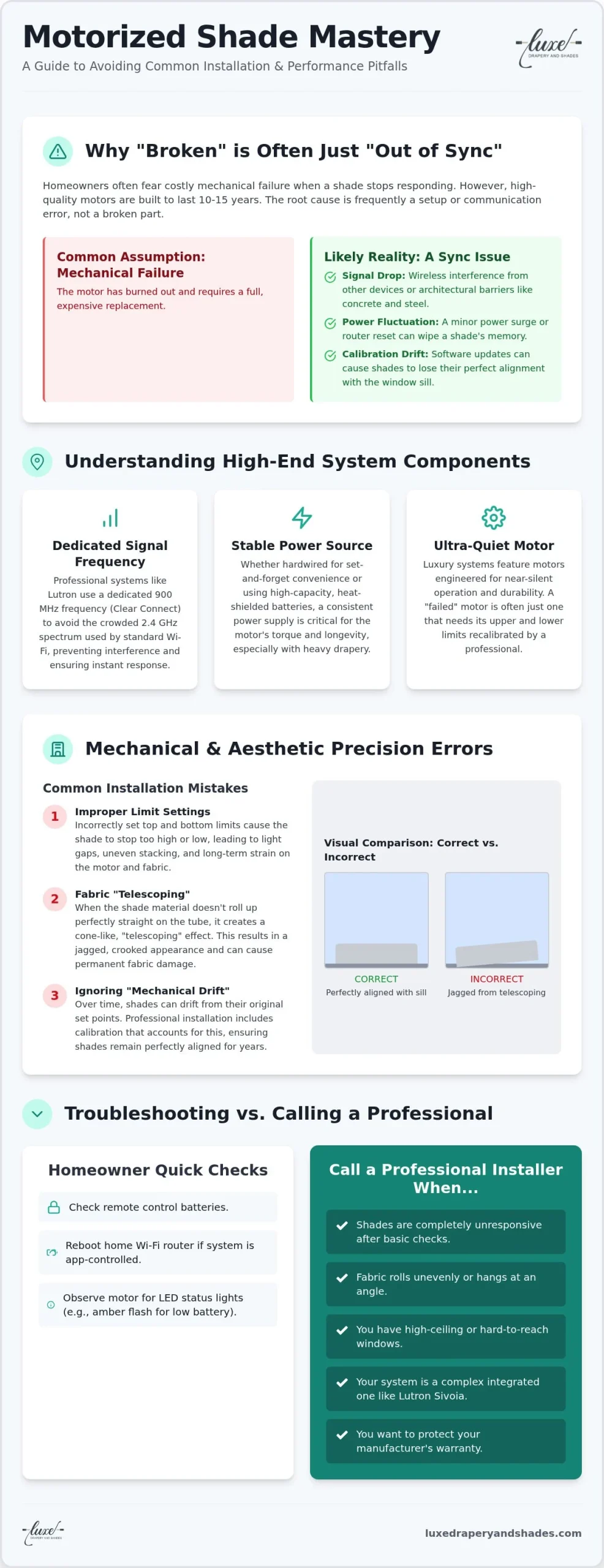
When to Troubleshoot vs. Calling a Professional Installer
Deciding whether to address a technical glitch personally or seek expert assistance is a pivotal moment for any homeowner. While the desire to maintain one’s own environment is natural, the high stakes of luxury home automation mean that certain motorized blind installation mistakes to avoid involve knowing when to step back. In the expansive estates of the Westside or the high-ceilinged lofts of Downtown Los Angeles, physical safety is a primary concern. Attempting to access recessed pockets or oversized windows without specialized ladders and safety equipment can lead to injury or unintentional damage to the surrounding architecture.
Beyond physical safety, the integrity of your warranty is often tied to professional handling. Most premium manufacturers specify that internal repairs or motor casing adjustments must be performed by certified dealers. Tampering with these components as a DIY fix might save time in the short term, but it can void the long-term luxury coverage you’ve invested in. Additionally, the software layer of modern systems has grown significantly more complex. Programming levels for Lutron RadioRA 3 or Homeworks require specific certifications and proprietary tools that go far beyond basic remote pairing.
The Essential DIY Troubleshooting Checklist
Before requesting a service visit, there are several low-risk steps you can take to identify simple errors. A basic system reset, often referred to as a “power cycle,” can resolve minor communication glitches by clearing the motor’s temporary memory. You should also perform a thorough visual inspection for physical obstructions. Small objects, dust buildup in the tracks, or even a slightly loose bracket can impede the hem bar’s movement. Finally, verify your remote channel settings. It’s common for a signal path to be blocked by new furniture or for batteries to lose just enough voltage to weaken the transmission without appearing completely dead.
Signs You Need a Specialized Technician
Certain symptoms indicate that the issue has moved beyond a simple sync error. If you notice a persistent grinding noise, or worse, a faint electrical smell or smoke from the motor casing, disconnect the power immediately. These are clear signs of motor burnout or a short circuit. System-wide failures where multiple integrated lighting zones stop responding simultaneously also suggest a deeper hub or wiring problem. Furthermore, complex installations like motorized plantation shutters or heavy Roman shades require a level of mechanical nuance that only a specialist can provide. If your system requires more than a simple reset, it’s best to contact our team for professional installation and support to ensure your home’s refined atmosphere is restored without compromise.
Ensuring Long-Term Performance with Professional Integration
The ultimate goal of any premium window treatment is to blend into the background of your daily life, providing comfort without requiring your attention. Achieving this level of effortless operation requires a level of foresight that goes beyond the initial mounting of brackets. Professional integration serves as the definitive solution to the motorized blind installation mistakes to avoid, specifically the gradual mechanical drift that occurs when systems aren’t perfectly balanced from day one. By selecting ultra-quiet motors for your bedrooms and media rooms, you prioritize a sensory experience that respects the silence of your home. For those seeking the pinnacle of performance, Lutron Roman Shades remain the industry benchmark for reliability, offering a marriage of bespoke textile beauty and flawless engineering.
Preventative maintenance is the final pillar of long-term success. Just as a luxury vehicle requires periodic tuning, high-end motorization benefits from a scheduled review of limit settings and battery health. This proactive approach ensures that your home automation remains a seamless luxury experience rather than a source of frustration. When your shades are integrated into a broader home ecosystem, they do more than just block the sun; they enhance your home’s energy efficiency and protect your interior design from UV damage automatically.
The Luxe Approach to Smart Shading
A professional setup begins with precision leveling that accounts for the unique settling of your home’s architecture. This isn’t just about the hardware; it’s about curating the specific motor torque required for the weight of your chosen fabrics. For instance, high-performance outdoor shades require significantly different power profiles than delicate silk rollers to withstand wind loads and Southern California’s external elements. For estate owners in Los Angeles, this specialized knowledge ensures that your automated accents remain as functional as they are beautiful. Ongoing support and proactive programming adjustments allow your system to evolve with your lifestyle, preventing the common motorized blind installation mistakes to avoid that often plague unmonitored, mass-market systems.
Investing in Reliable Automation
There is a profound difference between a boutique installation and a mass-market solution. While off-the-shelf products may offer immediate convenience, they often lack the infrastructure to support a truly integrated home. Future-proofing your residence involves moving toward sophisticated ecosystems like Lutron RadioRA 3 and Homeworks. These platforms offer a level of signal range and stability that ensures every shade in your home moves in perfect unison, every time. This intentionality creates an environment where technology serves the design, rather than dictating it. To ensure your home automation remains a seamless luxury experience, we invite you to experience quiet luxury with a Professional Consultation from Luxe Drapery and Shades.
Refined Living Through Precise Automation
Your window treatments should be a source of effortless beauty, not technical concern. By understanding the most frequent motorized blind installation mistakes to avoid, you can protect your investment and ensure your home remains a sanctuary of curated comfort. Whether it’s the subtle recalibration of limits or the strategic placement of communication bridges, the difference between a functional shade and a luxury experience lies in the meticulous details of the initial setup. Precision ensures that your high-end fabrics and sophisticated motors perform in perfect harmony with your daily rhythms.
As a Lutron Certified Platinum Dealer and a licensed and bonded CA contractor (#1066068), we specialize in the unique architectural demands of Los Angeles luxury estates. We don’t just install hardware; we curate an atmosphere of quiet sophistication through expert craftsmanship. If you’re ready to transition from troubleshooting to true enjoyment, Schedule a Professional Consultation with Luxe Drapery and Shades. Let us ensure your home automation remains a seamless, high-performance asset that enhances your quality of life. Your journey toward a more beautiful, responsive living space starts with the right partner.
Frequently Asked Questions
Why are my motorized blinds not responding to the remote?
Unresponsiveness is often caused by depleted batteries or signal interference from other household electronics. In large Los Angeles residences, the distance between the remote and the motor may exceed the manufacturer’s range. Check the LED indicator on the motor for a low-battery signal, which often appears as a flashing amber light. If the hardware is powered, you may need to re-pair the remote to the specific channel assigned during setup.
How long do the batteries in motorized shades typically last in Los Angeles?
High-quality lithium-ion batteries typically last between three and five years under normal conditions. However, in sun-drenched Los Angeles environments, extreme UV exposure and coastal heat can cause batteries to discharge more rapidly. Frequent use for thermal regulation in large glass-walled rooms also increases power draw. To minimize motorized blind installation mistakes to avoid, ensure battery packs are shielded from direct sunlight or consider hardwired power for high-use areas.
Can I manually pull my motorized blinds if the power goes out?
You should never manually pull or tug on motorized window treatments, as this can permanently strip the internal gears and void your manufacturer’s warranty. Motorized systems are designed to be moved exclusively by their internal drive units. If the power goes out, hardwired systems will remain in their current position until power is restored. For essential privacy or light control during outages, we recommend integrating a battery backup or choosing a system with a manual override feature.
Why is my motorized shade making a grinding or clicking noise?
A grinding or clicking noise usually indicates that the motor is fighting against a physical obstruction or mechanical misalignment. This often happens if a bracket has shifted or if the fabric is catching on the mounting hardware. If the sound persists after clearing the tracks, it may signal internal gear wear. Discontinue use immediately to prevent motor burnout and consult a professional technician to re-level the system and ensure the hardware is properly seated.
What is telescoping, and how do I fix it on my roller shades?
Telescoping occurs when the shade fabric rolls unevenly toward one side of the tube, eventually rubbing against the brackets. This is a common aesthetic issue caused by an unlevel roller or a buildup of dust on the tube. You can often correct minor drift by placing a small piece of adhesive tape on the opposite side of the roller to balance the weight. For luxury custom fabrics, professional leveling is essential to prevent frayed edges and permanent material damage.
How do I reset the limit positions on my motorized blinds?
Resetting limit positions involves using specific button sequences on your remote or smart home app to redefine where the shade stops. While the exact process varies by brand, it generally requires entering “programming mode” to adjust the upper and lower boundaries. To prevent common motorized blind installation mistakes to avoid, professional recalibration is recommended if the hem bar no longer sits parallel to the sill. Be cautious not to over-extend the motor during a DIY reset.
Will my motorized shades still work if my Wi-Fi is down?
Yes, most professional systems like Lutron Sivoia will continue to operate via their dedicated remote controls even if your Wi-Fi is down. These systems use Radio Frequency (RF) signals that don’t depend on an internet connection for basic movement. However, you will lose the ability to control your shades through smartphone apps or voice commands until your local network is restored. This independent signal layer is a hallmark of reliable home automation in sophisticated estates.
Can I add motorization to my existing manual blinds?
While retrofit kits exist, we specialize in fully integrated custom solutions that offer superior longevity and quiet operation. Adding a motor to an older manual blind often results in increased noise and unreliable movement because the original hardware wasn’t designed for automated torque. For a seamless luxury experience, it’s best to invest in a purpose-built motorized shade. This ensures all components, from the motor to the fabric roll, are engineered to work in perfect harmony.