

What if your outdoor living space wasn’t at the mercy of the Santa Ana winds or the midday glare? For many Los Angeles homeowners, the patio is a beautiful but temperamental asset, often abandoned when the heat intensifies or the coastal breeze turns aggressive. You’ve likely experienced the frustration of a curated outdoor dinner interrupted by dust or the persistent nuisance of insects. Integrating high-quality zip screens for patios provides a definitive answer to these environmental challenges, ensuring your transition from the living room to the garden is always effortless.
In this guide, you’ll discover how these precision-engineered systems transform exposed decks into sophisticated, climate-controlled sanctuaries. We’ll explore the seamless integration of whisper-quiet Lutron motorization and architectural-grade fabrics that protect your view while defining a new standard of “outdoor room” elegance. From understanding wind-resistant engineering to selecting bespoke finishes that complement your estate’s design, you’ll gain the expertise needed to reclaim your outdoor space. It’s time to move beyond seasonal limitations and embrace a lifestyle where your patio remains a year-round haven of privacy and smart home comfort.
Key Takeaways
- Learn how zip screens for patios create a high-performance seal that protects against insects and wind while maintaining your architectural aesthetic.
- Understand the physics of side-track tension and why professional installation is the critical factor in managing heavy coastal breezes.
- Discover how to integrate your outdoor shading with Lutron smart home systems to create automated lighting and privacy scenes.
- Compare the functional differences between standard roller shades and zip systems to see why a sealed edge is essential for true climate control.
- Explore the importance of working with a licensed California contractor to ensure your investment meets the highest standards of safety and technical calibration.
What Are Zip Screens for Patios and Why Do They Matter?
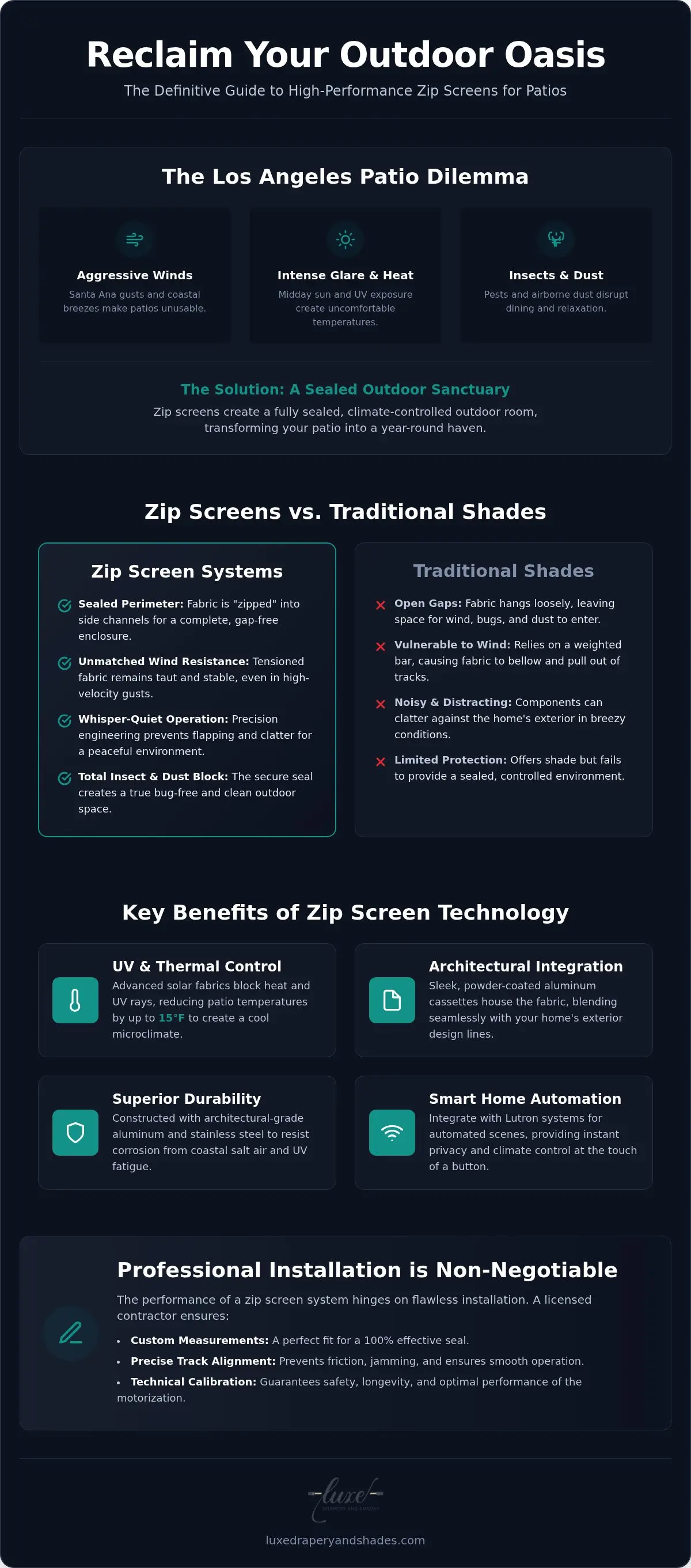
A zip screen is a motorized outdoor shade featuring a unique side-track system that “zips” the fabric into the channel, creating a complete seal. Unlike traditional shades that hang loose, these systems stay locked in place regardless of the breeze. A zip screen is a tensioned, track-guided system that seals the perimeter of an outdoor opening. This architectural precision is what distinguishes a luxury installation from a standard window treatment.
In Los Angeles, the desire for a seamless “indoor-outdoor” lifestyle is a cornerstone of luxury home design. High-quality zip screens for patios facilitate this shift by effectively expanding your home’s usable footprint. By enclosing a porch or loggia, you create a protected environment that feels like a natural extension of your interior living room. This transformation allows you to enjoy the California climate without the typical drawbacks of exposure.
The primary benefits of these systems include:
- Wind Resistance: The fabric remains taut even during high-velocity gusts.
- Insect Protection: A perimeter seal keeps mosquitoes and pests out of your dining area.
- UV Thermal Control: Advanced fabrics block heat before it reaches your glass doors or seating area.
The Essential Components of a Luxury Zip Screen
The system relies on a compact, powder-coated aluminum cassette that houses the fabric when it’s retracted. These cassettes are designed to be unobtrusive, blending into your home’s existing lines. The secret to their performance is the zipper track, which locks the fabric into the side channels. This mechanism ensures the screen doesn’t flap or pull out of the track during Santa Ana gusts. You can choose between high-tech solar mesh for heat management or clear vinyl for wind protection without losing your view. For those seeking inspiration from high-quality custom manufacturers, aussieonlineblinds.com.au showcases how these systems are engineered for maximum durability and style.
Solving the Los Angeles Patio Dilemma
Living on the Westside or in the South Bay brings specific environmental challenges that can make outdoor spaces unusable. Zip screens for patios provide a sophisticated solution for these local issues. They block the intense afternoon sun in Westside neighborhoods without ruining the sunset view. For coastal estates in the South Bay, these screens protect expensive outdoor furniture from corrosive salt air and fine dust. They also create a bug-free environment for evening entertaining, offering a much more elegant alternative to traditional, bulky mesh enclosures.
The Engineering of Comfort: How Zipper Track Systems Work
The mechanical superiority of a zipper track system lies in its ability to distribute tension evenly across the entire surface of the fabric. Standard outdoor shades often rely on a simple weighted hem bar to keep the material down. While this works in a vacuum, it fails the moment a breeze enters the equation. In contrast, zip screens for patios utilize a continuous side-channel lock. This design ensures the fabric remains perfectly flat and stable, preventing the distracting clatter of hardware against your home’s exterior during a gusty afternoon.
High-performance engineering requires high-performance materials. For California estates, using architectural-grade aluminum and stainless steel components is non-negotiable. These materials resist the corrosive effects of coastal salt air and the structural fatigue caused by intense UV exposure. When paired with premium motorized hardware, the result is a whisper-quiet operation. It feels less like a utility and more like a sophisticated architectural feature that responds instantly to your needs.
Wind Resistance and Structural Integrity
The primary enemy of any outdoor shade is the “bellowing” effect. This occurs when wind catches the fabric like a sail and pulls it out of its tracks. A professionally installed zip system eliminates this risk by anchoring the fabric within a deep side-channel. Precise track alignment is essential; even a few millimeters of deviation can cause friction or jamming. Custom measurements ensure a 100% seal, which is the only way to effectively block both the Santa Ana winds and persistent local pests.
Fabric Technology and UV Protection
The comfort of your outdoor room is largely dictated by the Solar Heat Gain Coefficient (SHGC) of your chosen mesh. Advanced solar fabrics can reduce patio temperatures by up to 15 degrees, creating a cool microclimate even during a heatwave. Choosing the right “openness factor” allows you to balance airflow with privacy. Interestingly, darker meshes often provide a clearer view of the landscape than lighter colors because they absorb more light and reduce glare. If you’re ready to refine your home’s exterior, exploring bespoke outdoor shades is the first step toward a more comfortable lifestyle.
Comparing Outdoor Shading: Zip Screens vs. Traditional Shades
Standard outdoor shading often provides a mere suggestion of protection, whereas zip screens for patios offer a definitive barrier. When you compare a standard roller shade to a zipped system, the most immediate difference is the perimeter seal. Traditional shades leave significant gaps at the sides, allowing mosquitoes and cool evening breezes to bypass the fabric entirely. This “seal factor” is what transforms a simple porch into a year-round outdoor room. It’s the difference between sitting under a cover and relaxing within a controlled environment.
Wind performance further separates these technologies. Most standard shades require retraction when wind speeds exceed moderate levels to prevent damage to the fabric or the home’s siding. Zip systems stay down and functional during the same conditions because the tension is held by the track, not the fabric itself. This stability also increases longevity. Without the constant flapping and snapping associated with loose-hanging shades, the fabric avoids the premature wear and fraying that often plagues lower-end installations. Visually, the sleek profile of a zip screen cassette is far more refined than the bulky arms of traditional awnings, maintaining the clean lines of your home’s architecture.
Zip Screens vs. Cable-Guided Shades
Cable-guided shades are often positioned as a minimalist alternative, yet they frequently fall short in luxury applications. The primary issue is the gap problem; cables cannot provide a bug-proof or wind-proof seal because the fabric isn’t physically locked into a channel. Visually, tension cables can appear industrial or cluttered, while the clean lines of a track integrate seamlessly into a home’s facade. Additionally, track systems require less frequent maintenance as they aren’t prone to the cable stretching or hardware loosening that occurs over time.
Zip Screens vs. Fixed Screen Enclosures
While a fixed screen cage offers protection, it lacks the flexibility that luxury homeowners demand. The ability to fully retract your screens allows you to enjoy an open-air feel on perfect coastal days, a benefit that permanent mesh cages cannot offer. Retractable luxury structures tend to enhance property value more effectively than fixed enclosures, as they preserve the home’s original architectural silhouette. For those exploring their options, you can learn more about luxury outdoor shades in Los Angeles to see how these systems adapt to different estate styles. This adaptability ensures your outdoor space remains a versatile sanctuary rather than a static room.
Design and Automation: Integrating Zip Screens into Your Smart Home
The true mark of a luxury estate lies in its ability to anticipate the needs of its inhabitants. While the physical engineering of zip screens for patios provides the foundation for comfort, smart home integration provides the soul of the experience. By connecting your outdoor shading to a centralized control system, you move beyond manual adjustments. Your patio becomes an intelligent environment that responds to the time of day, the angle of the sun, and your personal entertaining schedule. It’s an effortless extension of the modern, connected lifestyle.
Lutron Sivoia technology serves as the gold standard for this level of architectural integration. By utilizing these advanced motorization systems, you can sync your outdoor screens with your interior lighting and window treatments. This creates a unified aesthetic across your entire property. If you want to dive deeper into these capabilities, you can explore Lutron home automation in Los Angeles to understand how these systems redefine domestic convenience.
Automation also serves a protective function. Sensor-driven programming allows your screens to lower automatically when the afternoon sun reaches a specific intensity, preserving your interior flooring and outdoor upholstery from UV damage. Conversely, wind sensors can trigger an immediate retraction during extreme gales, protecting the system’s structural integrity when you aren’t home. One-touch “Evening Entertaining” modes can be programmed to lower the screens, dim the patio pendant lights, and activate your outdoor heating with a single command.
The Lutron Advantage for Outdoor Spaces
Precision alignment is a hallmark of the Lutron experience. When you have multiple zip screens for patios installed along a single loggia, Lutron technology ensures they move in perfect synchronization. This visual harmony is essential for maintaining the high-end feel of a luxury estate. You can manage the entire environment via a dedicated app from anywhere in the world or utilize voice control through Josh.ai. This allows for hands-free operation while you’re hosting guests or carrying trays of refreshments.
Architectural Aesthetics and Customization
A sophisticated installation should never look like an afterthought. Custom powder-coating allows the aluminum cassettes to match your home’s trim, pergola, or stone facade perfectly. For the most demanding design requirements, recessed mounting hides the cassette within the ceiling or soffit, making the system completely invisible when retracted. This clean look is paired with a curated selection of fabrics. We focus on textures and tones that complement your interior drapery, ensuring the transition from your living room to the garden feels intentional and refined. To begin your transformation, consult with our design experts to find the perfect automated solution for your estate.
The Luxury Standard: Custom Zip Screen Installation in Los Angeles
Achieving a flawless integration of zip screens for patios requires more than high-end hardware; it demands the precision of an expert hand. While many providers treat outdoor shading as a secondary service, we approach every project as a bespoke architectural commission. In California, choosing a licensed and bonded contractor (CSLB #1066068) is essential not just for the integrity of your warranty, but for the safety and longevity of the installation. A luxury estate deserves a system that functions as perfectly as the interior it protects. It’s the difference between a simple home improvement and a curated lifestyle upgrade.
Our Bespoke Design Consultation
The process begins with an intimate understanding of your property’s specific micro-climate. An estate in Santa Monica faces different challenges from one in Beverly Hills or the South Bay. We evaluate factors such as salt air exposure, prevailing wind patterns, and peak sun angles. This technical site survey determines the optimal mounting solutions, whether you require a surface-mounted cassette or a fully recessed “invisible” profile. We curate materials and powder-coated finishes that ensure a perfect match with your existing architecture. By treating the screen as an essential design element, we ensure it complements your home’s aesthetic rather than detracting from it.
Professional Installation and Long-Term Support
The performance of a track-guided system depends entirely on the precision of the alignment. Even a minor deviation can lead to fabric friction or mechanical strain over time. Our installation experts specialize in the technical calibration required for lifetime “zip” performance. This ensures the fabric remains taut and the motor operates in a whisper-quiet manner. This phase includes the seamless programming of your Lutron or home automation system, allowing you to control your environment with intuitive ease. Our commitment doesn’t end once the hardware is mounted. We provide ongoing technical support to ensure your smart home scenes remain perfectly calibrated as your lifestyle evolves.
When selecting a provider for zip screens for patios, consider this final checklist:
- Does the provider hold a valid California contractor’s license?
- Are they specialists in high-end motorization like Lutron Sivoia?
- Do they offer custom powder-coating to match your home’s trim?
- Is there a clear process for technical site surveys and architectural integration?
Investing in a professional installation ensures your patio remains a sophisticated sanctuary for years to come. You can schedule your custom outdoor shade consultation today to begin tailoring your outdoor space.
Redefining the Boundary of Your Home
Transforming your patio into a functional, year-round sanctuary requires a blend of advanced engineering and aesthetic vision. By choosing zip screens for patios, you’re investing in a system that masters the elements while maintaining the architectural integrity of your estate. From the wind-resistant zipper track technology to the effortless sophistication of Lutron-controlled automation, these screens redefine how you experience the Los Angeles climate. They provide more than just shade; they create a climate-controlled environment where you can host, relax, and retreat without compromise.
As a Licensed California Contractor (#1066068) and expert Lutron certified installers, we bring a boutique level of craftsmanship to every project. Our bespoke design expertise ensures that your installation reflects the unique character of your home, whether you’re overlooking the coast or nestled in the hills. It’s time to reclaim your outdoor space and enjoy the luxury of a seamless indoor-outdoor lifestyle. Design your dream outdoor retreat with Luxe Drapery and Shades today. We look forward to helping you curate a more comfortable and elegant home atmosphere.
Frequently Asked Questions
Can zip screens withstand high winds in Los Angeles?
Zip screens are engineered specifically to handle the intense gusts common in Los Angeles neighborhoods. The fabric is locked into the side tracks, preventing the “sail effect” that often damages traditional shades. While standard treatments must be retracted during high-wind events, these systems maintain their structural integrity. Professional installation ensures the tracks are anchored securely to your home’s frame, providing a reliable barrier against the Santa Ana winds and coastal breezes.
Are zip screens truly bug-proof for my patio?
Yes, these systems create a complete perimeter seal that effectively blocks insects from entering your outdoor living area. Unlike traditional shades that leave gaps at the sides and bottom, zip screens for patios utilize a continuous track that “zips” the fabric into place. This eliminates entry points for mosquitoes and other pests. When fully lowered, the system transforms your patio into a secure, bug-free environment for evening dining and relaxation.
Can I integrate my zip screens with my Lutron home automation system?
You can absolutely integrate these screens into a Lutron home automation system for seamless control. We specialize in Lutron Sivoia technology, which allows your outdoor shading to sync with interior lighting and window treatments. This integration enables you to create customized “scenes” where your screens lower and your patio lights dim with a single command. It’s a sophisticated way to manage your home’s atmosphere while ensuring maximum energy efficiency and convenience.
How do I clean and maintain my motorized zip screens?
Maintaining your motorized systems is a straightforward process that ensures long-term performance. You should occasionally rinse the fabric with clear water and a mild detergent to remove dust and salt residue, especially in coastal areas like the South Bay. Avoid using abrasive chemicals or high-pressure washers that could damage the solar mesh. It’s also helpful to keep the side tracks free of debris to ensure the zipper mechanism continues to operate with whisper-quiet precision.
What is the difference between a zip screen and a standard solar shade?
The primary distinction lies in the side-channel locking mechanism that defines a zip system. Standard solar shades hang freely or use cables, which allows the fabric to flap and creates gaps at the edges. Zip screens for patios lock the fabric into a track, providing superior wind resistance and a complete seal against pests. This engineering makes them a more durable and functional choice for Los Angeles homeowners who prioritize climate control and privacy.
Can zip screens be recessed into the ceiling for a hidden look?
Yes, architectural-grade zip screens can be recessed into the ceiling or soffit for a completely hidden appearance. This approach is ideal for new construction or extensive renovations where a clean, minimalist aesthetic is desired. When retracted, the cassette is invisible, leaving your patio’s lines undisturbed. We coordinate with architects and contractors to ensure the structural requirements for a recessed installation are met, providing a truly integrated luxury finish for your estate.
Do zip screens provide privacy from neighbors?
These screens provide excellent daytime privacy by utilizing specialized solar mesh fabrics. The visibility depends on the “openness factor” you choose; a tighter weave offers more privacy while still allowing you to see out into your garden. During the day, the mesh acts like a one-way mirror, blocking the view from neighbors while you enjoy the scenery. For evening privacy, we can recommend specific fabric densities that maintain a sense of seclusion even when your patio lights are on.
How long does the installation process typically take?
The installation itself typically takes one to three days, depending on the number of screens and the complexity of the automation. However, the entire process begins with a custom design and manufacturing phase, which usually spans several weeks. Because every system is bespoke, we take precise measurements to ensure a 100% seal. Once the custom-fabricated screens arrive, our expert team handles the technical calibration and smart home integration to ensure everything functions perfectly from day one.