

Could the soft, sculptural fold of a custom silk drape actually be the most advanced piece of technology in your Los Angeles home? For many homeowners across the Westside and South Bay, the challenge isn’t just adding automation, it’s ensuring that technology serves the architecture rather than disrupting it. You likely believe that a truly luxurious room should feel effortless, yet the technical jargon of Matter 1.6, Zigbee, and protocol compatibility often creates more noise than a standard motor. Integrating motorized drapery into smart home systems shouldn’t require a compromise between sophisticated aesthetics and modern convenience.
We believe that window treatments are more than just fabric; they’re a lens through which you experience a more refined lifestyle. This guide provides the expertise you need to master a seamless integration that prioritizes whisper-quiet performance and the preservation of your design’s integrity. We’ll explore how to synchronize your drapes with Lutron lighting systems for a total environment solution, ensuring your home responds intuitively to the movement of the sun. From understanding the latest interoperability standards to achieving perfect hem-bar alignment, you’ll discover how to create a unified ecosystem where light, privacy, and comfort exist in perfect, automated harmony.
Key Takeaways
- Learn why integrating motorized drapery into smart home systems in 2026 requires a focus on networked architecture rather than simple remote controls.
- Discover how Lutron and the Matter 1.6 protocol ensure your window treatments communicate flawlessly with lighting and climate controls.
- Evaluate the benefits of hardwired reliability for new Los Angeles estates versus the sophisticated flexibility of modern battery-powered systems.
- Master the hardware-first planning phase to preserve your custom drapery folds while ensuring adequate space for motorized tracks.
- Understand the necessity of professional programming to achieve perfect hem-bar alignment and a truly unified smart home environment.
The Architecture of Connectivity: Understanding Smart Motorized Drapery
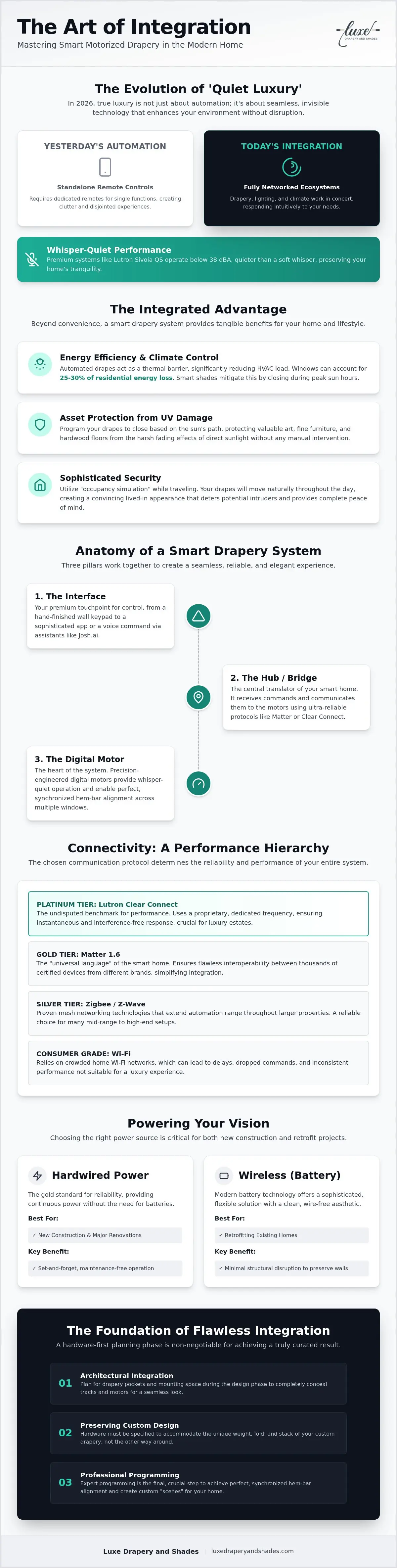
Integration isn’t just about a motor; it’s about intelligence. Integrating motorized drapery into smart home systems transforms a passive textile into an active participant in your home’s climate and mood. We’ve moved past the era of standalone motorized rods that require a dedicated remote. Today, we design fully networked drapery systems that communicate with the broader architecture of home automation systems. This connectivity allows your window treatments to work in concert with other devices, creating a living environment that is both responsive and intuitive.
This shift defines the “Quiet Luxury” movement. In 2026, technology should be invisible. A motor that hums or vibrates is a design failure. We prioritize whisper-quiet operation, such as the Lutron Sivoia QS, which maintains a sound level below 38 dBA. This silence allows for the creation of “scenes”-choreographed moments where your drapes glide open, the lights dim, and your favorite playlist begins, all from a single command. It’s about orchestrating your environment to match the rhythm of your day.
Beyond the Remote: Why Integration Matters
True luxury is found in the things you don’t have to do. Automated scheduling ensures your drapes respond to the sun’s path, protecting your art and furniture from UV damage without your intervention. In sunny Los Angeles, this is a functional necessity. Since windows can account for 25% to 30% of residential heating and cooling energy loss, your drapes act as a thermal barrier. By closing during the peak heat of the day, they significantly reduce the load on your HVAC system.
Security also gains a sophisticated edge. For those maintaining a Westside estate, occupancy simulation is vital. Your drapes can move naturally throughout the day while you’re traveling, creating the appearance of a lived-in home. This automated movement provides peace of mind that a static window treatment simply cannot offer.
Key Components of an Integrated System
Building this ecosystem requires three fundamental pillars. First is the motor. We favor digital motors for their precision. This digital control allows for exact “hem-bar” alignment across multiple windows, which requires professional programming to ensure every fold is perfectly synchronized. Second is the bridge or hub. This device acts as the translator, converting commands from protocols like Matter 1.6 into movement. Finally, the interface provides the touchpoint. Whether it’s a hand-finished wall keypad, a smartphone app, or a voice-activated assistant like Josh.ai, the control should feel as premium as the fabric itself. Integrating motorized drapery into smart home systems ensures these components work as one, providing a seamless experience that honors both technology and design.
Connectivity Standards: From Lutron to Josh.ai
The foundation of any high-end smart home is its ability to communicate. Integrating motorized drapery into smart home systems in 2026 means navigating a landscape of shifting protocols, where the goal is long-term stability rather than temporary novelty. While many consumer-grade solutions rely on crowded Wi-Fi networks, luxury estates require the dedicated bandwidth of professional-grade standards. This ensures that when you command your drapes to close, the response is instantaneous and reliable. The choice of protocol determines whether your window treatments are a lifelong asset or a technical burden.
The release of Matter 1.6 on June 17, 2026, has fundamentally changed the conversation around interoperability. With over 4,000 Matter-certified devices now available, the “universal language” of the smart home is finally a reality. This standard allows different brands to work together without the need for complex custom bridges. However, for those seeking the highest tier of performance, specialized systems like Zigbee and Z-Wave still play a role in mid-range setups, offering mesh networking capabilities that extend the reach of your automation throughout larger properties.
Lutron Sivoia and Homeworks: The Platinum Standard
For designers and homeowners alike, Lutron home automation in Los Angeles remains the undisputed benchmark for performance. The secret lies in their proprietary Clear Connect protocol. Unlike standard wireless signals that compete with your home’s streaming and browsing traffic, Clear Connect operates on a quiet, dedicated frequency. This creates a rock-solid link between your Lutron Sivoia motorized shades and your drapery tracks.
One of the greatest advantages of a Lutron-centric system is the total environmental synergy. Your drapery hardware doesn’t just function; it coordinates. You can match the finish of your motorized rods with the architectural aesthetics of Lutron wall keypads, creating a visual thread that ties the room together. If you’re looking for the latest smart blind technology, you’ll find that Lutron’s integration with lighting control is what truly elevates a space from smart to sophisticated.
Voice and AI Integration
Integrating motorized drapery into smart home systems is more streamlined than ever, yet for those who value absolute privacy and advanced logic, Josh.ai is the preferred choice. Josh.ai offers a level of nuance that basic assistants lack. You can give complex, natural language commands like “Close the drapes halfway if the sun is too bright in the gallery.” Because Josh.ai prioritizes local processing, your voice data stays within your walls, and the response time is significantly faster.
Whether you prefer the accessibility of Apple HomeKit or the specialized intelligence of a Josh Core system, the interface should always feel like an extension of your intent. If you are ready to experience this level of control, our team can help you select the ideal automation protocol for your specific architecture.
Powering Your Vision: Hardwired vs. Wireless Integration
While the digital protocols discussed earlier provide the intelligence for your window treatments, the physical power source determines their long-term performance. Integrating motorized drapery into smart home systems requires a decision early in the design process to avoid aesthetic compromises. In the expansive estates of the Westside or the historic architecture of the South Bay, this choice impacts both the installation timeline and the daily experience of your home. You must weigh the permanence of hardwired infrastructure against the adaptable nature of wireless power.
Hardwired Systems: The Set-and-Forget Choice
For new construction or major renovations, hardwired systems are the gold standard. They offer unparalleled reliability for high-capacity motorized traverse rods, which are essential when working with heavy velvet or thick, interlined drapery panels. Low-voltage 24V DC wiring ensures that every motor receives consistent power, eliminating the risk of signal lag or battery fatigue in large-scale residences. We recommend coordinating with your architect during the framing phase to designate specific power drops. This foresight allows for a clean, architectural finish where wires are entirely concealed within the wall or ceiling pocket. Centralized power panels further simplify the system, housing the transformers in a single AV closet for easy access and a clutter-free environment.
Battery and Wireless: When Retrofitting is Key
In many historical South Bay homes, opening walls to run new wiring isn’t always a desirable option. This is where modern wireless solutions shine. By 2026, lithium-ion battery technology has advanced to support longer duty cycles, even for frequent daily use. These systems utilize wireless bridges to communicate with the broader network, often adhering to the standards set by the Connectivity Standards Alliance to ensure they remain compatible with other smart devices.
While battery-powered options offer incredible flexibility, consider the “hidden” maintenance costs associated with integrating motorized drapery into smart home systems. Heavy custom drapes consume more energy during operation, meaning batteries may require more frequent charging than lighter roller shades. To preserve the aesthetic of your curated space, we utilize decorative hardware designed specifically to hide battery packs within the track or behind the leading edge of the fabric. This ensures the technology remains invisible to the eye while providing the convenience of modern automation.
The Planning Phase: Integrating Motorization into Design
Successful automation begins long before the first yard of fabric is cut. While manual window treatments often allow for aesthetic decisions to lead the way, integrating motorized drapery into smart home systems requires a “hardware-first” mentality. This approach ensures that the structural requirements of the motorized track are fully reconciled with the architectural vision of the room. When we design custom drapes in Los Angeles, we prioritize the physical footprint of the motor and the track to prevent the technology from becoming a visual afterthought.
One of the most critical considerations is stack-back, the space the fabric occupies when the drapes are fully open. Motorized tracks are often deeper and more robust than manual rods, meaning they require precise calculations to ensure the fabric clears the glass entirely. This is especially vital for floor-to-ceiling glass walls where preserving the unobstructed Westside view is paramount. We find that Ripplefold pleats offer the most sophisticated synergy with motorized traverse tracks, as their consistent, S-curve folds glide effortlessly and maintain their perfect spacing even after years of daily operation.
Recessed Pockets and Architectural Concealment
To achieve the coveted “floating” drape look found in modern California architecture, we often collaborate with builders during the framing stage to create recessed ceiling pockets. These hidden channels house both the track and the motor, rendering the technology completely invisible. Technical precision is non-negotiable here. A pocket must be deep and wide enough to accommodate the fabric’s fold without creating friction, which can strain the motor and disrupt the whisper-quiet performance. For those planning a renovation, our team can provide the exact architectural specifications needed to ensure a seamless fit within your ceiling structure.
Matching Hardware to High-End Fabrics
The weight of your chosen textile dictates the power requirements of your system. Integrating motorized drapery into smart home systems involves selecting a motor with a weight capacity that exceeds the combined pull of heavy custom linens, interlining, and blackout layers. A motor that is under-powered will struggle, leading to uneven movement and premature wear. We also utilize a deep “return,” a custom-bent piece of hardware that wraps the fabric around the end of the track to the wall. This simple design element effectively hides the motor and wiring from every angle. If a recessed pocket isn’t feasible, we offer decorative fascias in finishes that match your interior hardware, bridging the gap between high-tech functionality and curated style.
Curated Installation: The Luxe Drapery Advantage
The final stage of integrating motorized drapery into smart home systems is where technical precision meets artistic execution. While many AV firms can mount a motorized track, they often lack the specialized “soft goods” expertise required to properly dress and steam a custom drape. A high-capacity motor is only as good as the fabric it carries. We position ourselves at the unique intersection of audiovisual technology and textile design, ensuring that your window treatments perform flawlessly without sacrificing their aesthetic soul. As a licensed California contractor (CSLB #1066068), we bring a level of structural accountability and white-glove service that is essential for the residential estates of Los Angeles.
Our installation process is thorough and intentional. We don’t just hang the fabric; we meticulously program the system to respect the architecture of your home. This includes setting precise upper and lower limits to ensure a perfect hemline that skims your flooring without dragging or hovering awkwardly. This attention to detail preserves the life of the motor by preventing unnecessary strain and ensures that your custom drapes maintain their tailored look for years to come.
Professional Programming and Scene Setting
True automation should reflect your daily rituals. We specialize in tailoring schedules that respond to the specific sun patterns of the Westside and South Bay, moving your drapes to protect your interiors during peak UV hours while opening them to capture the evening light. A critical part of our service is achieving perfect hem-bar alignment. We ensure that every drape in a room moves in perfect synchronization, reaching their stopping points at the exact same moment. This creates a visual harmony that is the hallmark of a professionally integrated system. Before we leave your estate, we provide comprehensive training, ensuring you feel confident whether you’re using a wall keypad, a smartphone app, or a voice command via Josh.ai.
Maintenance and Long-Term Support
Integrating motorized drapery into smart home systems is a long-term investment in your home’s performance. Like any sophisticated technology, these systems benefit from occasional firmware updates and health checks to ensure they remain compatible with evolving home automation standards. Our local presence in Los Angeles allows us to provide responsive, personalized support that mass-market providers can’t offer. We understand the nuances of South Bay coastal environments and Westside architectural trends, allowing us to anticipate the specific needs of your system. If you’re ready to elevate your living space with the ultimate in convenience and style, Schedule your smart home drapery consultation today and let us help you design a total environment solution.
Elevating Your Environment Through Intelligent Design
Integrating motorized drapery into smart home systems represents the final, sophisticated bridge between architectural intent and modern performance. By prioritizing a hardware-first approach and selecting industry-standard protocols like Lutron, you ensure your window treatments are active participants in your home’s climate and mood. The success of your project rests on the precision of professional programming and seamless architectural concealment; these are the elements that transform a simple automated rod into a curated design statement.
As a Lutron Certified Platinum Dealer and licensed California contractor (#1066068), our expert Los Angeles installation team understands the delicate balance between AV technology and fine textiles. We believe that every functional detail should serve as a lens for experiencing a more refined lifestyle. If you are ready to orchestrate a home that responds intuitively to your touch and the sun’s path, we invite you to take the next step. Schedule a Design Consultation for Your Smart Home Drapery and discover how quiet luxury can redefine your living space. We look forward to helping you create a unified, effortless environment.
Frequently Asked Questions
Can I integrate motorized drapes into an existing smart home system?
Integrating motorized drapery into smart home systems is highly feasible for most existing setups. We utilize specialized bridges and the latest Matter 1.6 protocol to ensure your new drapes communicate effortlessly with your current ecosystem. Whether you’re running a Lutron Homeworks environment or a more decentralized hub, our team ensures the hardware speaks the same language. This process allows your window treatments to join your home’s existing scenes and schedules without requiring a complete system overhaul.
Do motorized drapes work with voice commands like Alexa or Josh.ai?
They certainly do. High-end motorized systems offer native support for Josh.ai, Apple HomeKit, and Amazon Alexa. This allows you to use intuitive voice commands for precise control, such as asking your system to set the drapes to fifty percent. For our Westside clients, we often recommend Josh.ai because it prioritizes local processing and privacy. It creates a more responsive experience while keeping your voice data secure within the walls of your own home.
What happens to my motorized drapes if the Wi-Fi goes out?
Your drapes will continue to function through local controls even if your internet connection fails. Professional systems like Lutron rely on proprietary radio frequency protocols rather than standard Wi-Fi for their primary communication. This means your wall keypads and handheld remotes remain fully operational. While cloud-based features like remote app control or voice assistants might experience a temporary pause, the essential movement and automated scheduling of your drapery stay perfectly intact and reliable.
Are motorized drapery tracks noisier than manual ones?
Modern luxury motors are designed to be virtually silent. When integrating motorized drapery into smart home systems, we select motors that operate at sound levels below 38 dBA. This is quieter than a soft whisper in a library. Unlike manual tracks that can sometimes click or drag, a high-capacity motorized rod offers a smooth, fluid motion. This silent operation is a hallmark of Quiet Luxury; it ensures your home’s atmosphere remains peaceful and undisturbed.
Can I use any fabric for motorized smart drapes?
Most premium textiles are compatible with motorization, though the weight of the fabric is a critical planning factor. We specialize in tailoring high-capacity tracks that can easily handle the significant weight of interlined velvet or heavy custom linens. The motor is selected based on the total weight of the finished panels. This ensures that even the most substantial fabrics glide effortlessly across your glass walls without putting undue strain on the internal drive system.
Is it possible to hide the motor in a custom drapery installation?
Concealing the technology is a priority in every luxury project. We achieve this through two primary methods: recessed ceiling pockets or custom fabric returns. Architectural pockets allow the entire track and motor to disappear into the ceiling for a clean, modern look. Alternatively, a custom return wraps the fabric around the end of the rod to the wall, effectively shielding the motor from view. This ensures your aesthetic remains the primary focus of the room.
How much power do motorized drapes consume?
Motorized drapery systems are remarkably energy efficient. Most operate on a low-voltage 24V DC power supply and only consume significant power during the brief moments when the drapes are actually in motion. When the system is idle, it enters a low-power standby mode. In fact, the energy you save on cooling costs by automating your drapes to block the Los Angeles sun often far outweighs the minimal electricity required to operate the motors themselves.
Do I need a special professional to install smart drapes?
Professional installation is essential for both structural integrity and technical performance. Because these systems involve low-voltage wiring and complex digital programming, you should always partner with a licensed contractor. Our team handles everything from the physical mounting of high-capacity tracks to the professional programming required for perfect hem-bar alignment. This specialized expertise ensures that your window treatments operate safely and that every fold remains perfectly synchronized across multiple windows in the same room.