

What if the most impactful architectural detail in your home isn’t the crown molding or the fireplace, but the space just above your windows? You’ve likely spent weeks selecting the perfect fabric or the most responsive motorized shades, yet the final result can still feel incomplete when unsightly brackets or light gaps remain visible. It’s a common design dilemma where even the most expensive treatments look flat without a proper structural anchor. Custom cornice boards provide the essential architectural tailoring needed to bridge the gap between fine textiles and the room’s permanent structure.
You deserve a window solution that looks as sophisticated as it performs. By choosing custom cornice boards, you’ll discover how to hide complex hardware and create a seamless, clean finish that enhances your home’s overall value. This guide explores the nuances of cornice design, from selecting the right upholstered shapes to integrating Lutron motorization for a truly modern experience. We’ll walk through how these bespoke accents transform functional coverings into intentional design statements that define luxury living in Los Angeles. Whether you’re seeking a minimalist profile or an ornate upholstered finish, you’ll find the expertise needed to complete your vision.
Key Takeaways
- Understand how hard-top treatments provide a definitive architectural finish that soft valances can’t replicate.
- Learn to choose between the soft texture of upholstered custom cornice boards and the architectural continuity of wood-finished designs.
- Discover how these structures elegantly conceal motorized hardware and eliminate light gaps for a truly tailored environment.
- Explore the seamless integration of Lutron motorization within a cornice to maintain a clutter-free, luxury aesthetic.
- Gain insight into the bespoke design and installation process essential for securing heavy architectural accents in luxury estates.
What is a Custom Cornice Board? Defining Architectural Window Tailoring
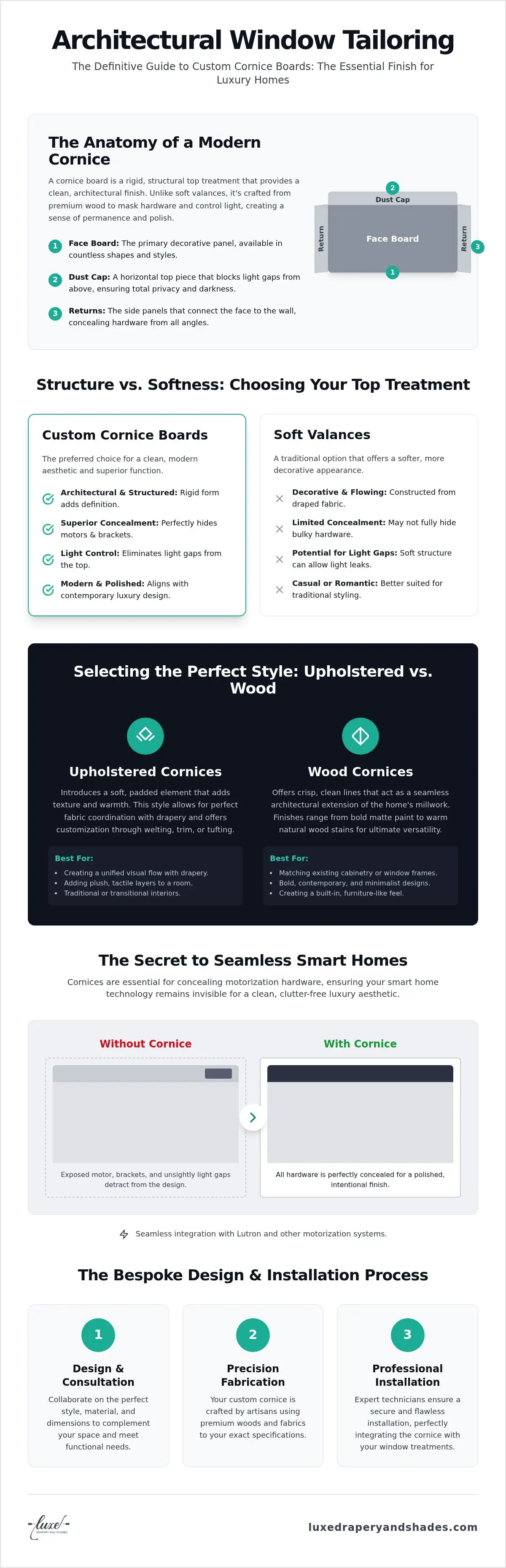
A cornice board is a structural window accent designed to hide hardware and enhance room proportions. Unlike soft valances that rely on the fluid movement of draped fabric, custom cornice boards are rigid, hard-top treatments constructed from premium wood or high-density foam. They act as an architectural bridge, transforming a standard window opening into a focal point with defined edges and a sense of permanence. While a valance might feel romantic or casual, a cornice offers a sense of structural integrity that grounds the entire design of a room.
The distinction between a cornice and a soft valance is one of structure and mood. Valances provide a soft aesthetic, but they often fail to conceal the industrial look of modern motorized hardware. Pelmets are similar to cornices, though the term often refers specifically to fabric-covered boards used in more traditional styling. In a modern luxury context, the cornice is the preferred choice for its ability to provide a clean, boxed-in finish that feels like a natural extension of the home’s woodwork. It functions as both a crown for your window and a clever mask for the mechanical components of your window treatments.
The Anatomy of a High-End Cornice
True craftsmanship is found in the details that the casual observer might miss. A high-end cornice features a dust cap, which is the horizontal board covering the top of the unit. This piece isn’t just for cleanliness; it blocks light gaps that often appear at the top of shades, ensuring total privacy. The returns are the side panels that extend from the face of the board back to the wall. These returns create a three-dimensional profile that neatly tucks away the ends of drapery rods or roller tubes. Choosing an outside mount can visually extend the height of your walls, while an inside mount offers a sleek, integrated appearance within the window casing.
Why Custom Cornices are Essential for Luxury Homes
For homes in Los Angeles that lack substantial crown molding, custom cornice boards provide the necessary architectural weight to ground a room. They offer a finished look that harmonizes your drapery with the surrounding wall colors and textures. While ready-made options are limited by standard sizes and basic materials, bespoke cornices are scaled precisely to your window’s dimensions. This precision ensures the treatment doesn’t overwhelm the space or look like an afterthought. It’s the difference between a suit off the rack and one tailored to your exact measurements. A custom cornice serves as the final, polished layer that elevates a functional room into a curated living space.
Selecting the Perfect Style: Upholstered vs. Wood Cornices
Selecting the right material for your window treatments involves more than just color matching. It’s a choice between the tactile warmth of fabric and the crisp, architectural definition of timber. Your room’s existing design language usually dictates the path. Modern spaces often favor the stark, clean lines of painted wood, while traditional interiors benefit from the layered textures of upholstered custom cornice boards. Both styles serve to ground the window, but they communicate different levels of formality and comfort.
The Elegance of Upholstered Designs
Upholstered cornices introduce a soft, padded element to the top of the window that counteracts the hard surfaces of glass and walls. High-quality designs utilize thick batting to create a plush, three-dimensional profile that feels substantial rather than flat. This style allows for intricate details like contrasting welting, decorative trim, or even button tufting for a more regal appearance. By coordinating fabrics with your custom drapes in Los Angeles, you create a unified visual flow that draws the eye upward and elongates the room.
Stained and Painted Wood Cornices
Maintenance needs vary significantly between these two paths. Wood structures are incredibly resilient and only require a light dusting to maintain their luster over decades. Upholstered versions, while adding a layer of acoustic dampening to the room, need more attentive care to prevent dust buildup in the fabric fibers. Choosing a performance fabric can mitigate these concerns, ensuring your custom cornice boards remain a pristine part of your interior for years. If you’re unsure which direction fits your space, a professional design consultation can help determine the best material for your lifestyle and aesthetic goals. Each material offers a unique way to experience luxury, turning a simple window into a curated architectural feature.
Cornice Boards vs. Soft Valances: A Comparison for the Discerning Homeowner
Choosing between a cornice and a valance is essentially a choice between architecture and atmosphere. While both treatments occupy the upper portion of the window, they serve very different aesthetic and functional roles. Custom cornice boards are rigid, hard-top structures that offer a crisp, tailored finish. Soft valances, conversely, rely on the natural drape and fluid movement of fabric to create volume. This structural difference impacts everything from the room’s ambient light levels to the long-term maintenance of the window treatment itself.
Light control is where the cornice truly excels. Because a cornice is built with a solid top, often referred to as a dust cap, it creates a physical barrier that prevents light from leaking over the top of your shades. Valances, being made of soft fabric, often allow light to spill through the gaps between the rod and the wall, which can be distracting in media rooms or bedrooms. In high-traffic Los Angeles homes, the durability of a hard-top treatment is also superior. A well-constructed cornice maintains its geometric precision for decades, while fabric valances can eventually sag or lose their shape due to gravity and humidity.
When to Choose a Cornice Board
If your design goal is a modern, minimalist space with sharp lines, custom cornice boards are the definitive choice. They provide a sophisticated housing that completely conceals heavy motorized drapery hardware, ensuring that the only thing you see is the beauty of the fabric or the view outside. This “built-in” look mimics the appearance of custom millwork, making the window treatment feel like a permanent part of the home’s architecture rather than an accessory. It’s the ideal solution for homeowners who value a clean, uncluttered aesthetic.
When a Valance Might Be Preferred
There are instances where a softer touch is required to balance a room’s design. Valances are ideal for creating a relaxed, casual atmosphere in spaces like guest bedrooms or nurseries where fluid movement feels more appropriate than rigid structure. They are also a practical solution when the mounting surface is delicate and can’t support the weight of a heavy wood board. In coastal South Bay estates, a light linen valance can capture a breezy, effortless aesthetic that complements a more laid-back interior style. While they don’t offer the same architectural weight as a cornice, they provide a gentle frame that softens the room’s hard edges.
The Secret to Seamless Smart Homes: Cornices and Motorization
In the modern Los Angeles estate, technology should be felt through convenience, not seen through cluttered wiring. While motorized shades offer unparalleled ease, the industrial look of motors and battery packs can disrupt a curated interior. Custom cornice boards serve as the definitive architectural solution for this challenge, providing a sophisticated “housing” that conceals the mechanics of luxury. By integrating these structures into your Lutron home automation plan, you ensure that your window treatments operate with precision while remaining visually silent. This approach moves beyond simple window covering; it’s about creating an environment where the transition between light and shadow is effortless.
Concealing the Tech with Style
The primary advantage of a bespoke cornice is its ability to swallow the unsightly elements of smart home tech. Deep returns allow wires and battery packs to sit comfortably out of sight, tucked neatly behind the face of the board. This design doesn’t sacrifice accessibility; we engineer our cornices so that maintenance can be performed without dismantling the entire installation. A custom cornice provides the 4-6 inches of clearance required for high-end motorized shade brackets. This generous spacing prevents the fabric from rubbing against the structure, ensuring a smooth, silent transition every time you adjust your environment. It allows for a clutter-free aesthetic that prioritizes the room’s architecture over its mechanical components.
Quiet Luxury in Motion
Pairing Lutron Sivoia systems with custom-shaped cornices represents the pinnacle of window tailoring. While Lutron motors are famous for their near-silent operation, the hard surfaces of a wood cornice can sometimes amplify mechanical vibrations. To achieve true “quiet luxury,” we often recommend upholstered padding on the interior of the board. This extra layer acts as an acoustic dampener, absorbing resonance and making the motion almost imperceptible to the ear. When integrated into a comprehensive smart home lighting and shading plan, your cornices become the anchor for a living space that responds intuitively to your needs. This level of detail ensures that your home functions as a sanctuary, free from the distractions of visible hardware or mechanical noise.
Because these boards are often heavy and house sensitive electronic components, professional installation is a non-negotiable part of the process. Securing a custom architectural board requires a deep understanding of wall structures and weight distribution to ensure long-term safety and performance. If you’re ready to elevate your home with seamless technology, explore our motorized window treatment solutions to see how we can transform your space with a perfect blend of style and automation.
The Bespoke Design Process: From Concept to Professional Installation
The journey to a perfectly tailored window begins with a specialized consultation that prioritizes architectural harmony. In the context of a Los Angeles estate, this isn’t just about taking numbers; it’s about understanding the specific rhythm of your home’s interior. We select materials and finishes that speak to your existing decor, ensuring the custom cornice boards feel like an original feature rather than an addition. Unlike mass-produced alternatives that rely on thin, flimsy materials, artisan fabrication involves high-quality wood cores and premium upholstery. This commitment to craftsmanship ensures that the final product possesses the weight and presence required for a luxury environment.
Measuring for the Perfect Fit
Precision is the hallmark of true luxury. When measuring for a cornice, we must carefully account for the drapery stack-back. If the board is too narrow, the gathered fabric will crowd the window and unnecessarily block your natural light. We also determine the ideal mounting height to create an illusion of taller ceilings, often positioning the board just below the ceiling line to draw the eye upward. The depth of the “return” is equally critical. It must be deep enough to house your specific shade type without the fabric rubbing against the interior, preserving the life of your textiles while maintaining a sleek profile.
Professional White-Glove Installation
Professional installation is where the design vision finally becomes a structural reality. These aren’t lightweight accessories; a solid wood or heavily upholstered cornice requires expert mounting into wall studs to ensure long-term safety and stability. We focus on achieving perfect leveling, as even a fraction of an inch of misalignment can disrupt the room’s clean architectural lines. For homeowners with integrated motorized shades, our team makes final adjustments to ensure the fabric drops perfectly straight within the housing. This meticulous approach guarantees that the hardware remains invisible and the operation remains flawless. It’s the final, essential step in delivering a window treatment that looks as if it were built into the home’s very foundation.
Every element of this process is handled with a sense of quiet confidence and aesthetic expertise. We understand that your home is a sanctuary, and our goal is to enhance that atmosphere through disciplined design and impeccable execution. By choosing a bespoke path, you’re investing in a standard of quality that mass-market solutions simply cannot replicate. The result is a clean, tailored look that provides lasting value and effortless beauty for your living space.
Elevating Your Home’s Architectural Narrative
Refined window tailoring is about more than just privacy; it’s about the intentional integration of form and function. By choosing custom cornice boards, you’ve moved beyond standard coverings to create a permanent architectural finish that defines your space. These structures don’t just hide Lutron motorization or bulky hardware; they add a sense of deliberate structure that grounds your entire interior design. Whether you prefer the crisp lines of finished wood or the tactile warmth of upholstered layers, the result is a clean, tailored environment that reflects a high standard of living.
Our team of expert Lutron certified installers is dedicated to bringing this level of bespoke craftsmanship to Los Angeles interiors. We provide a comprehensive white-glove service that handles every detail from the initial precise measurements to the final secure mounting. This meticulous approach ensures that your window treatments aren’t just functional, but essential elements of a beautiful home. It’s the difference between a house that’s merely furnished and one that’s thoughtfully curated.
Schedule your bespoke design consultation with Luxe Drapery and Shades today to begin transforming your windows into curated works of art. We look forward to helping you experience a better lifestyle through exceptional design and impeccable service.
Frequently Asked Questions
What is the difference between a cornice and a valance?
A cornice is a rigid, hard-top window treatment, whereas a valance is a soft fabric treatment that drapes. Cornices are typically constructed from wood or foam and offer a crisp, architectural look. Valances provide a more fluid, romantic movement. This structural difference makes cornices the superior choice for hiding hardware and creating a built-in appearance that complements modern millwork.
Can I use a cornice board with motorized shades?
Cornice boards are the ideal housing for motorized shades because they completely conceal the motor, wires, and battery packs. They provide the necessary internal clearance for systems like Lutron Sivoia to operate without friction. By using a cornice, you maintain a clean, clutter-free aesthetic while enjoying the convenience of smart home automation. This combination represents the pinnacle of modern window tailoring.
How deep should a custom cornice board be?
The standard depth for custom cornice boards typically ranges from 4 to 8 inches, depending on the treatments they are concealing. If you are housing a single roller shade, 4 to 6 inches is often sufficient. However, if you are layering drapes over a motorized shade, you may require a depth of 8 inches or more to allow for proper movement. Precise measurements ensure the fabric doesn’t rub against the structure.
Are cornice boards out of style in 2026?
Cornice boards remain a staple of luxury design in 2026, specifically through the trend of minimalist, quiet luxury aesthetics. While ornate, heavy styles have evolved, the demand for clean, sculptural shapes and LED-integrated profiles is rising. Modern cornices often feature sleek XPS foam or simple painted wood that mimics crown molding. They continue to be favored for their ability to ground a room’s architecture and hide smart home technology.
What are the best fabrics for an upholstered cornice board?
Mid-to-heavyweight upholstery fabrics like linen blends, velvet, or high-end jacquards are best for achieving a smooth finish on custom cornice boards. These textiles have enough body to hide the underlying padding and batting without sagging. Performance fabrics are also an excellent choice for Los Angeles homes, as they offer resistance to fading from intense sunlight. Avoid very thin fabrics, as they can reveal the structural seams of the board beneath.
Can cornice boards help with energy efficiency?
Cornice boards contribute to energy efficiency by acting as a physical barrier that prevents air convection at the top of the window. By sealing the gap between the window treatment and the wall, they help trap a layer of air that acts as insulation. This reduces heat gain during warm California afternoons and keeps interiors cooler. When paired with cellular shades, the thermal performance of the window is significantly improved.
Do I need professional installation for a custom cornice board?
Professional installation is highly recommended for custom cornice boards due to their weight and the precision required for alignment. These structures must be securely anchored into wall studs to prevent sagging or safety hazards over time. Expert installers also ensure the board is perfectly level, which is critical for maintaining the clean lines of your home’s architecture. This is especially true for boards housing sensitive motorized components.
How do I clean an upholstered cornice board?
Regular maintenance for an upholstered cornice involves a light vacuuming with a soft brush attachment to remove surface dust. For deeper cleaning, professional upholstery services are preferred to avoid damaging the internal padding or shrinking the fabric. Spot cleaning should be done with caution using a mild, fabric-safe cleaner. Because they are mounted high, they stay cleaner than drapery hems, but routine care preserves the vibrancy of the textile.