

True luxury in a modern Los Angeles estate isn’t defined by what you see, but by the effortless silence of what you don’t. While the convenience of automation is undeniable, the debate between hardwired vs battery powered motorized shades often brings a touch of anxiety to even the most curated design projects. You might worry that hardwiring requires invasive construction that disturbs your home’s architectural integrity, or perhaps you fear that battery options will leave you managing a tedious charging schedule for dozens of windows. These concerns are valid, as the power source you choose today serves as the foundation for your home’s comfort for the next decade.
We understand that your goal is a sophisticated, invisible system that integrates perfectly with platforms like Lutron Homeworks. This 2026 guide provides the definitive technical and aesthetic clarity you need to choose between permanent wiring and advanced lithium-ion solutions. You’ll discover how to balance the 2026 California “Electric Ready” mandates with the desire for minimal maintenance and a clean, uncluttered aesthetic. We’ll examine the specific scenarios where each power source excels, ensuring your window treatments provide lasting elegance and intuitive control.
Key Takeaways
- Discover how battery-powered systems offer a surgical, wire-free solution for retrofitting established Los Angeles estates without compromising architectural integrity.
- Learn why hardwired motorization represents the pinnacle of effortless living, providing a permanent, zero-maintenance power source directly from your home’s electrical panel.
- Compare the long-term value and aesthetic impact of hardwired vs battery powered motorized shades to select the foundation that best supports your lifestyle.
- Explore the seamless integration of motorized treatments with elite smart home ecosystems like Lutron Homeworks for intuitive, synchronized control.
- Identify the essential role of a licensed California contractor in navigating the 2026 building codes and complex architectural requirements of Westside and South Bay homes.
Understanding the Power Behind Modern Window Automation
Modern window automation represents a sophisticated marriage between architectural intent and digital convenience. For the discerning homeowner, motorized blinds are no longer a luxury add-on but a foundational element of a well-appointed living space. The decision between hardwired vs battery powered motorized shades dictates far more than just the installation process. It influences the very sensory experience of your home, from the subtle hum of the motors to the surgical precision of the shade alignment. This choice impacts motor torque, operational noise levels, and the depth of integration possible within a broader smart home ecosystem.
Choosing the right power source is a decision best made early, particularly for those navigating the 2026 building standards in Los Angeles. Whether you’re building a glass-walled contemporary in the Westside or restoring a Spanish Colonial in the South Bay, your home’s current construction stage will largely dictate which path is most elegant. Hardwiring offers a permanence that suits new builds, while modern battery technology provides a refined solution for existing spaces where opening walls isn’t an option.
The Evolution of Motorized Shade Technology
The industry has moved beyond the era of bulky, external battery wands that cluttered the window frame. Today’s options have matured into sleek, integrated lithium-ion motors or sophisticated low-voltage (DC) hardwired systems. This shift toward low-voltage wiring has established a new gold standard for high-end properties, offering a level of reliability that matches the permanence of the architecture itself. Quiet luxury is the art of multiple shades moving in perfect, hushed synchronization, a feat only achieved through precise power management.
Why Power Source Matters for Home Value
A home’s “tech-ready” status is a significant differentiator in the premium real estate market. Hardwiring your window treatments signals a commitment to longevity and integration that appeals to future owners. Beyond resale value, the consistency of a dedicated power source protects your investment in custom fabrics and hardware. Battery levels that fluctuate can lead to uneven motor torque, which may cause subtle misalignments or unnecessary wear on delicate Roman shades or woven woods. By selecting a power system that scales with your growing smart home ecosystem, you ensure your investment remains as functional as it is beautiful.
The Versatility of Battery-Powered Motorized Shades
Battery power is the quintessential choice for retrofitting established Los Angeles residences where architectural integrity is paramount. It bypasses the need for invasive construction, allowing you to introduce sophisticated automation without disturbing pristine plasterwork or intricate historical moldings. This “wire-free” aesthetic ensures that the design remains uncluttered; the focus stays entirely on the texture of your custom fabrics or the organic weave of your shades. For high-reach windows in grand foyers or vaulted great rooms, battery power provides a refined solution where running dedicated electrical conduits would be structurally complex or cost-prohibitive.
When navigating the nuances of hardwired vs battery powered motorized shades, the most compelling argument for battery power is its surgical precision during installation. Modern systems don’t just offer convenience; they contribute to significant energy savings by responding dynamically to the intense Southern California sun. By automating your shades to lower during peak heat hours, you preserve your home’s interior climate and protect valuable furnishings from UV exposure. If you’re curious about how these systems might fit into your specific floor plan, exploring our range of motorized shades is an excellent starting point for your design journey.
Rechargeable vs. Replaceable Battery Systems
The landscape of 2026 window technology has moved decisively toward integrated lithium-ion motors. These advanced systems eliminate the need for disposable alkaline batteries, offering a more sustainable and convenient ownership experience. Premium brands like Lutron have refined this technology so that charging ports, often micro-USB or proprietary magnetic connections, are hidden discreetly within the headrail. While budget alternatives may require frequent attention, high-end rechargeable motors typically boast a battery life of three to five years on a single charge, depending on the frequency of use and the size of the window treatment.
When to Choose Battery: The Ideal Use Cases
Battery-powered systems are particularly well-suited for several specific scenarios in the Los Angeles market:
- Historical Estates: Ideal for Spanish Colonial or Mid-Century Modern homes where preserving original wall surfaces is a priority.
- Leased Luxury: Provides renters in high-end buildings the ability to enjoy automation that can be easily removed and relocated.
- Single-Window Solutions: Perfect for individual “problem” windows, such as those behind a large soaking tub or in a high stairwell, that don’t require a full-home hardwired infrastructure.
- Lighter Fabric Profiles: Best utilized for small to medium-sized windows where the motor doesn’t need to move the heavy weight of oversized drapery.
The Unrivaled Reliability of Hardwired Motorization
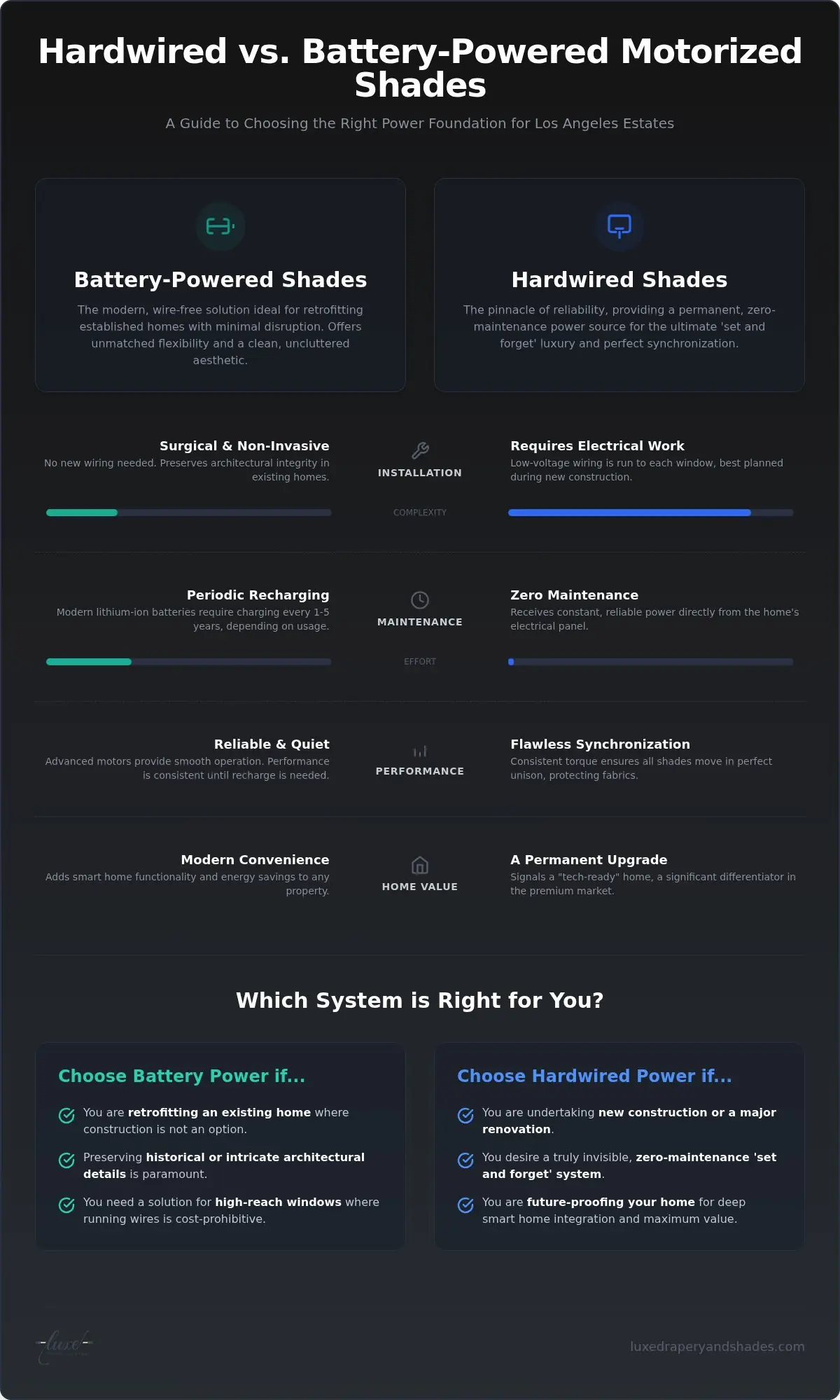
Hardwired motorization represents the ultimate commitment to seamless home automation. These systems connect directly to your home’s electrical panel through low-voltage wiring, creating a dedicated power infrastructure that operates independently of battery life or charging cycles. When evaluating the merits of hardwired vs battery powered motorized shades, the primary distinction lies in the concept of permanence. A hardwired system is an architectural investment that integrates into the very bones of a property, providing a reliable foundation for light control that lasts as long as the home itself.
This configuration supports a genuine zero-maintenance lifestyle. You won’t ever need to manage a charging schedule for dozens of windows or climb a ladder to access high-set headrails. For expansive architectural features common in Los Angeles estates, hardwired motors provide the superior torque necessary to move large-scale roller shades or heavy, custom-lined drapery with absolute ease. Systems that have been Tested and Reviewed by industry experts consistently highlight that hardwired solutions offer the most stable performance, especially when managing the weight of premium textiles across wide spans of glass.
Beyond raw power, hardwiring facilitates a visual symphony of movement. Because every motor receives a constant, identical stream of power, multiple shades can move in perfect, digital unison. There is a specific aesthetic pleasure in watching four or five shades rise at the exact same speed, stopping at a precise, pre-set limit without the slight variations in timing that can sometimes occur as battery levels fluctuate. It is this level of precision that defines a truly professional installation.
The Lutron Sivoia Advantage
Lutron Sivoia is the undisputed preferred choice for sophisticated Lutron home automation in Los Angeles. These motors are engineered with advanced digital circuitry that ensures ultra-quiet operation, making them nearly imperceptible during use. By integrating Sivoia shades with a Lutron Homeworks system, you can curate complex “scenes” and schedules. Your shades can descend automatically as the sun hits the Westside horizon, perfectly synchronized with your home’s lighting and climate controls to create the ideal evening atmosphere.
Low-Voltage vs. Line-Voltage Wiring
Modern luxury installations almost exclusively utilize 24V DC low-voltage wiring. This approach is significantly safer and more flexible than standard line-voltage (120V) electrical work. Low-voltage wires are considerably thinner, making them much easier for a skilled contractor to hide within custom window trim or narrow pocket headers. A central power distribution panel typically houses the transformers, neatly organizing the power runs for the entire home in one accessible location. This centralized setup simplifies troubleshooting and ensures that every shade receives the consistent voltage required for peak performance.
Choosing Your System: A Comparison of Performance and Lifestyle
Selecting the foundation for your window treatments requires looking beyond the initial installation. It is a choice between immediate convenience and long-term architectural integration. While both systems offer the modern ease of automation, the decision between hardwired vs battery powered motorized shades ultimately shapes the daily rhythm of your home and the visual clarity of your interior design. A hardwired system functions as a permanent utility, much like your lighting or climate control, whereas battery power serves as a flexible, self-contained solution that adapts to your home’s existing structure.
Performance is also measured by the intelligence of the system. Hardwired configurations typically offer more robust, two-way communication with your smart home processor. This means your system doesn’t just send a command to lower the shades; it receives real-time feedback regarding their exact position. This level of precision is essential for maintaining the visual alignment of multiple windows across a large gallery or open-plan living area. If you’re ready to see how these systems can transform your space, explore our professional automation services to find the perfect fit for your estate.
The Aesthetic Impact: Headrails and Fascias
High-end design thrives on the absence of clutter. Hardwired motors are inherently more compact because they don’t need to house an internal power source. This allows for the smallest possible brackets and sleek “pocket” installations where the shade disappears completely into the ceiling when raised. In contrast, battery-powered options, particularly motorized roman shades, may require a slightly more substantial headrail or fascia to accommodate the lithium-ion cells. While modern engineering has minimized this “bulk” factor, a professional design consultant is vital to ensure these components remain invisible and don’t detract from the elegance of your custom window treatments.
Cost Analysis: Initial Investment vs. Long-Term Value
There is a common misconception that battery-powered shades are always the more economical choice. While the upfront cost is lower because it avoids specialized electrical labor, the total cost of ownership tells a different story. For a property with more than 10 windows, hardwiring often becomes the more efficient choice. You eliminate the recurring task of battery management and the eventual cost of replacement cells every few years. In the competitive Los Angeles real estate market, a hardwired infrastructure is viewed as a permanent architectural asset that adds tangible value to the property, whereas battery shades are often classified as removable personal property.
- Maintenance: Hardwired is zero-maintenance; battery requires periodic charging or replacement.
- Aesthetics: Hardwired allows for a more minimalist, integrated look.
- Reliability: Hardwired provides the most stable communication for large-scale automation.
- Value: Hardwired adds permanent “tech-ready” value to your home’s infrastructure.
Professional Integration for Los Angeles Estates
In the high-stakes world of Los Angeles real estate, the complexity of residential architecture demands more than just a premium product. It requires the expertise of a Licensed California Contractor (CSLB #1066068) who understands the structural nuances unique to Westside and South Bay estates. Whether you’re finalizing a contemporary new build in Pacific Palisades or updating a historic Spanish Colonial in the South Bay, the decision between hardwired vs battery powered motorized shades is a curated choice that must reflect the specific “Job to be Done” for each room. A master suite might demand the absolute silence of a hardwired system, while a guest wing in a historic property could be perfectly served by a surgical battery retrofit.
We believe in a collaborative approach where our technical installers work alongside homeowners and interior designers from the earliest stages of a project. This ensures that the technology serves the aesthetic, rather than dictates it. A modern glass-walled estate often prioritizes a hardwired system for its truly “invisible” integration, while a historic home benefits from the non-invasive installation of advanced battery motors that preserve original plasterwork. By evaluating your home’s construction and your long-term maintenance preferences, we help you select the foundation that ensures your window treatments remain a source of effortless comfort.
For those looking to extend this level of high-quality craftsmanship to other areas of the home, such as outdoor living spaces, consulting with a full-service contractor like Acadiana Patios & Construction can provide a comprehensive approach to home improvement.
The Luxe Drapery White-Glove Process
Our commitment to excellence is visible in every step of our white-glove process. From the initial consultation in our Beverly Hills or Torrance locations to the final digital programming, every detail is managed with a focus on discretion and precision. We specialize in the art of hiding wiring within existing structures, ensuring that even a complex hardwired installation results in a clean, uncluttered environment. Once the hardware is in place, our team assists with post-installation support, helping you curate smart home scenes that synchronize your shades with the natural rhythm of the California sun.
Ready to Automate Your View?
The path to a more intuitive home starts with a conversation. We invite you to visit our Los Angeles showroom or book a private home consultation to experience the “Quiet Luxury” of Lutron motorization firsthand. While the hardwired path remains the gold standard for permanence and architectural value in a “forever home,” battery power offers a sophisticated and immediate upgrade for established environments. Each system has its place in a well-designed estate. Speak with a Lutron-certified expert today to discover which power source will provide the lasting luxury and seamless control your living space deserves.
Refining Your Home’s Atmosphere with Intelligent Automation
The choice between hardwired vs battery powered motorized shades is a fundamental step in crafting a home that responds intuitively to your daily rhythm. Hardwired systems represent a permanent architectural investment, offering zero-maintenance reliability for new builds and extensive renovations. For those looking to preserve the delicate plasterwork of a historic South Bay estate or seeking a surgical upgrade for a Westside residence, modern lithium-ion battery technology provides a sophisticated, wire-free alternative that never compromises on elegance.
As a Lutron Certified Platinum Dealer and Licensed California Contractor (#1066068), Luxe Drapery and Shades has been serving Los Angeles and the surrounding coastal communities since 2020. We believe that window treatments are essential elements of a beautiful living space, serving as the lens for experiencing a better lifestyle. Our team is ready to help you navigate the technical nuances of your project to achieve a seamless, invisible automation system that integrates perfectly with your home’s aesthetic.
Schedule your curated consultation with our Los Angeles design experts today to begin your journey toward effortless light control. We look forward to helping you transform your home into a sanctuary of quiet luxury and aesthetic precision.
Frequently Asked Questions
Is it worth hardwiring motorized shades in an existing home?
Hardwiring in an existing home is a worthwhile investment if you’re performing a renovation that already involves opening walls or ceilings. While the initial construction is more involved, you’ll eliminate the need for battery management across your property. This path is particularly beneficial for high-value Los Angeles estates where permanent, tech-ready infrastructure significantly enhances the home’s market appeal and long-term convenience.
How long do the batteries actually last in motorized shades in 2026?
Premium rechargeable lithium-ion batteries in 2026 typically last between three and five years on a single charge. This estimate assumes the shades are operated twice daily. Factors such as the weight of the custom fabric and the size of the window will influence this duration. High-end systems from brands like Lutron utilize patented technology to maximize efficiency, ensuring that your maintenance schedule remains as unobtrusive as possible.
Can I mix hardwired and battery-powered shades in the same room?
You can certainly mix both power sources within a single room to suit the specific architectural needs of each window. This hybrid approach allows you to utilize hardwiring for large, primary windows while opting for battery power on smaller or more restricted openings. When choosing between hardwired vs battery powered motorized shades in a shared space, a professional installer ensures that both systems are programmed to move in synchronized harmony.
Do battery-powered shades make more noise than hardwired ones?
Modern battery motors are engineered to be nearly as silent as their hardwired counterparts. While older battery technology often produced a distinct mechanical hum, 2026 models from elite manufacturers prioritize “Quiet Luxury” through advanced acoustic dampening. Hardwired systems still hold a slight edge in consistency, but the difference is often imperceptible to the ear in a typical residential environment, especially when using high-end components. For instance, when motorizing specific styles like vertical blinds, you can learn more about how high-quality motors maintain silence and precision across different hardware configurations.
What happens to hardwired shades during a power outage?
Hardwired shades will remain in their current position during a power outage unless your home is equipped with a battery backup or generator. Because they rely on a constant connection to your electrical panel, they won’t respond to remote or automated commands until power is restored. In contrast, battery-powered shades will continue to operate normally, providing a reliable fallback for privacy and light control during local utility interruptions.
Do I need an electrician to install hardwired motorized blinds?
A licensed electrician is typically required to run the primary 120V power to the central distribution panel for hardwired systems. However, the subsequent 24V low-voltage wiring that connects the panel to the individual motors is often managed by specialized window treatment contractors. As a licensed California contractor, we coordinate this entire process to ensure that all electrical work complies with the 2026 building standards and local Los Angeles codes.
Are there solar-powered options for battery motorized shades?
Solar-powered charging kits are an excellent addition for battery-operated shades in south-facing windows with consistent sun exposure. These discreet panels mount directly to the glass or window frame to trickle-charge the internal battery, potentially extending the time between manual charges indefinitely. It’s a sustainable solution that works exceptionally well in sun-drenched regions like the Westside and South Bay, though it requires sufficient daylight to remain effective.
Which system is better for large, heavy custom drapes?
Hardwired motorization is the superior choice for large, heavy custom drapes and oversized roller shades. The constant power supply allows for significantly higher motor torque, which is necessary to move substantial weights without straining the system. While battery motors have improved, they may struggle with the inertia of floor-to-ceiling velvet drapery or wide-span woven woods. Hardwiring ensures these grand architectural features move with effortless, reliable precision every time.