

Why would a masterfully designed home ever settle for anything less than complete automation on every window? The answer isn’t about cutting corners; it’s about curated intentionality and understanding the unique rhythm of your living spaces. Many homeowners fear that mixing different control systems will lead to a disjointed aesthetic or a confusing array of remotes and cords. It’s a common worry that the technical complexity of a smart home might be compromised by keeping manual elements in the mix.
The truth is that you can achieve a perfectly cohesive look without motorizing every single opening. You’ll discover exactly how to operate manual and motorized shades together to create a high-functioning environment that feels both technologically advanced and aesthetically grounded. By focusing on professional continuity, you can ensure your roller shades or elegant Roman shades look identical regardless of how they move. This guide provides a clear roadmap for deciding which windows deserve the luxury of motorization and how to establish a streamlined operational workflow for your entire home. You’ll learn to blend these systems into a singular, sophisticated standard of comfort that elevates your daily lifestyle and reflects the high standard of living you’ve carefully built.
Key Takeaways
- Adopt a hybrid shading strategy to balance automated convenience with tactile control; it’s a sophisticated choice for managing extensive window layouts in grand residences.
- Maintain aesthetic continuity by selecting identical fabric lots and coordinating headrail profiles to hide motors and manual clutches uniformly.
- Master how to operate manual and motorized shades together by integrating Lutron control systems with manual adjustments for a streamlined, intuitive experience.
- Identify high-priority zones for motorization, such as blackout scenes in the master suite or large banks of windows in formal dining areas.
- Achieve a flawless look through professional installation that ensures perfectly aligned hem lines and consistent mounting depths across all window treatments.
Mixing Manual and Motorized Window Treatments: A Strategic Design Choice
True luxury in interior design is defined by the seamless integration of form and function. In the most thoughtfully curated homes, this doesn’t always mean automating every single window opening. Instead, sophisticated homeowners are adopting what we call a Hybrid Shading Strategy. This approach is a deliberate balance between the effortless convenience of motorized window treatments and the tactile, reliable nature of manual shades. It’s a strategic choice that prioritizes your daily lifestyle needs over technology for technology’s sake.
In expansive Los Angeles estates, where a single floor might feature dozens of architectural openings, motorizing every window can lead to unnecessary technical complexity. Mixing systems allows you to manage the project scope with precision. By focusing your investment on high-impact areas like a grand Great Room or a glass-walled dining space, you create a sense of effortless luxury where it is felt most. There’s a common misconception that manual shades might detract from a home’s premium feel. However, when you understand how to operate manual and motorized shades together, you realize that a high-quality manual clutch provides a satisfying, tactile engagement that many design purists still appreciate.
The Functional Benefits of a Hybrid System
A hybrid system offers practical advantages that a fully automated setup might overlook. For windows within easy reach, a manual pull provides an instant response without searching for a remote or opening an app. This simplicity is particularly valuable in secondary guest rooms. Visitors often find traditional controls more intuitive than navigating a complex smart home interface. Additionally, choosing manual options for less-frequented spaces, such as a laundry room or home gym, reduces the long-term maintenance of battery replacements or extensive wiring; this keeps your home’s ecosystem lean and focused.
Defining Your Motorization Priorities
Determining which windows to automate requires an analysis of your home’s natural rhythm. High-frequency windows are your prime candidates. For instance, the master suite is an ideal place for motorization to facilitate “Blackout” scenes for sleep or “Good Morning” routines that welcome the sun. Conversely, windows in a powder room often function perfectly with manual operation. In the modern, high-ceilinged architecture found throughout Westside LA, vertical height is often the deciding factor. Any window requiring a ladder for adjustment should always be motorized. Learning how to operate manual and motorized shades together ensures that your home remains both a sanctuary of comfort and a masterpiece of functional design.
Aesthetic Continuity: How to Match Manual and Motorized Shades Perfectly
Achieving a cohesive visual narrative in a luxury home requires meticulous attention to the details that often go unnoticed by the untrained eye. When you learn how to operate manual and motorized shades together, you quickly realize that the success of the system depends on visual invisibility. The goal is to ensure that guests cannot distinguish which window is powered by a motor and which is adjusted by hand. This level of continuity preserves the architectural integrity of your space while providing the modern functionality you desire.
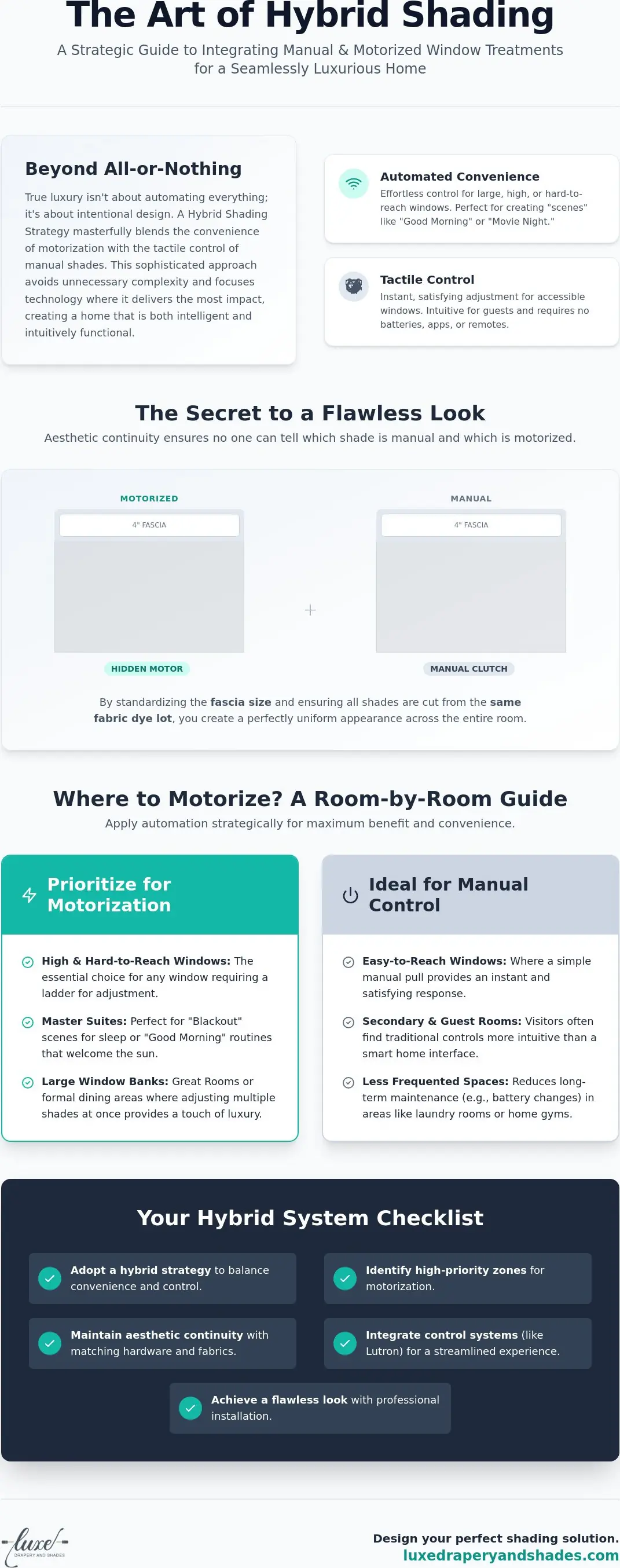
Consistency begins with the hardware profiles. Motorized units, particularly those utilizing advanced technology like Lutron, often require slightly larger headrails or fascias to house the motor and power source. To maintain a uniform look, we recommend standardizing the fascia size across all windows in a single room. If the motorized shade requires a 4 inch square fascia, the manual shades should utilize the same 4 inch housing, even if a smaller 3 inch version would suffice for the manual clutch. This prevents the staggered, uneven appearance that can occur when mixing hardware sizes on adjacent windows.
The Importance of Fabric Selection
Dye lot consistency is the silent hero of high-end interior design. When ordering window treatments, it’s vital to request that all units, both manual and automated, are cut from the same fabric lot. Even a slight variation in the manufacturing run can lead to noticeable differences in color or sheen when sunlight hits the fabric. This is especially critical when selecting from our curated collection of roller shades, where the minimalist aesthetic leaves no room for error. Additionally, you should ensure that the transparency levels, whether sheer, translucent, or blackout, are identical to maintain a uniform visual weight across the entire bank of windows.
Matching Hardware and Fascias
Integrating smart home-enabled window coverings alongside manual options requires hardware that accommodates both technologies without revealing the difference. Beyond the fascias, consider the following elements:
- Bottom Bar Finishes: Use identical shapes and weights for the bottom rails. A custom-wrapped bottom rail, using the same shade fabric, creates a clean, premium finish that hides the hem line.
- Bracket Styles: In modern Westside LA homes with open-roll designs, the brackets are often visible. Matching the metal finish and architectural shape of these brackets is essential for a polished look.
- End Caps: Color-match these components to your window frames or wall color to help the hardware recede into the background.
A truly refined home is one where technology serves the design, not the other way around. If you’re ready to see how these elements can transform your specific space, exploring a personalized design consultation can help clarify these technical nuances. By standardizing these physical components, you master how to operate manual and motorized shades together while keeping the focus on your home’s beautiful aesthetic.
Streamlining Operation: Managing Your Hybrid Shading System
Managing a home with mixed window treatments requires a shift in perspective. It’s not about juggling two separate systems; it’s about creating one unified, intuitive experience. Understanding how to operate manual and motorized shades together effectively means establishing a hierarchy of control. In this model, automation handles the heavy lifting of environmental management, while manual adjustments provide the instant, tactile response needed for specific moments of privacy or comfort. This dual approach ensures your home remains responsive to both the path of the sun and your personal whims.
A successful daily flow often involves programming your automated shades to follow an astronomical clock. They rise to greet the morning light and lower to protect your interiors from the harsh afternoon glare. Meanwhile, your manual shades stay in place until you decide otherwise. This is particularly useful for windows that face a neighbor’s walkway or a street; you can keep the manual shade lowered for permanent privacy while the motorized units above or beside them continue their automated dance with the daylight. This intentional division of labor simplifies your interaction with the home environment.
Centralized Control with Lutron Keypads
The integration of Lutron home automation is the most effective way to bridge the gap between different shade types. By utilizing elegant wall-mounted keypads, you can program “Scenes” that command entire groups of motorized shades with a single touch. When you press a “Movie” or “Relax” button, the motorized units move to their precise, pre-set positions. Because you’ve mastered how to operate manual and motorized shades together, your scenes can be designed to complement the likely position of your manual shades. We often recommend placing these keypads near clusters of manual shades, allowing you to adjust the automated group while you’re already at the window for a manual tweak.
Manual Operation Best Practices
For the manual components of your hybrid system, the choice of lift mechanism is vital for both safety and aesthetics. To maintain a clean, modern look that matches the cordless nature of motorized units, we prioritize cordless spring lifts or wand-operated systems. These options eliminate dangling cords, ensuring compliance with the latest safety standards while providing a sleek profile. It’s also important to coordinate the “stack” height. When a manual shade is fully raised, it should sit at the exact same level as its motorized counterpart to maintain the visual order of the room. This attention to operational detail ensures that the tactile experience of your home feels just as premium as the automated one.
Room-by-Room Strategy: Determining Which Windows to Motorize
Luxury design is defined by intentionality. When planning your home, understanding how to operate manual and motorized shades together allows you to allocate your budget toward high-impact areas while maintaining a sophisticated atmosphere. Not every window requires a motor to be functional; instead, logic should dictate where technology enhances your lifestyle and where a manual touch suffices. This room-by-room breakdown helps you navigate these choices with the confidence of a seasoned designer.
In the primary living and dining areas, visual order is paramount. These spaces often feature large banks of windows where even a slight misalignment in shade height is noticeable. Motorization ensures that every shade stops at the exact same millimeter, creating perfectly aligned hem lines that frame your view with architectural precision. Conversely, in kitchens and bathrooms, manual operation is often the superior choice. These environments are prone to moisture and frequent, quick adjustments for privacy. A high-quality manual clutch provides the immediate response needed during a morning routine without the complexity of a digital interface.
The Master Suite: The Case for Full Automation
The master suite is the sanctuary of the home, making it the most critical candidate for full automation. Integrating Lutron Sivoia systems allows for silent, scheduled waking, where shades rise gradually with the sun. Many designers choose to layer treatments here, using motorized blackout shades for deep sleep and manual sheer drapes for soft daytime diffusion. This combination offers the ultimate luxury: the ability to control your environment from the comfort of your bed while retaining the soft, tactile beauty of manual fabrics. To begin transforming your private retreat, you can view our motorized shade collections to find the perfect fit for your suite.
Secondary Spaces: Where Manual Makes Sense
Secondary spaces like guest bedrooms, laundry rooms, and powder rooms are ideal for manual treatments. Guests often feel more comfortable with a familiar cordless lift system rather than navigating a smart home keypad. In home offices, manual shades allow for precise glare control that changes as you move throughout the day. For smaller windows in these areas, using honeycomb shades in a manual format provides exceptional energy efficiency without the need for wiring. By mastering how to operate manual and motorized shades together, you create a home that feels intuitive, balanced, and perfectly tailored to your family’s needs.
Expert Installation: Why Professional Integration Matters for LA Homes
Professional installation is the final, essential step in translating a design vision into a living reality. In the sprawling estates of Los Angeles, where architectural styles range from mid-century modern to Mediterranean revival, window openings are rarely perfectly square. This structural variation makes the challenge of aligning hem lines between different motor and clutch brands a task for experts. When you’re learning how to operate manual and motorized shades together, the physical placement of the hardware is just as important as the digital programming. If the motorized motor isn’t mounted at the exact same depth as the manual clutch, the visual continuity of the room is instantly compromised.
Precision Measurement and Mounting
A mere 1/8th inch difference in mounting depth or height can ruin the hybrid look you’ve worked so hard to achieve. Professional mounting ensures that both manual and motorized units sit flush within the window frame or at an identical distance from the wall in an outside mount configuration. This precision is particularly vital for motorized units that require hidden wiring or specific power requirements. Managing these technical needs during the installation phase prevents unsightly cables from cluttering your clean aesthetic. We ensure that every bracket is perfectly level, allowing the fabric to track straight and the bottom bars to rest in a single, unbroken line across your windows.
The Luxe Consultative Approach
At Luxe Drapery and Shades, we understand that a shading plan must be tailored to the specific microclimate of your Los Angeles neighborhood. A home facing the coastal breezes of Malibu has different thermal and UV requirements than a residence absorbing the intense valley heat in Calabasas. We coordinate closely with your interior designers to ensure that every hardware finish and fabric weight harmonizes with your overall decor. This collaborative process ensures that the transition between automated convenience and manual control feels intentional and effortless.
Our service concludes with a comprehensive final walkthrough. We take the time to teach you how to operate manual and motorized shades together, ensuring you’re comfortable with both the tactile pull of your manual treatments and the sophisticated scene-setting of your automated ones. This personalized education turns a complex technical system into a natural extension of your daily life. It’s this commitment to craftsmanship and individual style that elevates a functional house into a lens for experiencing a better lifestyle.
Elevating Your Home with a Unified Shading Vision
Transforming your home into a sanctuary of light and comfort doesn’t require a one-size-fits-all approach to automation. By thoughtfully selecting where to invest in technology and where to maintain a tactile connection, you create a space that responds intuitively to your needs. Mastering how to operate manual and motorized shades together allows for a sophisticated balance; it ensures that every window, from the grand Great Room to the quiet guest suite, contributes to a cohesive architectural narrative. Aesthetic continuity and professional alignment are the hallmarks of a truly curated environment.
As Specialists in Los Angeles Luxury Estates and a Certified Lutron Platinum Dealer, we bring technical precision to every project. Our team, a Licensed and Bonded California Contractor (CSLB #1066068), ensures your hybrid system is both beautiful and perfectly integrated into your home’s infrastructure. Schedule your curated design consultation with Luxe Drapery and Shades today. We look forward to helping you discover how high-quality window accents can become the lens for experiencing a better lifestyle.
Frequently Asked Questions
Can I control manual and motorized shades with the same remote?
No, manual shades cannot be controlled by a remote because they lack the internal motors and receivers necessary to process digital signals. You must adjust manual shades physically using a cordless lift or a wand. Understanding this distinction is a fundamental part of learning how to operate manual and motorized shades together, as it allows you to choose which windows require automated convenience and which are better suited for tactile control.
Do motorized shades look bulkier than manual ones?
Motorized shades may require a slightly larger headrail or fascia to house the motor and power supply, but they don’t have to look bulkier. By standardizing the larger fascia size across every window in a room, you can hide the technical components and maintain a uniform aesthetic. This design strategy ensures that your manual and automated treatments share an identical, high-end profile that preserves the visual order of your space.
Is it possible to automate my manual shades later?
Automating manual shades at a later date is possible, though it usually involves replacing the internal roller tube and installing a motor. While some retrofit kits are available, we recommend a professional replacement to ensure the new motorized components fit perfectly and operate silently. This approach maintains the architectural integrity of your window treatments while upgrading your home’s functionality to a smart home standard.
How do I ensure the colors match if I buy them at different times?
The only way to guarantee a perfect color match is to order all your shades at once so they are cut from the same fabric dye lot. If you purchase manual shades and then add motorized versions months later, you risk subtle variations in color or texture. These differences often become apparent when sunlight hits the fabric, potentially disrupting the cohesive look of your interior design.
Are manual shades safer for homes with children and pets?
Manual and motorized shades are equally safe as long as they utilize a cordless design. According to the ANSI/WCMA A100.1-2022 safety standard, most window coverings sold in the United States must be cordless to eliminate strangulation risks. Since motorized shades are inherently cordless, they are a premier choice for safety, while manual cordless models provide the same peace of mind through a spring-loaded or wand-operated mechanism.
What happens to motorized shades if the power goes out?
Battery-powered motorized shades will continue to operate normally during a power outage because they don’t rely on the home’s electrical grid. Hardwired models will remain in their current position until power is restored, unless your estate is equipped with a backup power system. Manual shades remain a reliable fallback in these situations, as they are always ready for physical adjustment regardless of your home’s power status.
How often do I need to charge or change batteries in motorized units?
Rechargeable motorized shades typically require a charge every 6 to 12 months, depending on your daily usage patterns. For models that use replaceable batteries, you can expect to change them every 1 to 3 years. This infrequent maintenance schedule makes automation a low-effort luxury that enhances your standard of living without becoming a constant technical burden.
Can I integrate my manual shades into my Lutron lighting scenes?
Manual shades cannot be directly integrated into Lutron lighting scenes because they lack the digital connectivity required to communicate with a smart home hub. However, you can master how to operate manual and motorized shades together by programming your scenes to account for the static position of your manual units. This allows your automated shades and lighting to adjust around your manual treatments, creating a balanced and intentional environment.