

The most sophisticated home improvement isn’t something you see; it’s the seamless, silent transition of light that defines the atmosphere of a room. If you view motorized window treatments as a simple gadget, you’re missing the true potential of your home’s architecture. You likely want the modern convenience of smart technology but worry that a complex setup might disrupt your curated interior design or become outdated before the year is out. It’s a valid concern, especially when navigating the nuances of wiring requirements and the latest safety standards like the ANSI/WCMA cordless mandates.
This guide will help you master whole home shade automation planning by aligning technical architectural requirements with aesthetic excellence. You’ll learn how to integrate a system that enhances your daily comfort and protects your furniture without sacrificing style. We’ll explore the essential foundations for a reliable environment, from the whisper-quiet performance of Lutron systems to the future-proof benefits of the Matter protocol. By the end, you’ll have a clear roadmap for creating a home that responds intuitively to your lifestyle while maintaining a sense of quiet, understated luxury.
Key Takeaways
- Learn how proactive environmental management protects your home’s most valuable assets, including fine art and hardwood flooring, from silent UV exposure.
- Understand the critical infrastructure differences between hardwired and battery-powered systems to select the most reliable foundation for your renovation.
- Discover the art of “zonal planning” and how fabric openness factors are tailored to balance intimate privacy with your home’s natural views.
- Master whole home shade automation planning by transitioning from simple remotes to integrated Lutron environments and elegant architectural keypads.
- Explore the technical benefits of partnering with a professional design consultant to ensure precision measurement and seamless system synchronization.
The Foundations of Whole Home Shade Automation Planning
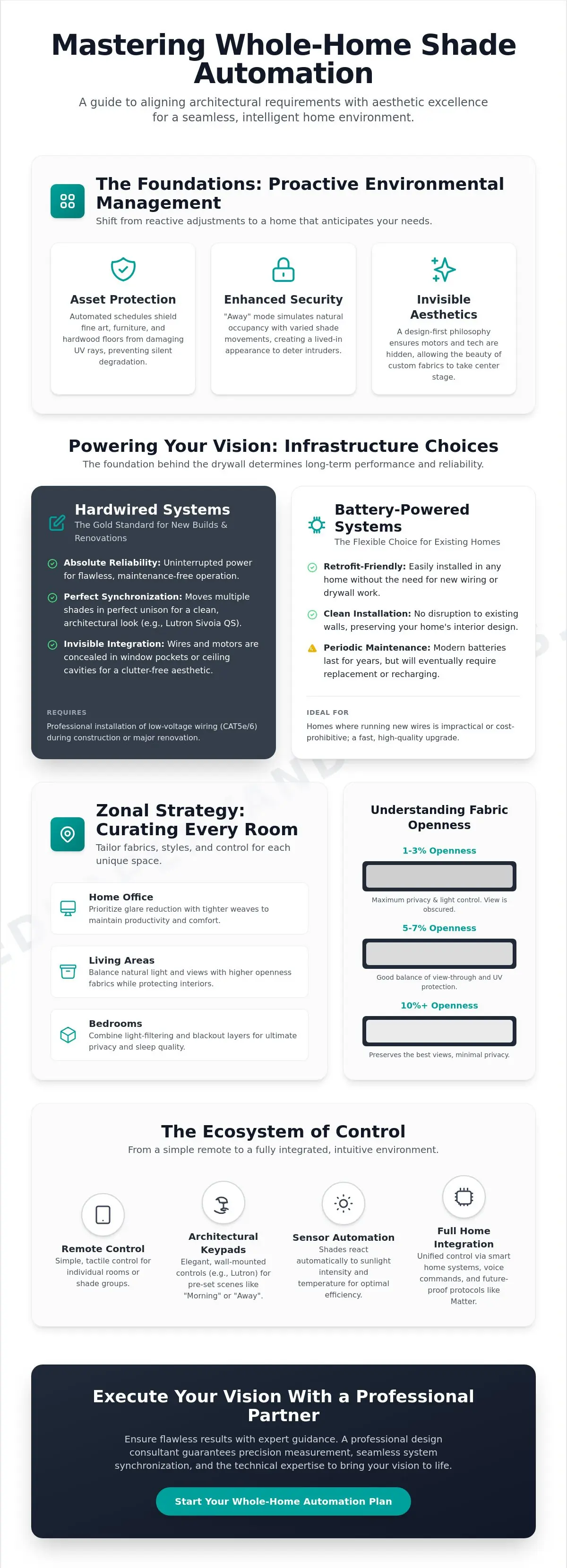
The transition from manual window treatments to a fully integrated home automation system represents more than a technical upgrade. It’s a fundamental shift from reactive adjustments to proactive environmental management. In a luxury residence, your home should anticipate your needs rather than wait for your intervention. Successful whole home shade automation planning begins by viewing these accents as the skin of your architecture, regulating light and temperature before you even notice a shift in the atmosphere.
This proactive approach is essential for preserving the curated interior you’ve built. Sunlight, while beautiful, is the primary enemy of fine art and high-end flooring. Automated schedules ensure that your shades descend precisely when UV rays are at their peak, shielding delicate pigments and natural wood grains from silent degradation. By adopting a design-first philosophy, we ensure that the technology serves the aesthetic vision of the space. The most successful integrations are those where the high-tech motors remain invisible, allowing the beauty of custom fabrics to take center stage.
Security is another pillar of this foundation. For Los Angeles estates, “Away” modes provide a sophisticated layer of protection that goes beyond traditional alarms. By simulating natural occupancy through varied shade movements throughout the day, your home maintains a lived-in appearance even while you’re traveling. It’s a quiet, effective deterrent that integrates seamlessly into your daily security protocols.
Defining Your Lifestyle Objectives
Every room has a unique rhythm. You might struggle with a persistent glare on your monitors in the home office or excessive heat in a sun-drenched breakfast nook. Identifying these specific pain points is the first step in whole home shade automation planning. We look at the level of autonomy you desire, whether you prefer the tactile control of a bespoke keypad or fully sensor-driven scenes that respond to the sun’s position. We also consider the needs of guests and family members to ensure the interface remains intuitive and elegant for everyone in the household.
The Impact on Home Value and Energy Efficiency
In the high-end Los Angeles real estate market, integrated systems are no longer optional; they’re expected. Automated thermal barriers significantly reduce the HVAC load during intense California summers by blocking solar heat gain before it enters the room. This efficiency translates into a measurable ROI and a heightened sense of environmental responsibility. Shading automation contributes to LEED and green building standards by optimizing natural light harvesting and reducing the energy required for artificial climate control.
Powering Your Vision: Hardwired vs. Battery-Powered Infrastructure
The success of whole home shade automation planning often rests on the decisions made behind the drywall. While the fabric selection defines the room’s character, the power infrastructure determines its long-term performance. In a luxury environment, the goal is absolute reliability and a complete absence of visual clutter. This requires choosing a power source that aligns with your home’s architectural stage, whether you’re breaking ground on a new estate or carefully updating a historic residence.
For new constructions and major renovations, hardwired systems are the undisputed choice. These systems eliminate the need for battery replacements and offer the most stable communication between devices. By integrating Energy Efficient Window Coverings into a wired backbone, you ensure that your shading environment operates with surgical precision. To maintain an “Invisible Tech” aesthetic, power sources and control modules are tucked away in dedicated window pockets or recessed ceiling cavities, ensuring the motor remains hidden from every angle.
Hardwired Systems: The Gold Standard for Reliability
Wired solutions like the Lutron Sivoia QS system are favored for their ability to move multiple shades in perfect synchronization. This simultaneous alignment creates a clean, architectural line across a wall of windows that battery systems sometimes struggle to replicate. These installations require low-voltage communication wires, such as CAT5e or CAT6, which run back to a centralized power panel. Typically housed in an AV room or mechanical closet, this panel provides a single, organized point of maintenance for the entire home, keeping the living spaces free from hardware distractions.
Battery-Powered Solutions for Retrofit Excellence
When wiring is restricted, particularly in historic Los Angeles homes with plaster walls or preserved millwork, modern battery technology offers a sophisticated alternative. Systems like Lutron Triathlon have redefined expectations for retrofitted spaces. These high-capacity motors offer a “no-drill” aesthetic that preserves architectural integrity while delivering whisper-quiet operation. You can expect a battery life of three to five years under standard use, making them a low-maintenance luxury for existing interiors. If you’re unsure which power profile fits your floor plan, consulting with a design expert can help clarify the structural requirements of your project.
Strategic whole home shade automation planning ensures that regardless of the power source, the technology remains a silent, supportive element of your lifestyle. Whether you choose the permanence of a wired system or the flexibility of battery power, the focus remains on creating a responsive environment that enhances your comfort without ever demanding your attention.
Zonal Strategy: Curating Fabrics and Styles for Every Room
Effective whole home shade automation planning treats every room as a distinct micro-climate. We call this zonal planning. It’s the practice of selecting fabrics that respond to the specific orientation and purpose of each space. A west-facing gallery requires different solar management than a north-facing library. To achieve this balance, we look at openness factors. A 1% openness provides significant heat reduction and privacy, while a 5% openness preserves your connection to the outdoors. For a truly finished look, we often coordinate motorized roller shades with custom drapes in Los Angeles. This layering adds depth and softens the architectural lines of the windows.
To ensure the technology disappears, we prioritize color-matched hardware. Hem bars and brackets should blend into the window frame or the fabric itself. When the motor is silent and the hardware is invisible, the focus remains entirely on the curated design of your living space. This attention to detail is what separates a basic installation from a professional architectural integration.
The Bedroom: Achieving True Blackout
In the bedroom, the primary objective is restorative sleep. Standard shades often leave light gaps at the edges, which is why we recommend side channels. These tracks seal the perimeter, eliminating light leakage completely. A dual-shading system is the gold standard here. It pairs a sheer shade for daytime privacy with a dedicated blackout shade for the evening. Adding motorized drapery as a final layer provides an extra acoustic barrier, dampening outside noise while finalizing the room’s aesthetic with a sense of warmth—a design-forward approach that many homeowners extend to their bathrooms by selecting premium fixtures from Milan Gallery Bathroom Vanities.
Social Spaces: Balancing View and Glare
Your social spaces are where high-performance solar screens shine. These fabrics allow you to enjoy the Los Angeles skyline without the discomfort of harsh glare or heat. When you’re considering smart home-enabled window coverings, texture is just as important as transparency. Integrating motorized Roman shades introduces a soft, tailored feel to modern environments. To maximize efficiency, we can program sensors to lower these shades automatically based on the sun’s azimuth, protecting your interiors before the room temperature begins to rise.
The Ecosystem of Control: Beyond the Remote
The true measure of a luxury residence is its ability to operate without constant manual input. Effective whole home shade automation planning moves the narrative away from the clutter of handheld remotes toward a unified, integrated environment. By leveraging Lutron home automation, your window treatments become part of a larger, responsive system that manages light, privacy, and climate as a single cohesive element. This transition allows your home to “breathe” with the day, adjusting itself to your lifestyle through sophisticated software and local processing.
A central feature of this intelligent design is the Astro Clock. Rather than relying on simple timers, this system calculates the precise sunrise and sunset for your specific Los Angeles zip code, ensuring your shades respond to the actual position of the sun throughout the year. For homeowners who prioritize privacy and high-end tech, integrating these systems with Josh.ai provides a voice-controlled experience that processes commands locally. This ensures your home remains a private sanctuary while offering the convenience of hands-free operation. If you are ready to eliminate wall clutter and embrace a more intuitive home, contact our design team today to discuss your control architecture.
Keypads and Wall Controls
Architectural keypads are the elegant solution to “wall acne,” the unsightly cluster of multiple light switches and plastic remotes. Bespoke options like Lutron Palladiom keypads offer a tactile, high-end experience with custom-engraved buttons that clarify home navigation. A single “Movie” button can be programmed to dim the lights, lower the blackout shades, and activate the audio system simultaneously. Placing these keypads at natural transition points, such as entryways or bedside, ensures that your most frequent “scenes” are always within reach.
Sensors and Autonomous Operation
While keypads provide manual override, sensors offer true autonomy. Sun sensors monitor real-time brightness levels, triggering your shades to lower during the most intense parts of the day to protect your interiors. During Los Angeles heatwaves, temperature sensors can automatically close honeycombs or roller shades to maintain a cool indoor climate, significantly reducing the strain on your HVAC system. Occupancy sensors further refine this experience, triggering privacy modes only when a room is in use, which ensures that your whole home shade automation planning serves both efficiency and personal comfort.
Executing Your Vision with a Professional Design Partner
The final stage of whole home shade automation planning is the transition from architectural theory to physical reality. While the digital foundation and fabric selections are vital, the execution of a high-end shading environment requires a level of craftsmanship that DIY solutions simply cannot replicate. In a luxury residence, the margin for error is non-existent. A single torque calculation error or a misaligned bracket can lead to motor strain, uneven fabric tracking, or premature system failure. To ensure your investment performs as intended, partnering with a licensed and bonded contractor (CSLB #1066068) is a non-negotiable requirement for complex installations.
A professional design partner brings more than just technical skill; they provide a comprehensive process that begins with a detailed site measure and concludes with personalized programming. This local Los Angeles expertise is essential for navigating the unique architectural challenges found in Southern California estates. From managing the logistics of oversized window expanses to calibrating sensors for the specific light patterns of your neighborhood, a professional ensures the system is optimized for your home’s unique footprint.
The Importance of Precise Measurement
In the world of motorized window treatments, 1/8th of an inch is the difference between a seamless integration and a visible flaw. Precise measurement is critical when fitting shades into tight architectural pockets or recessed ceiling cavities where there is no room for adjustment. Professional installers are trained to identify and account for “out of square” windows, a common occurrence in many historic or custom-built Los Angeles homes. Beyond the aesthetic benefits, it is important to remember that professional measurement and installation are the only ways to fully guarantee the Lutron warranty, protecting your technology for years to come.
Post-Installation Support and Programming
The relationship with your design consultant doesn’t end when the last shade is hung. The “fine-tuning” phase is where the system truly begins to reflect your daily rhythm. During this period, we adjust scenes to ensure that the transition of light feels natural and effortless as you move through your home. Because we operate as a certified dealer, we provide ongoing support that includes firmware updates and seamless system expansions. This long-term partnership ensures your home remains at the forefront of automation technology. We invite you to experience the quiet confidence that comes with a curated, professional installation designed to elevate your standard of living.
Elevating Your Home’s Environmental Intelligence
The journey toward a fully realized shading environment is about more than just selecting beautiful fabrics; it’s about the invisible foundation of power and the intuitive logic of control. Successful whole home shade automation planning ensures that every window in your residence contributes to a larger sense of comfort, security, and energy efficiency. By choosing the right infrastructure and a tailored zonal strategy, you transform your living space into a responsive sanctuary that anticipates your needs throughout the day.
As a Certified Lutron Gold Dealer and Licensed California Contractor (CSLB #1066068), we bring specialized expertise to Westside LA and South Bay estates. We understand that true luxury lies in the details, from the whisper-quiet movement of a motor to the tactile elegance of a custom-engraved keypad. Our team is dedicated to ensuring your vision is executed with technical precision and aesthetic harmony, providing a seamless experience from initial measure to final programming.
Your home deserves an environment that reflects your lifestyle and protects your most cherished assets. Schedule your curated design consultation for whole home automation to begin creating a more intelligent, beautiful way of living. We look forward to helping you master the art of light control.
Frequently Asked Questions
How much does whole home shade automation planning typically cost?
The investment for professional whole home shade automation planning depends on several variables, including the total number of windows, fabric rarity, and the complexity of your power infrastructure. While project scopes vary significantly based on the scale of your estate, the cost reflects the architectural integration and the long-term protection of your home’s interiors. We recommend a personalized consultation to establish a precise budget that aligns with your design objectives and technical requirements.
Can I automate my existing manual shades or do I need new ones?
Automation almost always requires the installation of new shades because the motors are precision-engineered to fit inside specific roller tubes and headrails. Attempting to motorize existing manual treatments often leads to torque issues and fabric misalignment. Selecting new, purpose-built motorized shades ensures that the system operates silently and carries a full manufacturer warranty. This approach guarantees the aesthetic harmony and technical reliability expected in high-end environments.
Are motorized shades noisy enough to wake someone up?
High-end motorized shades are engineered for near-silent operation and won’t wake a light sleeper. Leading systems are specifically designed to be whisper-quiet, producing a subtle, low-frequency sound that blends into the background. This makes them ideal for nursery environments or primary suites where maintaining a serene atmosphere is a top priority. You can enjoy the convenience of automated light control without ever disrupting the quiet confidence of your home.
What happens to my automated shades if the power or Wi-Fi goes out?
Your shades’ behavior during an outage depends on their power source; battery-powered units will continue to function, while hardwired systems require electricity. Most professional systems store their schedules locally on a processor rather than relying on a cloud connection. This means your automated routines will still trigger at the correct times even if your Wi-Fi connection is temporarily interrupted, ensuring your privacy and security remain intact.
How long do the batteries last in high-end motorized shades like Lutron?
You can expect high-capacity batteries in premium systems to last between three and five years under normal daily use. This impressive longevity is achieved through efficient power management and low-friction motor designs. When the time comes for a replacement, the process is straightforward and doesn’t require any structural changes to your window frames. This ensures that your whole home shade automation planning remains a low-maintenance addition to your lifestyle.
Can automated shades help reduce my monthly energy bills in Los Angeles?
Automated shades can significantly reduce cooling costs by up to 25% during warm Los Angeles summers. By blocking solar heat gain before it enters the living space, these systems reduce the workload on your HVAC equipment. This efficiency is a core component of modern home management, offering a sustainable way to maintain a comfortable indoor climate. It’s a functional benefit that complements the aesthetic value of your custom window treatments.
Is it better to use a dedicated hub or connect shades directly to Wi-Fi?
A dedicated hub is the superior choice for luxury environments because it offers greater reliability and security than connecting individual shades directly to Wi-Fi. Hubs use specialized frequencies that don’t compete with your streaming devices or work-from-home bandwidth. This architecture ensures that your shading system remains responsive and stable, even in large estates with dozens of automated windows. It also simplifies the integration with larger home control systems.
Do motorized shades require special maintenance or cleaning?
Motorized shades require very little maintenance beyond occasional light dusting with a soft cloth or a vacuum with a brush attachment. Because the motors are sealed units, they don’t require lubrication or internal servicing. For battery-powered models, the only recurring task is replacing the power cells every few years to ensure the system continues to operate with its original precision. This allows you to focus on the beauty of your space rather than its upkeep.