

Why do we invest so much in high-end mattresses and curated interiors, only to let a single pane of glass and the relentless hum of city traffic dictate our sleep quality? You’ve likely felt the frustration of a siren breaking your concentration or construction noise cutting your rest short. It’s a common struggle for those seeking sound dampening curtains for urban homes, especially as the residential sector accounts for 54.56 percent of the global acoustic curtain market in 2026. You shouldn’t have to choose between a quiet room and a beautiful one, yet many retail options look more like industrial blankets than luxury decor.
This guide reveals how bespoke acoustic drapery utilizes a sophisticated mass-plus-seal strategy to create a true sanctuary. You’ll learn how multi-layered fabrics and innovative materials, such as those seen in the 2025 launch of the Noren system, provide professional-grade noise reduction without compromising your aesthetic. We’ll explore the intersection of acoustic science and interior design, helping you select window treatments that look like a deliberate style choice while offering the peaceful atmosphere you deserve.
Key Takeaways
- Understand how modern architecture and hard surfaces amplify city noise and why specific sound-dampening techniques are required to restore tranquility.
- Learn how multi-layer construction and dense natural fibers outperform standard fabrics when selecting sound dampening curtains for urban homes.
- Identify the critical performance gaps between mass-market panels and bespoke window treatments tailored to your specific environment.
- Explore how professional header styles and the “deep fold” technique maximize sound absorption while maintaining a sophisticated interior aesthetic.
- Discover how a personalized design consultation can bridge the gap between technical acoustic needs and your vision for high-end home comfort.
The Science of Silence: Why Urban Homes Need Acoustic Drapery
Modern Los Angeles architecture often favors expansive glass walls and polished concrete floors. While these elements define a contemporary aesthetic, they also create a significant acoustic challenge. Hard surfaces reflect sound waves, causing echoes that amplify the chaotic hum of the city. Sound dampening is the strategic reduction of this echo and the softening of ambient noise infiltration. The growing demand for sound dampening curtains for urban homes reflects a shift toward holistic home design. For residents seeking The Science of Silence, understanding how sound interacts with interior spaces is the first step toward a peaceful home.
Urban dwellers face a unique cocktail of noise pollutants that penetrate even the most exclusive neighborhoods. These disturbances often include:
- The low-frequency drone of traffic from the 405 or local thoroughfares.
- The rhythmic pulse of police and news helicopters.
- High-frequency chatter and activity from neighboring residences.
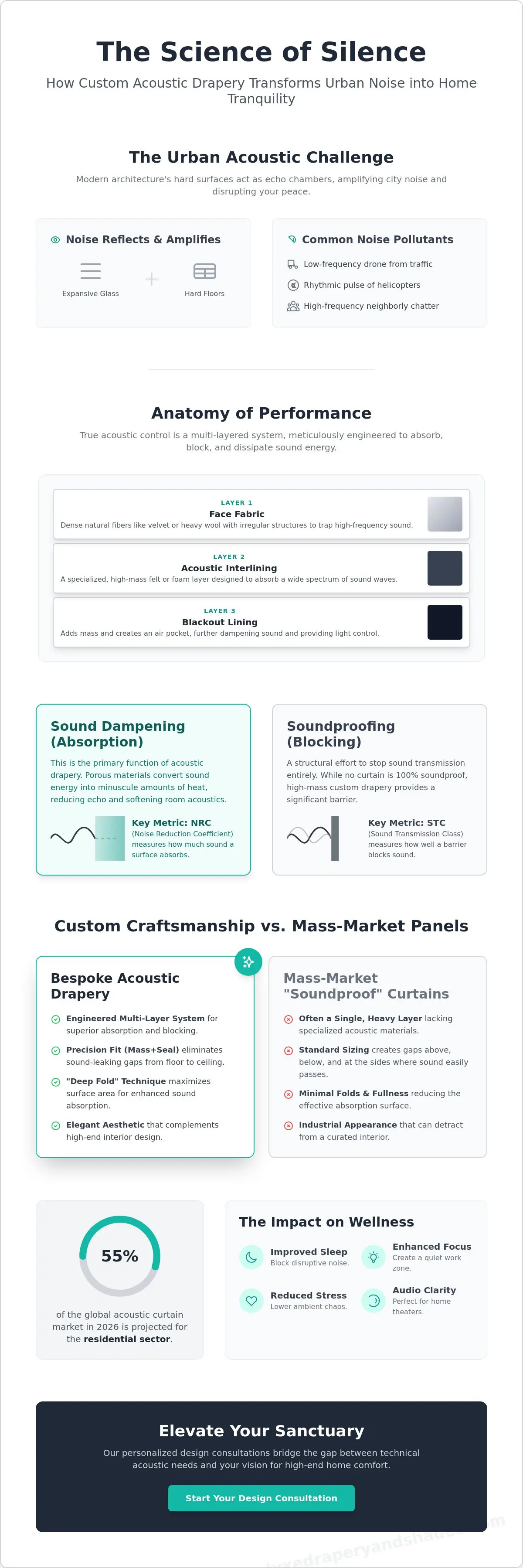
Choosing sound dampening curtains for urban homes allows you to manage these disturbances with precision. Homeowners should distinguish between two key metrics: Noise Reduction Coefficient (NRC), which measures sound absorption within a room, and Sound Transmission Class (STC), which measures how well a material blocks sound from passing through it. While drapery primarily excels at absorption, high-mass custom options provide a substantial barrier against external intrusion. This is a critical investment in 2026, as the residential sector now accounts for 54.56 percent of the global acoustic curtain market.
Sound Dampening vs. True Soundproofing
It’s vital to understand that true soundproofing is a structural endeavor. It involves altering walls, windows, and floors to stop sound transmission entirely. It’s often invasive and costly. In contrast, sound dampening is a surface treatment. It uses dense, porous materials to soak up sound energy. No curtain can promise 100 percent silence against the deep, low-frequency vibrations of a nearby construction site. Premium acoustic drapes significantly lower the noise floor of a room, however. They transform a sharp, echoing environment into a soft, muted space where conversations feel private and external chaos feels distant.
The Impact of Urban Noise on Wellness
The home has become more than a residence; it’s a sensory sanctuary. Constant exposure to urban noise triggers a subtle stress response in the body, impacting sleep quality and focus. High-quality window treatments do more than block light. They provide a psychological buffer. For those with high-end home theaters, acoustic drapery is essential for audio clarity. It prevents sound from bouncing off windows and muddying the experience. By managing the auditory landscape, you’re not just decorating a room. You’re curating a lifestyle defined by tranquility and intentionality.
Anatomy of Performance: Materials That Absorb and Block Sound
True acoustic luxury isn’t found in a single layer of fabric. It’s achieved through a meticulous “sandwich” of materials that work in tandem to disrupt and dissipate sound energy. High-performance sound dampening curtains for urban homes are engineered as multi-layered systems. Each layer serves a specific purpose, from the initial absorption of high-frequency chatter to the blocking of low-frequency drones. By creating intentional air pockets between these layers, the drapery acts as a thermal and acoustic buffer, trapping sound waves before they can bounce off hard interior surfaces. This multi-layer approach is a rising trend in 2026, as homeowners prioritize dual-functionality in their window treatments.
The choice of face fabric is the first line of defense. Natural fibers like heavy wool and dense velvet are prized for their irregular, microscopic structures that naturally trap sound. Unlike synthetic, flat-weave fabrics, these materials offer a high surface area that converts sound energy into trace amounts of heat. For those seeking a balance between Custom Craftsmanship vs. Mass-Market solutions, the difference lies in the integration of mass-loaded materials. These high-density elements are often sewn directly into the drapery stack, providing the “heft” required to block sound transmission effectively.
The Role of Specialized Acoustic Interlining
Many homeowners mistakenly believe that standard blackout lining provides sufficient noise reduction. Blackout materials are designed to block light, not sound. Professional-grade acoustic bumps and interlinings are far more complex, often featuring a blend of cotton, wool, or specialized polymers. Acoustic interlining is a dense, non-porous layer designed to disrupt sound paths. This hidden component is what separates a decorative panel from a functional acoustic tool. For those refining their home’s auditory profile, exploring custom drapery options ensures each layer is selected for both beauty and performance.
Weight, Density, and the “Pliable Wall” Concept
In the world of acoustics, mass is king. The weight per square yard of a drapery system correlates directly to its decibel reduction capabilities. This is why bespoke solutions favor 2.5x to 3x fullness. By using significantly more fabric than the width of the window requires, we create deep, undulating folds. These folds don’t just look elegant; they increase the fabric’s acoustic footprint, creating a “pliable wall” that absorbs high-frequency noise more effectively than a flat surface. This combination of density and surface area ensures that your sound dampening curtains for urban homes perform as well as they look.
Custom Craftsmanship vs. Mass-Market “Soundproof” Curtains
The allure of a quick, off-the-shelf solution is understandable when city noise becomes overwhelming. However, many homeowners find that mass-market “soundproof” panels fail to meet their expectations. These retail options are often little more than standard blackout drapes with a slightly heavier lining. They lack the specialized density and, more importantly, the precise fit required to manage acoustic energy. When searching for sound dampening curtains for urban homes, the distinction between a decorative panel and a engineered acoustic tool becomes clear through the lens of craftsmanship.
Bespoke window treatments address the fundamental physics of sound that ready-made products ignore. Achieving a serene environment requires the expertise found in custom drapes los angeles, where every measurement is taken with acoustic integrity in mind. Custom solutions allow for specialized headers, such as pinch pleats or Euro pleats, which create deeper folds. These folds don’t just add visual depth; they increase the surface area available to trap sound waves, providing a level of performance that a flat, narrow retail panel cannot replicate.
The “Gap” Problem: Why Sizing Matters
Sound waves are remarkably fluid. They act like water, seeking out the smallest available opening to enter a room. A standard-sized curtain that leaves even a half-inch gap at the sides or bottom significantly diminishes its acoustic value. This is why floor-to-ceiling coverage is non-negotiable for high-end urban performance. Professional installers utilize a “return to wall” technique, where the drapery fabric wraps around the side of the hardware to meet the wall directly. This creates a functional seal that prevents noise from “leaking” around the edges of the window treatment.
Aesthetic Versatility of Custom Solutions
Performance no longer requires a sacrifice in style. While industrial acoustic blankets are effective, they’re rarely beautiful. Custom craftsmanship allows us to integrate high-performance interlinings behind luxury face fabrics like silk, linen, or mohair. This means your acoustic solution looks like a deliberate design choice rather than a utility item. In many sophisticated interiors, we recommend plantation shutters as a primary, solid-core barrier. Layering custom drapes over these shutters or over motorized shades creates a multi-functional window that addresses light, privacy, and sound with effortless elegance.
Designing for Quiet: Aesthetics Meets Acoustic Engineering
Achieving a serene interior requires more than just high-density materials; it demands a marriage of aesthetic choices and engineering precision. When selecting sound dampening curtains for urban homes, the way the fabric is manipulated significantly influences its performance. Designers often use the “deep fold” technique to maximize the fabric’s acoustic footprint. By increasing the fullness of the drapes to 2.5 or 3 times the window width, we create a larger surface area that traps and breaks down sound waves. This approach ensures that your window treatments aren’t just decorative elements but active participants in your home’s acoustic environment.
Color and texture also play a subtle yet vital role in the perceived “quietness” of a space. Saturated, matte textures like deep charcoal, navy, or forest green tend to absorb more than just light; they contribute to a visual stillness that complements the auditory dampening. Selecting hardware that supports the substantial weight of these drapes is equally critical. Heavy acoustic panels require reinforced rods and brackets to prevent sagging and ensure a smooth operation over time. To maintain this balance of performance and style, consider these hardware essentials:
- Heavy-duty metal rods with a minimum diameter of 1.25 inches.
- Wall brackets anchored directly into studs or using high-capacity toggle bolts.
- Ball-bearing glides that allow heavy panels to move with minimal friction.
Pleat Styles and Functional Beauty
The choice between pinch pleats and ripple folds often comes down to the architectural style of the home, but each offers unique acoustic benefits. Pinch pleats create structured, dense pockets of fabric at the header, which are excellent for disrupting sound at the top of the window where gaps often occur. In contrast, ripple folds provide a consistent, undulating wave that maintains uniform sound absorption across the entire span. Deeper pleats create more surface area for sound waves to dissipate. For modern homes with expansive glass, motorized drapery hardware handles these heavy acoustic panels effortlessly, providing a seamless transition from an open view to a quiet sanctuary at the touch of a button.
The Impact of Professional Installation
Even the finest materials will underperform if they aren’t installed to create an “acoustic envelope.” This concept involves sealing the window as thoroughly as possible to prevent noise leaks. Professional mounting often utilizes wraparound rods, sometimes called French rods, which allow the fabric to curve back to the wall. This eliminates side-light and side-noise, creating a cohesive barrier. Because these systems are significantly heavier than standard drapery, a professional installation by a licensed contractor (CSLB #1066068) is necessary. This ensures that the hardware is securely anchored to the wall structure, providing safety and long-term performance for your investment.
If you’re ready to transform your living space into a refined sanctuary, explore our luxury window treatment collections to find the perfect balance of style and silence.
Elevating Your Sanctuary with Luxe Drapery and Shades
Luxe Drapery and Shades stands as the premier Los Angeles partner for homeowners who refuse to compromise on either silence or style. We understand that a home in the hills or a penthouse in the city is more than a property; it’s a sanctuary that requires a tailored approach to environmental control. Investing in sound dampening curtains for urban homes is a commitment to your long-term quality of life. Our team brings a sense of quiet confidence and aesthetic expertise to every project, ensuring that your window treatments serve as essential elements of a beautiful, peaceful living space.
The transition from a noisy street to a hushed interior is a hallmark of true luxury. By focusing on the nuances of interior design and acoustic science, we help you reclaim your home from the relentless hum of the city. High-quality home accents have the power to transform not just a room, but the way you experience your daily life. This philosophy elevates functional household items into a lens for experiencing a better lifestyle, grounded in the unique architectural character of Southern California.
The Luxe Consultation: Curated for Your Space
The journey toward a quieter home begins with a comprehensive on-site evaluation. Our experts analyze the specific architectural needs of Westside LA estates, identifying noise entry points that standard solutions often overlook. We don’t believe in mass-market compromises. Instead, we curate a selection of fabrics and interlinings that align with your existing decor while meeting rigorous acoustic standards. This personalized approach ensures the final design is as effective as it is elegant.
Our collaborative design process ensures that every detail is considered. We evaluate the orientation of your windows, the height of your ceilings, and the specific frequencies of local noise pollutants. This attentive approach allows us to recommend bespoke window treatments that feel like a natural extension of your home’s architecture. It’s a boutique service that values craftsmanship and individual style, positioning us as a trusted partner in your home improvement process.
Smart Integration for Modern Living
Modern luxury is increasingly defined by effortless control. Integrating your acoustic drapery with advanced automation systems allows you to manage your environment with unparalleled precision. By utilizing Lutron sivoia technology, you can synchronize your drapes and shades to respond to the rhythm of your day. This synergy is particularly effective when layering Lutron roman shades with heavy acoustic drapes, providing both a physical and automated barrier against the outside world.
Smart home systems enable the scheduling of “quiet hours,” where your window treatments automatically deploy to lower the noise floor during sleep or focused work periods. This intentional movement of fabric creates a dynamic sanctuary that adapts to your needs. By merging traditional craftsmanship with cutting-edge technology, we elevate the standard of urban living and provide the professional validation of performance you expect. Your home deserves an atmosphere of absolute tranquility. Schedule your professional acoustic consultation with Luxe Drapery today and discover how sound dampening curtains for urban homes can redefine your sense of comfort.
Reclaiming Your Home’s Auditory Landscape
True tranquility in a bustling city is a deliberate achievement, not a coincidence. By understanding the interplay of mass, density, and professional installation, you can effectively silence the external chaos that often permeates modern living. We’ve explored how specialized interlinings and the “deep fold” technique provide a superior barrier compared to mass-market alternatives. Selecting sound dampening curtains for urban homes is the final step in curating a living space that feels as peaceful as it looks. It allows you to enjoy the architectural beauty of your home without the distraction of environmental noise.
As a Licensed and Bonded California Contractor (CSLB #1066068) and specialists in Lutron smart home integration, our team provides expert professional installation throughout Los Angeles and the South Bay. We’re dedicated to helping you find the perfect balance between high-end aesthetics and acoustic performance. Transform your home into a quiet sanctuary, book your custom drapery consultation today. Your journey toward a more refined and restful lifestyle begins with a single, intentional choice. We look forward to helping you design a space that truly resonates with your personal style.
Frequently Asked Questions
Do sound dampening curtains really work for traffic noise?
High-quality acoustic drapery is exceptionally effective at softening the high-frequency sounds of urban life, such as tire sizzle, wind, and distant sirens. While no fabric can entirely eliminate the deep, low-frequency rumbles of heavy trucks or construction, these curtains significantly lower the overall noise floor. They transform sharp, intrusive sounds into a muted background hum that is much easier for the mind to ignore during sleep or work.
What is the difference between soundproof and sound dampening curtains?
Soundproofing is a structural term that refers to blocking 100 percent of noise transmission through walls or glass. In contrast, sound dampening curtains for urban homes are designed to absorb sound waves and reduce echo within a room. They use dense, porous materials to soak up energy, preventing sound from bouncing off hard surfaces and making a space feel much quieter and more private.
Are these curtains the same as blackout drapes?
Blackout drapes are designed primarily to block light using opaque coatings, which are often thin and lack acoustic mass. True sound-dampening solutions require a multi-layered construction featuring heavy face fabrics and specialized interlinings. While our custom acoustic drapery typically provides full blackout capabilities as a secondary benefit, its primary engineering focus is on density and sound absorption rather than just light exclusion.
How much noise reduction can I realistically expect?
When using sound dampening curtains for urban homes, you can realistically expect a reduction of 5 to 10 decibels in ambient noise levels. Because the decibel scale is logarithmic, this often translates to a perceived 20 to 30 percent reduction in loudness. This difference is frequently the “tipping point” that allows a homeowner to finally achieve restful sleep or maintain focus in a home office.
Can I use motorized hardware with heavy acoustic curtains?
Yes, premium motorized drapery hardware is specifically designed to handle the significant weight of multi-layered acoustic panels. High-end systems utilize reinforced motors and heavy-duty tracks to ensure smooth, quiet operation. This allows you to deploy your acoustic barriers at the touch of a button or via a pre-set schedule without worrying about strain on the hardware or the fabric.
Do I need professional installation for noise-reducing drapes?
Professional installation is highly recommended for two critical reasons: safety and performance. Acoustic panels are much heavier than standard curtains and require specialized anchoring into the wall structure to prevent sagging or damage. Additionally, an expert installer can ensure a tight “return to wall” seal, which prevents sound waves from leaking around the edges and bypassing the fabric altogether.
What are the best fabrics for sound absorption?
Natural fibers with a high pile or dense weave are the most effective choices for sound management. Heavy wool, mohair, and thick velvet are the gold standards because their irregular microscopic structures naturally trap and dissipate sound energy. We recommend selecting face fabrics with a high weight per square yard to ensure the material has enough mass to act as a functional acoustic buffer.
How do I clean multi-layered acoustic drapery?
Because of their complex multi-layer construction and specialized interlinings, acoustic drapes should never be laundered in a standard washing machine. We recommend periodic light vacuuming with a soft brush attachment to remove surface dust. For deep cleaning, you should always consult a professional dry cleaner who specializes in high-end custom window treatments to ensure the acoustic properties and fabric integrity remain intact.