

In a truly sophisticated interior, a window treatment is far more than a decorative layer; it’s a functional architectural element that controls the soul of the room. Mastering how to choose the right window treatment fabric is the secret to moving beyond basic utility into the realm of curated luxury. You’ve likely felt the weight of too many textile options or feared that the relentless California sun might fade an expensive linen within a single season. These concerns are valid, especially as 2026 design standards prioritize both safety and smart home integration. Since the 2024 mandate requiring cordless indoor treatments, the technical requirements for your textiles have become just as important as their aesthetic appeal.
You deserve a home that feels both expensive and effortless, where your Roman shades or custom drapery move with silent precision. It’s natural to feel protective of your investment when balancing tactile beauty with the demands of Lutron motorization. This guide promises to transform your uncertainty into expertise, teaching you to harmonize high-end aesthetics with the functional performance your lifestyle requires. We’ll examine the best materials for automated systems, explore the rise of sustainable woven woods, and identify the high-performance weaves that will keep your living space vibrant and protected for years to come.
Key Takeaways
- Evaluate how textile quality serves as a critical variable in the aesthetic ROI of your custom window treatments and overall interior atmosphere.
- Master how to choose the right window treatment fabric by navigating the scale from ethereal sheers to absolute blackout for tailored privacy.
- Explore the nuances of material science to decide when to prioritize the prestige of natural linens or the resilience of performance synthetics.
- Align your fabric selections with the technical requirements of motorized hardware to ensure your Lutron smart home automation functions with effortless elegance.
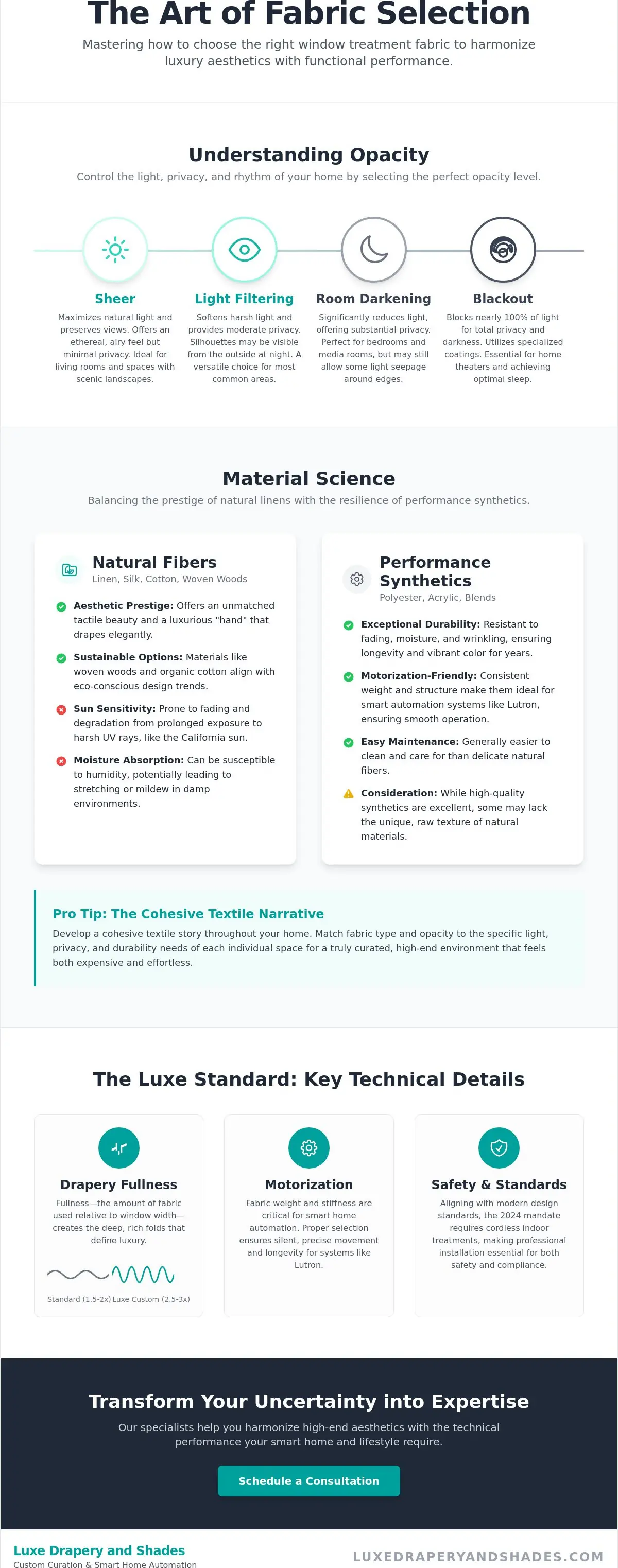
- Develop a cohesive textile narrative throughout your home that meets the specific light and durability needs of every individual space.
The Art of Selection: Why Window Treatment Fabric Defines Your Space
The atmosphere of a home is often determined not by its furniture, but by the way light interacts with its surfaces. When you consider how to choose the right window treatment fabric, you’re essentially selecting the filter through which you’ll experience your daily life. This is the essence of quiet luxury. It isn’t about grand gestures; it’s about the subtle psychological comfort provided by a textile that drapes perfectly and softens the transition between the interior sanctuary and the outside world. In custom design, fabric represents the most significant variable in your return on investment. While the hardware provides the structure, the textile provides the soul.
The Luxe Standard is defined by bespoke tailoring. Unlike ready-made panels that often feature thin linings and standard lengths, custom drapery allows for a precise calculation of fullness. This refers to the amount of fabric used relative to the window’s width. A bespoke piece uses two to three times the width of the window in material; this creates deep, rich folds that ready-made options simply cannot replicate. This density also allows you to manipulate the perceived architectural scale of a room. By mounting high-quality textiles near the ceiling and extending them beyond the window frame, you can make a standard eight-foot ceiling feel like a soaring gallery.
Balancing Aesthetic Appeal with Functional Performance
Texture has become a cornerstone of modern Los Angeles interior design. Designers are moving away from flat, glossy finishes toward tactile materials like heavy bouclés and raw silks. The hand of a fabric, or how it feels and moves, dictates the final silhouette of your window treatments. A stiff, heavy velvet offers a sense of permanence and grounding, whereas a loose-weave linen suggests a breezy, coastal ease. Understanding different types of window coverings is the first step in matching these textures to your home’s specific architectural language. It’s about finding the weight that complements your room’s volume without overwhelming it.
The Impact of Fabric on Light and Privacy
Light filtration is a science in high-end estates. In Southern California, the entry state of natural light can be harsh, necessitating specific light-filtering strategies. This is where translucency levels come into play. A sheer textile might offer a soft glow while preserving a view of the garden, but it won’t provide the privacy required for a street-facing bedroom. When learning how to choose the right window treatment fabric, you must evaluate how the weave density interacts with both midday glare and evening privacy needs. Custom solutions allow for layering sheers with heavier blackout-lined panels, ensuring the light serves the room’s purpose at every hour of the day.
Understanding Opacity: From Ethereal Sheers to Absolute Blackout
Light is the most dynamic element in any interior, yet its impact is often misunderstood. When you evaluate how to choose the right window treatment fabric, you’re essentially deciding how much of the outside world you wish to invite into your sanctuary. Opacity exists on a precise spectrum, ranging from transparent sheers that merely tint the daylight to dense blackout textiles that offer total seclusion. This choice isn’t just about brightness; it’s about controlling the rhythm of your home.
The science of light filtration is rooted in weave density. A fabric’s ability to provide privacy is determined by how closely its threads are interlaced. High-end design rarely relies on a single layer to solve every problem. Instead, a sophisticated approach involves multi-layered fabric strategies. This might include a delicate sheer for daytime ambiance paired with a heavy, lined drapery for evening privacy. It’s also vital to distinguish between room darkening and true blackout performance. Room darkening fabrics significantly reduce glare and dim the space, but true blackout textiles utilize a specialized multi-pass coating to ensure no light penetrates the weave. This makes them essential for media rooms and primary suites where rest is the priority.
Sheer and Semi-Sheer Fabrics for Natural Light
For estates with coastal views or lush garden landscapes, sheers offer an unmatched elegance. Materials like voile and batiste provide a soft, ethereal glow, while open-weave linens add a touch of organic texture. These fabrics act as a sophisticated veil, maintaining your connection to the outdoors while protecting your fine art and interior finishes from harsh UV rays. Consulting a curtain fabric selection checklist can help you determine the exact level of translucency your specific orientation requires. It’s the difference between a room that feels exposed and one that feels intentionally airy.
Room-Darkening and Blackout Linings
In the world of luxury textiles, the lining is the hidden hero. It provides the necessary structure and weight for a perfect drape. Beyond aesthetics, high-quality linings offer significant thermal insulation and acoustic dampening, creating a quiet, temperature-controlled environment. When selecting a lining, consider your home’s exterior curb appeal. A uniform white or ivory lining ensures that your windows look as curated from the street as they do from the sofa. If you are ready to explore these possibilities for your own space, our team at Luxe Drapery and Shades can guide you through the selection process.
Material Science: Natural Fibers vs. Performance Synthetics
Selecting a textile is a study in chemistry as much as it is in style. When homeowners investigate how to choose the right window treatment fabric, they often find themselves torn between the storied prestige of natural fibers and the resilient engineering of modern technology. In high-end estates, the “California Factor” serves as the ultimate litmus test for any material. This refers to the intense, relentless UV exposure that can transform a vibrant textile into a brittle, faded shadow of itself within a few seasons. A fabric that looks magnificent in a showroom must also possess the structural integrity to withstand the bleaching effects of the Pacific sun.
Sustainability has also emerged as a non-negotiable standard for the modern connoisseur. As we move through 2026, the demand for eco-conscious materials like organic cotton, bamboo-derived weaves, and recycled performance yarns has reached a new peak. A truly luxurious home balances its visual impact with a sustainable footprint, ensuring that the beauty of the interior doesn’t come at the expense of the environment outside.
The Timeless Elegance of Linen and Silk
Linen remains the quintessential choice for a refined Los Angeles aesthetic. Its characteristic irregular slubs and organic texture provide a relaxed elegance that perfectly complements both mid-century modern and Mediterranean revival architectures. Natural fibers like linen and wool offer superior breathability, allowing for a subtle movement of air that synthetics sometimes restrict. Silk, while undeniably the pinnacle of luxury, requires a more cautious approach. It’s notoriously fragile in the face of direct sunlight. This functional guide to window treatments suggests that while style is paramount, the longevity of natural materials depends entirely on how they’re protected. To preserve silk, heavy interlining and UV-protective sheers are essential components of the installation.
The Rise of Luxury Performance Blends
The rise of luxury performance blends has bridged the gap between tactile beauty and everyday durability. These aren’t the flat, industrial polyesters of the past. Modern textile engineering has produced synthetic blends that mimic the dry hand of linen or the soft sheen of wool while offering exceptional fade resistance. When you’re deciding how to choose the right window treatment fabric for high-traffic areas like kitchens or coastal patios, these performance blends are often the superior choice. They resist moisture and humidity, making them far easier to maintain than their organic counterparts. Cleaning expectations are also more realistic with these materials, as they’re less prone to the shrinking or stretching that can occur with 100% natural fibers.
A Room-by-Room Guide to Choosing the Right Textile
Every room in a luxury estate possesses its own environmental micro-climate and functional purpose. Understanding how to choose the right window treatment fabric requires a nuanced analysis of these distinct spaces. A cohesive textile story doesn’t mean using the same material in every corner. Instead, it involves selecting a consistent color palette or a shared thread of texture that weaves through each floor. This allows for functional variation without disrupting the visual flow of your home’s interior design.
For South Bay homes, the proximity to the Pacific introduces specific challenges that generic guides often overlook. Salt air and high humidity can degrade lesser fabrics, making performance-driven selections essential in rooms with significant ventilation. Matching the fabric weight to the scale of the architecture is equally critical. A soaring great room demands a textile with enough heft to hold its shape over a twenty-foot drop. Conversely, a smaller study might benefit from the crisp, clean lines of a more delicate, tailored Roman shade.
Living Areas and Great Rooms
In expansive living areas and great rooms, the custom drapes Los Angeles designers recommend serve as the primary architectural anchor. Large windows are stunning, but they can lead to significant solar heat gain. Adding a premium interlining between the face fabric and the lining provides an invisible layer of thermal protection. This keeps the space cool during the peak of the afternoon while adding a luxurious, heavy drape to the panels. Floor-to-ceiling panels in formal dining rooms create a sense of verticality and drama, turning a functional necessity into a bold design statement.
Serene Bedrooms and Media Centers
The Sleep Sanctuary approach treats the bedroom as a place of total sensory control. Combining absolute blackout linings with opulent velvets or heavy cotton weaves creates an environment optimized for rest. These materials also offer acoustic benefits, dampening outside noise for a quieter, more serene interior. Soft-touch fabrics, such as brushed linens or silk-wool blends, provide a cozy, inviting atmosphere that balances the technical performance of the blackout layers. For media centers and recording studios, these heavy textiles are indispensable for managing sound reflections and ensuring total light exclusion.
If you are ready to refine your home’s aesthetic with high-performance textiles, explore our collection of custom window treatments today.
The Luxe Drapery Advantage: Custom Curation and Automation
The final stage of curating a high-end interior involves bridging the gap between tactile beauty and modern convenience. When you consider how to choose the right window treatment fabric, you must account for the mechanical demands of motorization. Fabric weight is the primary factor in selecting motorized hardware; it dictates the amount of torque required for smooth, consistent movement. A heavy, opulent velvet requires significantly more power from a motor than a breezy linen sheer. Ignoring this relationship can lead to premature motor wear or sluggish operation. In a luxury environment, performance should be as seamless as the design itself.
The integration of luxury textiles with Lutron home automation allows for a level of control that elevates the daily experience. Beyond the motor’s power, the fabric’s physical properties dictate the success of the automation. Bespoke hardware choices, such as solid brass or matte black finishes, must be matched to both the textile’s weight and the room’s aesthetic. Because heavy or intricate fabrics can shift or stretch over time, professional measurement is an absolute necessity. This ensures the finished product aligns perfectly with your architectural frame without dragging or catching.
Automating Luxury: Textiles and Lutron Sivoia
Selecting the correct material is vital for motorized rollers to ensure they don’t fray or jam over time. High-performance weaves are engineered to maintain their edge integrity even with daily use. For those preferring a more structured look, Lutron Roman shades utilize specific fabric stiffness to achieve perfect, consistent pleating every time they’re raised. The silent operation of Lutron motors is best paired with high-quality dampening fabrics that absorb sound rather than reflecting it. This creates a quiet, automated transition that feels like a natural part of the home’s rhythm.
The Boutique Experience: From Consultation to Installation
Every fabric behaves differently under the unique quality of Los Angeles light. An in-home consultation is the only way to ensure accurate color matching and to see how a weave’s texture interacts with your specific orientation. Expert installation makes a profound difference in the final hang of your drapery. Professional installers understand how to dress the fabric and adjust the tension for a flawless silhouette. Finalizing your design involves more than just picking a color; it’s about curating the hardware and trim options that turn a functional item into an essential element of your living space. Mastering how to choose the right window treatment fabric is a journey that ends with a perfectly installed, automated masterpiece.
Elevate Your Home with Bespoke Textile Artistry
We’ve explored how the weight of a textile influences the performance of motorized hardware and how varying opacity levels define the daily rhythm of your home. Selecting the perfect material is about more than just aesthetic preference; it’s about understanding architectural scale and environmental resilience in the face of the California sun. Mastering how to choose the right window treatment fabric ensures that your investment remains a source of enduring beauty and sophisticated comfort.
As a licensed and bonded California contractor (CSLB #1066068), Luxe Drapery and Shades has served Los Angeles, Torrance, and the South Bay since 2020. We are specialists in Lutron and high-end automation, bringing technical precision to every bespoke installation. Our team is dedicated to helping you find the perfect balance between luxury textiles and smart home functionality. Schedule your curated design consultation with Luxe Drapery and Shades today. We look forward to helping you create a living space that feels both inspired and perfectly tailored to your lifestyle.
Frequently Asked Questions
What is the best fabric for blocking out 100% of the light in a bedroom?
A heavy face fabric like velvet or dense cotton paired with a professional grade, multi-pass blackout lining is the most effective solution for total light exclusion. While the face fabric provides the aesthetic weight, the lining features a specialized coating that prevents light from penetrating the weave. For a true sleep sanctuary, ensure the treatment is mounted with minimal light gaps at the edges to prevent “light leakage” around the perimeter.
Can I use natural silk for window treatments in a sunny Los Angeles home?
You can use natural silk in Los Angeles, but it requires substantial protection to survive the intense UV exposure. Silk is a delicate organic fiber that will become brittle and discolored if left exposed to direct sunlight for extended periods. We always recommend pairing silk drapery with heavy interlining and a UV-resistant sheer to act as a buffer against the sun’s rays and preserve the textile’s integrity.
How do I choose a fabric that won’t fade from UV exposure?
To select a fabric that resists fading, you should prioritize solution-dyed performance textiles or specialized polyester blends engineered for UV stability. Unlike natural fibers where the dye sits on the surface, solution-dyed fibers have the pigment integrated throughout the material during production. This is a critical consideration when learning how to choose the right window treatment fabric for west-facing rooms with high sun exposure.
What is the difference between room-darkening and blackout fabric?
The primary difference lies in the level of light penetration through the textile weave. Blackout fabrics utilize a specific coating or a very dense weave to block 100% of light from passing through the material itself. Room-darkening fabrics are designed to dim the environment and reduce glare significantly, but they still allow a soft, diffused glow to permeate the room during peak daylight hours.
Are linen drapes high-maintenance compared to synthetic blends?
Linen drapes are generally higher maintenance than synthetic blends because they’re susceptible to “hemming,” where the length changes slightly based on ambient humidity levels. They also tend to wrinkle more easily, which is often considered part of their relaxed, organic charm. If you prefer a crisp, static look with minimal steaming, a luxury performance blend that mimics the linen texture is often a more practical choice.
How does fabric weight affect the type of motorized hardware I need?
Fabric weight directly dictates the torque requirements and motor size of your automation system. Heavy textiles like interlined velvet or thick jacquards put more strain on the motor and require sturdier tracks or rollers to operate with silent precision. When we help clients determine how to choose the right window treatment fabric, we always cross-reference the textile’s weight with the technical specifications of the Lutron or motorized hardware.
What are performance fabrics, and are they suitable for luxury interiors?
Performance fabrics are textiles engineered for high durability, stain resistance, and UV stability, and they’ve become a staple in modern luxury interiors. Modern versions use sophisticated weaving techniques to replicate the dry hand of linen or the soft sheen of wool with remarkable accuracy. They’re ideal for high-end homes because they offer longevity without sacrificing the tactile elegance that defines a curated living space.
Should I choose the same fabric for every room in my house for consistency?
You don’t need to use the same fabric in every room; it’s often more effective to vary your choices based on the specific functional needs of each space. A cohesive look is better achieved by maintaining a consistent color palette or a shared textural theme throughout the home. This allows you to use blackout velvets in a media room and airy sheers in a sunroom without disrupting the overall design flow.