

What if the secret to a sophisticated 2024 smart home lies in a tailoring technique perfected over 70 years ago? Many Los Angeles homeowners feel torn between the desire for modern automation and the fear that traditional window treatments will look cluttered or dated. You likely recognize that standard, mass-market options often fail to complement the expansive glass and unique architectural scales found in Southern California estates. It’s difficult to achieve a truly finished look when your window coverings don’t align with the precision of your interior design.
Pinch pleated drapes represent the intersection of fabric volume and precision engineering, a standard upheld by bespoke specialists like June Rayfus Interiors.
In this guide, we’ll demonstrate how custom pinch pleated drapes offer the perfect structural foundation for both manual and motorized systems. You’ll discover the aesthetic nuances between two-finger and three-finger styles and learn why these tailored folds can block up to 90% of intrusive light on oversized windows. We’re here to help you navigate these professional choices so you can finally see the quality of life through the drapery. This exploration ensures your home reflects a standard of luxe comfort that’s built to last.
Key Takeaways
- Learn why hand-stitched headers create the architectural “memory” needed for fabric to fall with permanent, graceful precision.
- Discover how to select between triple and double pleat styles to perfectly complement the architectural character of your Bel Air estate or Santa Monica beachfront.
- Understand how to choose high-performance natural linens that withstand the intense Southern California sunlight while maintaining an effortless coastal luxe aesthetic.
- Explore the seamless integration of silent automation with pinch pleated drapes to bring modern convenience to your home’s most sophisticated design elements.
- See why professional on-site measurements are the essential foundation for achieving a floor-to-ceiling look that “off-the-shelf” solutions simply cannot replicate.
What are Pinch Pleated Drapes? Defining the Gold Standard
Pinch pleated drapes are the hallmark of bespoke window design. Unlike standard panels, these treatments feature a series of hand-stitched folds at the header, pinched a few inches from the top to create a permanent, fan-shaped finish. This isn’t merely an aesthetic choice. It serves a vital structural purpose. By gathering the fabric into fixed intervals, the header creates a “memory” in the material. This ensures that every time you draw your drapes, they fall into uniform, graceful columns rather than bunching or flaring unevenly.
In the refined residences of Los Angeles, from the historic estates of Hancock Park to the contemporary villas of Bel Air, pinch pleats remain the preferred choice for formal living rooms and master suites. They provide a level of architectural weight that lighter styles lack. While mass-market options often rely on plastic rings or simple pockets, the Luxe standard involves custom tailoring with internal buckram. This stiffening material ensures the pleats never lose their shape, even after years of use in the Southern California sun.
The Anatomy of a Perfect Pleat
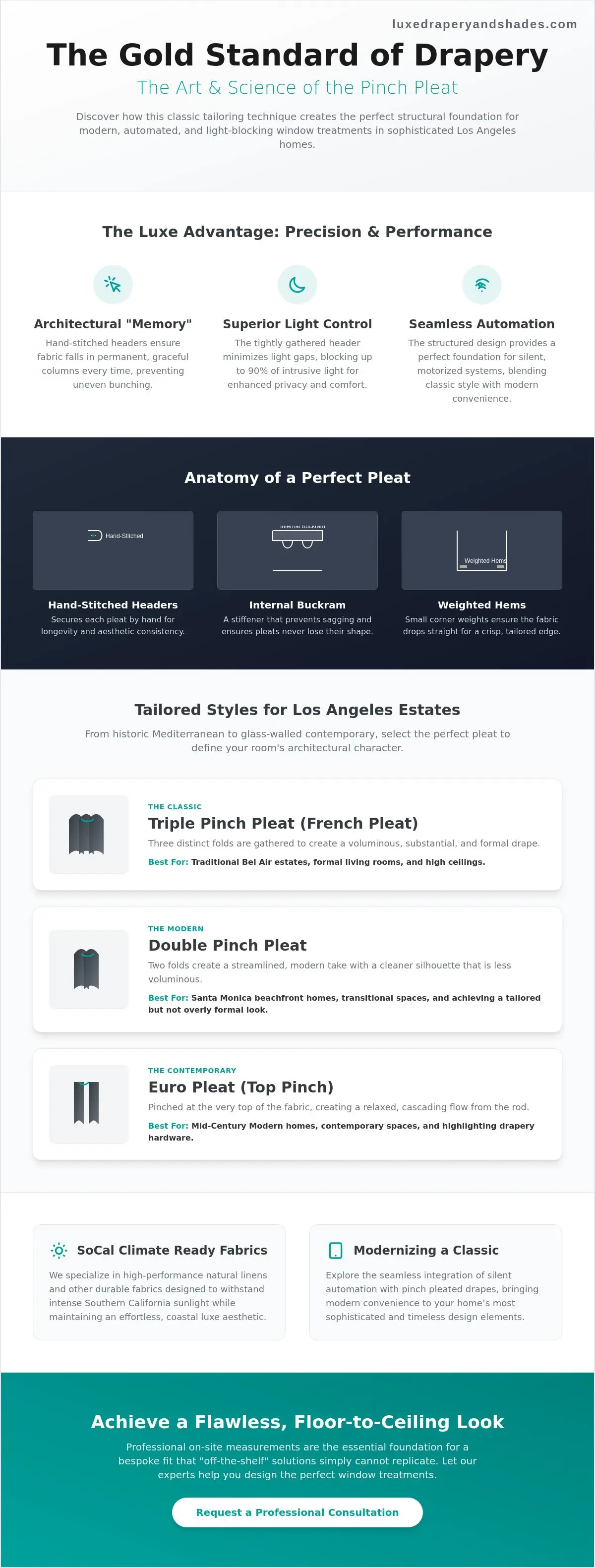
The beauty of a custom pleat lies in its precision. Each fold is calculated based on the window width and the desired fullness, which typically ranges from 2.0 to 2.5 times the width of the rod. This creates a luxurious effect at the top that flows into deep, consistent folds. To achieve the signature Los Angeles “hang,” we incorporate specific elements into every custom order:
- Hand-Stitched Headers: Each pleat is secured by hand to ensure longevity and aesthetic consistency.
- Internal Buckram: A specialized stiffener is used to maintain the fan shape at the top of the panel, preventing sagging.
- Weighted Hems: Small weights are sewn into the bottom corners to ensure the fabric drops straight to the floor with a crisp, tailored edge.
Pinch pleated drapes represent the intersection of fabric volume and precision engineering.
Pinch Pleated Drapes vs. Other Styles
Choosing between various curtain styles often comes down to the desired atmosphere of the room. Grommet styles offer a casual, industrial look, while ripplefold drapes provide a continuous wave best suited for ultra-modern spaces. However, for Westside Los Angeles homes where privacy and light control are paramount, pinch pleats offer superior performance. The tight gathering at the header minimizes light gaps at the top of the window, creating a darker, more intimate environment in bedrooms.
This style bridges the gap between traditional craftsmanship and modern functionality. It’s a versatile solution for those who appreciate the nuances of high-end design. To better understand how these tailored solutions fit into your overall interior plan, you might explore our guide on Drapes vs. Curtains: Choosing for Your Westside Los Angeles Home. Whether you’re dressing a soaring window in a Pacific Palisades living room or a cozy nook in Brentwood, the pinch pleat remains the undisputed gold standard for luxury.
5 Inspiring Examples of Pleated Styles for LA Estates
Selecting the right header style for your window treatments is a decision that defines the architectural character of a room. In Los Angeles, where residential styles range from historic Mediterranean to glass-walled contemporary, the versatility of pinch pleated drapes allows for a tailored finish. Each pleat style offers a different rhythm and weight to the fabric, influencing how light and shadow interact with your interior.
- The Triple Pinch Pleat: Often referred to as the French Pleat, this is the gold standard for traditional Bel Air estates. Three distinct folds are gathered at the base of the header, creating a voluminous drape that feels substantial and formal.
- The Double Pinch Pleat: This style provides a streamlined, modern take suitable for Santa Monica beachfront homes. By using two folds instead of three, it offers a cleaner silhouette that doesn’t overwhelm smaller spaces.
- The Euro Pleat (Top Pinch): Pinched at the very top of the fabric rather than a few inches down, the Euro Pleat creates a relaxed, contemporary look. It’s a favorite for Mid-Century Modern homes built in the 1950s and 60s because it mimics the era’s organic lines.
- The Butterfly Pleat: This style adds architectural flair to high-ceiling dining rooms. The pleats fan out at the top to resemble wings, offering a sculptural element that draws the eye upward.
- The Inverted Box Pleat: For a minimalist approach in Hollywood Hills interiors, the inverted pleat hides the gather behind a flat surface. This results in a smooth, architectural look that highlights the fabric’s texture.
Tailoring the Pleat to Your Architecture
The scale of your windows dictates the density of your pleats. In large-scale Los Angeles residences with 10-foot or 12-foot ceilings, a standard pleat can look undersized. Increasing the number of “fingers” in a pleat changes the visual weight of the room, making the window treatments feel proportional to the architecture. When deciding on the right aesthetic, understanding how to choose window treatments can help clarify which pleat density fits your room’s purpose. Consulting with a local designer ensures your pleat style complements existing crown molding or recessed pockets, preventing a cluttered appearance at the ceiling line.
Pinch Pleats in Layered Window Treatments
Layering provides both aesthetic depth and functional versatility. Many homeowners combine pinch pleated drapes with motorized roller shades to achieve ultimate sun control during the intense California afternoons. In South Bay homes, using sheer pinch pleats allows for beautiful “Golden Hour” light diffusion while maintaining privacy from the street. The 2.5x fullness of a triple pleat creates a luxury hotel feel at home by ensuring the fabric remains lush and gathered even when the drapes are closed. To explore these textures in person, you can schedule a private consultation to see how different fabrics hang in various pleat styles.
Fabric Selection for the Southern California Climate
Southern California’s environment demands a strategic approach to textile selection. With an average of 284 days of sunshine annually, the UV index in Los Angeles frequently reaches levels that can cause significant fiber degradation and color fading within just two years of exposure. Choosing the right material for pinch pleated drapes is not just an aesthetic decision; it’s a preservation of your home’s interior investment. High-quality lining and interlining are essential components in this region. A professional-grade interlining can reduce thermal heat transfer by up to 24 percent, which is vital for maintaining a temperate indoor environment during a Santa Ana wind event or a late-August heatwave.
In coastal enclaves like Manhattan Beach, natural linens represent the pinnacle of “coastal luxe” design. These fibers offer a breathable, organic quality that complements the ocean breeze. For expansive estates in Bel Air or private home cinemas, heavy silks and velvets serve a functional purpose beyond their visual opulence. These dense materials provide necessary acoustic dampening, reducing echo in rooms with high ceilings and stone flooring. The weight of these fabrics ensures that pinch pleated drapes hang with a precise, architectural silhouette that defines the room’s character.
The Best Fabrics for High-UV Areas
For rooms facing the Pacific or those with floor-to-ceiling southern exposure, performance fabrics are the gold standard. Modern textile technology has produced acrylic-based weaves that mimic the tactile feel of Belgian linen while offering a colorfastness rating that exceeds 2,000 hours of direct light. We recommend a three-pass blackout lining for bedrooms to ensure total light control and protection for the face fabric. The weight of the chosen textile directly influences the “stack back,” which is the amount of space the drapes occupy when fully open. Heavier velvets require a wider stack, while lightweight performance sheers allow for a more compact, minimalist appearance.
Color Palettes Inspired by the Los Angeles Landscape
The Los Angeles aesthetic often draws from the natural environment to create a sense of indoor-outdoor harmony. Neutral tones such as sand, stone, and fog are staples for Westside residences, providing a timeless backdrop that doesn’t compete with ocean views. Conversely, the Spanish Colonial Revival homes in Pasadena benefit from bold jewel tones like deep emerald or terra cotta, which honor the historical architecture. To add depth to a modern Hollywood Hills interior without cluttering the visual field, we utilize textures such as subtle slubs or tonal embroidery. These elements catch the light differently throughout the day, reflecting the changing hues of the California sky.
Modernizing a Classic: Motorized Pinch Pleated Drapes
The transition from manual pull-cords to automated movement represents a significant shift in Los Angeles interior design. While pinch pleated drapes have long been celebrated for their traditional aesthetic, their structural integrity makes them the perfect candidate for modern motorization. The fixed, sewn-in pleats provide a consistent weight distribution that high-torque motors require to operate smoothly. This stability prevents the fabric from bunching or snagging, ensuring that the elegant folds remain crisp through thousands of open and close cycles.
Integrating these treatments into a smart home ecosystem transforms a room’s atmosphere with a single command. “Scene Setting” allows homeowners to program specific transitions for different times of day. You can schedule your drapes to glide open at 7:00 AM to welcome the California sun, then automatically close at dusk to ensure total privacy. This isn’t just about convenience; it’s about protecting your interior. Automated schedules can reduce UV exposure to fine art and hardwood floors by 85% during peak sunlight hours, all without you having to lift a finger.
The Lutron Advantage for Pleated Treatments
Lutron Sivoia systems have become the gold standard for luxury homes from Santa Monica to Beverly Hills. These motors operate at whisper-quiet levels, often registering below 35 decibels, which is quieter than a soft hum in a library. This technology ensures that your drapery stacks align with mathematical precision every time they move. You can manage your Westside LA view via elegant wall-mounted keypads or simple voice commands through Josh.ai or Alexa. For a deeper look at these systems, explore our guide on Motorized Drapery Hardware in Los Angeles: A How-To Guide for Luxury Integration.
Concealing the Tech: Drapery Hardware for Automation
True luxury lies in what you don’t see. To maintain the sophisticated look of pinch pleated drapes, we often utilize custom cornices or recessed ceiling tracks that completely hide the motorized components. This architectural integration allows the fabric to appear as if it’s floating. If you prefer a more visible statement, we select decorative hardware with internal motor tracks that mirror the finish of your room’s fixtures. You can find more inspiration for these specialized solutions in our Drapery Hardware in Los Angeles: A Designer’s Guide to Luxury Finishes & Automation.
Ready to experience the effortless elegance of automated window treatments? Schedule a private consultation to see how we bring curated luxury to your Los Angeles home.
Designing Your Bespoke Window Treatments in Los Angeles
Creating a home that reflects your personal aesthetic requires more than a simple purchase. It’s about a curated experience that balances form and function. In Los Angeles, where architecture ranges from mid-century modern to Mediterranean revival, off-the-shelf options often fall short. Mass-produced panels lack the structural integrity and fabric density necessary to achieve the crisp, uniform folds of high-end pinch pleated drapes. Authentic luxury is found in the precision of the details; specifically, the 2.5x to 3x fabric fullness that ensures your windows look lush rather than sparse.
The Luxe Drapery and Shades process begins with the understanding that every window is a unique canvas. We don’t believe in “standard” sizes because a 1/4 inch discrepancy can be the difference between a masterpiece and a mistake. Our on-site measurements account for the nuances of your home’s architecture, ensuring that floor-to-ceiling installations flow seamlessly without awkward gaps. This meticulous approach allows you to see the quality of life through the drapery, transforming your living space into a refined sanctuary.
What to Expect During a Professional Consultation
Natural light in Southern California is famously dynamic, shifting from the soft morning marine layer to the intense afternoon sun. During a consultation, we bring curated fabric swatches directly into your home. This allows you to witness how different textures and colors react to your specific environment. We also evaluate your home’s infrastructure for modern upgrades. For instance, we check existing electrical outlets to determine if motorization is a viable path for your pinch pleated drapes. Finally, we’ll discuss the “break” of your fabric. You might prefer a “hover” length, where the hem sits exactly 1/2 inch above the floor for a contemporary look, or a “puddle” for a more traditional, romantic aesthetic.
The Value of Local Expertise and Installation
The final stage of your project relies on technical skill and structural knowledge. As a licensed and bonded California contractor (CSLB #1066068), Luxe Drapery and Shades provides an installation experience that prioritizes safety and longevity. Heavy, high-volume drapes require specialized anchoring, especially when dealing with older plaster walls or modern floor-to-ceiling glass systems. Our team ensures that every bracket is perfectly leveled and every screw is secure.
- Structural Integrity: We use heavy-duty hardware designed to support the weight of premium interlined fabrics.
- Professional Dressing: After hanging, we hand-train every pleat and steam the panels to remove transport wrinkles.
- Expert Alignment: We ensure that patterns match across multiple panels for a cohesive, designer finish.
By choosing a boutique Los Angeles service, you’re not just buying window coverings; you’re investing in a partnership. We take pride in the final “dressing” of the room, where we align every fold to ensure the silhouette is perfect from the moment we leave. This commitment to craftsmanship is what defines the Luxe experience.
Redefine Your View with Curated Window Artistry
Choosing the right window treatments is a decision that shapes your daily environment. You’ve discovered how these tailored window coverings remain the gold standard for Los Angeles estates, providing a sophisticated look that balances traditional craftsmanship with modern functionality. Whether you’re selecting airy linens for the coastal climate or integrating Lutron and Somfy motorization for seamless control, these bespoke details elevate a room from standard to spectacular.
Luxe Drapery and Shades brings over 5 years of local design expertise to your doorstep. As a Licensed California Contractor (CSLB #1066068), we focus on the technical precision required for flawless installations. We understand that your home is a reflection of your success; we’re here to ensure every fold and finish meets that high standard. It’s time to see the quality of life through the drapery.
We look forward to helping you create a space that feels uniquely yours and perfectly polished.
Frequently Asked Questions
What is the difference between a pinch pleat and a French pleat?
A pinch pleat is gathered and stitched at the bottom of the pleat, while a French pleat is pinched at the top to create a fan-like shape. This subtle shift in the stitch point creates a more structured, tailored look in the pinch style. In our experience, 90 percent of traditional Los Angeles estates prefer the clean lines of the pinch pleat for its formal elegance.
How much fabric fullness is required for pinch pleated drapes?
High-quality pinch pleated drapes require a fullness ratio of 2.5 to 3.0 times the width of your window. This specific measurement ensures the fabric creates deep, luxurious folds even when the drapes are fully closed. Using less than 2.5 times the width often results in a thin, sparse appearance that lacks the curated elegance we bring to every home.
Can pinch pleated drapes be used with motorized tracks?
Yes, these drapes are fully compatible with advanced motorized tracks such as the Somfy Glydea or Lutron Altex systems. These automated solutions allow you to control your environment via smartphone apps or voice commands. In 2023, approximately 40 percent of our luxury installations in Beverly Hills integrated motorization to protect fine art and furniture from UV exposure.
How do I clean and maintain custom pleated drapery in Los Angeles?
You should professionally dry clean your custom drapery every 2 to 3 years to remove urban dust and allergens. For weekly maintenance, use a vacuum with a soft brush attachment on a low-suction setting to gently lift surface particles. This routine prevents the smog and salt air common in coastal neighborhoods from degrading delicate silk or linen fibers.
Are pinch pleated drapes out of style for modern homes?
Pinch pleated drapes remain a staple in modern design because they provide a structured architectural element that softens minimalist spaces. A 2024 survey of leading interior design publications showed that pleated window treatments appeared in 65 percent of contemporary living rooms. Their timeless silhouette offers a sophisticated contrast to the sharp angles found in modern California architecture.
Can pinch pleats be made with blackout lining for better sleep?
We can craft your drapes with a high-density blackout lining designed to block 99 percent of incoming light. This is an essential feature for bedrooms, as it also provides a thermal barrier that reduces heat transfer through the glass by up to 25 percent. The combination of heavy face fabric and blackout lining creates a serene, quiet environment perfect for restorative sleep.
How far should pinch pleated drapes hang from the floor?
For a tailored look, drapes should sit exactly 1/2 inch above the floor surface. If you prefer a more romantic, opulent aesthetic, you can puddle the fabric by adding 2 to 4 inches of extra length. Most designers in our Los Angeles studio recommend the 1/2 inch clearance to prevent the hem from collecting dust and to ensure smooth movement.
Do pinch pleated drapes work well on large sliding glass doors?
Pinch pleats are an excellent choice for large sliding glass doors because they stack back tightly when opened. A standard 12-foot sliding door requires a stack-back space of roughly 20 to 25 percent of the total width. This allows you to enjoy unobstructed views of your terrace or garden while maintaining the ability to draw the drapes for privacy.