

Imagine a sunset over the Hollywood Hills interrupted by the grinding mechanical whir of a sub-par curtain rod. It’s a common frustration for homeowners who realize too late that standard window treatments often fail when paired with the weight of bespoke, interlined velvets. You’ve curated every inch of your estate to reflect a specific standard of living; you expect your technology to be invisible. High-performance motorized drapery hardware should operate at whisper-quiet levels below 38 decibels, ensuring it’s felt through the atmosphere it creates rather than heard through the walls.
We understand that true comfort in a Los Angeles home means having technology that works in harmony with your lifestyle. You’ll discover how to select and install architectural-grade systems that move heavy fabrics with silent precision. We’ll guide you through the process of integrating these systems with your existing lighting and HVAC hubs for optimized energy savings. This guide provides a clear roadmap to achieving a seamless, sophisticated window treatment solution that allows you to see the quality of life through the drapery.
Key Takeaways
- Learn why professional-grade systems are the foundation of quiet luxury, offering a level of sophistication and durability that standard consumer options cannot match.
- Discover how to accurately assess drapery weight and track configurations to ensure your custom window treatments perform with effortless, silent precision.
- Master the integration of your motorized drapery hardware with premium smart home ecosystems to create a seamless, automated environment tailored to your daily rhythms.
- Explore design-forward techniques for concealing hardware within architectural pockets or selecting curated finishes that elevate the aesthetic of any Los Angeles interior.
- Understand why professional installation by licensed experts is essential for protecting your investment and ensuring the long-term reliability of your automated systems.
Understanding Motorized Drapery Hardware: The Foundation of Quiet Luxury
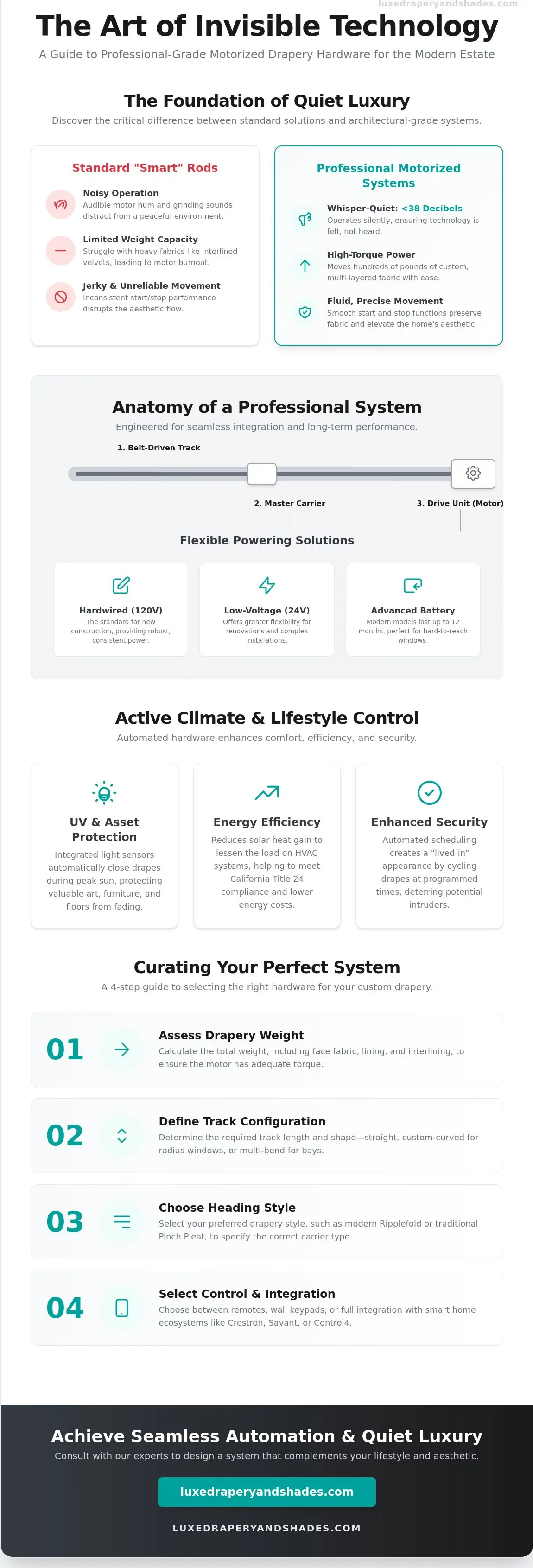
High-end Los Angeles interiors demand more than mere window coverings; they require seamless architectural integration. At its core, motorized drapery hardware is a precision-engineered system consisting of an aluminum track, a high-torque motor, and a reinforced belt drive designed for hands-free textile control. Unlike standard rods, these systems are built to disappear into the ceiling pocket or blend into the molding, allowing the fabric to take center stage. While many homeowners are familiar with basic motorized blinds, professional-grade drapery systems utilize heavy-duty components to move hundreds of pounds of custom fabric with surgical precision.
Los Angeles estates often feature expansive glass walls and soaring ceilings that render consumer-level “smart rods” insufficient. These retail-grade products frequently struggle with the weight of interlined silks or heavy velvets, leading to motor burnout or jerky movements. Professional motorized drapery hardware provides the torque necessary for a smooth start and stop, ensuring the hardware never distracts from the home’s aesthetic. This technology also serves a vital role in textile preservation. By eliminating the need for manual pulling, you prevent the transfer of skin oils and the physical strain that causes delicate custom drapes to fray or lose their shape over time. Quiet luxury in the 2026 home is defined by the invisible orchestration of one’s environment, where silent motor technology ensures the only evidence of automation is the fluid, silent movement of textiles against the Pacific horizon.
The Anatomy of a Motorized Track System
A sophisticated track system relies on three primary components: the drive unit, the belt-driven track, and the master carrier. For Westside homes with open-concept layouts, internal motors are often the preferred choice because they sit flush within the track profile for a cleaner look. Powering these systems depends on the stage of your project. Hardwired 120V solutions are the standard for new constructions, while 24V low-voltage systems offer flexibility for renovations. Battery-operated motors have advanced significantly, with some 2024 models lasting up to 12 months on a single charge, making them ideal for hard-to-reach clerestory windows.
Performance Benefits for the Los Angeles Climate
Automated hardware transforms window treatments into active climate control tools. In Santa Monica, where UV exposure can reach extreme levels, integrated light sensors trigger drapes to close automatically during peak sun hours, protecting curated art collections and hardwood floors from fading. This automation is a practical step toward California Title 24 energy compliance, as it significantly reduces solar heat gain and lessens the load on HVAC systems. For homeowners traveling from their South Bay residences, automated scheduling creates a “lived-in” appearance by cycling drapes at sunset, providing an essential layer of security that manual treatments cannot offer. When you choose to see the quality of life through the drapery, you recognize that these technical details are what create a truly effortless living space.
How to Select the Right Hardware for Your Custom Drapery
Selecting the ideal motorized drapery hardware requires a blend of aesthetic vision and mechanical precision. In high-end Los Angeles interiors, where heavy velvets or double-lined linens are frequently used, the hardware must be as robust as it is elegant. This selection process ensures your window treatments operate with the quiet grace expected in a luxury home. Follow these essential steps to curate your system.
- Step 1: Calculate the total weight of your drapery panels. You must include the weight of the face fabric, the lining, and any flannel interlining used for insulation.
- Step 2: Determine the track length and configuration. Decide if your space requires a simple straight run, a custom curve for a radius window, or a multi-bend setup for a bay window.
- Step 3: Choose your heading style. Whether you prefer the modern, uniform folds of a Ripplefold system or the traditional structure of a Pinch Pleat, your choice dictates the specific carrier type needed.
- Step 4: Select a control method. Options range from handheld remotes and wall-mounted keypads to full integration with home automation platforms like Control4 or Savant.
Weight Capacity and Motor Torque
Heavy, bespoke fabrics demand high-torque motors to ensure a smooth, silent glide. Systems like the Lutron Sivoia or Somfy Glydea are engineered to handle the substantial load of 100-pound drapery spans without strain. In expansive Los Angeles installations, track friction can accumulate over long distances, which shortens the life of underpowered motors. The weight-to-torque ratio serves as a vital technical rule, stating that for every 10 pounds of total drapery weight, the motor should provide at least 1.0 Newton-meter (Nm) of torque to ensure a decade of reliable service. Beyond the aesthetic appeal, these systems offer practical benefits. A study by the Illinois Institute of Technology found that automated window coverings can lead to significant energy savings by regulating solar heat gain throughout the day.
Track Configurations for Complex Architecture
Modernism in the Hollywood Hills often features floor-to-ceiling glass walls that disappear into corners. Managing these expansive views requires custom bending and curving of the motorized drapery hardware. Expert technicians can handle an architectural radius window by precision-curving the track, ensuring the motor performs consistently even around tight 12-inch bends. If you desire both privacy and light filtration, consider a double-track system. This allows you to implement motorized sheers and blackout drapes in one seamless installation, providing total control over your environment. You can explore our bespoke window treatments to see how these sophisticated hardware solutions transform a room’s atmosphere.
Integration Strategies: Syncing Hardware with Your LA Smart Home
Selecting the right motorized drapery hardware is about more than aesthetics; it’s about creating a unified ecosystem. In a city where home automation defines modern living, your drapery must communicate fluently with lighting and HVAC systems. This synergy ensures your home responds to the environment without constant manual input. A 2020 report from Forbes highlights that smart home-enabled window coverings help manage solar heat gain, which is essential for West Side homes facing the intense afternoon sun.
Communication protocols dictate the reliability of your system. Radio Frequency (RF) offers simplicity for retrofits where running new wires isn’t feasible. Zigbee provides a robust mesh network, ideal for larger estates where signals must travel through multiple rooms. For new constructions in neighborhoods like Bel Air or Pacific Palisades, hardwired communication remains the benchmark. It offers zero-latency performance and eliminates the need for battery replacements. To see how these technical choices pair with aesthetic hardware, consult our Drapery Hardware in Los Angeles: A Designer’s Guide to Luxury Finishes & Automation.
Lutron vs. Somfy: Which System Wins?
Lutron sets the standard for ultra-quiet operation. Its motors move in perfect synchronization, ensuring all drapes start and stop at the exact same millisecond. This precision is a hallmark of the Lutron ecosystem, especially when paired with their lighting controls. Somfy, however, offers unmatched versatility. It works with a wider variety of decorative tracks and integrates easily with diverse third-party platforms. For a typical 4-bedroom renovation in Santa Monica, Lutron often represents a higher initial investment, but the seamless, “whisper-quiet” experience provides a level of luxury that is difficult to match.
Voice and App Control Implementation
Luxury suites in Los Angeles are increasingly utilizing Josh.ai for natural language control. Unlike mass-market assistants, Josh.ai prioritizes privacy and understands complex, multi-step commands. You can say, “Josh, close the drapes halfway and dim the lights to 20 percent,” and the room responds instantly. This level of control allows for sophisticated “Scenes.” A “Movie Night” command in a South Bay media room can instantly lower blackout drapes, dim the sconces, and set the perfect temperature.
Despite the focus on automation, manual override features remain vital. Touch-Motion technology allows you or your guests to pull a drape by hand without damaging the motor. It’s a critical safety and convenience feature that ensures your motorized drapery hardware remains functional even if the remote isn’t nearby. This blend of high-tech control and tactile reliability defines the modern Luxe home.
Aesthetic Execution: Matching Hardware to Los Angeles Styles
Integrating motorized drapery hardware requires a deliberate shift from pure utility to architectural harmony. Many homeowners worry that automation implies a bulky, industrial aesthetic that might clash with a curated interior. In Los Angeles, where architectural styles range from glass-walled modernism to historic Spanish Colonial, the hardware must either disappear entirely or contribute to the room’s visual narrative. Achieving this balance depends on selecting finishes and headings that mirror the home’s existing design language.
Finish selection is a vital component of this integration. Current Westside design trends favor three primary palettes. Matte Black provides a high-contrast, modern edge; Satin Nickel offers a timeless, transitional appeal; and Warm Brass adds a layer of luxury to traditional spaces. These finishes ensure the track or rod complements the premium hardware found in high-end kitchens and baths. For a comprehensive look at how these elements pair with fabric, our Custom Drapes Los Angeles: The Ultimate Luxury Guide to Bespoke Window Treatments explores the synergy between textile weight and hardware capacity.
The “Ripplefold” heading remains the gold standard for modern estates in areas like Malibu and Beverly Hills. This style creates consistent, S-curve folds that look identical from both the interior and the street. It’s a clean, architectural look that hides the motorized drapery hardware behind the fabric, allowing the drapes to glide effortlessly without visible hooks or clips.
Concealment Techniques for Minimalist Interiors
For homes featuring floor-to-ceiling glass, concealment is the priority. Architects often specify ceiling pockets during the initial framing stage. These pockets, typically measuring 5 to 7 inches in depth, allow the track to be recessed directly into the ceiling. This creates a “floating” effect where the fabric appears to emerge from the architecture itself. If a renovation doesn’t allow for structural changes, matching the track color to the specific ceiling paint code effectively renders the system invisible to the casual observer.
Decorative Motorized Rods for Traditional Estates
Traditional architecture in neighborhoods like Hancock Park or Pasadena often demands a classic touch. You don’t have to sacrifice automation for style. Modern motorized traverse systems now accommodate decorative rings and finials, allowing you to maintain the elegant look of pinch pleated drapes while utilizing a hidden belt-drive motor. It’s a sophisticated marriage of Mediterranean charm and 21st-century smart home convenience that preserves the historical integrity of the property.
Ready to elevate your home’s aesthetic with seamless automation? Explore our curated hardware collections to find the perfect match for your Los Angeles interior.
Professional Installation: Ensuring Longevity and Performance
Installing premium motorized drapery hardware in a Los Angeles estate is a task of architectural precision, not a weekend DIY project. High-end systems from Lutron or Somfy rely on delicate tension balances. If the alignment is off by even a few millimeters, the motor works harder, which significantly shortens its functional lifespan. For properties in neighborhoods like Bel Air or Pacific Palisades, professional integration ensures that your investment remains a permanent asset rather than a maintenance burden.
Electrical safety is the primary concern for hardwired installations. California law requires a CSLB licensed contractor for any project involving permanent electrical modifications. This isn’t just about functionality; it’s about adhering to the California Electrical Code to protect your home’s infrastructure. Once the hardware is mounted, our technicians perform precise limit-setting. This calibration ensures the drapery stops exactly where it should, preventing the fabric from bunching or the motor from straining against the brackets. To keep your silent motors running smoothly for decades, we recommend a brief professional inspection every 24 months to check for track debris and software synchronization.
The Luxe Drapery and Shades Approach
Our team provides a white-glove experience that begins at our Torrance facility and extends to every corner of Los Angeles. We don’t just hang rods; we engineer environments. This involves close collaboration with your architects and AV integrators to sync window treatments with systems like Control4 or Crestron. We specialize in the Lutron and Somfy ecosystems, providing the ongoing firmware updates and system checks necessary for modern smart homes. Recent industry data suggests that 48% of luxury home buyers now prioritize pre-integrated smart tech, making our professional oversight a vital part of your home’s long-term value.
Scheduling Your Los Angeles Consultation
Every luxury home presents unique challenges, from 20-foot floor-to-ceiling glass walls to complex arched windows that standard hardware cannot accommodate. During your in-home design consultation, we evaluate the structural integrity of your mounting surfaces and the specific power requirements of your chosen motorized drapery hardware. We handle the logistical complexities of high-reach installations and ensure that every motor is programmed to your exact lifestyle preferences. Our goal is to make the technology invisible while the aesthetic remains front and center.
Refining Your Home Experience with Seamless Automation
Integrating motorized drapery hardware into your Los Angeles residence transforms a functional necessity into an effortless expression of style. Selecting the correct high-capacity systems ensures that even the heaviest bespoke luxury fabrics glide with silent precision. By syncing these components with your existing smart home ecosystem, you gain total control over natural light and privacy. Our team brings technical mastery to every project as a Licensed and Bonded California Contractor (CSLB #1066068). We operate as Certified Lutron and Somfy Platinum Installers; this ensures your investment performs reliably for years. Every detail matters when you’re curating a space that reflects your standard of living. If you want to carry that same sense of elegance into your personal wardrobe, you might check out Luxe Lane for high-end evening wear that mirrors your home’s sophistication. It’s about more than just convenience; it’s about the quiet confidence that comes from expert craftsmanship and intentional design. You deserve a home that responds to your needs with grace and sophistication.
Experience the peak of window automation. Schedule your Los Angeles design consultation today.
We look forward to helping you see the quality of life through the drapery.
Frequently Asked Questions
How loud are motorized drapery motors in a quiet bedroom?
High-end motors like the Somfy Glydea Ultra operate at a sound level below 38 decibels, which is quieter than a soft whisper in a library. For a restful Los Angeles bedroom, these silent motors ensure your morning routine remains undisturbed while the fabric glides open. You’ll experience the quality of life through the drapery as the system moves with a refined, hushed precision that respects your home’s tranquility.
Can I motorize my existing custom drapes with new hardware?
You can integrate your existing custom drapery panels with new motorized drapery hardware as long as the header style is compatible with the track carriers. We often retrofit high-quality panels onto motorized tracks to preserve your original design investment while adding modern functionality. This curated approach allows you to upgrade your lifestyle without the need to replace the luxury fabrics that already define your interior space.
What happens to motorized drapes if the power goes out in Los Angeles?
Most premium systems feature a manual override or touch motion technology that allows you to pull the drapes by hand during a power failure. In Southern California, where occasional grid maintenance occurs, this feature ensures your window treatments remain fully functional at all times. You won’t risk damaging the internal motor components when moving the fabric manually, providing peace of mind and consistent home comfort during any utility interruption.
How much weight can a high-end motorized drapery rod actually hold?
A heavy-duty motorized track system can typically support up to 132 pounds of fabric on a single 32-foot span without losing performance. This capacity is essential for Los Angeles homes with floor-to-ceiling windows that require heavy velvet or thick interlined silk. We calculate the exact weight of your chosen textiles to ensure the motor operates smoothly, maintaining the elegant drape and longevity of your window treatments for years to come.
Do motorized drapes require a special type of electrical wiring?
Motorized systems offer three distinct power options: plug-in, battery-operated, or hardwired 110V AC connections. For new construction in neighborhoods like Beverly Hills, we recommend a dedicated 14/2 wire to a junction box for a seamless, hidden look. If you’re updating an existing space, battery-powered motors provide a clean aesthetic without the need for an electrician, making the installation process efficient and uncluttered.
Can I control my motorized drapery hardware with my iPhone or voice assistant?
You can manage your motorized drapery hardware through dedicated smartphone apps or smart home hubs like Control4, Crestron, and Lutron. Integration with Siri, Alexa, or Google Assistant allows for hands-free operation via simple voice commands. This connectivity transforms your window treatments into a responsive element of your home’s digital ecosystem, allowing you to set schedules that align with the natural Los Angeles sunlight.
Is motorized hardware compatible with Ripplefold and Pinch Pleat styles?
Motorized tracks are fully compatible with both the modern Ripplefold look and traditional pinch pleated drapes headings. The carriers inside the track are spaced at 2.125 inches or 2.625 inches to maintain the precise folds of your chosen style. This versatility ensures that your aesthetic preferences are never compromised for the sake of modern convenience, allowing the motor to handle the heavy lifting while you enjoy the visual order.
How long do the batteries last in a wire-free motorized drapery system?
Lithium-ion battery packs typically last between 6 and 12 months on a single charge, based on an average of two daily cycles. These rechargeable units eliminate the need for permanent wiring while maintaining the sophisticated profile of your window treatments. You’ll receive a notification on your smartphone when the power level drops below 20 percent, ensuring you have ample time to plug in the discreet charging cable.